
When driving near schools and areas where children gather, your driving approach must change significantly. These 'school zones' in France are designated for increased vigilance, lower speeds, and an acute awareness of pedestrians, especially during school arrival and dismissal times. This page details the specific responsibilities drivers have to ensure the safety of vulnerable young road users in accordance with the Code de la route.
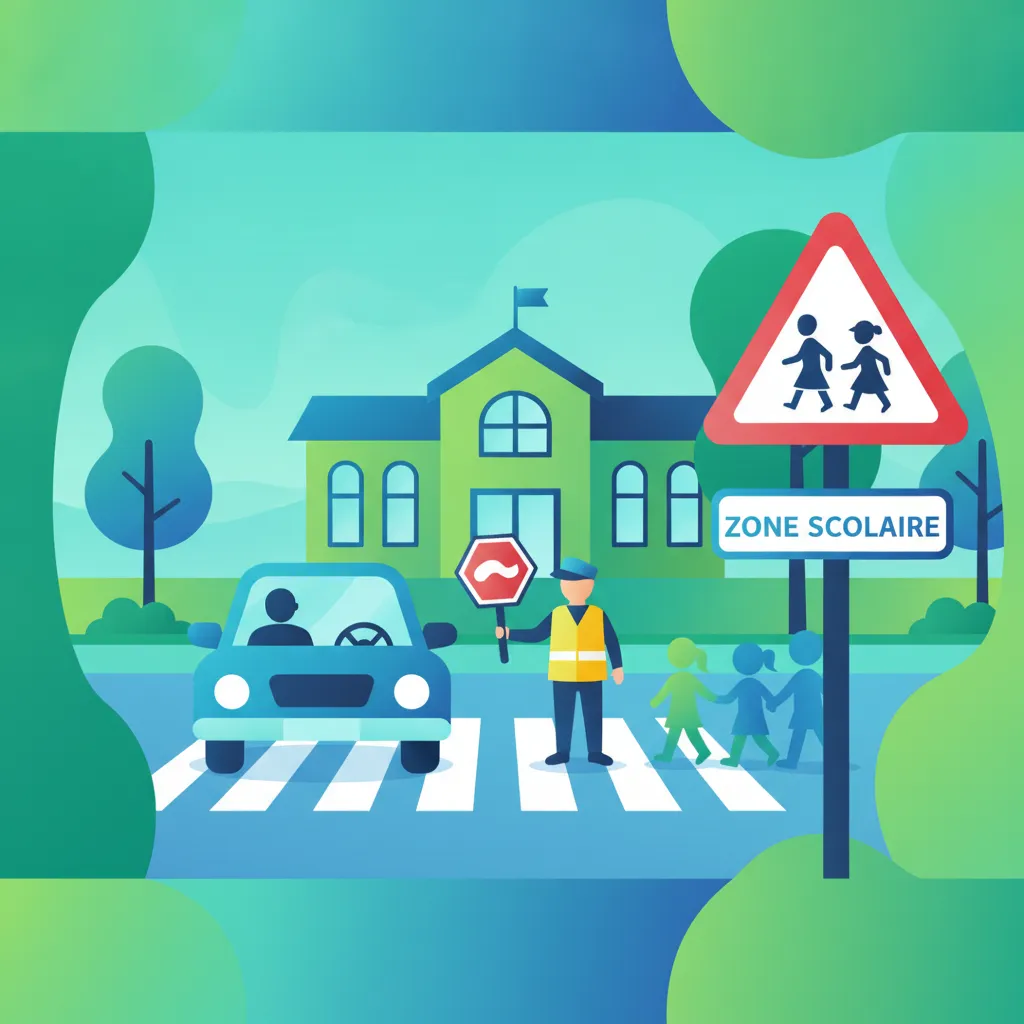
Theory topic content overview
Read the full theory topic guide for School Zone Safety with structured, easy-to-scan content built for learners in France. This detailed section explains the exact rule, meaning, traffic context, comparison points, and exam logic behind this French driving theory topic so you can study faster, understand the concept more clearly, and avoid common interpretation mistakes on the theory test.
A school zone in France refers to any area near an educational institution – be it an école (primary school), collège (middle school), or lycée (high school) – where children and young people frequently walk, cycle, or cross roads. These zones are formally recognized under the Code de la route as areas demanding exceptional vigilance from drivers due to the presence of vulnerable road users.
The core concept behind school zones is that children, by their very nature, can be impulsive, have limited peripheral vision, and often do not fully understand traffic dangers or judge distances and speeds accurately. Therefore, drivers must compensate for these vulnerabilities by adjusting their driving behavior proactively.
The importance of safe driving in school zones cannot be overstated, both for real-world safety and for success in your French driving theory exam (ETG).
Driving through a school zone requires a fundamental shift in your approach. Here are the key principles and practices:
This is the most critical requirement. Even if no explicit lower speed limit sign is present, you must reduce your speed considerably.
Your attention must be fully focused on the road environment and potential hazards.
Several factors can make driving in school zones even more challenging:
It's vital for your French driving theory exam and practical driving to understand that the legal speed limit is the maximum permissible speed, not necessarily a safe speed. In a school zone, even if the general urban limit of 50 km/h applies, the safe speed will almost always be considerably lower. The Code de la route prioritizes safety over adherence to maximum limits in hazardous situations. Your speed must always be appropriate for the conditions, especially when children are present.
Consider these examples to practice your decision-making:
Learners often make these critical errors concerning school zones:
The French driving theory exam places a strong emphasis on the driver's responsibility towards vulnerable road users (usagers vulnérables), especially children. Questions often test your ability to:
Remember, the goal is not just to know the rules, but to internalize the mindset of maximum precaution when children are present.
When entering any area near a school or where children are likely to be present, adopt an "Anticipate and Protect" mindset. Drive significantly slower, scan aggressively, be prepared to stop instantly, and assume children might do the unexpected. Your actions must fully compensate for their lack of road sense and vulnerability. This diligent approach is not just a legal requirement under the Code de la route, but a fundamental aspect of responsible driving in France.
School zones in France demand exceptional driver vigilance and reduced speed to protect vulnerable children who cannot accurately judge traffic dangers. The Code de la route mandates heightened duty of care, with legal speed limits serving as maximums rather than safe speeds in these areas. Drivers must anticipate unpredictable child behavior, scan continuously beyond parked vehicles, be prepared to stop instantly, and always yield to children at crossings and crossing guards. The French theory exam tests your ability to choose maximum precaution over speed, recognizing that defensive driving and hazard anticipation are non-negotiable in zones where children are present.
A short set of high-value points that capture the most important ideas from this theory explanation.
Reduce speed considerably in school zones even without explicit signs, as 50 km/h is often too fast when children are present
Assume children will behave unpredictably and be prepared to stop instantly, as they cannot judge distances and speeds like adults
Never overtake a vehicle that has stopped for pedestrians, as it may be allowing children to cross
Scanning beyond parked cars is essential because children can suddenly appear from behind vehicles
The legal speed limit is the maximum permissible speed, not a safe speed—safety always takes priority over speed limits when children are present
Pedestrians, especially children, always have priority in school zones and at crossings
Peak danger times are school arrival and dismissal periods when pedestrian and vehicle traffic increases dramatically
Crossing guards and authorized personnel directing traffic must be obeyed—stop when they signal
School buses with hazard lights active require extra caution for children boarding or alighting
The 'Anticipate and Protect' mindset means driving slower, scanning aggressively, and assuming unexpected child behavior
Underestimating children's unpredictability by expecting them to behave like adults or follow traffic rules
Driving too close to the legal urban limit of 50 km/h instead of reducing to a genuinely safe speed
Only looking directly ahead instead of actively scanning pavements, parked cars, and potential crossing points
Assuming that if you can see children, they can see you—children may not register approaching vehicles
Allowing distractions like mobile phones to reduce attention in these high-risk areas
Start with a short, direct summary of School Zone Safety before reading the full explanation below.
In school zones, drivers must reduce their speed considerably and maintain heightened awareness for children, who may behave unpredictably. Be prepared to stop quickly, anticipate sudden movements from pedestrians and cyclists, and always yield to crossing guards. These areas demand maximum attention to protect vulnerable road users, aligning with French driving safety principles.
Review the most important terms, rule signals, and traffic concepts linked to School Zone Safety.
Explore related theory topic pages connected to School Zone Safety and continue with the next useful rule explanation.
See the common search queries learners use when trying to understand School Zone Safety in France.

Continue your journey by exploring specific French driving theory topics, from road signs and priority rules to vehicle safety and administrative procedures. Deepen your understanding of the Code de la route and prepare effectively for your permis de conduire ETG exam to ensure success and safe driving practices.
French Driving Theory Topics & RulesTheory topic content overview
A short set of high-value points that capture the most important ideas from this theory explanation.
Reduce speed considerably in school zones even without explicit signs, as 50 km/h is often too fast when children are present
Assume children will behave unpredictably and be prepared to stop instantly, as they cannot judge distances and speeds like adults
Never overtake a vehicle that has stopped for pedestrians, as it may be allowing children to cross
Scanning beyond parked cars is essential because children can suddenly appear from behind vehicles
The legal speed limit is the maximum permissible speed, not a safe speed—safety always takes priority over speed limits when children are present
Pedestrians, especially children, always have priority in school zones and at crossings
Peak danger times are school arrival and dismissal periods when pedestrian and vehicle traffic increases dramatically
Crossing guards and authorized personnel directing traffic must be obeyed—stop when they signal
School buses with hazard lights active require extra caution for children boarding or alighting
The 'Anticipate and Protect' mindset means driving slower, scanning aggressively, and assuming unexpected child behavior
Underestimating children's unpredictability by expecting them to behave like adults or follow traffic rules
Driving too close to the legal urban limit of 50 km/h instead of reducing to a genuinely safe speed
Only looking directly ahead instead of actively scanning pavements, parked cars, and potential crossing points
Assuming that if you can see children, they can see you—children may not register approaching vehicles
Allowing distractions like mobile phones to reduce attention in these high-risk areas
Start with a short, direct summary of School Zone Safety before reading the full explanation below.
In school zones, drivers must reduce their speed considerably and maintain heightened awareness for children, who may behave unpredictably. Be prepared to stop quickly, anticipate sudden movements from pedestrians and cyclists, and always yield to crossing guards. These areas demand maximum attention to protect vulnerable road users, aligning with French driving safety principles.
Review the most important terms, rule signals, and traffic concepts linked to School Zone Safety.
Explore related theory topic pages connected to School Zone Safety and continue with the next useful rule explanation.
See the common search queries learners use when trying to understand School Zone Safety in France.
Continue your journey by exploring specific French driving theory topics, from road signs and priority rules to vehicle safety and administrative procedures. Deepen your understanding of the Code de la route and prepare effectively for your permis de conduire ETG exam to ensure success and safe driving practices.
French Driving Theory Topics & RulesUse this exam-focused revision tip to understand how School Zone Safety is likely to appear in theory questions for learners in France. This section helps you identify the most testable part of the rule, avoid common traps, and remember the concept more effectively during French driving theory exam preparation.
A common exam trap for school zones revolves around underestimating children's unpredictability. Always choose the answer that prioritizes maximum vigilance, slowest safe speed, and being prepared to stop instantly, regardless of the apparent situation. Remember, children may not understand traffic risks like adults do.
Read direct answers to the most common learner questions about School Zone Safety in France. This FAQ focuses on rule confusion, practical meaning, comparison with similar concepts, and the exact uncertainties that appear most often in French driving theory revision and exam preparation.
A school zone in France typically refers to the area immediately surrounding an educational institution, identified by specific signage (like 'École') and often marked by reduced speed limits or pedestrian crossing indicators, where children are frequently present.
While specific signage will dictate the exact limit, a default speed of 30 km/h is common in urban areas and often applies to school zones in France. The general rule is to reduce your speed significantly to be able to react to any sudden movements by children.
Always assume children might act unpredictably. Reduce your speed, be prepared to stop, and maintain a safe distance. Look out for children crossing the road, emerging from between parked cars, or cycling near the curb. Make eye contact if possible.
Yes, French school zones are often indicated by a triangular warning sign with a depiction of children, often accompanied by a panel indicating 'École' (School) or a specific speed limit. These signs alert drivers to heightened pedestrian activity.
Crossing guards, known as 'agents de circulation' or 'halte scolaire', assist children in safely crossing the road. You must always obey their signals, just as you would a police officer, and stop when they indicate, allowing children to cross.
Parking illegally or inappropriately in a school zone can obstruct visibility for both drivers and pedestrians, creating blind spots where children might unexpectedly emerge, significantly increasing the risk of accidents.
When a school bus is stopped with its hazard lights flashing, particularly when children are boarding or alighting, drivers must stop and wait until the bus moves off or its signals are off, ensuring children's safety around the vehicle.
Ready to focus your study? Use the practice search to find exactly the French driving theory questions you need for the Code de la route and permis de conduire ETG. Refine your knowledge on specific topics or challenging rules to boost your confidence and exam readiness.