
A breakdown on the German Autobahn presents significant dangers. This guide provides a clear, sequential explanation of what to do, focusing on immediate safety measures such as activating hazard lights, safely exiting the vehicle, deploying the Warndreieck, and contacting the appropriate emergency services. Mastering these procedures is crucial for both road safety and the German driving theory test.
Article content overview
Breaking down on the German Autobahn is a high-stakes situation that demands immediate, correct action to ensure your safety and the safety of others. The immense speeds at which vehicles travel on these highways mean that any unexpected obstruction, like a stopped vehicle, poses a significant risk. Understanding and meticulously following the established safety procedures is not just a matter of good practice; it is a critical requirement for passing your German driving theory test and, more importantly, for survival on Germany's high-speed roads. This comprehensive guide details the essential steps you must take when your vehicle experiences a breakdown on the Autobahn.
The very first moments after your vehicle becomes immobilized on the Autobahn are crucial. As soon as you realise you have a problem that prevents safe continuation, your primary objective is to alert other road users and move your vehicle to the safest possible position. This involves a swift but controlled sequence of actions designed to minimise danger.
The instant you identify a breakdown or an immediate need to stop, you must activate your hazard warning lights. This flashing signal is the universal alert that your vehicle is experiencing an issue and is likely to impede traffic. This action should be performed immediately, even before you begin to slow down or manoeuvre. It provides an early warning to following drivers, giving them precious seconds to react, reduce their speed, and prepare for an obstruction ahead.
Once your hazard lights are on, your next critical step is to steer your vehicle to the emergency breakdown lane, known in Germany as the Pannenstreifen. This lane is located on the far right of the Autobahn. It is imperative to manoeuvre your vehicle as far to the right as possible, ensuring it is completely off the active traffic lanes. Avoid braking suddenly if possible, especially on the Autobahn where high speeds are common; instead, gently reduce your speed and steer towards the Pannenstreifen. If you are able to, switch off the engine once safely stopped. Driving backwards on the Autobahn is strictly forbidden and exceptionally dangerous, so never attempt to reverse.
Never stop in a live traffic lane. Always aim to reach the Pannenstreifen or, if that's not immediately possible, the furthest right position to minimise disruption and risk to yourself and other drivers.
Once your vehicle is safely positioned on the Pannenstreifen, the focus shifts to personal safety for yourself and any passengers. Remaining inside a stationary vehicle on the Pannenstreifen is incredibly dangerous, as it remains a potential hazard to high-speed traffic. Therefore, prompt and safe exit from the vehicle is paramount.
Before exiting the vehicle, you must put on your high-visibility vest, the Warnweste. This is not optional; it is a legal requirement in Germany for all occupants of a vehicle that has broken down or is involved in an accident, and it must be worn before anyone leaves the car. The Warnweste significantly increases your visibility to other drivers, especially in poor light conditions or during adverse weather.
All occupants must exit the vehicle from the side facing away from the traffic flow – typically the passenger side. Never open doors on the side facing the Autobahn lanes. Once outside, all occupants should immediately move away from the vehicle and the road itself. The safest place to be is behind the guardrail (Schutzplanke) if one is present. If no guardrail exists, move to a safe distance from the roadway, well away from your disabled vehicle. Standing near the vehicle or on the carriageway itself can be fatal.
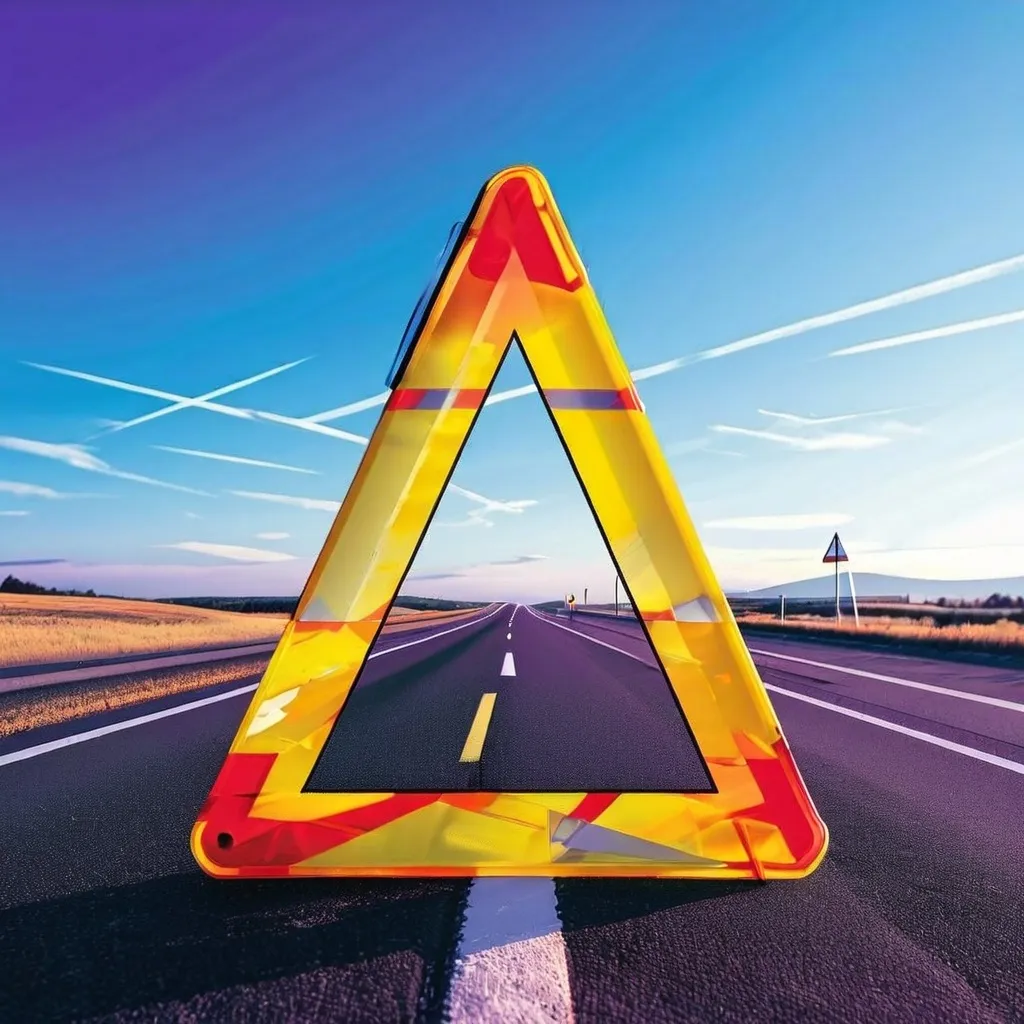
After ensuring everyone's personal safety, the next critical step is to make the presence of your broken-down vehicle unmistakably clear to oncoming traffic. This is achieved by deploying the warning triangle, the Warndreieck.
The Warndreieck must be placed at a sufficient distance before the breakdown location to give approaching drivers ample time to react. The required distance varies depending on the type of road. On Autobahnen, due to the high speeds, the warning triangle should be placed at least 150 metres behind your vehicle. This distance is often marked by guide posts (Leitpfosten), which are typically spaced about 50 metres apart, so aim for roughly three such intervals. When approaching the placement area, it is safest to walk behind the guardrail or along the very edge of the road, facing oncoming traffic. The triangle should be clearly visible to drivers approaching from behind.
When placing the Warndreieck, always consider the road's layout. If there is a bend or a crest in the road before your location, the Warndreieck must be positioned before that obstruction to ensure it is seen in time by drivers coming around the bend or over the crest.
With the scene secured and everyone safe, the final crucial step is to contact the appropriate services to get help. Germany has a well-established system for roadside assistance and emergency response.
In Germany, the universal emergency number is 112. This number connects you to the fire brigade, ambulance services, and police. If there is no immediate threat to life or limb but your vehicle is obstructing traffic or creating a hazard, the police (110) may also be contacted directly. For standard breakdown assistance, if you are a member of an automobile club like the ADAC, you will have their specific breakdown number.
The Allgemeine Deutsche Automobil-Club (ADAC) provides a 24-hour breakdown service. Their primary emergency number is 0800 5 33 53 53.
Along the Autobahn, emergency communication columns (Notrufsäulen) are typically installed at intervals of approximately two kilometres. These columns provide a direct line to the relevant traffic control centre and can pinpoint your exact location automatically, which is invaluable if you are unsure of your precise position. Using these is often more efficient than a mobile phone if you don't know your kilometre marker.
Understanding what to do is as important as knowing what not to do in a breakdown situation on the Autobahn. Several actions can turn a manageable situation into a severe accident.
As already stressed, remaining inside a stationary vehicle on the Pannenstreifen is extremely dangerous. Even though it might seem like the safest place to wait, it is highly vulnerable to high-speed impacts from the rear. Always move away from the vehicle and, if possible, behind the guardrail.
Unless your vehicle is causing a significant obstruction and it is safe to do so, do not attempt to push it. Pushing a car on the Autobahn is hazardous and generally not permitted unless it is absolutely necessary for immediate safety. If you must move it a short distance, ensure all occupants are out of the vehicle and that you have assistance and are in a safe position.
If emergency vehicles are approaching, ensure that you have formed a Rettungsgasse (emergency lane) correctly if traffic is slow or stopped. When you are broken down, never obstruct the path of emergency vehicles. Your priority is to be out of the way and clearly visible, not to interfere with rescue operations.
Failure to form a Rettungsgasse when required can lead to severe penalties and, more critically, can delay emergency services reaching those in need, potentially with fatal consequences.
Mastering the procedures for handling a breakdown on the Autobahn is a vital part of safe driving in Germany. These steps are frequently tested in the official driving theory examination. Ensure you are confident in your understanding of each phase, from immediate actions to calling for help.
Understanding these safety protocols is paramount for any driver in Germany. By following these steps diligently, you not only comply with the law and increase your chances of passing your theory test but, most importantly, protect yourself and others from the significant dangers of an Autobahn breakdown.
Handling a breakdown on the German Autobahn requires a precise sequence of actions to protect lives. First, activate hazard lights immediately, then carefully maneuver to the Pannenstreifen. Once safely positioned, all occupants must don the mandatory Warnweste before exiting from the passenger side and move behind the guardrail if available. Deploy the Warndreieck at least 150 metres behind your vehicle, considering road layout for visibility. Finally, call for assistance via emergency number 112 or use the nearest Notrufsäule. These procedures are examinable in the German driving theory test and are critical for survival on high-speed German highways.
A short set of high-value points that capture the most important ideas from this article.
Activate hazard warning lights immediately upon realizing a breakdown, even before slowing down or maneuvering
Steer your vehicle to the Pannenstreifen (emergency breakdown lane) on the far right, completely off active traffic lanes
All occupants must put on the Warnweste before exiting the vehicle and move away from traffic, ideally behind the guardrail
Place the Warndreieck at least 150 metres behind your vehicle, approximately three Leitpfosten intervals apart
Contact emergency services using 112 or locate the nearest Notrufsäule for direct communication with traffic control
The Warnweste is a legal requirement in Germany—mandatory for all occupants before leaving the vehicle outside built-up areas
Exit the vehicle from the passenger side (away from traffic flow), never open doors facing Autobahn lanes
On the Autobahn, the Warndreieck must be placed at least 150 metres behind the breakdown location
Emergency number 112 connects to fire, ambulance, and police; Notrufsäulen are installed approximately every 2 kilometres
If a bend or crest exists before your location, place the Warndreieck before that obstruction so drivers can see it in time
Remaining inside the vehicle while on the Pannenstreifen—extremely dangerous due to high-speed rear impacts
Failing to activate hazard lights immediately, depriving following drivers of precious reaction time
Placing the Warndreieck too close to the vehicle instead of the required 150-metre distance
Not wearing the Warnweste before exiting, violating the legal requirement and reducing visibility
Attempting to push the vehicle unless it is absolutely necessary and safe to do so
Article content overview
A short set of high-value points that capture the most important ideas from this article.
Activate hazard warning lights immediately upon realizing a breakdown, even before slowing down or maneuvering
Steer your vehicle to the Pannenstreifen (emergency breakdown lane) on the far right, completely off active traffic lanes
All occupants must put on the Warnweste before exiting the vehicle and move away from traffic, ideally behind the guardrail
Place the Warndreieck at least 150 metres behind your vehicle, approximately three Leitpfosten intervals apart
Contact emergency services using 112 or locate the nearest Notrufsäule for direct communication with traffic control
The Warnweste is a legal requirement in Germany—mandatory for all occupants before leaving the vehicle outside built-up areas
Exit the vehicle from the passenger side (away from traffic flow), never open doors facing Autobahn lanes
On the Autobahn, the Warndreieck must be placed at least 150 metres behind the breakdown location
Emergency number 112 connects to fire, ambulance, and police; Notrufsäulen are installed approximately every 2 kilometres
If a bend or crest exists before your location, place the Warndreieck before that obstruction so drivers can see it in time
Remaining inside the vehicle while on the Pannenstreifen—extremely dangerous due to high-speed rear impacts
Failing to activate hazard lights immediately, depriving following drivers of precious reaction time
Placing the Warndreieck too close to the vehicle instead of the required 150-metre distance
Not wearing the Warnweste before exiting, violating the legal requirement and reducing visibility
Attempting to push the vehicle unless it is absolutely necessary and safe to do so
Explore related topics, search based questions, and concepts that learners often look up when studying Autobahn Breakdown Safety. These themes reflect real search intent and help you understand how this topic connects to wider driving theory knowledge in Germany.
Find clear and practical answers to common questions learners often have about Autobahn Breakdown Safety. This section helps explain difficult points, remove confusion, and reinforce the key driving theory concepts that matter for learners in Germany.
Immediately switch on your hazard warning lights. Then, steer your vehicle to the Pannenstreifen (hard shoulder) or the rightmost lane as far as safely possible, and switch off the engine.
Put on your Warnweste (high-visibility vest) *before* exiting. Exit the vehicle only from the right-hand side (passenger side), away from traffic, and move all occupants to a safe location behind the safety barrier.
On the Autobahn, the Warndreieck should be placed at least 150 meters behind your vehicle. Walk along the roadside or behind the safety barrier, facing oncoming traffic, to place it.
You can call the emergency services (112), the police (110), or a breakdown assistance service like ADAC. Provide your exact location, including the Autobahn number, direction of travel, and kilometer marker.
No, it is not safe. Always exit the vehicle from the right side and move to a safe location behind the protective barrier. The Pannenstreifen is a dangerous area due to high-speed traffic.
Didn't find what you were looking for? Continue your German driving theory preparation by exploring related articles, specific road sign categories, or in-depth guides on complex traffic situations. Deepen your understanding before the official test.