
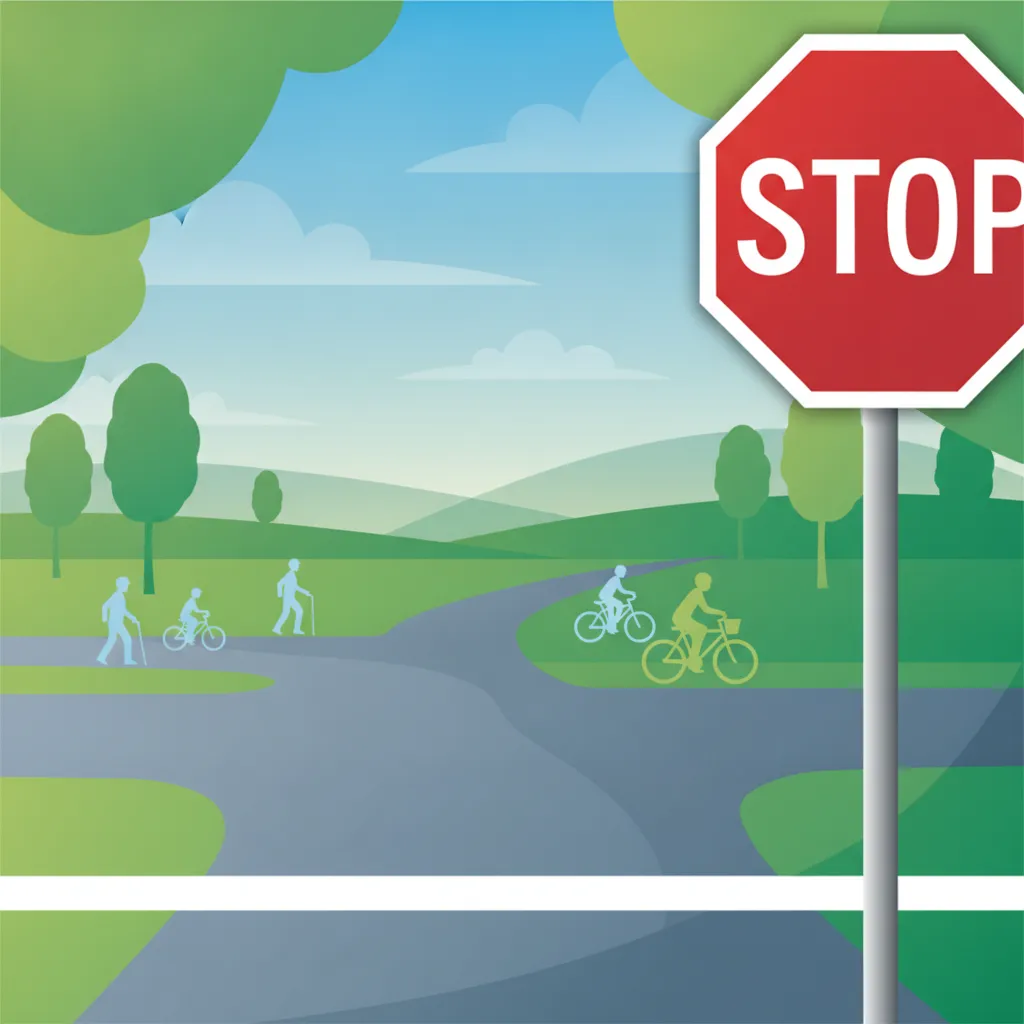
In Germany, the stop sign, officially known as Zeichen 206 (Halt! Vorfahrt gewähren!), is a regulatory traffic sign that demands immediate and unconditional compliance. Unlike a yield sign, it requires every driver to bring their vehicle to a complete and full stop before proceeding. This rule is paramount for ensuring safety at high-risk intersections and is a frequent focus in the German driving theory exam.
Theory topic content overview
Read the full theory topic guide for Stop Sign (Zeichen 206) Rules with structured, easy-to-scan content built for learners in Germany. This detailed section explains the exact rule, meaning, traffic context, comparison points, and exam logic behind this German driving theory topic so you can study faster, understand the concept more clearly, and avoid common interpretation mistakes on the theory test.
The stop sign, officially known in German traffic law as Zeichen 206 Halt! Vorfahrt gewähren!, is one of the most critical regulatory signs you will encounter on German roads. It demands an absolute and unconditional stop before proceeding, signifying a point of high potential conflict where other traffic has priority.
This sign is fundamental for ensuring safety at intersections and is a frequent focus in the German driving theory exam. Understanding its precise requirements, especially how it differs from a yield sign, is crucial for both theoretical knowledge and practical driving safety.
The primary purpose of Zeichen 206 is to prevent collisions at intersections or entry points onto priority roads. It enforces a mandatory pause, giving drivers sufficient time to:
Mistakes at stop signs are a common cause of accidents and a major point of failure in driving tests in Germany. Ignoring this sign, even with a "rolling stop," is a serious traffic violation with potential legal consequences and, more importantly, high accident risk.
When you encounter a German stop sign (Zeichen 206), follow these steps meticulously:
Important Note: Even if you perceive no immediate traffic, the stop is still mandatory. This is a regulatory sign that dictates behaviour, not just a warning to be cautious.
The placement of Zeichen 206 by German traffic authorities (as guided by the VwV-StVO) is not arbitrary. It's used in specific situations where heightened caution is necessary:
This is perhaps the most critical distinction for German driving theory and practical application:
Confusing these two signs is a very common mistake in the German theory exam and a significant safety hazard on the road. Remember: "Halt!" means HALT!
Learners often struggle with Zeichen 206 in the German driving test. Be aware of these common pitfalls:
For Zeichen 206 (Halt! Vorfahrt gewähren!) in Germany, adopt the STOP mindset:
Mastering the stop sign is not just about passing your German driving test; it's a fundamental skill for safe and responsible driving on German roads.
The German stop sign (Zeichen 206 Halt! Vorfahrt gewähren!) is a regulatory sign requiring drivers to make a complete, unconditional stop before the Haltlinie or at the intersection edge, even when no traffic is visible. This differs fundamentally from the yield sign (Zeichen 205), which only requires stopping if necessary to give way. Drivers must scan all directions for vehicles, cyclists, and pedestrians before proceeding, as all traffic on the priority road has absolute right of way. Common mistakes include rolling stops, stopping past the line, inadequate observation, and ignoring non-vehicular road users. Use the STOP method: Stop completely, Think about priority, Observe thoroughly, then Proceed only when safe.
A short set of high-value points that capture the most important ideas from this theory explanation.
Zeichen 206 (Halt! Vorfahrt gewähren!) requires an unconditional full stop before the Haltlinie or intersection edge, regardless of visible traffic
The stop must be complete with wheels fully stopped—not a rolling stop or slow pause
You must stop before the white Haltlinie; stopping past it obstructs cyclists and pedestrians and positions you incorrectly
Vehicles, cyclists, and pedestrians on the priority road all have absolute right of way after you proceed from a stop sign
The stop sign placement follows specific criteria: limited visibility, complex layouts, high accident risk, and cycle path crossings
Stop sign (Zeichen 206) always requires complete halt; yield sign (Zeichen 205) only requires stopping if necessary to give way
If no Haltlinie exists, stop at the intersection edge or where you have the best view without impeding cross-traffic
After stopping, scan left, right, ahead, and behind for all road users before proceeding
Haltlinie positioning often places cyclists before the main road intersection—always check for cycle paths crossing your path
Even with no visible traffic, the mandatory stop is still legally required
Performing a rolling stop—failing to bring wheels to a complete halt results in test failure and violations
Stopping past the Haltlinie, which can block cyclists and position you incorrectly for visibility
Only briefly glancing after stopping instead of thoroughly scanning all directions
Assuming the road is clear because no vehicles are immediately visible—faster traffic or blind spots may exist
Focusing only on vehicular traffic and forgetting to yield to pedestrians and cyclists at crossings
Start with a short, direct summary of Stop Sign (Zeichen 206) Rules before reading the full explanation below.
A stop sign (Zeichen 206) in Germany mandates a complete halt of your vehicle at the white stop line (Haltlinie) or, if absent, at the intersection edge. You must then carefully assess the road for all other traffic, including pedestrians and cyclists, and only proceed when it is entirely safe to do so. This rule is stricter than a yield sign and is fundamental for preventing collisions.
Review the most important terms, rule signals, and traffic concepts linked to Stop Sign (Zeichen 206) Rules.
Explore related theory topic pages connected to Stop Sign (Zeichen 206) Rules and continue with the next useful rule explanation.
See the common search queries learners use when trying to understand Stop Sign (Zeichen 206) Rules in Germany.

Solidify your understanding of German road rules. Explore specific theory topics in detail, from priority rules to complex Autobahn situations. Review key concepts and prepare thoroughly for every aspect of your official driving license theory examination.
German Driving Theory TopicsTheory topic content overview
A short set of high-value points that capture the most important ideas from this theory explanation.
Zeichen 206 (Halt! Vorfahrt gewähren!) requires an unconditional full stop before the Haltlinie or intersection edge, regardless of visible traffic
The stop must be complete with wheels fully stopped—not a rolling stop or slow pause
You must stop before the white Haltlinie; stopping past it obstructs cyclists and pedestrians and positions you incorrectly
Vehicles, cyclists, and pedestrians on the priority road all have absolute right of way after you proceed from a stop sign
The stop sign placement follows specific criteria: limited visibility, complex layouts, high accident risk, and cycle path crossings
Stop sign (Zeichen 206) always requires complete halt; yield sign (Zeichen 205) only requires stopping if necessary to give way
If no Haltlinie exists, stop at the intersection edge or where you have the best view without impeding cross-traffic
After stopping, scan left, right, ahead, and behind for all road users before proceeding
Haltlinie positioning often places cyclists before the main road intersection—always check for cycle paths crossing your path
Even with no visible traffic, the mandatory stop is still legally required
Performing a rolling stop—failing to bring wheels to a complete halt results in test failure and violations
Stopping past the Haltlinie, which can block cyclists and position you incorrectly for visibility
Only briefly glancing after stopping instead of thoroughly scanning all directions
Assuming the road is clear because no vehicles are immediately visible—faster traffic or blind spots may exist
Focusing only on vehicular traffic and forgetting to yield to pedestrians and cyclists at crossings
Start with a short, direct summary of Stop Sign (Zeichen 206) Rules before reading the full explanation below.
A stop sign (Zeichen 206) in Germany mandates a complete halt of your vehicle at the white stop line (Haltlinie) or, if absent, at the intersection edge. You must then carefully assess the road for all other traffic, including pedestrians and cyclists, and only proceed when it is entirely safe to do so. This rule is stricter than a yield sign and is fundamental for preventing collisions.
Review the most important terms, rule signals, and traffic concepts linked to Stop Sign (Zeichen 206) Rules.
Explore related theory topic pages connected to Stop Sign (Zeichen 206) Rules and continue with the next useful rule explanation.
See the common search queries learners use when trying to understand Stop Sign (Zeichen 206) Rules in Germany.
Solidify your understanding of German road rules. Explore specific theory topics in detail, from priority rules to complex Autobahn situations. Review key concepts and prepare thoroughly for every aspect of your official driving license theory examination.
German Driving Theory TopicsUse this exam-focused revision tip to understand how Stop Sign (Zeichen 206) Rules is likely to appear in theory questions for learners in Germany. This section helps you identify the most testable part of the rule, avoid common traps, and remember the concept more effectively during German driving theory exam preparation.
Pay close attention to questions distinguishing between a stop sign (Zeichen 206) and a yield sign (Zeichen 205) in the German theory exam. The key difference is the mandatory complete stop at a stop sign, regardless of traffic. Even a rolling stop is considered a violation and will result in incorrect answers and potential penalties.
Read direct answers to the most common learner questions about Stop Sign (Zeichen 206) Rules in Germany. This FAQ focuses on rule confusion, practical meaning, comparison with similar concepts, and the exact uncertainties that appear most often in German driving theory revision and exam preparation.
Zeichen 206, the stop sign, means you must bring your vehicle to a complete and full stop at the white stop line (Haltlinie) or, if no line exists, at the edge of the intersection where you have the best view.
Yes, a complete stop is always mandatory at a stop sign (Zeichen 206) in Germany, regardless of whether you perceive other traffic. A 'rolling stop' is a violation.
A stop sign (Zeichen 206) requires a mandatory complete stop. A yield sign (Zeichen 205, Vorfahrt gewähren) requires you to give way to traffic on the priority road, meaning you must slow down and potentially stop if necessary, but a full stop is not always required if the road is clear.
If there is no white stop line (Haltlinie), you must stop at a point where you have a clear view of the crossing traffic without entering the intersection or obstructing other road users.
After coming to a complete stop, you must carefully check for all road users (vehicles, cyclists, pedestrians) from all directions and only proceed when it is absolutely safe and you will not impede anyone.
Yes, failing to make a complete stop at Zeichen 206 is considered a serious traffic violation under German law (StVO) because it directly undermines intersection safety and priority rules.
Begin your targeted revision now. Use our practice search to quickly find specific German driving theory questions. Filter by StVO rules, road signs, or hazard perception to create your focused study plan. Master challenging areas and prepare confidently for your theoretical driving test.