
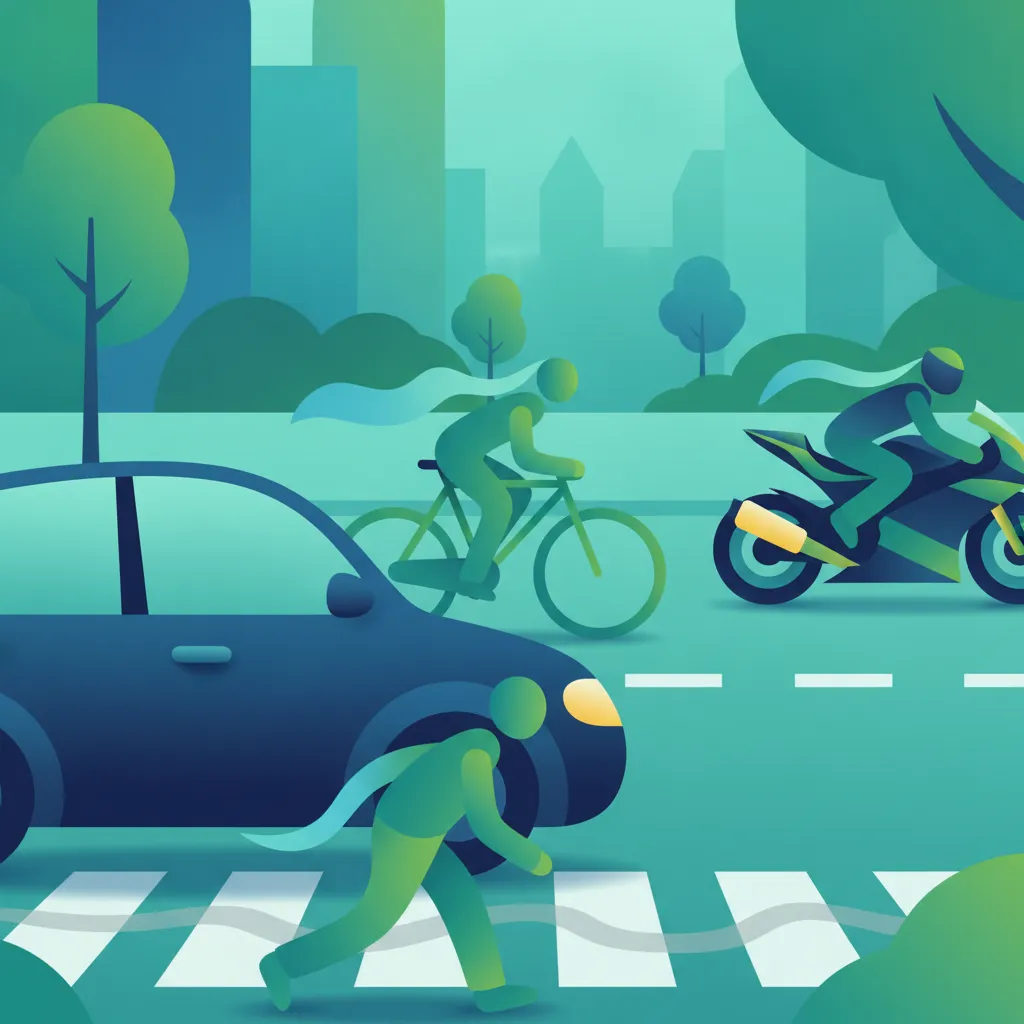
German roads are shared spaces, and safe driving requires understanding and adapting to the diverse characteristics of all traffic participants. From vulnerable pedestrians and agile cyclists to less visible motorcyclists and large, slow-moving trucks, each user group presents unique challenges. This page explains how drivers must adjust their behavior, maintain appropriate distances, and be constantly aware to prevent accidents and promote a cooperative traffic environment.
Theory topic content overview
Read the full theory topic guide for Safe Road Sharing with structured, easy-to-scan content built for learners in Germany. This detailed section explains the exact rule, meaning, traffic context, comparison points, and exam logic behind this German driving theory topic so you can study faster, understand the concept more clearly, and avoid common interpretation mistakes on the theory test.
Sharing the road is a foundational principle of safe driving in Germany, encompassing more than just following rules. It's about demonstrating mutual consideration (Rücksicht) for all traffic participants, a core tenet of the German Road Traffic Act (Straßenverkehrs-Ordnung, StVO) §1. As a driver, you operate a powerful vehicle, and this places a greater responsibility on you to protect more vulnerable road users. Understanding this dynamic and actively adapting your driving behavior is crucial for safety and a significant focus in the German driving theory exam.
The diverse mix of traffic in German cities, rural areas, and motorways means drivers constantly encounter different types of road users. Each group has unique characteristics, visibility, and vulnerability. Failing to account for these differences leads to misunderstandings, dangerous situations, and is a frequent cause of accidents.
Successful road sharing in Germany requires specific adaptations depending on who you are interacting with.
Pedestrians are the most vulnerable road users. They are often unpredictable, especially children and the elderly.
Cyclists are common on German roads and cycle paths. They are less stable and visible than cars and susceptible to road conditions.
Motorcyclists are fast-moving, smaller, and therefore harder to spot, often disappearing into blind spots (Toter Winkel).
Public transport vehicles have specific rules and present unique challenges in German urban traffic.
Large vehicles require more space for maneuvering, have significantly larger blind spots, and longer braking distances.
To safely share the road in Germany, always prioritize the principle of Rücksicht (consideration). Assume that other road users, particularly the most vulnerable, may not see you or may make mistakes. Maintain appropriate safe distances, actively use your mirrors and perform shoulder checks, and adapt your speed and positioning to the specific situation and type of road user. Anticipate potential hazards rather than just reacting to them. This proactive and considerate approach is not only vital for passing your German driving theory exam but is the cornerstone of safe and cooperative driving throughout Germany.
Sharing the road in Germany requires drivers to actively adapt their behavior based on the characteristics of each road user group. The StVO §1 principle of Rücksicht places greater responsibility on drivers to protect vulnerable users like pedestrians, cyclists, and motorcyclists. Key rules include specific overtaking distances for cyclists (1.5m/2m), walking pace when passing stopped buses, and comprehensive blind spot checks before any lateral maneuver. Understanding truck blind spots and turning circles, tram priority rules, and the importance of anticipatory driving (vorausschauendes Fahren) are essential for both passing the German theory exam and safe practical driving.
A short set of high-value points that capture the most important ideas from this theory explanation.
StVO §1 requires drivers to demonstrate Rücksicht (consideration) toward all road users, with greater responsibility toward more vulnerable participants
The vulnerable road user principle means drivers of larger vehicles bear increased responsibility for preventing accidents with pedestrians, cyclists, and motorcyclists
Safe overtaking of cyclists requires maintaining at least 1.5 meters in built-up areas and 2 meters outside built-up areas
Anticipatory driving (vorausschauendes Fahren) is emphasized over reactive driving, requiring you to predict hazards before they materialize
Blind spots for large vehicles are enormous on all sides; if you cannot see the driver in their mirror, they cannot see you
Cyclist overtaking distances: 1.5m minimum in towns, 2m minimum outside built-up areas
When passing a stopped bus, reduce to walking pace (Schrittgeschwindigkeit) to protect boarding passengers
Always perform a shoulder check (Schulterblick) for cyclists when turning right, as they may be in your blind spot
Buses signaling to pull out from a stop have priority; you must allow them to proceed
Trucks swinging wide before turning right create a gap never to be squeezed—hold back and wait
Failing to maintain the legally required lateral distance when overtaking cyclists, especially in tight urban conditions
Neglecting blind spot checks before turning or changing lanes, particularly missing motorcyclists and cyclists
Forgetting to reduce speed to walking pace when passing a bus that has stopped for passengers
Attempting to pass a turning truck on the right side as it swings wide to the left
Assuming vulnerable road users will always act predictably and yield appropriately
Start with a short, direct summary of Safe Road Sharing before reading the full explanation below.
Sharing the road safely in Germany means drivers must constantly adapt their behavior, speed, and spacing to account for the unique characteristics and vulnerabilities of all other road users. This includes providing ample space for cyclists, being extra vigilant for pedestrians at crossings, actively checking blind spots for motorcyclists, and understanding the maneuvering limitations of large vehicles, all in accordance with German traffic regulations (StVO).
Review the most important terms, rule signals, and traffic concepts linked to Safe Road Sharing.
Explore related theory topic pages connected to Safe Road Sharing and continue with the next useful rule explanation.
See the common search queries learners use when trying to understand Safe Road Sharing in Germany.

Solidify your understanding of German road rules. Explore specific theory topics in detail, from priority rules to complex Autobahn situations. Review key concepts and prepare thoroughly for every aspect of your official driving license theory examination.
German Driving Theory TopicsTheory topic content overview
A short set of high-value points that capture the most important ideas from this theory explanation.
StVO §1 requires drivers to demonstrate Rücksicht (consideration) toward all road users, with greater responsibility toward more vulnerable participants
The vulnerable road user principle means drivers of larger vehicles bear increased responsibility for preventing accidents with pedestrians, cyclists, and motorcyclists
Safe overtaking of cyclists requires maintaining at least 1.5 meters in built-up areas and 2 meters outside built-up areas
Anticipatory driving (vorausschauendes Fahren) is emphasized over reactive driving, requiring you to predict hazards before they materialize
Blind spots for large vehicles are enormous on all sides; if you cannot see the driver in their mirror, they cannot see you
Cyclist overtaking distances: 1.5m minimum in towns, 2m minimum outside built-up areas
When passing a stopped bus, reduce to walking pace (Schrittgeschwindigkeit) to protect boarding passengers
Always perform a shoulder check (Schulterblick) for cyclists when turning right, as they may be in your blind spot
Buses signaling to pull out from a stop have priority; you must allow them to proceed
Trucks swinging wide before turning right create a gap never to be squeezed—hold back and wait
Failing to maintain the legally required lateral distance when overtaking cyclists, especially in tight urban conditions
Neglecting blind spot checks before turning or changing lanes, particularly missing motorcyclists and cyclists
Forgetting to reduce speed to walking pace when passing a bus that has stopped for passengers
Attempting to pass a turning truck on the right side as it swings wide to the left
Assuming vulnerable road users will always act predictably and yield appropriately
Start with a short, direct summary of Safe Road Sharing before reading the full explanation below.
Sharing the road safely in Germany means drivers must constantly adapt their behavior, speed, and spacing to account for the unique characteristics and vulnerabilities of all other road users. This includes providing ample space for cyclists, being extra vigilant for pedestrians at crossings, actively checking blind spots for motorcyclists, and understanding the maneuvering limitations of large vehicles, all in accordance with German traffic regulations (StVO).
Review the most important terms, rule signals, and traffic concepts linked to Safe Road Sharing.
Explore related theory topic pages connected to Safe Road Sharing and continue with the next useful rule explanation.
See the common search queries learners use when trying to understand Safe Road Sharing in Germany.
Solidify your understanding of German road rules. Explore specific theory topics in detail, from priority rules to complex Autobahn situations. Review key concepts and prepare thoroughly for every aspect of your official driving license theory examination.
German Driving Theory TopicsUse this exam-focused revision tip to understand how Safe Road Sharing is likely to appear in theory questions for learners in Germany. This section helps you identify the most testable part of the rule, avoid common traps, and remember the concept more effectively during German driving theory exam preparation.
The German theory exam frequently tests your ability to identify hazards involving different road users. Pay close attention to scenarios with pedestrians, cyclists, and motorcyclists, especially regarding right-of-way, safe distances, and blind spots. Remember the 'vulnerable road user' principle: as a driver, you almost always bear more responsibility to prevent accidents with less protected participants.
Read direct answers to the most common learner questions about Safe Road Sharing in Germany. This FAQ focuses on rule confusion, practical meaning, comparison with similar concepts, and the exact uncertainties that appear most often in German driving theory revision and exam preparation.
Cyclists are considered vulnerable road users; they are less protected and can be less visible than cars. Drivers in Germany must maintain a safe lateral distance (minimum 1.5m in urban areas, 2m outside) when passing and anticipate their movements, especially when turning.
The primary principle is mutual consideration and caution. Drivers have a higher duty of care towards more vulnerable road users like pedestrians and cyclists, requiring them to adapt their speed and behavior to prevent danger.
Even at unmarked crossings, drivers must be prepared for pedestrians to cross. Always approach with caution, be ready to stop, and yield if pedestrians are already crossing or clearly intending to cross, especially in urban areas.
Large vehicles have significant blind spots (especially on the right side) and require more space to maneuver, particularly when turning. Avoid lingering in these blind spots, provide ample room, and anticipate wider turns.
Motorcyclists are smaller and can be easily hidden by vehicle structures or in blind spots. Always perform thorough shoulder checks (blik in de dode hoek) before changing lanes, turning, or opening your door, and assume they might be there.
In German driving theory, 'vulnerable road users' refers to pedestrians, cyclists, and motorcyclists. They are unprotected and face a higher risk of severe injury in a collision, which means drivers of cars and larger vehicles have an increased responsibility to protect them.
Yes, drivers must exercise special caution around public transport. For example, if a bus is signaling to depart from a stop, you must allow it to do so. If a tram is approaching, you often have to yield or ensure sufficient clearance, depending on the situation and specific signage.
Begin your targeted revision now. Use our practice search to quickly find specific German driving theory questions. Filter by StVO rules, road signs, or hazard perception to create your focused study plan. Master challenging areas and prepare confidently for your theoretical driving test.