
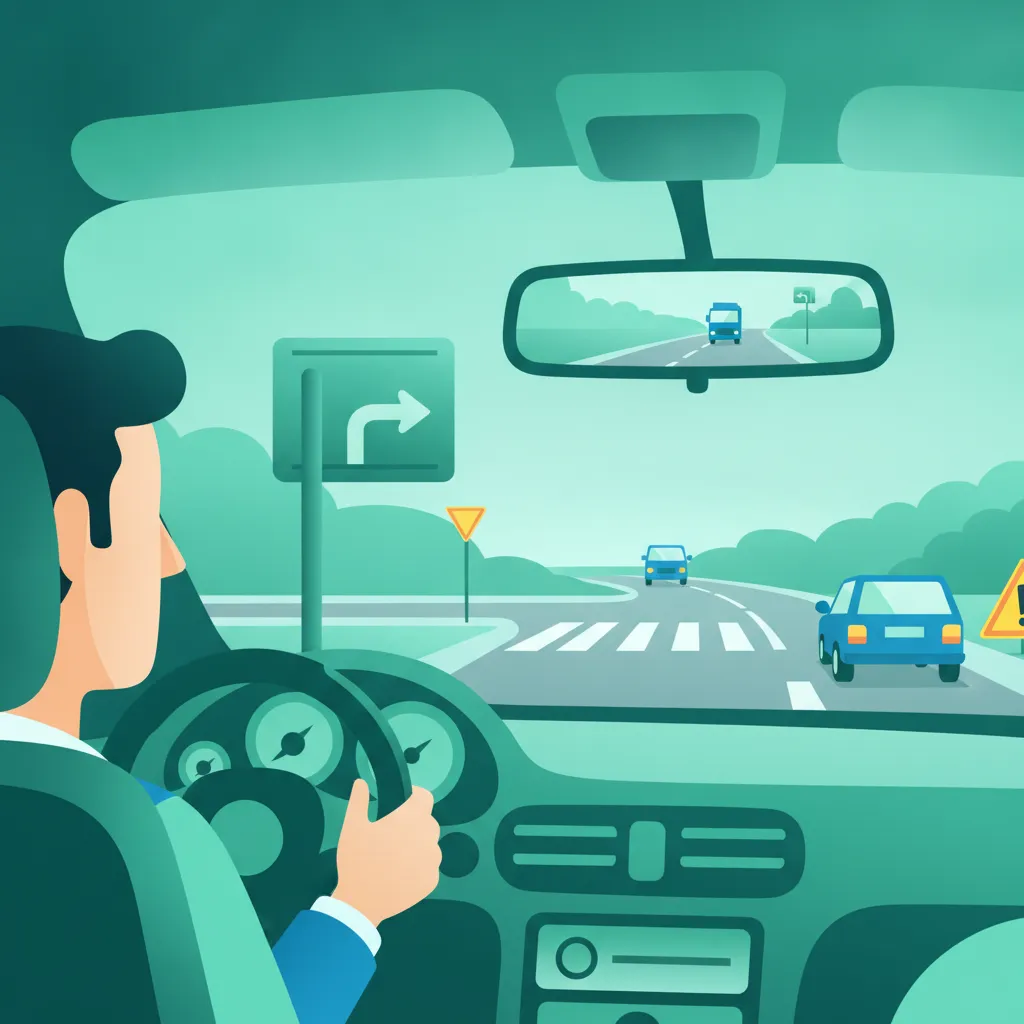
Effective mirror checks are a fundamental skill for any driver, crucial for maintaining awareness of your surroundings and making safe decisions in German traffic. You must actively use your interior rear-view mirror and exterior side mirrors to monitor traffic behind and beside your vehicle, constantly anticipating other road users' actions. Mastering this observation technique is vital for both your driving test and everyday safety on German roads.
Theory topic content overview
Read the full theory topic guide for Mirror Checks with structured, easy-to-scan content built for learners in Germany. This detailed section explains the exact rule, meaning, traffic context, comparison points, and exam logic behind this German driving theory topic so you can study faster, understand the concept more clearly, and avoid common interpretation mistakes on the theory test.
Mirror checks are a fundamental and continuous observation technique used by drivers to maintain comprehensive awareness of traffic conditions around their vehicle. In German driving theory and practice, this means actively and regularly scanning your interior rear-view mirror (Innenspiegel) and both exterior side mirrors (Außenspiegel) to monitor traffic behind and to the sides. This constant vigilance allows you to detect potential hazards, anticipate the actions of other road users, and make safe, informed decisions.
The core purpose of mirror checks is to provide "indirect vision" of areas not visible through the windscreen, crucial for safe participation in German road traffic (Straßenverkehr).
Effective mirror use is not merely a recommendation; it's a critical safety requirement and a cornerstone of the German driving test. Understanding and performing consistent mirror checks is vital for several reasons:
In German driving, mirror checks are not just an occasional glance; they are an integral part of a systematic observation routine. This routine involves both continuous awareness and specific checks before maneuvers.
Even when driving straight ahead, you should regularly glance at your mirrors – approximately every 5-8 seconds or more frequently in complex situations. This establishes a dynamic mental picture of your surroundings, allowing you to notice changes in traffic flow, identify vehicles that are following you closely, or observe potential overtaking attempts.
Critical moments require specific, focused mirror checks. Remember the "Blick-Signal-Manöver" (Mirror-Signal-Maneuver) principle, which emphasizes the correct sequence of observation:
While mirrors provide excellent rearward and lateral vision, they all have limitations. Every vehicle has blind spots (toter Winkel) – areas around the vehicle that are not visible in any mirror. These are particularly dangerous because they can hide entire vehicles, especially smaller ones like motorcycles, or vulnerable road users like cyclists.
In Germany, performing a "Schulterblick" (shoulder check) is an absolute necessity before any lateral movement (e.g., changing lanes, turning, pulling away from the curb). This involves briefly turning your head to glance over your shoulder in the direction you intend to move. This quick head turn directly checks the blind spot, confirming it is clear before you commit to a maneuver. Failing to perform the Schulterblick is a critical error in the German practical driving test.
Learners and even experienced drivers often make mistakes regarding mirror checks. Be aware of these common pitfalls:
The German Straßenverkehrs-Ordnung (StVO) does not explicitly state "check your mirrors now," but it underpins the entire concept of mirror use through its emphasis on safety (Sicherheit) and due care (Sorgfaltspflicht). Drivers are legally obliged to drive in a way that does not endanger others and to take all necessary precautions. This includes:
The continuous use of mirrors, combined with the Schulterblick, is therefore not just a driving skill but a legal expectation for anyone operating a vehicle on German roads. Even modern vehicles equipped with camera-monitor systems (KMS) or blind spot assistants still require active driver observation and interpretation; these systems supplement, but do not replace, the driver's responsibility to look.
Mastering mirror checks and the crucial "Schulterblick" is fundamental for safe and successful driving in Germany. Integrate mirror checks into a continuous, systematic observation routine. Always remember the Blick-Signal-Manöver principle and prioritize that swift, decisive head turn for the Schulterblick before any lateral movement. This consistent practice will not only help you pass your German driving theory and practical exams but, more importantly, ensure your safety and the safety of others on German roads.
Mirror checks in German driving theory involve a systematic observation routine combining interior rear-view and exterior side mirrors with mandatory Schulterblick shoulder checks before any lateral movement. The Blick-Signal-Manöver principle establishes the correct sequence: observe mirrors thoroughly, signal your intention, then execute the maneuver while continuing to monitor traffic. German traffic law (StVO §1, §7, §9) implicitly requires effective mirror use as part of your legal duty to avoid endangering others. Insufficient observation, particularly missing the Schulterblick, is a leading cause of practical driving test failures in Germany.
A short set of high-value points that capture the most important ideas from this theory explanation.
The Blick-Signal-Manöver (mirror-signal-maneuver) principle is the core observation sequence: check mirrors, signal, then execute the maneuver
Schulterblick (shoulder check) is mandatory before any lateral movement to verify blind spots are clear
Mirror checks must be continuous while driving, not just immediate pre-maneuver glances
Different maneuvers (lane change, turn, brake, overtake, start off, reverse) each have specific mirror check sequences
StVO legally requires effective observation as part of your duty to avoid endangering others on German roads
Sequence for lane changes and turns: interior mirror, then side mirror, then Schulterblick over shoulder, then signal
Quick glances at mirrors every 5-8 seconds when driving straight to maintain continuous situational awareness
Convex side mirrors make objects appear smaller and further away than they actually are
Schulterblick must be performed before changing lanes, turning, and starting off from stationary positions
Always check rear-view mirror before braking to assess following traffic and adjust braking force accordingly
Only checking mirrors immediately before a maneuver instead of maintaining continuous scanning while driving
Omitting the Schulterblick and relying solely on mirrors, which leaves blind spots unchecked
Staring into mirrors too long, causing the vehicle to drift or missing hazards ahead
Failing to check mirrors before braking, creating rear-end collision risk from following traffic
Adjusting mirrors incorrectly, which enlarges blind spots and reduces peripheral awareness
Start with a short, direct summary of Mirror Checks before reading the full explanation below.
Mirror checks are continuous, active observations of traffic around your vehicle using your rear-view and side mirrors. They are essential to maintaining awareness, especially before and during maneuvers such as changing lanes, turning, or braking in Germany. Regular checks help drivers detect potential hazards, understand the flow of traffic, and ensure safe execution of all driving actions, preventing collisions.
Review the most important terms, rule signals, and traffic concepts linked to Mirror Checks.
Explore related theory topic pages connected to Mirror Checks and continue with the next useful rule explanation.
See the common search queries learners use when trying to understand Mirror Checks in Germany.

Solidify your understanding of German road rules. Explore specific theory topics in detail, from priority rules to complex Autobahn situations. Review key concepts and prepare thoroughly for every aspect of your official driving license theory examination.
German Driving Theory TopicsTheory topic content overview
A short set of high-value points that capture the most important ideas from this theory explanation.
The Blick-Signal-Manöver (mirror-signal-maneuver) principle is the core observation sequence: check mirrors, signal, then execute the maneuver
Schulterblick (shoulder check) is mandatory before any lateral movement to verify blind spots are clear
Mirror checks must be continuous while driving, not just immediate pre-maneuver glances
Different maneuvers (lane change, turn, brake, overtake, start off, reverse) each have specific mirror check sequences
StVO legally requires effective observation as part of your duty to avoid endangering others on German roads
Sequence for lane changes and turns: interior mirror, then side mirror, then Schulterblick over shoulder, then signal
Quick glances at mirrors every 5-8 seconds when driving straight to maintain continuous situational awareness
Convex side mirrors make objects appear smaller and further away than they actually are
Schulterblick must be performed before changing lanes, turning, and starting off from stationary positions
Always check rear-view mirror before braking to assess following traffic and adjust braking force accordingly
Only checking mirrors immediately before a maneuver instead of maintaining continuous scanning while driving
Omitting the Schulterblick and relying solely on mirrors, which leaves blind spots unchecked
Staring into mirrors too long, causing the vehicle to drift or missing hazards ahead
Failing to check mirrors before braking, creating rear-end collision risk from following traffic
Adjusting mirrors incorrectly, which enlarges blind spots and reduces peripheral awareness
Start with a short, direct summary of Mirror Checks before reading the full explanation below.
Mirror checks are continuous, active observations of traffic around your vehicle using your rear-view and side mirrors. They are essential to maintaining awareness, especially before and during maneuvers such as changing lanes, turning, or braking in Germany. Regular checks help drivers detect potential hazards, understand the flow of traffic, and ensure safe execution of all driving actions, preventing collisions.
Review the most important terms, rule signals, and traffic concepts linked to Mirror Checks.
Explore related theory topic pages connected to Mirror Checks and continue with the next useful rule explanation.
See the common search queries learners use when trying to understand Mirror Checks in Germany.
Solidify your understanding of German road rules. Explore specific theory topics in detail, from priority rules to complex Autobahn situations. Review key concepts and prepare thoroughly for every aspect of your official driving license theory examination.
German Driving Theory TopicsUse this exam-focused revision tip to understand how Mirror Checks is likely to appear in theory questions for learners in Germany. This section helps you identify the most testable part of the rule, avoid common traps, and remember the concept more effectively during German driving theory exam preparation.
In the German driving theory test, questions often focus on the correct sequence of observation and when mirror checks are absolutely necessary. Remember the 'mirror-signal-maneuver' (Blick-Signal-Manöver) principle and prioritize checking for blind spots (Schulterblick) before any lateral movement. Incorrect or insufficient observation is a common reason for failing practical exams, so practice systematic mirror use.
Read direct answers to the most common learner questions about Mirror Checks in Germany. This FAQ focuses on rule confusion, practical meaning, comparison with similar concepts, and the exact uncertainties that appear most often in German driving theory revision and exam preparation.
Mirror checks are crucial in Germany for maintaining a complete picture of surrounding traffic, including vehicles in your blind spots. They enable you to anticipate hazards, make informed decisions during maneuvers, and comply with StVO (Straßenverkehrs-Ordnung) requirements for safe driving.
You should perform mirror checks continuously, but especially before any change in direction or speed: before braking, accelerating, changing lanes, turning, pulling away, or opening a car door. Regular glances help you stay aware even on straight roads.
The 'mirror-signal-maneuver' (or 'Schulterblick') emphasizes the correct sequence: check your mirrors (including a shoulder check for blind spots), signal your intention, and then perform the maneuver only when safe. This routine is vital for the German driving test and real-world safety.
To check your blind spot, perform a quick 'shoulder check' (Schulterblick) by briefly turning your head to glance over your shoulder in the direction you intend to move. This should be done just before signaling and initiating a lane change or turn, after checking your mirrors.
Yes, § 56 of the StVZO (Straßenverkehrs-Zulassungs-Ordnung) specifies that vehicles must have mirrors or other indirect vision devices positioned to allow the driver to observe all essential traffic events to the rear, sides, and immediately in front of the vehicle, even with a trailer.
On the Autobahn, frequent mirror checks are even more critical due to higher speeds. Continuously scan your mirrors every 5-10 seconds to monitor rapidly approaching traffic and maintain awareness, especially when planning to overtake or exit.
The interior rear-view mirror provides a direct view of traffic immediately behind your vehicle. Side mirrors (Außenspiegel) show traffic to the sides and rear, covering wider areas but with some distortion and blind spots. All three are essential for comprehensive awareness.
Begin your targeted revision now. Use our practice search to quickly find specific German driving theory questions. Filter by StVO rules, road signs, or hazard perception to create your focused study plan. Master challenging areas and prepare confidently for your theoretical driving test.