
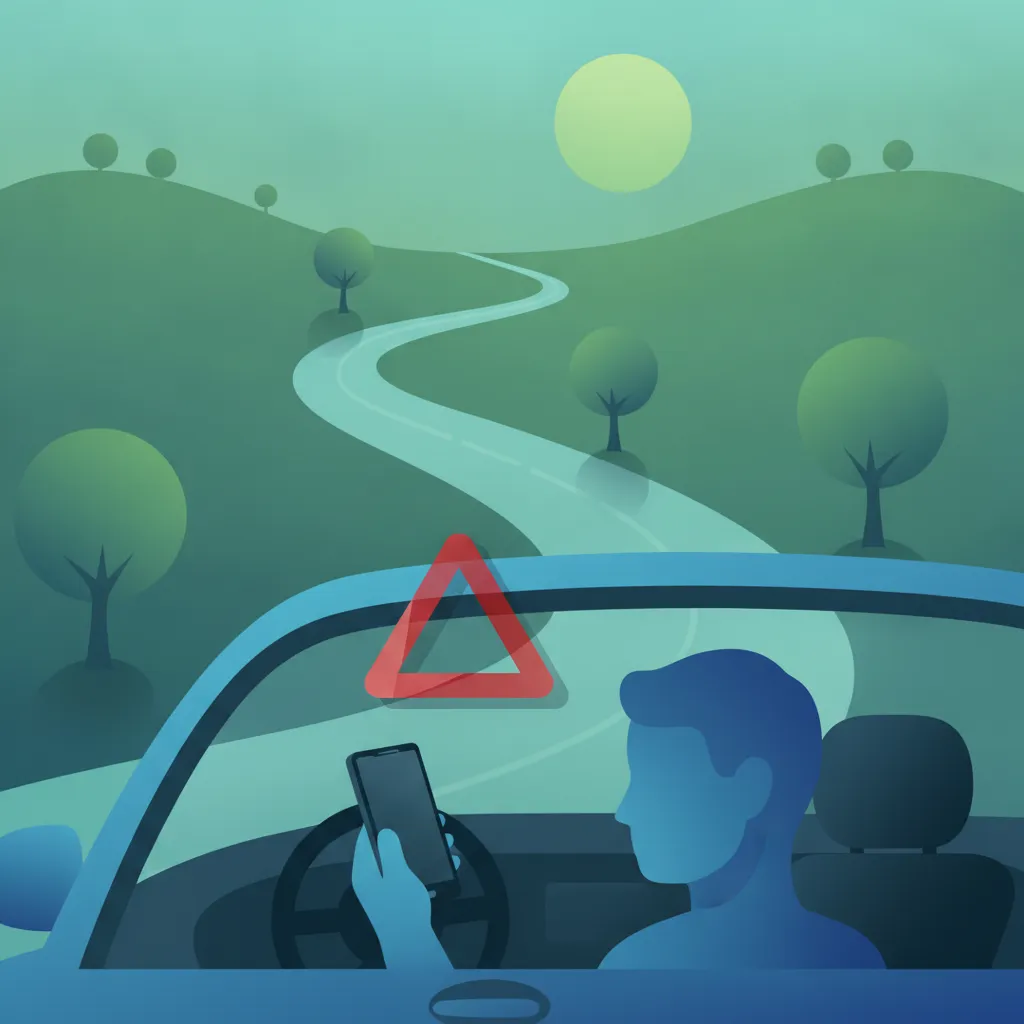
Driving demands your full and continuous attention. Using a mobile phone, whether for calls, texting, or navigation, introduces severe distractions that compromise your safety and the safety of others. In Italy, official data estimates that improper smartphone use is a factor in a high percentage of road accidents caused by driver distraction.
Theory topic content overview
Read the full theory topic guide for Phone Use & Driving Safety with structured, easy-to-scan content built for learners in Italy. This detailed section explains the exact rule, meaning, traffic context, comparison points, and exam logic behind this Italian driving theory topic so you can study faster, understand the concept more clearly, and avoid common interpretation mistakes on the theory test.
Using a mobile phone while driving is one of the most dangerous and prevalent forms of driver distraction on Italian roads. It directly compromises your ability to maintain full control of your vehicle, perceive hazards, and react in time, leading to a significantly increased risk of accidents. The Italian Codice della Strada (Traffic Code) strictly regulates mobile phone use to combat this severe safety threat.
Driving in Italy, with its diverse road network ranging from busy urban areas and historic centres to high-speed autostrade and winding mountain passes, demands continuous and undivided attention. Mobile phone use shatters this concentration, turning an otherwise skilled driver into a significant risk.
Official data from the Polizia di Stato highlights the gravity of this issue, estimating that improper smartphone use is a factor in up to 80% of road accidents caused by driver distraction in Italy. This shocking statistic underscores why understanding and avoiding mobile phone use while driving is not just a legal requirement but a fundamental aspect of road safety and a key topic in the Italian driving theory exam.
Mobile phones distract drivers in three primary ways, often simultaneously:
Visual Distraction: This occurs when your eyes are taken off the road to look at your phone. Whether you're reading a message, checking a notification, viewing a map, or even just glancing at the screen, your eyes are not on the critical task of driving. The Polizia di Stato warns that looking at your phone for just 15 seconds while driving at 100 km/h is equivalent to driving for 417 meters completely blind. This "invisible journey" can easily lead to missing sudden obstacles, traffic changes, or vulnerable road users.
Manual Distraction: This happens when you remove one or both hands from the steering wheel to operate your phone. Holding the device, typing, swiping, or dialling all reduce your ability to steer effectively, make emergency manoeuvres, or control other vehicle functions like indicators or the gear stick. Even a brief moment of manual interaction compromises your physical control over the vehicle.
Cognitive Distraction: This is when your mind is preoccupied with a phone conversation or message, even if your hands are on the wheel and your eyes are on the road. Your brain's capacity to process information about the road environment, anticipate hazards, and make quick decisions is severely impaired because your mental focus is elsewhere. You might be physically present but mentally absent from the driving task.
These three types of distraction rarely occur in isolation. Sending a text, for example, combines visual, manual, and cognitive distraction into one dangerous act, compounding the risk exponentially.
Driver distraction, particularly from mobile phone use, directly and significantly impacts your reaction time. Reaction time is the interval between perceiving a hazard and initiating an action (like braking or steering). Distraction lengthens this crucial interval, meaning your vehicle travels further before you even begin to respond.
This combined effect drastically increases your stopping distance and the likelihood of a collision. In an emergency situation, every fraction of a second and every meter counts.
The Codice della Strada is clear: it is strictly forbidden to use a mobile phone, smartphone, or any other electronic device while holding it in your hand (tenuto in mano) when driving.
However, the law does permit phone use under specific conditions:
It's vital for drivers in Italy to understand that while hands-free or earpiece use is legal, it does not eliminate cognitive distraction. Engaging in an intense conversation, even hands-free, can still divert your mental attention away from the road, potentially slowing your reaction time and reducing hazard perception. The Italian theory exam frequently tests this distinction.
Consider these everyday situations on Italian roads:
These scenarios illustrate how even a few seconds of distraction can have severe, life-altering consequences for you, your passengers, and other road users.
Learners often underestimate the risks or misunderstand the rules:
To ensure your safety and pass your Italian driving theory exam, remember this core principle: Driving requires 100% of your attention, 100% of the time.
By eliminating mobile phone distraction, you drastically reduce your accident risk, improve your reaction time, and contribute to safer roads for everyone in Italy.
Mobile phone use while driving in Italy creates three dangerous types of distraction—visual, manual, and cognitive—that compound to drastically increase reaction times and accident risk. The Codice della Strada strictly prohibits holding a phone while driving, permitting only hands-free systems or single earpieces, though even these do not eliminate cognitive distraction. Polizia di Stato data shows improper smartphone use contributes to up to 80% of distraction-related accidents, with brief glances translating to hundreds of meters of blind travel. Learners must understand that hands-free use remains legally permitted but cognitively risky, and that phone use at traffic stops is still prohibited. Italian theory exam questions frequently test the distinction between legal hands-free methods and the residual danger of cognitive distraction.
A short set of high-value points that capture the most important ideas from this theory explanation.
Mobile phone use creates three simultaneous distractions: visual (eyes off road), manual (hands off wheel), and cognitive (mind off driving), each compounding crash risk
At 100 km/h, a 15-second glance at your phone means driving 417 meters completely blind, as confirmed by Polizia di Stato data
Italian law strictly prohibits holding a mobile phone while driving; only hands-free (vivavoce) or single earpiece (auricolare) use is permitted
Hands-free and earpiece calls are legal but do NOT eliminate cognitive distraction, which still impairs reaction time and hazard perception
Improper smartphone use is estimated as a factor in up to 80% of road accidents caused by driver distraction in Italy
Only ONE ear may be covered when using an auricolare to maintain awareness of external sounds and traffic
Using a mobile phone while stationary at traffic lights or in traffic is still illegal in Italy under the Codice della Strada
Cognitive distraction persists even with hands-free devices; intense phone conversations reduce mental capacity to process road hazards
Adjusting navigation apps manually while driving is a manual and visual distraction that is forbidden and highly dangerous
If you must use your phone, pull over to a safe, legal stopping place and completely stop the vehicle first
Believing a brief glance at the phone is harmless; even a few seconds at speed creates significant blind travel distance
Assuming hands-free or earpiece use makes phone calls completely safe; cognitive distraction remains and is tested on the exam
Manually operating navigation apps while driving instead of setting the route before starting the journey
Thinking it is acceptable to use a phone while stopped at a red light; Italian law considers this still dangerous and illegal
Underestimating cognitive distraction by assuming that if hands and eyes are on the road, the mind is too
Start with a short, direct summary of Phone Use & Driving Safety before reading the full explanation below.
Using a mobile phone while driving is highly dangerous because it causes visual, manual, and cognitive distractions, drastically increasing reaction times and accident risk. Even brief glances away from the road can mean traveling hundreds of meters blind, making it one of the leading causes of road accidents in Italy. Italian traffic law strictly limits phone use to hands-free or earpiece devices only.
Review the most important terms, rule signals, and traffic concepts linked to Phone Use & Driving Safety.
Explore related theory topic pages connected to Phone Use & Driving Safety and continue with the next useful rule explanation.
See the common search queries learners use when trying to understand Phone Use & Driving Safety in Italy.

Ready to deepen your knowledge? Explore specific Italian driving theory topics in detail, review challenging concepts, or test your understanding with practice questions. Build confidence for your official Italian driving licence exam by continuously learning and applying these essential road rules.
Explore Italian Driving TheoryTheory topic content overview
A short set of high-value points that capture the most important ideas from this theory explanation.
Mobile phone use creates three simultaneous distractions: visual (eyes off road), manual (hands off wheel), and cognitive (mind off driving), each compounding crash risk
At 100 km/h, a 15-second glance at your phone means driving 417 meters completely blind, as confirmed by Polizia di Stato data
Italian law strictly prohibits holding a mobile phone while driving; only hands-free (vivavoce) or single earpiece (auricolare) use is permitted
Hands-free and earpiece calls are legal but do NOT eliminate cognitive distraction, which still impairs reaction time and hazard perception
Improper smartphone use is estimated as a factor in up to 80% of road accidents caused by driver distraction in Italy
Only ONE ear may be covered when using an auricolare to maintain awareness of external sounds and traffic
Using a mobile phone while stationary at traffic lights or in traffic is still illegal in Italy under the Codice della Strada
Cognitive distraction persists even with hands-free devices; intense phone conversations reduce mental capacity to process road hazards
Adjusting navigation apps manually while driving is a manual and visual distraction that is forbidden and highly dangerous
If you must use your phone, pull over to a safe, legal stopping place and completely stop the vehicle first
Believing a brief glance at the phone is harmless; even a few seconds at speed creates significant blind travel distance
Assuming hands-free or earpiece use makes phone calls completely safe; cognitive distraction remains and is tested on the exam
Manually operating navigation apps while driving instead of setting the route before starting the journey
Thinking it is acceptable to use a phone while stopped at a red light; Italian law considers this still dangerous and illegal
Underestimating cognitive distraction by assuming that if hands and eyes are on the road, the mind is too
Start with a short, direct summary of Phone Use & Driving Safety before reading the full explanation below.
Using a mobile phone while driving is highly dangerous because it causes visual, manual, and cognitive distractions, drastically increasing reaction times and accident risk. Even brief glances away from the road can mean traveling hundreds of meters blind, making it one of the leading causes of road accidents in Italy. Italian traffic law strictly limits phone use to hands-free or earpiece devices only.
Review the most important terms, rule signals, and traffic concepts linked to Phone Use & Driving Safety.
Explore related theory topic pages connected to Phone Use & Driving Safety and continue with the next useful rule explanation.
See the common search queries learners use when trying to understand Phone Use & Driving Safety in Italy.
Ready to deepen your knowledge? Explore specific Italian driving theory topics in detail, review challenging concepts, or test your understanding with practice questions. Build confidence for your official Italian driving licence exam by continuously learning and applying these essential road rules.
Explore Italian Driving TheoryUse this exam-focused revision tip to understand how Phone Use & Driving Safety is likely to appear in theory questions for learners in Italy. This section helps you identify the most testable part of the rule, avoid common traps, and remember the concept more effectively during Italian driving theory exam preparation.
In the Italian theory exam, pay close attention to questions about how mobile phone use affects reaction time and hazard perception. Remember that 'hands-free' or 'auricolare' (earpiece) use is generally permitted, but any manual or visual interaction with the device while driving is forbidden and leads to severe consequences.
Read direct answers to the most common learner questions about Phone Use & Driving Safety in Italy. This FAQ focuses on rule confusion, practical meaning, comparison with similar concepts, and the exact uncertainties that appear most often in Italian driving theory revision and exam preparation.
It causes distraction across three critical areas: visual (eyes off the road), manual (hands off the wheel), and cognitive (mind off driving), severely impairing your ability to detect and react to hazards.
Visual distraction (looking at the screen), manual distraction (holding or operating the phone), and cognitive distraction (mentally engaged in a call or message content).
Studies show that using a smartphone significantly lengthens a driver's reaction time. For example, at 100 km/h, glancing at your phone for just 15 seconds means driving over 400 meters 'blind'.
The Italian Codice della Strada prohibits holding a mobile phone or any electronic device while driving. Use is permitted only with a hands-free system or an earpiece, provided it does not impair hearing or attention.
Yes, but it must be mounted securely and operated hands-free. Manually setting or interacting with the navigation system while driving is a form of distraction and is prohibited.
Violation of the mobile phone use rules in Italy results in fines and points deduction from your driving license. Repeated offenses can lead to license suspension.
Yes. Even experienced drivers are susceptible to distraction. Driving requires continuous, undivided attention, and even short moments of distraction can lead to severe accidents, regardless of perceived skill.
Start searching now to pinpoint exactly which Italian driving theory topics, road signs, or traffic rules you need to master. Use our advanced filters to build a custom practice session and ensure you're fully prepared for every aspect of your official driving licence exam.