
Delve into the essential D-series informational signs in Poland, specifically signs D-1 for priority roads and D-3 for one-way traffic. This guide will clarify their meanings and how they dictate right-of-way and traffic direction, preparing you thoroughly for the Polish driving theory test by ensuring you can confidently interpret these critical guidance signals.
Article content overview
Successfully navigating Polish roads requires a firm grasp of traffic rules and the myriad of road signs that guide us. Among the most fundamental are the informational signs, particularly those in the D-series, which provide crucial guidance on road types and traffic flow. Understanding these signs is not just about obeying the law; it's about ensuring your safety and the safety of others, and it's absolutely critical for passing your Polish driving theory exam. This article will demystify some of the most impactful D-series signs, focusing on how they dictate road priority and indicate one-way traffic, ensuring you can confidently interpret these vital signals on your driving journey.
Informational signs, designated by the letter 'D' followed by a number in Poland, are distinct from warning or prohibitory signs. Their primary role is to inform road users about the road itself, how to use it, and what services or features are available. They are designed to streamline traffic flow, guide drivers towards destinations, and inform them about specific road conditions or types. In Poland, these signs are standardized according to the "Regulation on Road Signs and Signals" (Rozporządzenie w sprawie znaków i sygnałów drogowych), ensuring consistency with European conventions. There are 68 types of informational signs in Poland, identified by codes D-1 through D-53, each carrying a specific meaning crucial for safe and legal driving.
The Polish driving theory exam frequently tests your knowledge of these signs, often presenting scenarios where understanding their implications is paramount to correctly answering questions about right-of-way or navigating complex intersections. For instance, knowing when you are on a priority road or when you are entering a one-way street can completely change how you approach a junction. These signs do not restrict your actions directly like a "no entry" sign would; instead, they provide context for your driving, telling you what to expect and how others are expected to behave around you. Mastering these signs is a cornerstone of becoming a competent and safe driver in Poland.
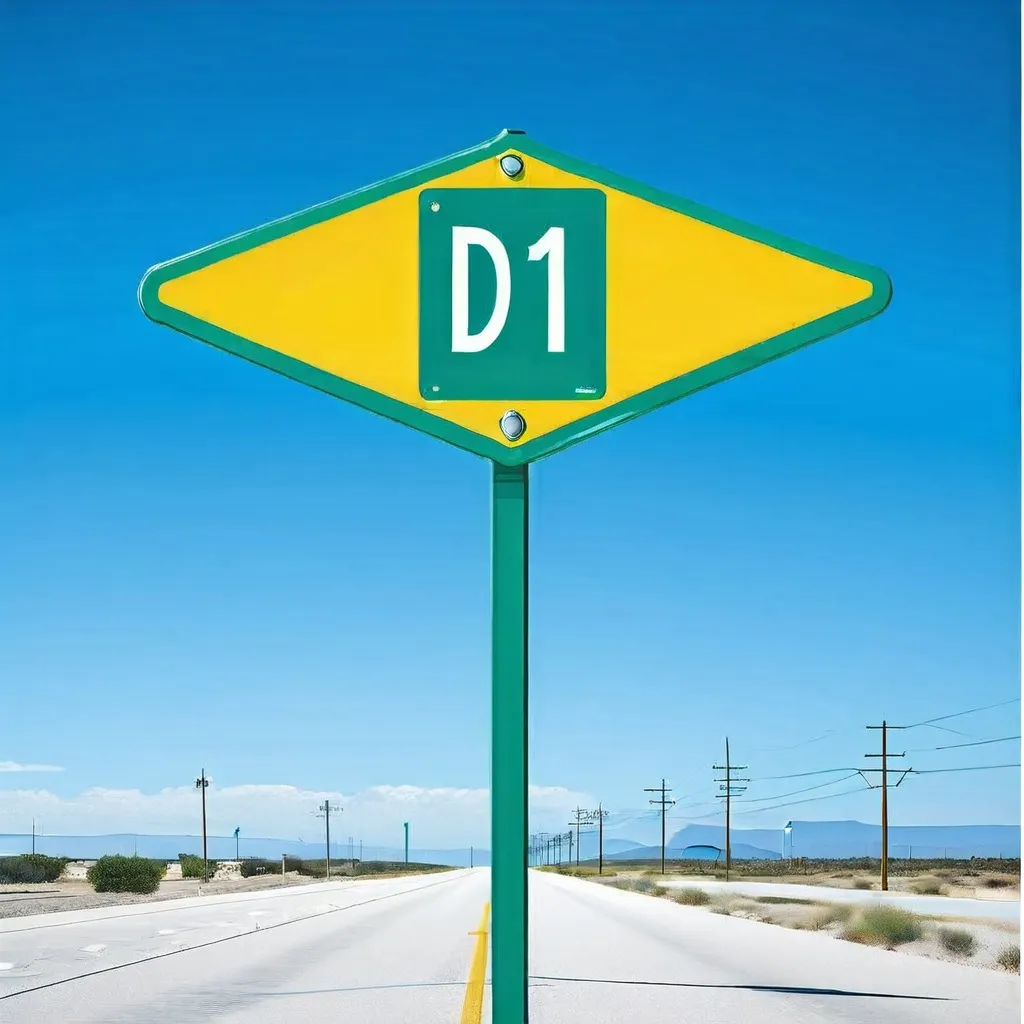
The concept of priority, or right-of-way, is one of the most frequently tested aspects of the Polish driving theory exam. Sign D-1, known as "Droga z pierwszeństwem" (Priority Road), is fundamental to understanding this. This yellow rhombus-shaped sign, often with a white border, clearly indicates that the road you are currently on has priority over intersecting roads. This means that you generally do not need to yield to vehicles on roads that join yours from the side, unless other signs or traffic signals indicate otherwise.
It is crucial to remember that the D-1 sign signifies priority for the entire length of the priority road, or at least until another sign explicitly cancels this status. This continuation is vital; even if you pass a side road without any vehicles present, you must remain aware that another vehicle could emerge, and your priority status remains until indicated otherwise. The presence of a D-1 sign fundamentally alters the dynamics of any upcoming intersections, establishing a clear hierarchy for who proceeds first. Failing to recognize this sign or misunderstanding its implications can lead to dangerous situations and exam failures, as priority rules are heavily scrutinized.
To complement the D-1 sign, the D-2 sign, "Koniec drogi z pierwszeństwem" (End of Priority Road), signals that your priority status on that particular road is about to cease. This sign is typically a white square with a thick black diagonal line from the bottom left to the top right, and it means that the road you are on will soon become a subordinate road. After encountering this sign, you will generally need to yield to traffic on intersecting roads, much like you would at an intersection controlled by yield signs.
The appearance of a D-2 sign signifies a shift in the traffic hierarchy. Drivers must be prepared to give way to vehicles on roads that now have priority. This transition point is often a source of confusion in theory exams, as it requires drivers to switch their mindset from having priority to yielding it. Understanding the sequence of D-1 and D-2 signs is therefore essential for correctly interpreting right-of-way at junctions and avoiding common errors that lead to penalty points or exam failure. Always be vigilant for the D-2 sign to know when your priority status has ended.
Another foundational element of traffic organization communicated by informational signs is the direction of traffic flow. The D-3 sign, "Droga jednokierunkowa" (One-Way Road), is instrumental in conveying this information. This sign, usually a blue square with a white arrow, indicates that all traffic on the road ahead moves in one direction only. This means you should not expect oncoming traffic from the opposite direction, with the primary exception being cyclists, who may sometimes be permitted to travel against the general flow if indicated by specific supplementary signs or markings.
When you see a D-3 sign, it fundamentally changes how you should position your vehicle on the road and anticipate other road users. For example, if you are turning left from a one-way street onto another road, you will need to position yourself on the left side of your current carriageway. Conversely, if you are turning right, you would naturally position yourself on the right side. The absence of oncoming traffic simplifies many intersection scenarios but also requires drivers to be mindful of vehicles that might be approaching from behind or attempting to enter the road from a side street. The theory exam often uses questions involving one-way streets to test your understanding of correct lane positioning and turning procedures.
Complementing the understanding of traffic flow, signs D-4a and D-4b, "Droga bez przejazdu" (No Exit Road), inform drivers that the road ahead leads to a dead end. While these signs do not prohibit entry, they clearly signal that the road will terminate and that drivers will need to turn around or backtrack. This information is critical for route planning and avoiding getting stuck in situations where a U-turn might be difficult or impossible.
These signs are particularly important for drivers unfamiliar with an area. They help prevent drivers from continuing down a road under the assumption that it will lead to their destination or connect to another main route, only to find themselves in a cul-de-sac. In the context of the driving theory exam, these signs test your ability to process directional information and make appropriate decisions about continuing travel or seeking an alternative route.
The Polish driving theory exam, administered by the WORD (Wojewódzkie Ośrodki Ruchu Drogowego), places significant emphasis on understanding road signs, including the D-series. Questions involving these signs often appear in multiple-choice formats, sometimes combined with other signs or road markings to create complex scenarios. For instance, you might be presented with an image of an intersection showing a D-1 sign on one approach and a yield sign on another, followed by a question about which vehicle has priority.
Exam questions also frequently test your understanding of the duration of effects from signs like D-1 and D-3. You might encounter a question that describes a sequence of roads and asks at which point priority is lost, or when a one-way street ends. Pay close attention to the supplementary plates (tabliczki) that can accompany D-series signs, as these can modify the sign's meaning, for example, by specifying exceptions or the exact layout of priority roads at complex junctions (as seen with supplementary plates T-6a and T-6b for the D-1 sign). The exam aims to ensure you can not only identify a sign but also correctly apply its meaning in real-world driving situations.
When encountering a D-1 sign, remember that your priority continues until you see a D-2 sign or a traffic light that dictates otherwise. Similarly, a D-3 sign means the entire road you are on is one-way until explicitly indicated otherwise. Always be aware of your surroundings and potential hazards, even when you have priority.
The informational signs of Poland's D-series, particularly those concerning road priority (D-1 and D-2) and traffic direction (D-3), are fundamental to safe and legal driving. They provide essential guidance that shapes how drivers interact with each other and navigate the road network. A thorough understanding of these signs, their meanings, and their implications is not only a requirement for passing the Polish driving theory exam but also a crucial skill for becoming a confident and responsible driver on Polish roads. By familiarizing yourself with these signs and practicing their application through mock exams, you will be well-equipped to handle various traffic situations and achieve your driving license.
This article explains Poland's D-series informational signs, focusing on D-1 (Priority Road), D-2 (End of Priority Road), and D-3 (One-Way Road)—signs that fundamentally shape how drivers interpret right-of-way and traffic flow. The D-1 sign grants priority over intersecting roads until cancelled by a D-2 sign or traffic control; the D-3 sign indicates all traffic moves in one direction, requiring adjusted lane positioning for turns. Understanding these signs and their duration effects is essential for both passing the WORD-administered Polish driving theory exam and navigating real intersections safely. Supplementary plates can modify sign meanings, so always read them alongside the main sign.
A short set of high-value points that capture the most important ideas from this article.
D-1 (Priority Road) grants right-of-way over intersecting roads for its entire length until a D-2 sign appears or traffic lights indicate otherwise
The D-2 (End of Priority Road) sign is critical—it signals you must now yield to traffic on intersecting roads
D-3 (One-Way Road) changes lane positioning: turn left from the left lane, turn right from the right lane
Informational D-series signs differ from warning or prohibitory signs—D signs guide and inform rather than restrict
The absence of a D-1 sign means your road has no inherent priority; default right-of-way rules apply at intersections
A D-1 sign establishes priority for the full length of the road, not just at one intersection
Cyclists may sometimes travel against the general flow on one-way streets when permitted by supplementary signs
Supplementary plates (tabliczki) can modify D-series sign meanings and must be read alongside the main sign
D-4a and D-4b No Exit signs do not prohibit entry—they simply indicate the road has no through route
A D-2 sign changes the traffic hierarchy: you must now give way where you previously had priority
Assuming priority ends after passing one intersection—D-1 priority continues until an explicit D-2 or traffic signal cancels it
Forgetting that one-way streets still require awareness of vehicles approaching from behind or side streets
Overlooking supplementary plates beneath D-series signs, which can significantly alter their meaning
Confusing informational signs (D-series) with prohibitory or warning signs based on visual similarity
Failing to adjust lane position on a one-way street before turning, leading to incorrect positioning violations
Article content overview
A short set of high-value points that capture the most important ideas from this article.
D-1 (Priority Road) grants right-of-way over intersecting roads for its entire length until a D-2 sign appears or traffic lights indicate otherwise
The D-2 (End of Priority Road) sign is critical—it signals you must now yield to traffic on intersecting roads
D-3 (One-Way Road) changes lane positioning: turn left from the left lane, turn right from the right lane
Informational D-series signs differ from warning or prohibitory signs—D signs guide and inform rather than restrict
The absence of a D-1 sign means your road has no inherent priority; default right-of-way rules apply at intersections
A D-1 sign establishes priority for the full length of the road, not just at one intersection
Cyclists may sometimes travel against the general flow on one-way streets when permitted by supplementary signs
Supplementary plates (tabliczki) can modify D-series sign meanings and must be read alongside the main sign
D-4a and D-4b No Exit signs do not prohibit entry—they simply indicate the road has no through route
A D-2 sign changes the traffic hierarchy: you must now give way where you previously had priority
Assuming priority ends after passing one intersection—D-1 priority continues until an explicit D-2 or traffic signal cancels it
Forgetting that one-way streets still require awareness of vehicles approaching from behind or side streets
Overlooking supplementary plates beneath D-series signs, which can significantly alter their meaning
Confusing informational signs (D-series) with prohibitory or warning signs based on visual similarity
Failing to adjust lane position on a one-way street before turning, leading to incorrect positioning violations
Explore related topics, search based questions, and concepts that learners often look up when studying Poland Priority & One-Way Signs. These themes reflect real search intent and help you understand how this topic connects to wider driving theory knowledge in Poland.
Find clear and practical answers to common questions learners often have about Poland Priority & One-Way Signs. This section helps explain difficult points, remove confusion, and reinforce the key driving theory concepts that matter for learners in Poland.
D-series signs in Poland primarily inform drivers about road types, traffic organization, and how to use the road. They provide guidance rather than imposing restrictions.
The D-1 sign, which has a distinctive rhombus shape with a yellow background, indicates that you are on a priority road. You have the right-of-way until this status is cancelled by a D-2 'end of priority road' sign.
The D-3 'droga jednokierunkowa' sign indicates the beginning or continuation of a one-way road or carriageway. Drivers should expect traffic to flow only in one direction.
Yes, understanding signs like D-1 and D-3 is crucial for the Polish driving theory exam as they directly relate to right-of-way rules and traffic direction, key components tested.
The D-1 sign establishes your right-of-way on a particular road. Warning signs, like A-7 'Ustąp pierwszeństwa' (Yield), typically indicate that you must yield to traffic on another road, often at an intersection, and do not confer priority.
After finding your specific article, continue your targeted learning by exploring related topics or diving deeper into practice questions. Our extensive library ensures you have all the resources needed to confidently prepare for your Polish driving license theory exam. Discover more guides and solidify your understanding of Polish road rules.