
While a green traffic signal indicates permission to proceed, it does not override all other priority rules in Poland. This article details scenarios, particularly when turning, where you must yield to pedestrians, even when the light is green for you. Mastering these critical exceptions is vital for your Polish driving theory exam and safe road conduct.
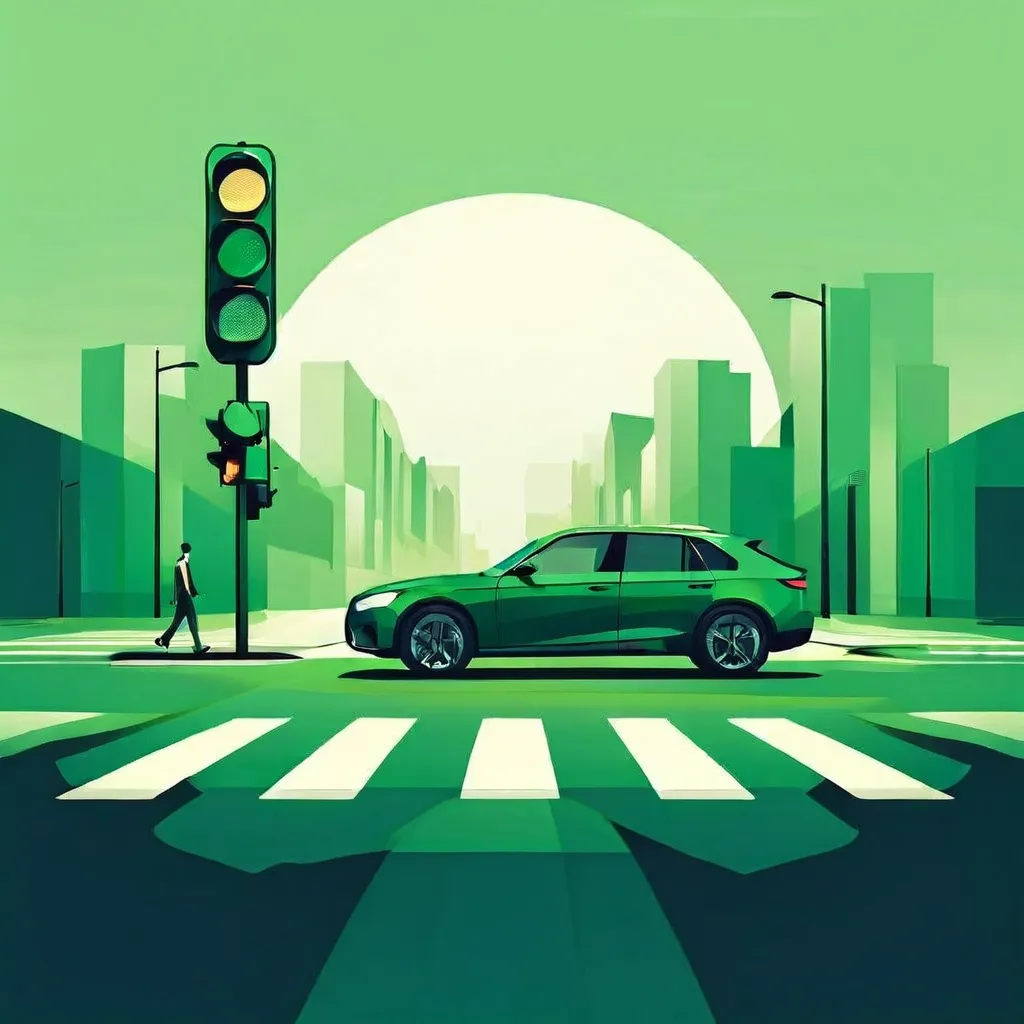
Article content overview
A green traffic light in Poland signifies permission to proceed, but this fundamental rule has crucial exceptions that learners must understand to navigate complex intersections safely and successfully pass their driving theory exams. It is a common misconception among new drivers that a green light grants absolute and unconditional priority. However, Polish traffic law, as outlined in the Prawo o ruchu drogowym, introduces nuances, particularly concerning interactions with vulnerable road users like pedestrians and cyclists, and the flow of traffic within intersections. Understanding these specific scenarios where a green light does not supersede other priority rules is paramount for avoiding penalties and ensuring road safety. This article delves into these critical exceptions, providing clarity on how to interpret traffic signals correctly in Poland.
One of the most significant exceptions to the general rule of a green light granting priority involves the interaction between turning vehicles and pedestrians. When a driver intends to turn at an intersection, whether to the right or left, and the traffic signal is green for their direction of travel, they are still obligated to yield to pedestrians who are crossing the road. This rule applies even if those pedestrians are also using a pedestrian crossing and have a green signal to cross. The fundamental principle is that a green light indicates that a driver may proceed past the traffic signal, but it does not grant permission to endanger or obstruct other road users, especially pedestrians.
When turning at an intersection, a driver must always yield to pedestrians crossing the roadway, regardless of the traffic light status for the vehicle. This paramount rule is enforced strictly to protect vulnerable road users.
This means that even with a green light, a driver must actively look for pedestrians and be prepared to stop to allow them to complete their crossing. Failing to yield to pedestrians at a designated crossing, especially in such a scenario, can result in severe penalties. These penalties are not just minor infringements; they are designed to deter dangerous behaviour that puts lives at risk. The Polish Road Traffic Act is explicit on this matter, emphasizing the duty of care drivers owe to those on foot.
A common exam trap involves scenarios where a vehicle has a green light but is turning. Learners often incorrectly assume they have priority over pedestrians who are also crossing with a green signal. Always remember that pedestrian priority is absolute at crossings, even when a vehicle's light is green.
The consequences of failing to yield to pedestrians can be substantial. In Poland, the penalty for not yielding to pedestrians at a designated crossing can be a fine of up to 1500 Polish złoty (PLN) and 15 penalty points. If the failure to yield creates a direct threat to the safety of the pedestrian, the fines can be higher, and the driver might face a suspension of their driving license. This underscores the critical importance of vigilant observation and adherence to the absolute priority afforded to pedestrians.
Beyond pedestrian interactions, another crucial aspect of green light policy in Poland relates to maintaining the flow of traffic within intersections. A green light allows a driver to enter an intersection, but it does not grant the right to block it. Drivers are prohibited from entering an intersection if they anticipate that their vehicle will be unable to clear it before the signal changes to red. This rule is in place to prevent gridlock, where traffic becomes completely stationary within the intersection, obstructing vehicles moving in perpendicular directions and potentially causing widespread disruption.
Gridlock occurs when a vehicle enters an intersection and becomes stuck due to congestion, preventing other vehicles from passing through. Polish law explicitly prohibits entering an intersection if it is foreseeable that one will not be able to clear it before the signal changes to red.
This means that even if the light is green, drivers must assess the traffic situation ahead before proceeding into the intersection. If the queue of vehicles on the other side of the intersection is not moving, or if there is significant congestion, it is safer and legally required to wait behind the stop line until there is clear space for your vehicle to pass through the entire intersection. The rationale behind this regulation is to ensure that intersections remain functional and that traffic can move smoothly in all directions according to the signal phasing.
The temptation to push through a green light, even when faced with visible congestion, can be strong. However, drivers must resist this impulse. The consequences of causing gridlock can include fines and penalty points, similar to other traffic violations. More importantly, it disrupts traffic for everyone else and can lead to dangerous situations if emergency vehicles need to pass. Therefore, a green light should always be interpreted as an opportunity to proceed if it is safe and clear to do so, not as an unconditional command to enter the intersection regardless of the circumstances.
While the primary exceptions to green light priority involve pedestrians and gridlock, it's worth noting that traffic signals are part of a larger system of traffic control. In some specific instances, other traffic control devices or signals might temporarily override a general green light. For example, if traffic is being directed by a police officer, their signals take precedence over traffic lights. Similarly, certain advanced traffic management systems or temporary signal installations might operate under specific rules not immediately apparent from standard signals.
Always be observant of your surroundings. While the green light is your primary indicator, pay attention to other drivers' behaviour, the presence of traffic wardens or police officers, and any unusual signal patterns that might indicate a temporary change in traffic management.
The general understanding of a green light in Poland is that it permits movement, but this permission is always qualified by the overarching principles of safety and the rights of other road users. The Prawo o ruchu drogowym is designed to create a predictable and safe traffic environment, and these nuanced rules surrounding traffic signals are a testament to that objective. Mastering these exceptions is not only crucial for passing the Polish driving theory exam but is fundamental to becoming a responsible and safe driver in Poland.
This article clarifies that a green traffic light in Poland does not guarantee absolute priority. Drivers turning at intersections must yield to pedestrians crossing the road, regardless of signal status, and this absolute pedestrian priority is a frequent exam trap. Additionally, drivers may not enter an intersection on green if they cannot clear it before red, as this causes gridlock. Violations carry substantial penalties including fines up to 1500 PLN and 15 penalty points. Understanding these exceptions is essential for both passing the Polish driving theory exam and safe driving practice.
A short set of high-value points that capture the most important ideas from this article.
A green traffic light in Poland gives permission to proceed but does not override other priority rules, especially concerning pedestrians
When turning at any intersection with a green light, drivers must always yield to pedestrians crossing the road
Entering an intersection is prohibited if traffic congestion ahead means you cannot clear it before the light turns red
Traffic controller signals (police officers) and certain temporary devices can override a green light
Penalties for not yielding to pedestrians at crossings can reach up to 1500 PLN and 15 penalty points
Pedestrian priority at crossings is absolute and overrides a driver's green light when turning
Polish law (Prawo o ruchu drogowym) explicitly prohibits blocking intersections by entering when you cannot clear them
The stop line is your boundary—assess whether you can fully cross before proceeding on green
Vulnerable road users (pedestrians, cyclists) retain priority even when your signal is green
Green light means proceed only if safe and clear—never as an unconditional command
Assuming a green light grants unconditional priority over pedestrians who are also crossing with a green signal
Entering an intersection during heavy congestion because the light is green, causing gridlock
Failing to check for pedestrians before turning, especially at multi-lane crossings
Confusing the permission to pass the stop line with the permission to complete a maneuver regardless of conditions
Overlooking that police officer signals take precedence over all traffic lights
Article content overview
A short set of high-value points that capture the most important ideas from this article.
A green traffic light in Poland gives permission to proceed but does not override other priority rules, especially concerning pedestrians
When turning at any intersection with a green light, drivers must always yield to pedestrians crossing the road
Entering an intersection is prohibited if traffic congestion ahead means you cannot clear it before the light turns red
Traffic controller signals (police officers) and certain temporary devices can override a green light
Penalties for not yielding to pedestrians at crossings can reach up to 1500 PLN and 15 penalty points
Pedestrian priority at crossings is absolute and overrides a driver's green light when turning
Polish law (Prawo o ruchu drogowym) explicitly prohibits blocking intersections by entering when you cannot clear them
The stop line is your boundary—assess whether you can fully cross before proceeding on green
Vulnerable road users (pedestrians, cyclists) retain priority even when your signal is green
Green light means proceed only if safe and clear—never as an unconditional command
Assuming a green light grants unconditional priority over pedestrians who are also crossing with a green signal
Entering an intersection during heavy congestion because the light is green, causing gridlock
Failing to check for pedestrians before turning, especially at multi-lane crossings
Confusing the permission to pass the stop line with the permission to complete a maneuver regardless of conditions
Overlooking that police officer signals take precedence over all traffic lights
Explore related topics, search based questions, and concepts that learners often look up when studying Green Light Priority Nuances in PL. These themes reflect real search intent and help you understand how this topic connects to wider driving theory knowledge in Poland.
Find clear and practical answers to common questions learners often have about Green Light Priority Nuances in PL. This section helps explain difficult points, remove confusion, and reinforce the key driving theory concepts that matter for learners in Poland.
No, a green light in Poland signifies permission to proceed, but it does not grant absolute priority. You must still yield to pedestrians and other road users who have priority according to specific rules, such as those at pedestrian crossings or when turning.
Yes, if you are turning left or right at an intersection in Poland and pedestrians are crossing the road perpendicular to your direction of travel, you must yield to them, even if you have a green light.
Failing to yield to a pedestrian at a designated crossing in Poland can result in a fine of 1500 PLN and 15 penalty points. This can increase if the action creates a direct threat to safety.
No, even with a green light, you must not enter an intersection if traffic conditions ahead mean you might become stuck and block other traffic. This rule helps prevent gridlock and ensures smoother traffic flow.
Yes, while traffic lights regulate vehicle flow, the fundamental priority given to pedestrians at crossings remains in effect. Drivers must always be prepared to yield to pedestrians, particularly when turning, regardless of the traffic signal.
After finding your specific article, continue your targeted learning by exploring related topics or diving deeper into practice questions. Our extensive library ensures you have all the resources needed to confidently prepare for your Polish driving license theory exam. Discover more guides and solidify your understanding of Polish road rules.