
Navigating Portugal's mountainous regions requires a solid understanding of specific traffic regulations and vehicle control techniques. This article explains the mandatory priority rules for steep inclines, the importance of engine braking to prevent brake failure, and the correct approach to navigating sharp hairpin bends. By mastering these concepts, you will be prepared for technical questions on your IMT theory exam and gain confidence for real-world driving.
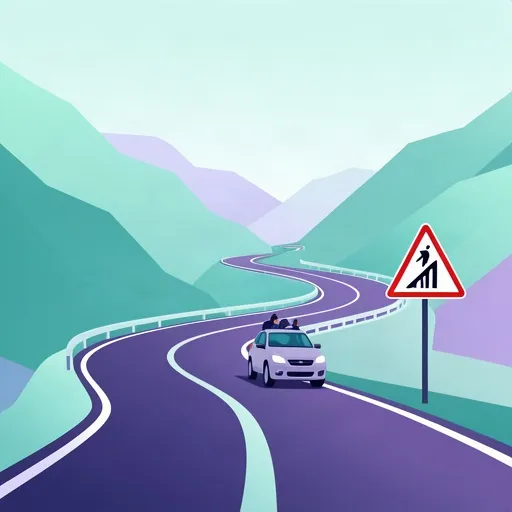
Article content overview
Driving through Portugal’s diverse landscapes—from the winding roads of the Serra da Estrela to the challenging terrain of Madeira—requires more than just standard vehicle control. The Portuguese Código da Estrada sets out specific mandates for steep gradients and narrow mountain paths that every student must master to pass the IMT theory exam. Understanding how to manage your vehicle's mechanics and interpret local right-of-way customs is essential for both your test success and your safety on rural, mountainous roads.
A frequent topic in the Portuguese theory exam concerns the interaction between vehicles on steep, narrow roads. When two vehicles meet on a slope where passing is difficult or impossible, the Código da Estrada establishes a clear hierarchy to ensure traffic flows safely and to prevent hazardous reversing maneuvers.
Generally, the vehicle traveling downhill should yield to the vehicle traveling uphill. This rule exists because it is mechanically much more difficult to restart a vehicle on an incline than it is to hold a position on a descent. If you are traveling downhill and encounter an oncoming vehicle struggling up a steep grade, you are legally required to slow down or stop at a safe point to allow the ascending vehicle to pass.
On extremely narrow roads where one vehicle must reverse to allow the other to pass, the vehicle closest to a designated passing place, or the lighter vehicle if both are far from one, is typically expected to yield. However, the fundamental rule of uphill priority remains the guiding principle for examiner-assessed scenarios.
One of the most critical aspects of mountain driving is the intelligent use of your gearbox. Many learners fail to realize that the brake pedal is not the primary tool for speed management on long, steep descents. Relying solely on your brakes can lead to "brake fade," a dangerous condition where the brake fluid overheats and the system loses its effectiveness, potentially resulting in a total loss of stopping power.
Instead, you must utilize engine braking by selecting a lower gear—such as second or even first gear—before beginning a descent. By using the resistance of the engine to control your speed, you keep the vehicle moving at a safe, constant pace without overheating your braking system. On uphill stretches, similarly, selecting a lower gear ensures your engine remains within its power band, preventing the engine from "lugging" or stalling under the load of the gradient.
Hairpin bends (or "cotovelos") are common in Portugal’s mountainous regions and present unique challenges regarding visibility and lane positioning. When approaching a sharp turn, you must reduce your speed well in advance, as the curvature often obscures what lies ahead. Always maintain your position within your lane and avoid "cutting" the corner, as this practice is both illegal and dangerous, particularly if an oncoming vehicle is occupying the opposite lane.
Approaching the turn slowly allows you more time to react to hazards, such as fallen rocks, cyclists, or other vehicles moving unexpectedly. In many mountain areas, you will encounter signs warning of hazardous turns; it is imperative to heed these warnings and adjust your driving style accordingly to avoid skidding or loss of control on road surfaces that may be affected by gravel or changing weather conditions.
The IMT theory exam often uses situational images to test your knowledge of these rules. You may be presented with a question showing a vehicle on a narrow, steep hill and asked to identify which driver has the right of way. Remember to apply the logic of the Código da Estrada rather than just your driving intuition. Practice consistent observation of all road signs, as they provide the necessary context for the rules you must apply at that specific moment.
This article covers essential Portuguese mountain road rules for the IMT theory exam, focusing on the uphill priority rule, engine braking techniques to prevent brake fade, and safe navigation of hairpin bends. The Código da Estrada clearly establishes that uphill vehicles have right of way on steep, narrow roads, and learners must demonstrate knowledge of proper gear selection and speed management. Key technical concepts include engine braking, brake fade, and the correct use of passing places on extremely narrow sections. The content includes a step-by-step procedure for steep descents and a glossary of important terms, making it suitable for structured study support.
A short set of high-value points that capture the most important ideas from this article.
Uphill vehicles always have priority over downhill vehicles on narrow mountain roads, as restarting on a slope is mechanically harder than holding a descent position.
Engine braking in a lower gear (first or second) is the primary method for controlling speed on steep descents, not the brake pedal.
Brake fade occurs when brakes overheat from excessive use, potentially causing total loss of stopping power on long downhill stretches.
Never cut the corner on hairpin bends; stay within your lane to avoid collisions with oncoming traffic you cannot see.
Reduce speed well before entering sharp curves on mountain roads, as the curvature limits visibility of hazards ahead.
The Código da Estrada establishes uphill priority as the fundamental rule for two vehicles meeting on a steep, narrow incline.
On extremely narrow roads where reversing is required, the vehicle closest to a passing place (lugar de cruzamento) must yield.
Use low gears before starting a descent, not during it, to engage engine braking effectively.
Warning signs like A5a (dangerous descent) signal the need for engine braking and reduced speed.
Cutting corners on hairpin bends is both illegal and dangerous, especially when oncoming vehicles are hidden by the curve.
Relying solely on the brake pedal to control speed on long descents, leading to brake fade and loss of braking effectiveness.
Confusing which vehicle has priority; some learners assume the downhill vehicle should proceed because it is moving faster.
Attempting to use higher gears on steep inclines, causing engine lugging and potential stalling.
Failing to downshift early enough before a descent, reducing the effectiveness of engine braking.
Cutting corners on hairpin bends to shorten the turn, risking collision with vehicles in the opposite lane.
Article content overview
A short set of high-value points that capture the most important ideas from this article.
Uphill vehicles always have priority over downhill vehicles on narrow mountain roads, as restarting on a slope is mechanically harder than holding a descent position.
Engine braking in a lower gear (first or second) is the primary method for controlling speed on steep descents, not the brake pedal.
Brake fade occurs when brakes overheat from excessive use, potentially causing total loss of stopping power on long downhill stretches.
Never cut the corner on hairpin bends; stay within your lane to avoid collisions with oncoming traffic you cannot see.
Reduce speed well before entering sharp curves on mountain roads, as the curvature limits visibility of hazards ahead.
The Código da Estrada establishes uphill priority as the fundamental rule for two vehicles meeting on a steep, narrow incline.
On extremely narrow roads where reversing is required, the vehicle closest to a passing place (lugar de cruzamento) must yield.
Use low gears before starting a descent, not during it, to engage engine braking effectively.
Warning signs like A5a (dangerous descent) signal the need for engine braking and reduced speed.
Cutting corners on hairpin bends is both illegal and dangerous, especially when oncoming vehicles are hidden by the curve.
Relying solely on the brake pedal to control speed on long descents, leading to brake fade and loss of braking effectiveness.
Confusing which vehicle has priority; some learners assume the downhill vehicle should proceed because it is moving faster.
Attempting to use higher gears on steep inclines, causing engine lugging and potential stalling.
Failing to downshift early enough before a descent, reducing the effectiveness of engine braking.
Cutting corners on hairpin bends to shorten the turn, risking collision with vehicles in the opposite lane.
Explore related topics, search based questions, and concepts that learners often look up when studying Mountain Road Safety Rules. These themes reflect real search intent and help you understand how this topic connects to wider driving theory knowledge in Portugal.
Find clear and practical answers to common questions learners often have about Mountain Road Safety Rules. This section helps explain difficult points, remove confusion, and reinforce the key driving theory concepts that matter for learners in Portugal.
In accordance with standard road etiquette and safe driving practices, vehicles traveling uphill generally have priority over those traveling downhill because it is significantly more difficult to restart a vehicle on a steep incline.
Using a lower gear allows the engine to assist in slowing the vehicle, which prevents the constant use of brakes. This avoids brake fade, a dangerous condition where brake fluid overheats and the system loses its ability to stop the vehicle effectively.
Drivers should approach slowly and position their vehicle towards the outside of the turn to increase visibility. This provides a clearer view of the road ahead and prevents the vehicle from crossing into the path of oncoming traffic.
If you haven't found what you're looking for, use our powerful article search to explore related topics, refine your understanding of Portuguese road rules, or discover new insights for your IMT driving exam preparation. Continue building your knowledge effectively.