
Speeding is a leading cause of severe road accidents in Portugal, and understanding how enforcement works is vital for both your practical driving safety and your theoretical exam success. This guide clarifies the distinction between fixed SINCRO installations, which are generally signposted, and mobile police units that can be deployed at any time. You will learn why relying on third-party location apps is discouraged and why sticking to posted speed limits is the only reliable way to prevent severe penalties and licence disqualification.
Article content overview
Understanding speed enforcement in Portugal is a critical requirement for every learner driver. Whether you are navigating the historic streets of a town or cruising along a major motorway, adhering to speed limits is not just a legal obligation under the Código da Estrada—it is a fundamental pillar of road safety. Excessive speed significantly reduces a driver’s reaction time when faced with unforeseen obstacles and amplifies the severity of any potential collision, making it the most frequent traffic infraction across Europe.
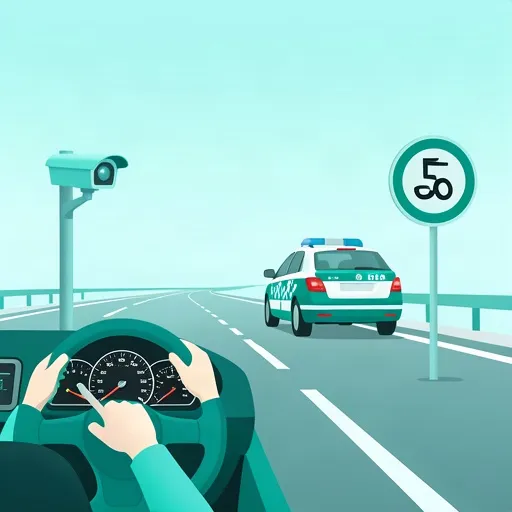
The Sistema Nacional de Controlo de Velocidade (SINCRO) is the backbone of Portugal’s fixed speed enforcement network. Managed by the Autoridade Nacional de Segurança Rodoviária (ANSR), these systems consist of fixed radar units installed at locations identified as high-risk for accidents.
It is a common misconception that signs only appear exactly where a camera is located. In reality, the signs you see on Portuguese roads are general warnings that you are entering a zone where speed is monitored. Drivers should never rely on the presence or absence of a sign to decide whether or not to follow the speed limit. The responsibility remains with the driver to observe the posted limits for the specific road type and conditions at all times.
Beyond the fixed SINCRO network, the Guarda Nacional Republicana (GNR) and the Polícia de Segurança Pública (PSP) frequently deploy mobile radar units. These units are highly versatile and can be set up at any location, including tunnels, areas near schools, or sections of the road currently undergoing construction.
Mobile speed enforcement units operated by the GNR and PSP do not require advance warning signage. Police may monitor traffic flow at any time and in any location to ensure compliance with speed limits, regardless of whether a sign has alerted you to the control.
In the context of your theory exam, remember that the law applies universally. Expecting to find "safe zones" for speeding based on the absence of visible cameras is a dangerous error. Mobile units are frequently used in areas where excessive speed has historically led to severe accidents, and their deployment is designed to be unpredictable to encourage consistent compliance.
While point-in-time radars measure your speed as you pass a specific spot, some motorway sections in Portugal employ average-speed detection systems. These systems calculate the time taken to travel between two points. If your average speed exceeds the limit for that segment of the road, a violation is recorded.
This method effectively prevents "braking only for the camera." Even if you slow down when you see a sign, the system registers your average performance, ensuring that drivers maintain a safe and legal pace throughout the entire journey. On your theory exam, you may be asked how these systems function to maintain traffic flow; always prioritize the understanding that consistent, steady adherence to the limit is the only way to avoid these penalties.
Speeding offences in Portugal are classified based on the severity of the violation, which is calculated by how much you have exceeded the speed limit and the type of road involved. The Código da Estrada categorizes these infractions as minor, serious, or very serious.
| Offence Category | Impact on Licence |
|---|---|
| Minor | Fine only |
| Serious | Fine, possible point loss, potential driving inhibition |
| Very Serious | Heavy fines, mandatory point loss, long-term driving inhibition |
A legal sanction that prevents a driver from operating a motor vehicle for a specified period, typically imposed for serious or very serious speed infractions.
Portugal operates three main speed enforcement systems: the SINCRO fixed camera network, mobile GNR/PSP radar units, and average-speed detection on motorways. Fixed camera warning signs indicate monitored zones rather than exact camera locations, and mobile units may appear anywhere without warning. Average-speed cameras calculate your average pace between two points, so slowing only near enforcement points offers no protection. Speed violations are categorized as minor, serious, or very serious, with penalties ranging from fines to driving inhibition and licence disqualification. Always obey posted limits regardless of whether you can see enforcement equipment.
A short set of high-value points that capture the most important ideas from this article.
SINCRO is the national fixed speed camera network managed by ANSR, installed at high-risk accident locations
Mobile radar units operated by GNR and PSP can be deployed anywhere without advance warning signs
Average-speed cameras measure your pace between two points, making selective braking ineffective
Speed offences are classified as minor, serious, or very serious with escalating penalties including fines, points, and driving bans
Drivers must observe posted speed limits at all times regardless of visible camera presence or absence
Speed camera warning signs indicate you are entering a monitored zone, not the exact location of a camera
Mobile enforcement frequently occurs in tunnels, near schools, and in construction zones
Average-speed detection calculates travel time over a distance, rewarding consistent legal speeds
Serious and very serious offences can result in inibição de conduzir (driving inhibition)
Third-party radar-tracking apps are unreliable and should not be used as your speed compliance guide
Assuming speed signs mark exact camera positions rather than general monitored zones
Believing that slowing down only near visible cameras is sufficient to avoid penalties
Relying on mobile applications to identify safe zones where enforcement is absent
Expecting enforcement only on obvious high-speed roads like motorways
Failing to adjust speed for changing conditions such as rain, fog, or construction work
Article content overview
A short set of high-value points that capture the most important ideas from this article.
SINCRO is the national fixed speed camera network managed by ANSR, installed at high-risk accident locations
Mobile radar units operated by GNR and PSP can be deployed anywhere without advance warning signs
Average-speed cameras measure your pace between two points, making selective braking ineffective
Speed offences are classified as minor, serious, or very serious with escalating penalties including fines, points, and driving bans
Drivers must observe posted speed limits at all times regardless of visible camera presence or absence
Speed camera warning signs indicate you are entering a monitored zone, not the exact location of a camera
Mobile enforcement frequently occurs in tunnels, near schools, and in construction zones
Average-speed detection calculates travel time over a distance, rewarding consistent legal speeds
Serious and very serious offences can result in inibição de conduzir (driving inhibition)
Third-party radar-tracking apps are unreliable and should not be used as your speed compliance guide
Assuming speed signs mark exact camera positions rather than general monitored zones
Believing that slowing down only near visible cameras is sufficient to avoid penalties
Relying on mobile applications to identify safe zones where enforcement is absent
Expecting enforcement only on obvious high-speed roads like motorways
Failing to adjust speed for changing conditions such as rain, fog, or construction work
Explore related topics, search based questions, and concepts that learners often look up when studying Portugal Speed Enforcement Guide. These themes reflect real search intent and help you understand how this topic connects to wider driving theory knowledge in Portugal.
Find clear and practical answers to common questions learners often have about Portugal Speed Enforcement Guide. This section helps explain difficult points, remove confusion, and reinforce the key driving theory concepts that matter for learners in Portugal.
No. While fixed cameras under the SINCRO system are typically preceded by general warning signage, mobile speed control units operated by the GNR or PSP can be deployed anywhere without specific prior notice or warning signs.
SINCRO (Sistema Nacional de Controlo de Velocidade) is the national network of fixed speed cameras in Portugal, strategically placed at high-risk locations to manage traffic speed and improve road safety.
Average-speed enforcement calculates your speed by measuring the time it takes to travel between two points. This prevents drivers from simply slowing down only when they approach a specific camera installation.
No. Relying on apps is not a substitute for adhering to posted speed limits. Mobile radars are frequently moved, and relying on such tools can lead to dangerous driving habits and severe penalties under the Código da Estrada.
If you haven't found what you're looking for, use our powerful article search to explore related topics, refine your understanding of Portuguese road rules, or discover new insights for your IMT driving exam preparation. Continue building your knowledge effectively.