
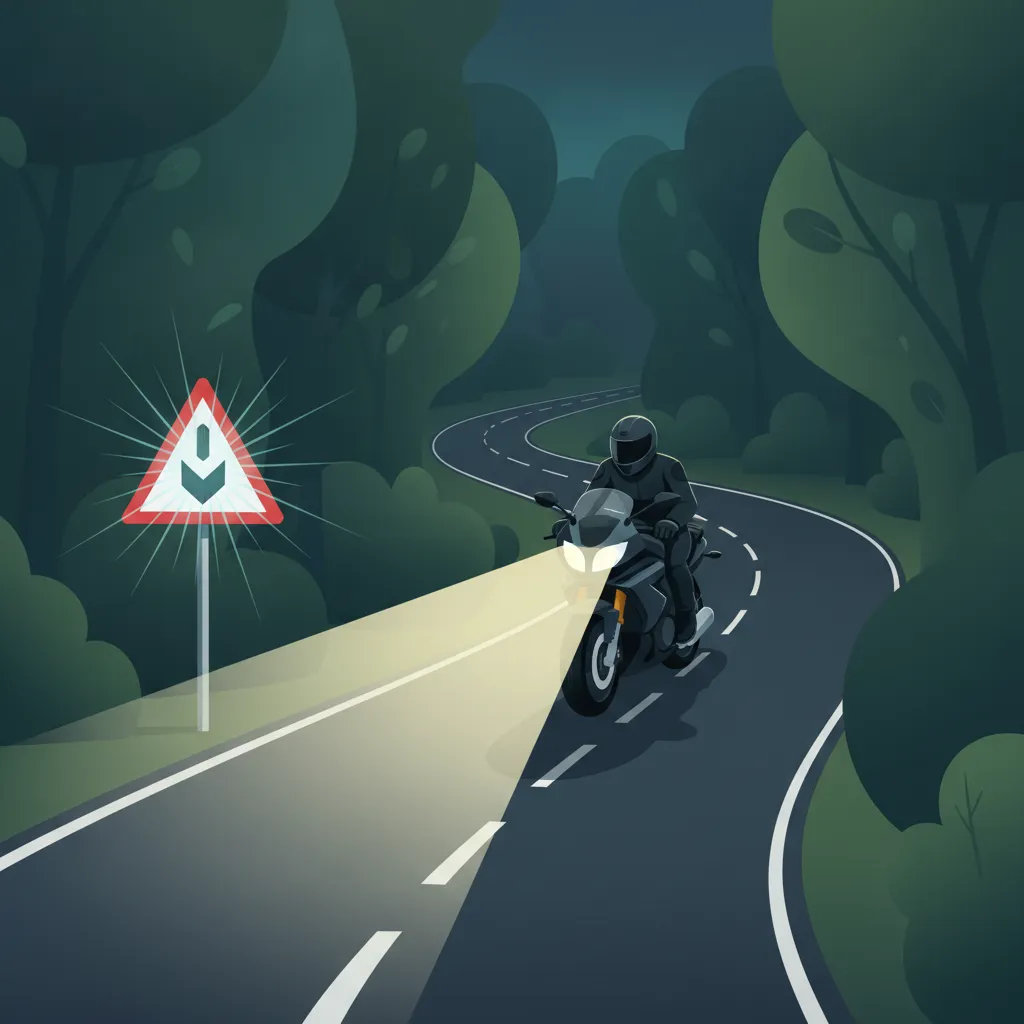
This lesson focuses on the essential skills for riding a motorcycle safely after dark on Irish roads. You will learn to manage your headlight settings and adjust your riding behavior to suit the reduced visibility conditions typical of night travel.
Lesson content overview
Operating a motorcycle at night significantly increases the complexity and risk of riding. In Ireland, where rural roads are often narrow, winding, unlit, and prone to sudden dampness, night riding demands a highly proactive and tactical approach.
This lesson provides comprehensive strategies for navigating dark or poorly illuminated environments under the Irish Motorcycle Theory Course for Category A, A1, and A2. It focuses on optimizing headlight usage, adjusting speed to visibility limits, managing glare, and utilizing road markings to ride safely and confidently after dusk.
When darkness falls, a rider’s visual environment changes dramatically. Human eyes require time to adjust to low-light conditions, a process known as dark adaptation. Even when adapted, your peripheral vision is severely degraded, depth perception is compromised, and the ability to distinguish colors is almost entirely lost.
A motorcyclist relies on a relatively narrow cone of artificial light projected by the vehicle's headlamp. This means you must make critical safety decisions based on a fraction of the visual information available during the day. Visual fatigue can set in rapidly as your brain works harder to interpret shadows, reflections, and unexpected silhouettes.
Motorcycle lighting systems are designed with two primary forward-facing settings. Understanding the precise engineering and purpose of these settings is vital for safe operation on Irish roads.
The dipped beam is designed to project light downward and slightly to the left (nearside) of the road. On Irish roads, where we drive on the left, this asymmetrical pattern ensures the nearside verge is illuminated while preventing the light beam from striking the eyes of oncoming drivers.
The high beam, or main beam, projects a intense, symmetrical, and far-reaching shaft of light straight ahead. It is engineered to maximize forward visibility on unlit roads.
Under Irish road traffic regulations, motorcyclists must adhere to strict rules regarding headlight management. Failing to use your lights correctly is not only a major safety hazard but also a serious road traffic offence.
Mandatory Day running: In Ireland, it is highly recommended and standard safety practice to ride with your dipped headlight on at all times, including during broad daylight, to increase your conspicuity to other road users. From dusk until dawn, headlight usage is strictly mandatory.
You must switch from high beam to dipped beam when an oncoming vehicle approaches within 200 metres. This rule applies to all motorized vehicles, as well as cyclists and pedestrians. Dazzling a pedestrian or cyclist can cause them to veer into your path.
When riding behind another vehicle, you must switch to dipped beams when you are within 150 metres of their rear bumper. If you maintain your high beams, the intense light will reflect off their rearview and side mirrors, severely blinding the driver ahead.
One of the most common and fatal mistakes riders make at night is "outriding" their headlights. This occurs when your stopping distance at a given speed is greater than the distance illuminated by your headlights.
The dangerous scenario where a rider travels at a speed where their total stopping distance (thinking distance plus braking distance) exceeds the range of the road illuminated clearly by their headlamps.
If your dipped beam illuminates the road for 30 metres ahead, you must be able to come to a complete, controlled stop within that 30-metre window. If you are riding at 80 km/h, your total stopping distance on a dry road is approximately 53 metres. If an obstacle, such as a fallen branch or a wandering animal, appears at the edge of your 30-metre beam, you will collide with it before your brakes can bring you to a halt.
As a safe rule of thumb, your speed in kilometres per hour should align conservatively with the range of your headlights. On unlit, winding regional roads under dipped beams:
Oncoming headlights can cause sudden, intense glare, leading to temporary blindness. Because a motorcycle requires precise balance and steering inputs, even a brief moment of visual impairment can cause you to drift out of your lane.
On unlit Irish national and regional roads, reflective markers and road studs (commonly known as "cat’s eyes") are invaluable navigation aids. They outline the geometry of the road far beyond the reach of your headlights.
By learning the color-coding system of cat's eyes used in Ireland, you can anticipate bends, junctions, and lane boundaries long before they are fully visible:
Using these markers to pre-plan your cornering lines allows you to position your motorcycle correctly well in advance of a bend.
A motorcycle's compact size means its single headlight is your primary lifeline. Any reduction in its performance can have catastrophic consequences.
Carrying a pillion passenger or heavy luggage compresses the motorcycle's rear suspension. This tilts the front of the bike upward, raising the angle of your headlight beam.
Refer to your motorcycle owner's manual to find the headlight adjustment screw or lever.
Adjust the suspension pre-load on the rear shock absorber to compensate for the extra weight.
Manually lower the headlight beam angle to prevent dazzling oncoming traffic and restore proper road illumination.
A scratched visor acts as a prism at night. When oncoming headlights strike scratches or smudges, they create a "starburst" effect of scattered light, which can completely block your view of the road.
Never use a tinted, smoke-coloured, or iridium visor at night; Irish law requires a clear visor or clear protective eyewear after dark. Carry a microfiber cloth and a small spray bottle of visor cleaner to clear away bugs and road grime during your journey.
At night, weather hazards are magnified. Wet roads reflect headlight beams like a mirror, creating double the glare from oncoming traffic and obscuring painted white road markings.
Pedestrians wearing dark clothing are extremely difficult to spot at night, especially on unlit rural roads without footpaths. Cyclists may have poor rear lighting. Always remain alert, ride defensively, and immediately dip your headlights if you spot a pedestrian or cyclist ahead to avoid disorienting them with your main beam.
Explore all units and lessons included in this driving theory course.
Lesson content overview
Explore all units and lessons included in this driving theory course.
Explore search topics learners often look for when studying Night Riding Strategies and Light Usage. These topics reflect common questions about road rules, driving situations, safety guidance, and lesson level theory preparation for learners in Ireland.
Browse additional driving theory lessons that cover connected traffic rules, road signs, and common driving situations related to this topic. Improve your understanding of how different rules interact across everyday traffic scenarios.
Learn how to anticipate hazards on Irish roads and plan safe routes. This theory lesson explains core defensive riding principles, helping you identify risk behaviours in other road users and manage your safety in various traffic conditions effectively.

This lesson teaches how to cultivate a proactive defensive riding mindset, focusing on situational awareness and constant hazard scanning. It describes the system of motorcycle control, encouraging riders to anticipate potential mistakes from other drivers, pedestrians, and cyclists. Motorcyclists will learn to position themselves defensively, leaving clear escape routes in all driving environments.
This lesson covers the strategic aspects of journey management, emphasizing the safety benefits of proactive route planning and weather checks. It teaches riders how to select safer roads, avoid high-congestion zones during rush hour, and schedule regular rest intervals. Motorcyclists will learn to pack essential tools, emergency contacts, and spare safety gear to remain prepared for any roadside situation.
This lesson focuses on riding techniques suited for gravel, loose surfaces, and rural roads. Learners will understand how to maintain stability, adjust braking and cornering approaches, and anticipate hazards such as potholes and farm vehicles, following RSA guidance for safe riding in the Irish countryside.

This lesson outlines how motorcyclists should respond when permanent road signs are dirty, damaged, or hidden by overgrown trees and hedges. It introduces the temporary signage, warning cones, and detour markers commonly deployed at active roadwork zones in Ireland. Riders will learn to read the road ahead defensively, reducing speed when visual information is incomplete or compromised.

This lesson identifies prevalent risky behaviours among motorcyclists, including speeding, tailgating, and reckless riding under the influence of alcohol or drugs. Learners will understand the associated penalties, legal implications, and the impact of fatigue and peer pressure on decision-making, following RSA and Irish legal frameworks.

Safeguarding vulnerable road users requires more than simple obedience to traffic signs; it demands a defensive driving mindset. This lesson summarizes safe practices, including scanning far ahead in urban areas, keeping massive safety margins in wet weather, and executing thorough blind spot checks before reversing. By anticipating the unpredictable movements of others, you can prevent accidents and support a safe road culture.

This lesson analyzes the crucial role of rider attitude, mental focus, and psychological factors in preventing motorcycle collisions on Irish roads. It addresses how overconfidence, fatigue, and peer pressure can negatively impact a rider's decision-making process and elevate risk levels. Motorcyclists will explore strategies to maintain a defensive mindset, exercise patience, and practice active situational awareness under all traffic conditions.

This lesson teaches riders how to create and preserve a protective safety envelope around their motorcycle under various traffic densities. It explains the two-second rule for dry conditions and how to expand this buffer zone in adverse weather or heavy traffic. Motorcyclists will learn to manage tailgaters by gradually increasing their following distance from the vehicle ahead to prevent sudden braking.

This lesson focuses on the critical techniques required to ride safely during severe rain or heavy fog in Ireland. It teaches riders how to handle aquaplaning risks, use headlights correctly, and significantly increase their following distances. Adapting speed to visibility ensures that riders can brake safely when road conditions deteriorate.

This lesson explains how to modify riding techniques when navigating wet tarmac, focusing on the heightened risk of hydroplaning and reduced tire grip. It details the necessity of increasing following distances, avoiding painted road markings, and executing smoother control inputs. Riders will understand how surface water accumulates in ruts, presenting severe hazards during heavy rainstorms.
Understand the impact of Irish weather and diverse road surfaces on motorcycle control. This guide covers riding in wet conditions, navigating gravel or loose surfaces, and adjusting your handling for wind and poor visibility to ensure stability on the road.
This lesson explains how to modify riding techniques when navigating wet tarmac, focusing on the heightened risk of hydroplaning and reduced tire grip. It details the necessity of increasing following distances, avoiding painted road markings, and executing smoother control inputs. Riders will understand how surface water accumulates in ruts, presenting severe hazards during heavy rainstorms.
This lesson teaches riders how to manage extreme weather conditions such as high crosswinds, thick fog, and low sun glare. It details how wind forces can push a motorcycle off course and how to use minor body adjustments and lane placement to maintain stability. Riders will learn how to manage visibility limits in dense fog, utilizing specialized riding gear and reducing speeds safely.
This lesson focuses on riding techniques suited for gravel, loose surfaces, and rural roads. Learners will understand how to maintain stability, adjust braking and cornering approaches, and anticipate hazards such as potholes and farm vehicles, following RSA guidance for safe riding in the Irish countryside.
This lesson focuses on the critical techniques required to ride safely during severe rain or heavy fog in Ireland. It teaches riders how to handle aquaplaning risks, use headlights correctly, and significantly increase their following distances. Adapting speed to visibility ensures that riders can brake safely when road conditions deteriorate.

This lesson explores common surface hazards encountered on municipal and rural Irish roads, including loose gravel and wet leaves. It explains how these surface conditions rapidly reduce tyre traction and affect overall handling and braking control. Riders will learn visual scanning techniques to identify these hazards early and execute safe evasion maneuvers.

This lesson analyzes how tyre contact patches generate grip and how different road surfaces affect stability. It explains the dangers of diesel spills, loose gravel, fallen leaves, and cold tyres, which drastically reduce traction limits. Motorcyclists will learn to identify these surface hazards early and modify their throttle, braking, and lean inputs to prevent loss of control.

This lesson highlights the importance of smooth throttle adjustments for maintaining traction and stability on a moped. It teaches riders how to anticipate potential road hazards early, reducing the need for sudden emergency braking. Developing strong observation habits allows riders to adjust their speed smoothly and respond safely to traffic changes.

This lesson explains the physics of cornering, focusing on lean angles, speed selection, and body positioning on a moped. It teaches riders how to assess road curves, adjust their speed prior to entering a turn, and handle slippery cambers. Mastering these cornering principles is essential for avoiding lose-of-control accidents on winding rural Irish roads.

This lesson covers the causes of front and rear-wheel skids and teaches the correct physical responses to regain control and stability. It describes how to recover from lockups caused by excessive braking or sudden downshifts on low-traction surfaces. Motorcyclists will learn how to react calmly during sudden deceleration events, maintaining straight-line stability under extreme pressure.
Find clear answers to common questions learners have about Night Riding Strategies and Light Usage. Learn how the lesson is structured, which driving theory objectives it supports, and how it fits into the overall learning path of units and curriculum progression in Ireland. These explanations help you understand key concepts, lesson flow, and exam focused study goals.
You must switch to dipped headlights when following another vehicle closely to avoid blinding the driver, or when approaching oncoming traffic. This ensures you do not impair the vision of other road users, which is a common scenario in theory exam questions.
At night, your ability to see hazards is limited by the distance your headlights illuminate. If you ride too fast, you may be unable to stop within the distance you can see to be clear, making it impossible to react to obstacles or changes in road conditions.
Beyond legal headlight usage, ensure your motorcycle's tail lights and indicators are clean and functioning. Wearing reflective or high-visibility clothing significantly increases your silhouette and helps other drivers spot you earlier, a key safety concept for the theory exam.
Yes, look for reflective cat's eyes and road studs which define lane edges and hazards. These are specifically designed to provide essential visual cues when overhead lighting is absent, helping you maintain a safe lane position.
Use the practice question search tool to pinpoint specific topics, road signs, or rules you need to master for your official Driver Theory Test. Refine your study strategy and ensure comprehensive preparation for all aspects of the Irish driving exam. Start your focused revision now and build confidence for your learner permit test.