
This lesson provides essential training on professional route management, interpretation of bus timetables, and the strategic use of service points. It is a critical part of the Category D Passenger Vehicle curriculum, helping you master the logistics required for safe and punctual public transport operation in Ireland.

Lesson content overview
Developing robust route-planning skills is vital for ensuring passenger services remain highly punctual, fuel-efficient, and structurally safe. Driving a Category D or D1 passenger vehicle in Ireland requires much more than simply following a GPS. Professional drivers must interpret complex timetables, schedule legal rest breaks, identify appropriate service points, and conduct proactive risk assessments on challenging road layouts—ranging from tight city streets to narrow rural lanes.
This lesson provides an in-depth exploration of the core systems, legal frameworks, and practical strategies required to plan and execute journeys safely and efficiently.
For professional coach and bus drivers, route planning represents the intersection of safety, regulatory compliance, and operational efficiency. Unlike light commercial vehicles or private cars, Category D passenger vehicles have unique physical and operational constraints that make spontaneous route changes risky and potentially dangerous.
The systematic integration of timetable requirements, mandatory driver rest intervals, vehicle physical limitations, and road conditions to determine the safest and most efficient path of travel.
A professionally planned route optimizes several competing objectives:
Timetables are the backbone of scheduled passenger transport. They manage passenger expectations and dictate the operational tempo of the service. Understanding the different types of timetables is critical for maintaining professional service standards.
Fixed timetables are rigid, pre-determined schedules that require the vehicle to pass through designated points at specific, unyielding times. These are common in public city bus networks and scheduled intercity coach services.
Variable timetables adjust dynamically based on operational demand, traffic patterns, seasonal factors, or specific private charter requirements.
A service point is a pre-planned, designated location where the driver can address vehicle needs, manage personal fatigue, or ensure passenger welfare. On long-distance journeys, service points must be mapped out before the wheels turn.
Not all service stations can accommodate a full-sized 12-metre to 15-metre coach or a double-decker bus.
These are designated parking areas, motorway service stations, or depots where a coach can be safely parked without obstructing traffic or blocking visibility.
For long-distance touring, drivers must identify authorized workshops or company depots along the route where technical faults (e.g., brake system warnings, pneumatic door failures, or tyre damage) can be addressed immediately by qualified personnel.
Fatigue is one of the leading causes of heavy vehicle collisions. Under EU social regulations (enforced in Ireland by the Road Safety Authority and An Garda Síochána), Category D drivers are subject to strict, legally mandated driving time and rest break rules.
The Golden Rule of Driver Hours: You must not drive for more than 4.5 hours without taking an uninterrupted break of at least 45 minutes, unless you take a split break.
If you choose not to take the 45-minute break in one block, you can split it into two distinct parts:
Initial Vehicle Check: Conduct a 15-minute walkaround check before starting the tachograph.
First Driving Period: Drive for 2.5 hours from your origin terminal.
First Split Break: Stop at a designated motorway service area for a continuous, qualifying 15-minute rest.
Second Driving Period: Drive for an additional 2 hours (reaching your 4.5-hour maximum limit).
Second Split Break: Take a continuous 30-minute rest break. Your driving timer now resets.
All professional Category D operations utilize digital or smart tachographs to record driving time, rest, and other work. Failing to record rest accurately, or exceeding driving limit boundaries, carries severe penal fines, penalty points, and can lead to the suspension of your CPC (Driver Certificate of Professional Competence).
A Route Risk Assessment (RRA) is a proactive evaluation of the hazards, physical limits, and traffic bottlenecks present along a chosen path. Large passenger vehicles are highly vulnerable to geometric and structural constraints.
Ireland's regional (R) and local (L) roads are frequently bordered by stone walls, thick hedges, and deep ditches.
City routes introduce tight turning radiuses, pedestrian crossings, active travel lanes (cyclists), and delivery vehicles double-parking.
Even the most meticulously planned route can be disrupted by road collisions, emergency utility works, or severe weather events. Professional drivers must be equipped to manage both pre-emptive and reactive detours.
                  [ Obstacle on Primary Route ]
                               |
            ---------------------------------------
           |                                       |
  [ Pre-emptive Detour ]                  [ Reactive Detour ]
  - Identified during pre-trip planning   - Formulated mid-journey
  - Based on known construction           - Immediate response to incident
  - Safe, verified clearance              - Safely pull over to assess
  - Passengers updated before departure   - Communicate with dispatch/passengers
These are planned alternatives established before the journey begins, typically in response to scheduled road closures, major events, or predicted adverse weather.
These are sudden, unplanned diversions required due to immediate incidents, such as a major crash blocking the M50 or an active flooding event.
If a detour is required, keep passengers informed. Clear, calm, and professional communication reduces passenger anxiety and maintains order on board.
Understanding where other drivers fail can help you avoid making the same critical errors. The table below outlines common operational violations in passenger route planning and how to mitigate them.
| Violation / Error | Consequence | Professional Mitigation Strategy |
|---|---|---|
| Skipping Mandatory Rest Breaks | Severe driver fatigue, increased crash risk, heavy regulatory fines, and operator licence suspension. | Treat rest areas as non-negotiable milestones. Program tachograph alerts and stop before the 4.5-hour driving mark. |
| Departing a Bus Stop Early | Leaves passengers stranded, damages service reliability, and violates public service contract terms. | Always check the official timetable and your vehicle's integrated clock before closing doors. If ahead of schedule, wait safely in the bay. |
| Using Inadequate Service Points | Becoming stuck in a tight forecourt, striking low canopies, or causing major traffic blocks. | Use pre-trip planning tools to verify that service stations feature high clearances and dedicated coach parking. |
| Failing to Conduct a Route Risk Assessment | Encountering low-clearance bridges or weight-restricted rural roads mid-journey, forcing hazardous reversing maneuvers. | Pre-screen routes for height and weight restrictions. Never drive on a route of unknown clearance with a double-decker bus. |
| Failing to Communicate Detours | Passenger panic, frustration, and an increase in distracting queries directed at the driver while in motion. | Make a clear PA announcement before executing the detour, explaining the reason and safety factors involved. |
| Driving Through Narrow Rural Lanes Unsafely | Side-swiping mirrors, hitting low-hanging branches, or colliding with oncoming agricultural vehicles. | Drop your speed to match the visibility limit, keep left, use your mirrors, and be prepared to stop completely to let oncoming traffic pass. |
Understanding the consequences of your decisions as a professional driver reinforces the need for rigorous route planning:
Safe, professional passenger transport relies heavily on disciplined route planning. Adhering to timetables must never compromise safety or legal rest mandates. By conducting thorough risk assessments, mapping appropriate service points, understanding EU driver hours, and preparing for unexpected detours, you ensure a safe, efficient, and stress-free journey for both yourself and your passengers.
Explore all units and lessons included in this driving theory course.
Lesson content overview
Explore all units and lessons included in this driving theory course.
Explore search topics learners often look for when studying Route Planning, Timetables and Service Points. These topics reflect common questions about road rules, driving situations, safety guidance, and lesson level theory preparation for learners in Ireland.
Browse additional driving theory lessons that cover connected traffic rules, road signs, and common driving situations related to this topic. Improve your understanding of how different rules interact across everyday traffic scenarios.
Understand the legal framework for driver rest intervals, the 4.5-hour rule, and mandatory tachograph record-keeping for Category D passenger vehicles. This lesson provides essential theory on ensuring compliance with EU social regulations while operating bus and coach services on Irish road networks.

This lesson examines the physiology of sleep deprivation and the absolute safety risks associated with commercial driver fatigue. It outlines the specific European Union and Irish tachograph regulations governing daily driving limits, mandatory break times, and weekly rest periods. Drivers will learn to properly record work and rest logs, spot warning signs of cognitive tiredness, and apply healthy sleep hygiene.

The regulatory framework in Ireland imposes strict standards of operation, dimension limits, and speed boundaries on heavy passenger fleets. This lesson reviews vehicle registration tax context, commercial operator licensing laws, and mandatory annual vehicle roadworthiness testing. By understanding these statutory regulations, drivers avoid severe legal infractions and maintain their professional driving credentials.
Speed management requires adjusting vehicle velocity to suit current weather, passenger load, and the specific limits of Irish roads. This lesson details speed restrictions for buses and minibuses on motorways, national routes, and built-up areas throughout Ireland. It highlights the driver obligation to prioritize passenger safety over schedule delays by maintaining appropriate speeds.

Violating passenger transport laws can lead to severe operator penalties, heavy fines, and the immediate suspension of driving privileges. This lesson examines common operational infractions, including tachograph violations, overloading offences, and driving with defective tires. Drivers will understand their personal legal liabilities under Irish legislation, supporting long-term safety compliance.

Operating long-distance intercity services requires meticulous journey planning to satisfy passenger comfort and comply with driver rest regulations. This lesson covers schedule coordination, planning convenient rest stop locations, and managing driver alertness over extended periods. Drivers will learn to perform intermediate safety checks on passenger comfort systems during journey breaks.
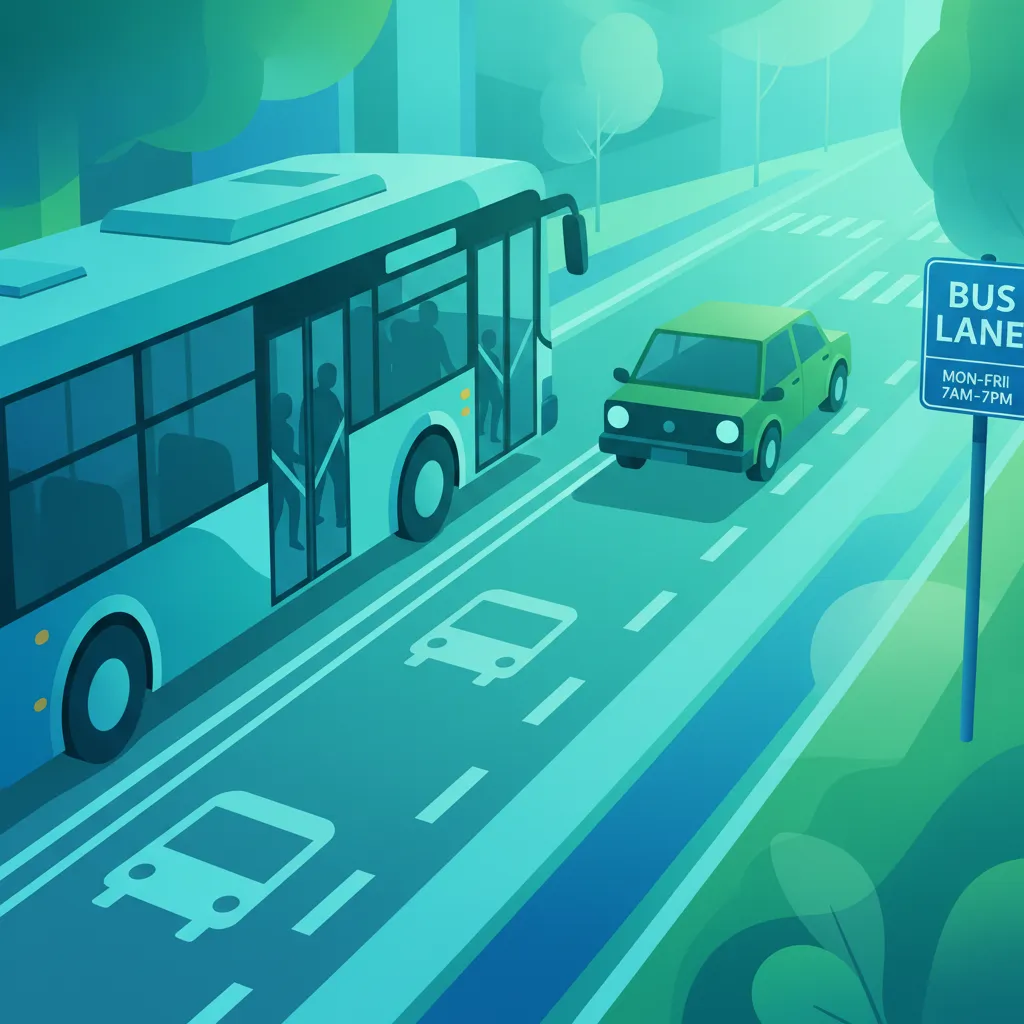
This lesson details the legal operations allowed within Irish bus lanes, including active hours, non-permitted traffic types, and exceptions. Drivers will learn safe approach trajectories for public transport stops, maintaining legal clearance, and navigating curbside hazards safely. The material highlights compliance with local bylaws to guarantee steady, uninterrupted traffic flow and passenger convenience.

This lesson explores the essential differences between D1, D, D1E, and DE licence categories under Irish road traffic legislation. It covers the medical fitness standards, age requirements, and national driver licensing service procedures necessary to qualify for passenger vehicle operation. By detailing these regulatory expectations, drivers gain a thorough understanding of their legal limitations and licensing pathways.

Motorway transport requires consistent forward planning, strict speed restriction compliance, and clear mirror checks before exiting lanes. This lesson details the rules of joining and leaving motorways, navigating toll plazas safely, and managing breakdowns on the hard shoulder. Drivers will learn to balance high-speed travel with passenger stability, ensuring a comfortable, secure ride.
Operating commercial passenger vehicles requires strict adherence to Irish road laws to prevent heavy fines, penalty points, or disqualification. This lesson outlines the primary motoring offences, the mechanics of the Irish penalty points system, and active enforcement by An Garda Síochána. Drivers will learn the serious operational and professional consequences of non-compliance, encouraging long-term safe driving habits.
Operating large passenger vehicles requires instant, accurate interpretation of general and specialized Irish road signage to prevent regulatory violations. This lesson covers the precise meanings of clearway signs, bus corridor indicators, low bridge warnings, and weight restriction zones. Drivers will examine how school zone beacons and specific roundabout indicators apply to large vehicle dimensions.
Learn the systematic approach to identifying hazards such as low bridges, weight-restricted structures, and narrow rural roads before starting a journey. This lesson outlines how to conduct thorough pre-trip risk assessments to ensure the physical safety and structural integrity of coaches and buses on diverse Irish road layouts.

This lesson teaches professional drivers how to systematically map out travel routes that are compatible with heavy vehicle dimensions. It covers the limitations of consumer-grade GPS systems and emphasizes the use of specialized truck navigation systems that account for low bridges and load restrictions. Drivers will also learn to plan for congestion, access timing regulations, and proper entrance paths into commercial zones.

Irish rural routes are often narrow, lacking central markings, and bordered by tall hedges that restrict forward visibility on sharp bends. This lesson teaches drivers how to negotiate blind curves, anticipate slow-moving agricultural machinery, and respond to wandering farm animals. Drivers will learn to regulate vehicle speed proactively, maintaining a safe stopping margin in rural areas.
The regulatory framework in Ireland imposes strict standards of operation, dimension limits, and speed boundaries on heavy passenger fleets. This lesson reviews vehicle registration tax context, commercial operator licensing laws, and mandatory annual vehicle roadworthiness testing. By understanding these statutory regulations, drivers avoid severe legal infractions and maintain their professional driving credentials.
Motorway transport requires consistent forward planning, strict speed restriction compliance, and clear mirror checks before exiting lanes. This lesson details the rules of joining and leaving motorways, navigating toll plazas safely, and managing breakdowns on the hard shoulder. Drivers will learn to balance high-speed travel with passenger stability, ensuring a comfortable, secure ride.
Operating large passenger vehicles requires instant, accurate interpretation of general and specialized Irish road signage to prevent regulatory violations. This lesson covers the precise meanings of clearway signs, bus corridor indicators, low bridge warnings, and weight restriction zones. Drivers will examine how school zone beacons and specific roundabout indicators apply to large vehicle dimensions.

As passenger numbers change throughout a service shift, a heavy vehicle suspension, center of gravity, and steering responsiveness adapt dynamically. This lesson covers load balancing, the physical risks of overloading, and how uneven weight distribution compromises stability during turns. Drivers will learn to perform regular axle weight assessments to comply with Irish transport safety rules.

Large passenger vehicles must maintain consistent lane positioning to prevent side-swipe incidents and sustain smooth urban traffic patterns. This lesson covers standard lane selection rules, safe overtaking procedures, and how to use designated public transit corridors correctly. Drivers will learn the importance of checking mirrors continuously and planning lane changes well in advance.
Speed management requires adjusting vehicle velocity to suit current weather, passenger load, and the specific limits of Irish roads. This lesson details speed restrictions for buses and minibuses on motorways, national routes, and built-up areas throughout Ireland. It highlights the driver obligation to prioritize passenger safety over schedule delays by maintaining appropriate speeds.
The Road Safety Authority establishes clear operational frameworks to ensure maximum safety in the Irish commercial passenger transport sector. This lesson covers critical guidelines regarding daily vehicle walkaround checks, scheduled maintenance records, and ongoing driver CPC compliance. By studying these official recommendations, drivers will understand how to maintain total legal compliance while elevating transport safety.

Maintaining an extensive buffer zone ahead of a large passenger vehicle is critical to ensuring enough space for emergency maneuvers. This lesson teaches the time-gap method, detailing how following distances must double on wet roads or increase with full passenger loads. It builds hazard anticipation skills, teaching drivers to read distant traffic cues and react early to hazards.
Find clear answers to common questions learners have about Route Planning, Timetables and Service Points. Learn how the lesson is structured, which driving theory objectives it supports, and how it fits into the overall learning path of units and curriculum progression in Ireland. These explanations help you understand key concepts, lesson flow, and exam focused study goals.
Effective route planning directly impacts passenger safety and fuel efficiency. The theory test includes questions on how to identify routes that are unsuitable for large vehicles due to height, weight, or width restrictions.
Always have a pre-planned alternative. As a professional driver, you must be able to assess if a detour route is safe for the dimensions and weight of your passenger vehicle before attempting it.
Consider accessibility, safety of boarding and alighting, and compliance with timetabling. Service points must be reachable without breaching traffic restrictions or endangering pedestrians.
Yes. You must account for narrow lanes and limited visibility. Route planning involves checking if the vehicle can safely pass other road users or navigate tight turns common on rural Irish routes.
Use the practice question search tool to pinpoint specific topics, road signs, or rules you need to master for your official Driver Theory Test. Refine your study strategy and ensure comprehensive preparation for all aspects of the Irish driving exam. Start your focused revision now and build confidence for your learner permit test.