
This lesson focuses on the unique demands of driving large passenger vehicles on motorways and dual carriageways. You will learn how to navigate high-speed environments, manage lane discipline, and follow correct procedures for toll plazas and emergency breakdowns to ensure passenger safety.
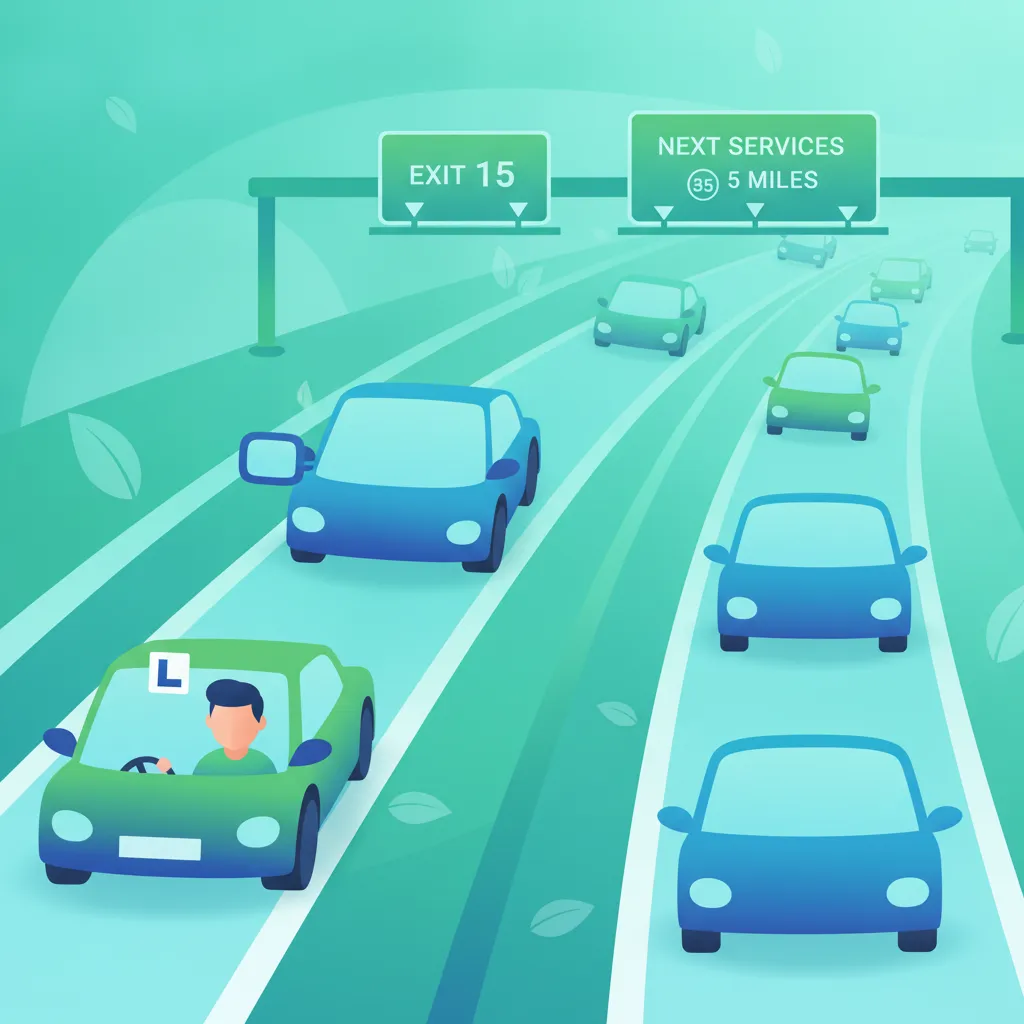
Lesson content overview
Operating a Category D passenger vehicle on high-speed roads requires exceptional planning, consistent situational awareness, and smooth vehicle control. Motorways and dual carriageways are designed to move high volumes of traffic safely at speed. However, because buses and coaches carry passengers and have unique vehicle dynamics—such as high-sided profiles, longer stopping distances, and significant blind spots—professional drivers must apply strict defensive driving techniques.
This lesson covers the essential rules, safety procedures, and vehicle handling techniques required to navigate motorways and dual carriageways safely, helping you prepare for the Irish Driver Theory Test Category D Passenger Vehicles and real-world passenger transport operations.
To drive safely on high-speed networks, you must first understand the infrastructural and legal differences between motorways and dual carriageways.
Motorways are specialized, limited-access roads designed for fast-moving, uninterrupted traffic. They are characterized by:
Dual carriageways also feature a central reservation separating opposing traffic flows, but they differ from motorways in several critical ways:
Understanding these differences is crucial for a Category D driver. On a dual carriageway, you must remain alert to the sudden appearance of slow-moving vehicles, turning traffic, or pedestrians, whereas motorway hazards generally revolve around lane management, high-speed merging, and high-density traffic streams.
In Ireland, speed limits are not solely determined by the road design; they are also governed by the category of the vehicle you are operating. For Category D passenger vehicles (buses and coaches), specific speed restrictions apply to ensure safety and stability.
While the general speed limit for passenger cars on Irish motorways is 120 km/h, the maximum legal speed limit for Category D passenger vehicles is 100 km/h. This limit applies provided the vehicle is fitted with a speed limiter (which is a legal requirement for most passenger vehicles in this category).
On dual carriageways that are designated as National Routes, the speed limit for Category D passenger vehicles is generally 80 km/h, unless a lower local speed limit is posted.
The Impact of Speed Limiters: Most modern coaches and buses are fitted with speed limiters calibrated to prevent the vehicle from exceeding 100 km/h. Never attempt to bypass this system. If you are descending a steep gradient, gravity can cause the vehicle to exceed 100 km/h despite the limiter; you must use your auxiliary braking systems (retarders) to keep the vehicle within legal and safe limits.
While exceeding the speed limit is highly dangerous, driving excessively slowly on a high-speed road without a valid reason (such as adverse weather or mechanical trouble) is also a hazard. A large bus traveling at 50 km/h on a 100 km/h motorway creates a significant "speed differential." Approaching drivers may misjudge your speed, leading to emergency braking or sudden, unsafe lane changes. Aim to maintain a consistent speed that matches the flow of traffic within your legal limits.
Maintaining correct lane discipline prevents unpredictable traffic flow and reduces the risk of side-swipe or rear-end collisions.
The fundamental rule of driving on multi-lane roads is to always drive in the left-hand lane (Lane 1) unless you are overtaking slower traffic or if lane-use signs or road markings direct you otherwise. Once you have safely completed an overtaking maneuver, you must return to the left-hand lane as soon as it is safe to do so.
To prevent large, slower-moving vehicles from blocking traffic flow, Irish law restricts certain vehicles from using the right-hand lane of motorways that have three or more lanes.
The Three-Lane Rule: If you are driving a passenger vehicle with seating capacity for more than 8 passengers (excluding the driver), you are legally prohibited from using the outermost right-hand lane (Lane 3) on a motorway or dual carriageway with three or more lanes, except in exceptional circumstances (such as lane closures, emergency diversions, or when directed by emergency services).
This means that on a three-lane motorway, Category D drivers must restrict their travel and overtaking maneuvers to Lane 1 (left) and Lane 2 (middle).
Overtaking in a Category D vehicle requires careful planning because your vehicle's acceleration is slower, its length is greater, and its blind spots are larger than those of a standard passenger car.
Assess the Hazard and Traffic Flow: Determine if overtaking is truly necessary. Look far ahead to ensure you will not simply catch up to another slow-moving vehicle immediately after.
Check Your Mirrors: Check your main mirrors, wide-angle mirrors, and close-proximity mirrors to assess the position and speed of vehicles behind and beside you.
Check Your Blind Spots: Glances to the sides are vital. Large passenger vehicles have blind spots directly adjacent to the driver's cab and along the rear quarters.
Signal Your Intention: Activate your right turn signal early to give drivers behind you ample warning of your intent to change lanes.
Manoeuvre Smoothly: Steer gradually into the overtaking lane. Avoid sudden, jerky steering inputs, which can cause passenger discomfort or instability.
Maintain Speed and Pass: Accelerate smoothly up to your legal limit (or the speed of the lane) to complete the pass as efficiently as possible. Do not linger in the overtaking lane.
Confirm Clearance: Before returning to the left lane, check your left-side mirrors. Ensure you can see the entire front of the overtaken vehicle in your main mirror. This ensures you have adequate physical clearance.
Signal and Return Left: Signal left, perform a final mirror check, and steer smoothly back into the left lane. Cancel your signal once established in the lane.
The points where vehicles join and leave high-speed roads are high-risk zones due to merging speed differentials.
The slip road is designed to give you space to accelerate and match the speed of vehicles already on the motorway.
Exiting safely requires you to manage your speed without disrupting the flow of traffic behind you.
Toll plazas are complex environments where multiple lanes merge, speed limits drop rapidly, and vehicles stop abruptly.
A vehicle breakdown on a high-speed road is an extreme hazard, particularly when carrying a large number of passengers. The hard shoulder is not a safe parking space; it is an active emergency zone.
The hard shoulder must only be used in an absolute emergency, such as a severe mechanical failure, medical emergency, or when directed to stop by the Gardaí. It must never be used for driver rest stops, passenger drop-offs, or consulting navigation devices.
Signal and Pull Over: Immediately activate your hazard warning lights to alert surrounding traffic. Move the vehicle as far to the left of the hard shoulder as possible, steering close to the grass verge or barrier.
Position the Wheels: Angle your front wheels to the left (toward the verge). If the vehicle is struck from behind, this prevents it from being pushed back into the live traffic lanes.
Turn Off and Secure: Apply the parking brake, turn off the engine, and leave the hazard lights flashing.
Evacuate Passengers Safely: This is a critical duty of care. Assess the safety of the embankment. If safe, evacuate all passengers through the left-side doors (the side away from the live traffic). Move them up onto the grass verge and behind the safety barrier.
Do Not Stay Inside: Passengers and drivers must never remain inside a broken-down vehicle on the hard shoulder, nor should they stand directly behind or in front of the vehicle.
Call for Assistance: Use a mobile phone or walk to the nearest roadside emergency telephone (located at 1-kilometre intervals, which connects directly to motorway control). State that you have a passenger vehicle with passengers on the verge.
Warning Triangles on Motorways: While standard traffic regulations require placing a warning triangle behind a broken-down vehicle, on a motorway, walking along the hard shoulder to place a triangle is extremely dangerous. Focus on safe passenger evacuation and immediately calling emergency services instead.
Driving a bus or coach at high speeds involves managing massive physical forces that impact both the vehicle's stability and your passengers' safety.
Buses and coaches have large side surface areas, making them highly susceptible to lateral wind forces.
The formula for kinetic energy means that stopping distance increases exponentially with speed.
Sudden lane changes or harsh braking at 100 km/h generate significant lateral and longitudinal G-forces. Passengers, some of whom may be moving to their seats, using onboard facilities, or not wearing seatbelts, can easily be thrown off balance. Every maneuver must be gradual, predictable, and planned far in advance.
High-speed environments amplify the dangers of poor weather. You must adapt your driving style immediately when environmental conditions degrade.
| Condition | Hazard Impact | Safe Driver Action / Rule Adjustment |
|---|---|---|
| Rain / Wet Roads | Halves tire grip; increases stopping distance; causes spray that reduces visibility. | Double your following distance (minimum 4 seconds); reduce speed below the limit; use dipped headlights. |
| Fog / Low Visibility | Drastically reduces reaction time; obscures lane markings and slow-moving traffic. | Reduce speed significantly; use fog lights; maintain a following distance that allows you to stop within your clear line of sight. |
| High Winds | Can cause vehicle instability, lane drift, and loss of control. | Reduce speed; anticipate gust points (e.g., bridge exits); keep both hands firmly on the wheel. |
| Ice / Snow | Extreme loss of traction; stopping distances can increase up to ten times. | Avoid motorways if possible; if on them, drive at a safe, highly reduced speed; use smooth, low-torque acceleration; extend following distance to at least 20 seconds. |
To review the key learnings for safe high-speed passenger operations:
This lesson covers the essential rules for operating Category D passenger vehicles on Irish high-speed roads, distinguishing between motorways (blue signs, grade-separated junctions, restricted access) and dual carriageways (green/white signs, at-grade intersections). Critical speed restrictions apply: 100 km/h maximum on motorways and 80 km/h on dual carriageways, enforced by mandatory speed limiters. Lane discipline is strict—always drive in Lane 1, reserve Lane 2 for overtaking, and never enter Lane 3 if your vehicle carries more than 8 passengers. Breakdown procedures prioritise passenger evacuation to the safety barrier, while toll plaza navigation requires early lane selection and smooth deceleration to protect passenger stability.
A short set of high-value points that capture the most important learning from this lesson.
Category D buses and coaches are limited to 100 km/h on motorways and 80 km/h on dual carriageways, with speed limiters required by law.
Passenger vehicles carrying more than 8 passengers are legally prohibited from using Lane 3 on three-lane motorways.
When exiting a motorway, do not brake in the live lane—maintain speed until fully in the deceleration lane, then signal and slow progressively.
In a breakdown on the hard shoulder, evacuate all passengers to safety behind the barrier before calling for assistance.
Smooth, progressive steering and braking are essential to manage G-forces that could throw passengers off balance at high speeds.
Explore all units and lessons included in this driving theory course.
Motorway: blue signs, no pedestrians/cyclists/learners; Dual carriageway: green or white signs, may have at-grade junctions.
Speed limiters prevent exceeding 100 km/h, but gradient descent may require auxiliary braking to stay within limits.
The hard shoulder is strictly for emergencies—never use it for rest stops, drop-offs, or navigation checks.
Maintain minimum 2-second following distance in dry conditions, extending to 4 seconds in rain and up to 20 seconds in ice or snow.
Warning triangles should not be placed on motorways due to the danger of walking along the hard shoulder.
Driving at the general 120 km/h motorway limit instead of the Category D-specific 100 km/h maximum.
Failing to use auxiliary braking systems when descending steep gradients, potentially allowing the vehicle to exceed its limiter.
Braking prematurely in the live lane when approaching an exit, creating rear-end collision risks.
Remaining inside or behind a broken-down vehicle on the hard shoulder instead of evacuating passengers to the embankment.
Lingering in the overtaking lane after passing another vehicle rather than returning to Lane 1 as soon as it is safe.
Lesson content overview
A short set of high-value points that capture the most important learning from this lesson.
Category D buses and coaches are limited to 100 km/h on motorways and 80 km/h on dual carriageways, with speed limiters required by law.
Passenger vehicles carrying more than 8 passengers are legally prohibited from using Lane 3 on three-lane motorways.
When exiting a motorway, do not brake in the live lane—maintain speed until fully in the deceleration lane, then signal and slow progressively.
In a breakdown on the hard shoulder, evacuate all passengers to safety behind the barrier before calling for assistance.
Smooth, progressive steering and braking are essential to manage G-forces that could throw passengers off balance at high speeds.
Explore all units and lessons included in this driving theory course.
Motorway: blue signs, no pedestrians/cyclists/learners; Dual carriageway: green or white signs, may have at-grade junctions.
Speed limiters prevent exceeding 100 km/h, but gradient descent may require auxiliary braking to stay within limits.
The hard shoulder is strictly for emergencies—never use it for rest stops, drop-offs, or navigation checks.
Maintain minimum 2-second following distance in dry conditions, extending to 4 seconds in rain and up to 20 seconds in ice or snow.
Warning triangles should not be placed on motorways due to the danger of walking along the hard shoulder.
Driving at the general 120 km/h motorway limit instead of the Category D-specific 100 km/h maximum.
Failing to use auxiliary braking systems when descending steep gradients, potentially allowing the vehicle to exceed its limiter.
Braking prematurely in the live lane when approaching an exit, creating rear-end collision risks.
Remaining inside or behind a broken-down vehicle on the hard shoulder instead of evacuating passengers to the embankment.
Lingering in the overtaking lane after passing another vehicle rather than returning to Lane 1 as soon as it is safe.
Explore search topics learners often look for when studying Safe Driving on Motorways and Dual Carriageways. These topics reflect common questions about road rules, driving situations, safety guidance, and lesson level theory preparation for learners in Ireland.
Browse additional driving theory lessons that cover connected traffic rules, road signs, and common driving situations related to this topic. Improve your understanding of how different rules interact across everyday traffic scenarios.
Learn how to navigate complex urban environments, manage interactions with vulnerable road users at bus stops, and follow specific traffic regulations for buses and coaches in Irish cities and towns. This guide covers safe maneuvering in high-density areas and public transport priority rules according to the Rules of the Road.
Speed management requires adjusting vehicle velocity to suit current weather, passenger load, and the specific limits of Irish roads. This lesson details speed restrictions for buses and minibuses on motorways, national routes, and built-up areas throughout Ireland. It highlights the driver obligation to prioritize passenger safety over schedule delays by maintaining appropriate speeds.

The regulatory framework in Ireland imposes strict standards of operation, dimension limits, and speed boundaries on heavy passenger fleets. This lesson reviews vehicle registration tax context, commercial operator licensing laws, and mandatory annual vehicle roadworthiness testing. By understanding these statutory regulations, drivers avoid severe legal infractions and maintain their professional driving credentials.

Driving large vehicles through dense city traffic requires outstanding lane discipline, spatial awareness, and consistent patience. This lesson teaches drivers how to utilize public bus corridors, manage tight yellow box intersections, and handle narrow city streets. It focuses on predicting traffic pattern shifts to maintain service timetables while minimizing fuel waste and driver stress.
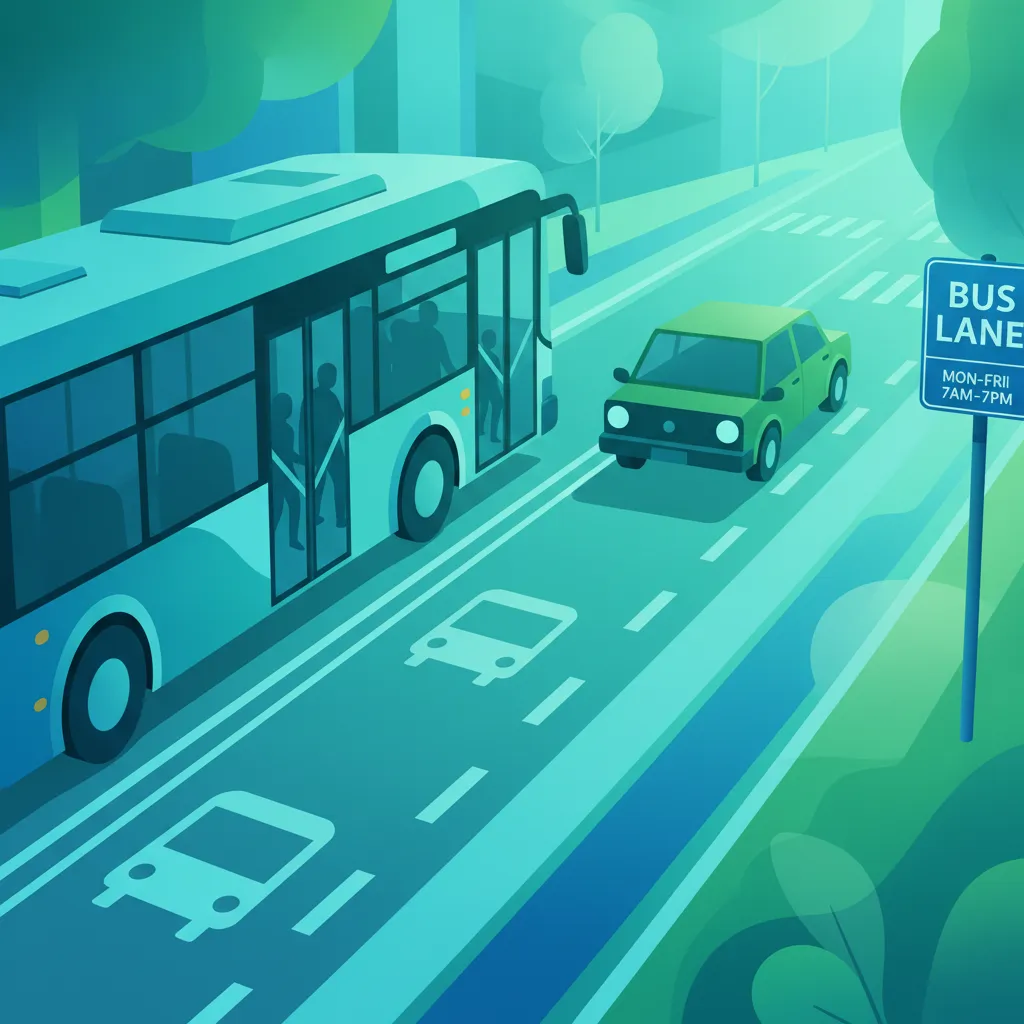
This lesson details the legal operations allowed within Irish bus lanes, including active hours, non-permitted traffic types, and exceptions. Drivers will learn safe approach trajectories for public transport stops, maintaining legal clearance, and navigating curbside hazards safely. The material highlights compliance with local bylaws to guarantee steady, uninterrupted traffic flow and passenger convenience.
Large passenger vehicles must maintain consistent lane positioning to prevent side-swipe incidents and sustain smooth urban traffic patterns. This lesson covers standard lane selection rules, safe overtaking procedures, and how to use designated public transit corridors correctly. Drivers will learn the importance of checking mirrors continuously and planning lane changes well in advance.
Operating large passenger vehicles requires instant, accurate interpretation of general and specialized Irish road signage to prevent regulatory violations. This lesson covers the precise meanings of clearway signs, bus corridor indicators, low bridge warnings, and weight restriction zones. Drivers will examine how school zone beacons and specific roundabout indicators apply to large vehicle dimensions.
School zones and pedestrian crossings require high driver alertness and strict compliance with local speed limits in Ireland. This lesson details the legal rules of zebra and pelican crossings, explaining driver requirements when amber warning beacons are flashing. Drivers will study safety procedures for dropping off or picking up children, preventing common blind-spot accidents near schools.

Securing passengers and luggage properly is essential to prevent injury during emergency braking, sudden steering inputs, or traffic collisions. This lesson provides instructions on passenger restraint systems, seatbelt laws in Ireland, and wheelchair ramp deployment processes. Drivers will study weight distribution guidelines for luggage compartments to protect the physical stability of the passenger vehicle.
Understand how to adapt driving techniques for high-sided passenger vehicles when facing rain, fog, or high winds. This lesson explains the physics of vehicle stability, braking adjustments, and how to maintain passenger comfort and safety on Irish roads during challenging environmental conditions.

This lesson explores the safe operation of heavy transport vehicles during severe meteorological hazards typical of the Irish climate. It teaches techniques for adjusting speed and doubling following distances to prevent loss of steering traction and control on waterlogged or icy roadways. Drivers will understand how to manage lateral aerodynamic forces from crosswinds on high-sided goods vehicles.
Wet roads, heavy winter fog, and strong lateral winds present major safety challenges for high-sided passenger vehicles in Ireland. This lesson explains how to prevent aquaplaning, double following distances on wet surfaces, and use fog lights correctly to maintain visibility. Drivers will learn handling adjustments to counteract sudden wind gusts when crossing exposed bridges or motorways.
Adverse weather severely compromises tyre traction and forward visibility, demanding immediate speed reductions and extra space. This lesson focuses on the physics of aquaplaning in heavy rain, driving safely on black ice, and navigating thick fog using designated fog lamps. You will learn how to manage your windshield defoggers, adjust wipers, and handle high crosswinds that can destabilise your vehicle.

This lesson focuses on the critical techniques required to ride safely during severe rain or heavy fog in Ireland. It teaches riders how to handle aquaplaning risks, use headlights correctly, and significantly increase their following distances. Adapting speed to visibility ensures that riders can brake safely when road conditions deteriorate.

This lesson teaches riders how to manage extreme weather conditions such as high crosswinds, thick fog, and low sun glare. It details how wind forces can push a motorcycle off course and how to use minor body adjustments and lane placement to maintain stability. Riders will learn how to manage visibility limits in dense fog, utilizing specialized riding gear and reducing speeds safely.
Large passenger vehicles must maintain consistent lane positioning to prevent side-swipe incidents and sustain smooth urban traffic patterns. This lesson covers standard lane selection rules, safe overtaking procedures, and how to use designated public transit corridors correctly. Drivers will learn the importance of checking mirrors continuously and planning lane changes well in advance.
Speed management requires adjusting vehicle velocity to suit current weather, passenger load, and the specific limits of Irish roads. This lesson details speed restrictions for buses and minibuses on motorways, national routes, and built-up areas throughout Ireland. It highlights the driver obligation to prioritize passenger safety over schedule delays by maintaining appropriate speeds.
Find clear answers to common questions learners have about Safe Driving on Motorways and Dual Carriageways. Learn how the lesson is structured, which driving theory objectives it supports, and how it fits into the overall learning path of units and curriculum progression in Ireland. These explanations help you understand key concepts, lesson flow, and exam focused study goals.
Yes. While the standard motorway limit is 120 km/h, Category D drivers must be aware of vehicle-specific legal limits and the requirement to maintain safe stopping distances, which are significantly longer due to the weight and size of passenger vehicles.
In Ireland, vehicles pulling trailers or large passenger vehicles may be restricted from the right-hand lane of a motorway depending on specific road signage and traffic regulations. Always check the Rules of the Road for current lane restrictions.
You must prioritize passenger safety by remaining behind the safety barrier, keeping passengers together, and contacting the emergency services or your depot. Do not attempt major repairs yourself on the roadside.
Approach toll plazas in the lanes designated for larger vehicles or those with the correct height clearance. Reduce speed well in advance to ensure a smooth transition and comfortable stop for all passengers on board.
Use the practice question search tool to pinpoint specific topics, road signs, or rules you need to master for your official Driver Theory Test. Refine your study strategy and ensure comprehensive preparation for all aspects of the Irish driving exam. Start your focused revision now and build confidence for your learner permit test.