
This lesson provides an essential overview of regulatory road signs, which communicate legal obligations for all moped and light quadricycle riders. By mastering these signs, you will build the foundation needed for safe navigation and exam success within the Category AM licensing framework.
Lesson content overview
Regulatory road signs are a cornerstone of road safety and traffic law in Great Britain. For riders of mopeds and light quadricycles, understanding and strictly adhering to these signs is not just a recommendation but a legal obligation. This lesson, part of your Great Britain Category AM theory test preparation, will equip you with the knowledge to recognise, interpret, and comply with these crucial visual instructions, ensuring safe and lawful operation of your AM vehicle on UK roads.
Regulatory road signs are distinctive visual symbols, colours, and shapes that convey legally enforceable instructions and prohibitions under UK law. Unlike warning signs, which merely advise of potential hazards, or informational signs, which provide guidance, regulatory signs demand mandatory compliance. Non-compliance with a regulatory sign can lead to severe legal penalties, including fines, penalty points on your licence, or even vehicle seizure.
These signs are designed to streamline traffic flow, reduce conflict points between road users, protect vulnerable individuals, and establish clear expectations for everyone on the road. For riders of AM vehicles, which include mopeds and light quadricycles, accurate interpretation of these signs is vital for preventing accidents and avoiding legal repercussions.
Riding an AM vehicle places unique demands on your attention and decision-making. Mopeds and light quadricycles are often smaller and less conspicuous than larger vehicles, making rapid and correct reactions to regulatory signs even more critical. These signs dictate where you can ride, how fast you can go, where you can stop, and specific manoeuvres you must or must not perform.
Proper understanding ensures you can navigate complex urban environments, arterial roads, and residential areas safely and legally. This lesson builds upon foundational knowledge from earlier units, such as "AM Licence Basics" and general "GB Road Signs, Markings, Signals and Priority Basics," and is essential for later modules covering "Junctions & Road Positioning" and "Speed & Grip Control."
Regulatory signs are designed with specific principles to maximise rapid recognition and minimise ambiguity, regardless of language barriers or driving conditions.
Every regulatory sign imposes a legal duty on road users. Failure to obey these signs constitutes a road traffic offence. The purpose of this strict enforcement is to standardise behaviour across all road users, thereby reducing variability that could lead to dangerous situations and accidents. As an AM rider, you must always be prepared to adjust your speed, direction, or manoeuvre as instructed by these signs and be aware of potential enforcement actions like speed cameras or police checks.
The design of regulatory signs in Great Britain follows a specific coding system to facilitate instant visual categorisation.
This distinct shape and colour coding allows for quick recognition, even when riding at speed or in challenging visibility conditions.
Most regulatory signs use pictograms rather than text to convey their meaning. These symbolic images are universal, ensuring consistent interpretation across diverse linguistic backgrounds and supplementing written regulations for international drivers. Riders must learn to decode common pictograms, such as arrows indicating direction, silhouettes of vehicles, or symbols for specific actions like 'no entry' or 'no overtaking.'
A critical distinction in regulatory signs is between mandatory and prohibitory instructions:
Recognising this distinction is crucial, as it dictates whether you need to take a specific action or refrain from one.
A red circular sign indicating an action or entry that is forbidden. Non-compliance is a legal offence.
A blue circular sign indicating an action or direction that must be followed. Failure to comply is a legal offence.
The meaning of a regulatory sign remains consistent regardless of its surrounding environment, unless additional information is provided by supplementary plates. These rectangular plates are placed directly beneath the main regulatory sign and can specify time-based restrictions, days of the week, or vehicle-specific applicability. Always check for supplementary plates, as they can significantly modify the primary sign's instruction.
Here we delve into the specific types of regulatory signs that are most relevant to riders of mopeds and light quadricycles in Great Britain.
Speed limit signs are among the most frequently encountered regulatory signs. They dictate the maximum speed at which you are legally allowed to travel on a given stretch of road.
Speed limit signs are circular with a red border, a white background, and black numerals indicating the maximum allowed speed in kilometres per hour (km/h). They may sometimes be accompanied by additional plates specifying particular vehicle types (e.g., "AM Vehicles") or times (e.g., "8am-6pm").
It is crucial to understand that the indicated speed is a maximum, not a suggestion. You must not exceed this speed under any circumstances, regardless of road conditions, traffic density, or your personal perception of safety. Temporary speed limits, often indicated by yellow-backed signs, override any permanent national or local limits. Exceeding the speed limit can lead to fines, penalty points, and an increased risk of severe collisions.
Do not assume that the maximum speed limit is always a safe speed. Always adjust your speed to conditions such as weather, visibility, traffic, and road layout, even if this means riding significantly below the posted limit.
These signs are critical for preventing head-on collisions and maintaining ordered traffic flow, particularly on one-way streets.
The No Entry sign is a red circular sign with a distinctive white horizontal bar. It means that you must not enter the road or area in the direction the sign is facing. This sign is commonly found at the entrance to one-way streets or at exits from car parks where entry is prohibited.
There might also be variations prohibiting specific vehicle categories, although "No Entry for AM Vehicles" is less common than the general prohibition. Misinterpreting this sign can put you directly into the path of oncoming traffic.
Overtaking manoeuvres, especially on smaller vehicles like mopeds, require careful judgment and clear visibility. "No overtaking" signs are placed where such manoeuvres are deemed unsafe.
A No Overtaking sign is a red circular sign featuring a black car silhouette with a red diagonal bar running across it. This sign prohibits all overtaking manoeuvres for all vehicles on the stretch of road where it is posted. This prohibition applies until you pass a sign indicating that overtaking is permitted again, or until the end of the restriction (often marked by a 'End of all speed restrictions' or 'End of restrictions' sign).
These signs are typically placed on roads with limited visibility, sharp bends, narrow sections, or areas with high pedestrian activity. As an AM rider, you must never attempt to overtake where this sign is displayed, regardless of how clear the road might appear or how slow the vehicle in front is travelling. There might be specific "No overtaking for motorcycles and AM vehicles only" signs, but the general prohibition applies to you too.
These signs regulate where you can temporarily halt your vehicle, crucial for maintaining traffic flow and accessibility.
Confusing these two signs is a common mistake that can lead to fines. Always observe any supplementary plates that might specify hours or days for these restrictions.
These blue circular signs are crucial for guiding traffic flow, especially at complex junctions, roundabouts, and one-way systems.
Directional mandatory signs are blue circular signs with white arrows. They indicate the only direction(s) in which traffic is permitted to travel. Examples include:
When you encounter these signs, you must place your AM vehicle in the correct lane (if applicable) and proceed only in the indicated direction. Ignoring these signs can lead to dangerous situations, right-of-way disputes, and traffic flow disruption at intersections. These signs apply to all road users unless a supplementary plate explicitly exempts certain vehicle types.
Certain roads or lanes are restricted for specific vehicle types to maintain safety or manage traffic flow.
These are red circular signs featuring a pictogram of a vehicle crossed by a red diagonal line. They indicate that the identified vehicle type is prohibited from using the road or lane where the sign is displayed. For AM licence holders, the most significant example is the prohibition of mopeds and light quadricycles on motorways. Motorways are high-speed environments for which AM vehicles are not designed, making their presence a significant safety hazard.
Always be vigilant for signs prohibiting "motorcycles," "mopeds," or "all motor vehicles" (which would include AM vehicles). These signs ensure that vehicles are matched to appropriate road conditions and speeds.
Familiarise yourself with routes that avoid motorways if you plan a longer journey on your moped, as entry is strictly prohibited for AM vehicles.
Specific restrictions may apply to tunnels and bridges, often due to structural limitations or safety concerns regarding certain types of cargo.
While less common for standard AM vehicle use, riders should be aware of regulatory signs restricting tunnels or bridges. These can include prohibitions based on height, width, weight, or the transport of hazardous goods. Although AM vehicles typically do not carry large, hazardous loads, it is still important to check for such signs, especially if you are using your light quadricycle for utility purposes. Entering a restricted tunnel or bridge with an inappropriate vehicle or load can have serious safety implications and legal consequences.
Many regulatory signs are not absolute but are instead accompanied by supplementary plates that specify conditions under which the restriction applies.
A rectangular sign placed beneath a main regulatory sign to provide additional information, such as time periods, days of the week, or vehicle types to which the restriction applies.
Supplementary rectangular plates are crucial for correctly interpreting regulatory signs. They modify the primary sign's instruction by indicating exact time periods (e.g., "8am-6pm"), specific days (e.g., "Weekdays only"), or particular vehicle types (e.g., "Except for motorcycles").
For example, a "No Parking" sign with a supplementary plate reading "8am-6pm Mon-Sat" means the parking restriction is only active during those hours and days. Outside these times, parking might be permitted. Riders must always read the main sign in conjunction with any supplementary plates to fully understand the legal requirement. Ignoring these plates is a common cause of violations and penalties.
Complying with regulatory road signs is a non-negotiable aspect of riding an AM vehicle safely and legally in Great Britain. The following table summarises the core rules and their implications for you as an AM licence holder.
Always adhere to posted speed limits. Never exceed the maximum speed shown on a regulatory sign, regardless of road conditions.
Do not enter roads marked with a 'No Entry' sign. This prevents head-on collisions and disruptions on one-way systems.
Never overtake where 'No Overtaking' signs are displayed. These signs indicate unsafe conditions for passing.
Observe 'No Parking' and 'No Stopping' signs. Understand the difference: 'no parking' may allow brief stops for loading/unloading, while 'no stopping' prohibits halting for any reason.
Follow all mandatory direction signs. Proceed only in the direction indicated by blue circular arrow signs at junctions or roundabouts.
Respect vehicle type prohibitions. Do not use roads or lanes where your AM vehicle is specifically prohibited (e.g., motorways).
Pay attention to conditional restrictions. Always read supplementary plates that indicate time, day, or vehicle-specific limitations.
Be aware of tunnel and bridge restrictions. Ensure your vehicle and any load comply with specific prohibitions.
Failure to comply with any regulatory road sign can result in legal penalties, including fines, penalty points, or even the immediate seizure of your vehicle in serious cases.
Understanding where riders typically go wrong can help you avoid making similar mistakes.
Regulatory signs must be obeyed at all times, but various conditions can influence how you perceive and react to them.
Time-based restrictions, indicated by supplementary plates (e.g., "No Parking 8am-6pm"), require you to be conscious of the time. Violations frequently occur due to misreading or forgetting these conditional rules, particularly during busy periods.
Every regulatory sign exists for a reason, directly contributing to road safety and efficient traffic management. Understanding the cause-and-effect relationships reinforces the importance of compliance.
| Principle | Correct Follow-through | Consequence of Violation |
|---|---|---|
| Speed limit adherence | Reduced stopping distance, lower crash severity | Increased kinetic energy exchanges, higher fatality risk, fines |
| No entry compliance | Smooth traffic flow, prevention of head-on collisions | High crash risk, obstructed traffic, fines |
| No overtaking observance | Prevents blind-spot manoeuvres, safer passing | Side-impact collisions, especially with limited visibility |
| Mandatory direction obedience | Predictable traffic patterns, efficient junction clearing | Gridlock, right-of-way disputes, fines |
| Vehicle type restrictions | Protects high-speed corridors, avoids speed mismatches | Endangerment of AM rider and other motorists; legal sanctions |
| No stopping/parking adherence | Keeps road space clear for emergencies and cyclists | Obstructed visibility, pedestrian risk, fines |
| Conditional restriction observance | Aligns road usage with demand and safety patterns | Unfair usage, congestion, fines |
This lesson on regulatory road signs is a foundational element of your Great Britain AM Licence Theory Course. The concepts learned here are vital prerequisites for several other modules.
Mastering these terms will enhance your understanding and enable you to discuss road safety with precision.
Let's look at how regulatory signs translate into practical riding situations for AM vehicle riders.
Beyond the legal aspect, there are profound safety and psychological reasons behind the design and enforcement of regulatory signs.
Regulatory road signs are not merely suggestions; they are legally binding instructions designed to maintain order, prevent collisions, and ensure the safety of everyone on Great Britain's roads. For riders of mopeds and light quadricycles, understanding these signs is paramount for safe and lawful travel.
By mastering the shapes, colours, and pictograms of prohibitory and mandatory signs, always checking for supplementary plates, and understanding the severe consequences of non-compliance, you will develop the essential awareness needed to be a responsible and safe AM licence holder. Your commitment to obeying these signs directly contributes to your safety and the safety of the wider road community. Continue to practice identifying and interpreting these signs in various real-world contexts to solidify your knowledge for your theory test and beyond.
Explore all units and lessons included in this driving theory course.
Lesson content overview
Explore all units and lessons included in this driving theory course.
Explore search topics learners often look for when studying Regulatory Road Signs for AM Vehicles. These topics reflect common questions about road rules, driving situations, safety guidance, and lesson level theory preparation for learners in Great Britain.
Browse additional driving theory lessons that cover connected traffic rules, road signs, and common driving situations related to this topic. Improve your understanding of how different rules interact across everyday traffic scenarios.
Learn the specific meaning and implications of prohibitory road signs for AM vehicles, including 'No Entry' and 'No Overtaking' signs. Essential theory for safe and legal riding on UK roads.
This lesson clarifies the specific speed limits that apply to Category AM vehicles on various British roads, from 30 mph zones in built-up areas to national speed limits on single and dual carriageways. It emphasizes that the posted limit is a maximum, not a target, and teaches you how to choose an appropriate speed based on factors like weather, traffic, and road layout. Understanding these rules is vital for both legal compliance and personal safety.

This lesson focuses on regulatory signs, which are legally enforceable and typically circular in shape. You will learn the meaning of signs with red borders that prohibit actions and blue signs that give a mandatory instruction. Understanding these signs, such as speed limits and 'no entry', is essential for lawful and safe riding.

This lesson provides a detailed definition of Category AM, specifying the types of vehicles it covers, including mopeds and light quadricycles. It clarifies the legal technical specifications, such as maximum engine size and speed caps, that define these vehicles in Great Britain. You will learn about the key differences between two- and three-wheeled options and understand how these classifications are crucial for legal compliance, road safety, and passing the theory test.

This lesson decodes the language of road markings painted on the road surface. You will learn the rules associated with solid and broken white lines, double white lines that restrict overtaking, and yellow lines controlling parking. Proper understanding of these markings is crucial for maintaining correct lane discipline and riding legally.
This lesson explains the function of warning signs, which are mostly triangular and alert road users to potential dangers ahead. You will learn to identify signs for bends, junctions, slippery surfaces, and other hazards particularly relevant to motorcyclists. Acting on these warnings allows a rider to adjust speed and position proactively, enhancing safety.
This lesson guides you through the compulsory insurance and tax obligations for Category AM vehicles in Great Britain. It differentiates between third-party and comprehensive insurance policies and explains the legal necessity of each. Furthermore, it details the process for vehicle tax and registration, highlighting the severe consequences of non-compliance, which can include fines, penalty points, and even vehicle seizure, ensuring you understand how to keep your vehicle road-legal.
This lesson details the legal requirements and best practices for using lights and reflectors on your moped or light quadricycle. It covers the correct operation of headlamps, daytime running lights, brake lights, and indicators to communicate your intentions clearly to other road users. You will also learn how to enhance your visibility further with strategically placed reflectors and reflective tape, ensuring you remain conspicuous in low-light conditions and compliant with British lighting regulations.
This lesson focuses on the rules conveyed by road markings, such as solid and broken white lines that dictate overtaking rules and lane boundaries. You will learn to interpret waiting and stopping restrictions indicated by yellow and red lines, and understand markings for specific road users like bus and cycle lanes. Maintaining correct lane discipline based on these markings is a fundamental skill for safe navigation and compliance with the Highway Code.

This lesson teaches you to interpret warning signs, which are typically triangular and designed to alert you to potential hazards ahead. You will learn the meanings of common signs indicating sharp curves, slippery surfaces, roadworks, or areas with frequent pedestrian or animal crossings. Understanding these signs is crucial for anticipating dangers and adjusting your speed and position defensively, which is especially important for vulnerable riders of AM vehicles.
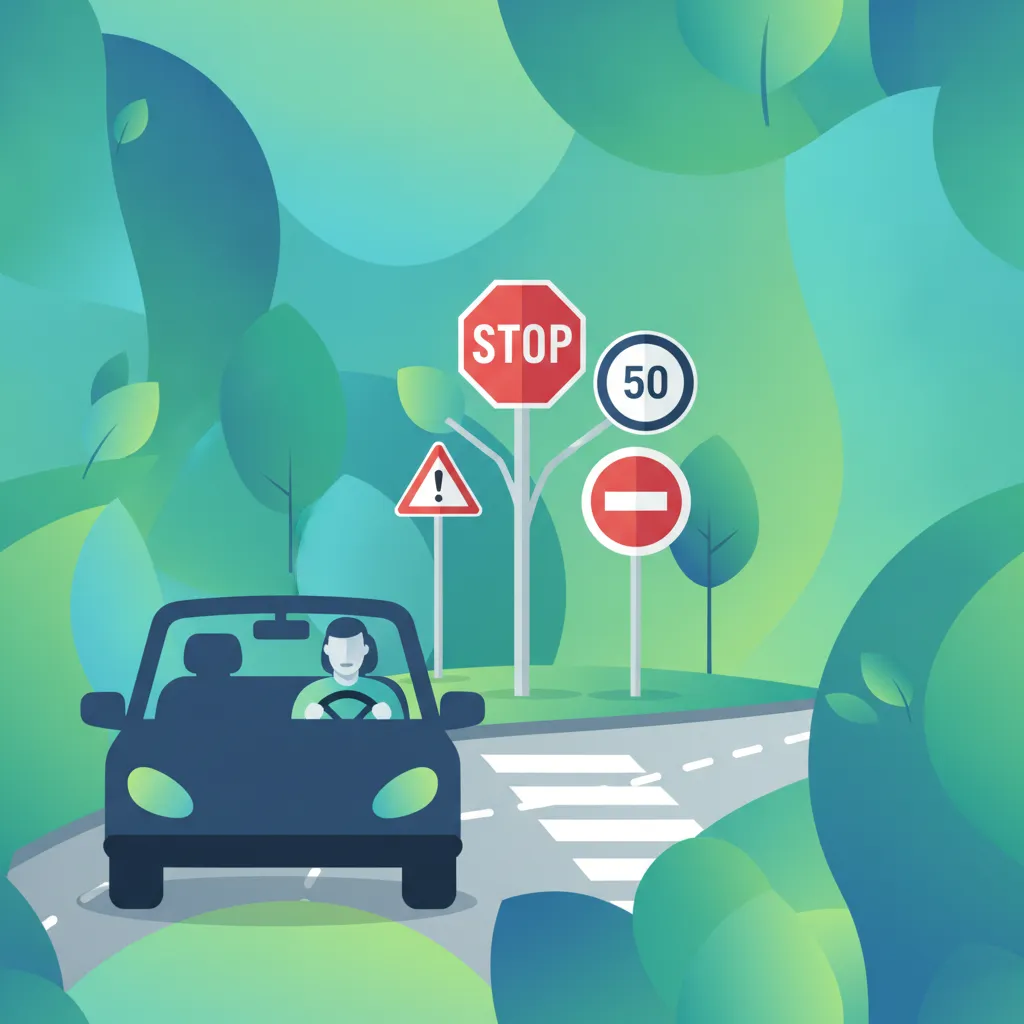
This lesson focuses on regulatory signs, which are legally enforceable and must be obeyed. It explains the difference between prohibitory signs, such as 'No Entry' or speed limits, and mandatory signs, like 'Turn Left'. Understanding the design and meaning of these signs is fundamental to safe and lawful driving in the UK.
Master the interpretation of regulatory road signs with supplementary plates. This lesson covers time-based and vehicle-specific restrictions crucial for AM licence holders in Great Britain.
This lesson focuses on regulatory signs, which are legally enforceable and typically circular in shape. You will learn the meaning of signs with red borders that prohibit actions and blue signs that give a mandatory instruction. Understanding these signs, such as speed limits and 'no entry', is essential for lawful and safe riding.
This lesson details the legal requirements and best practices for using lights and reflectors on your moped or light quadricycle. It covers the correct operation of headlamps, daytime running lights, brake lights, and indicators to communicate your intentions clearly to other road users. You will also learn how to enhance your visibility further with strategically placed reflectors and reflective tape, ensuring you remain conspicuous in low-light conditions and compliant with British lighting regulations.
This lesson clarifies the specific speed limits that apply to Category AM vehicles on various British roads, from 30 mph zones in built-up areas to national speed limits on single and dual carriageways. It emphasizes that the posted limit is a maximum, not a target, and teaches you how to choose an appropriate speed based on factors like weather, traffic, and road layout. Understanding these rules is vital for both legal compliance and personal safety.
This lesson explains the function of warning signs, which are mostly triangular and alert road users to potential dangers ahead. You will learn to identify signs for bends, junctions, slippery surfaces, and other hazards particularly relevant to motorcyclists. Acting on these warnings allows a rider to adjust speed and position proactively, enhancing safety.
This lesson covers the full range of road signs encountered by passenger vehicle drivers, focusing on regulatory, warning, and informational signs. It explains the visual characteristics of sign shapes, colors, and symbols, particularly those associated with bus lane usage and priority rules. By mastering sign hierarchy and meaning, drivers can quickly interpret the sign's intent and adjust their driving behaviour accordingly, ensuring full compliance with the Highway Code and enhancing road safety.
This lesson provides a detailed definition of Category AM, specifying the types of vehicles it covers, including mopeds and light quadricycles. It clarifies the legal technical specifications, such as maximum engine size and speed caps, that define these vehicles in Great Britain. You will learn about the key differences between two- and three-wheeled options and understand how these classifications are crucial for legal compliance, road safety, and passing the theory test.
This lesson focuses on regulatory signs, which are legally enforceable and must be obeyed. It explains the difference between prohibitory signs, such as 'No Entry' or speed limits, and mandatory signs, like 'Turn Left'. Understanding the design and meaning of these signs is fundamental to safe and lawful driving in the UK.
This lesson guides you through the compulsory insurance and tax obligations for Category AM vehicles in Great Britain. It differentiates between third-party and comprehensive insurance policies and explains the legal necessity of each. Furthermore, it details the process for vehicle tax and registration, highlighting the severe consequences of non-compliance, which can include fines, penalty points, and even vehicle seizure, ensuring you understand how to keep your vehicle road-legal.
This lesson decodes the language of road markings painted on the road surface. You will learn the rules associated with solid and broken white lines, double white lines that restrict overtaking, and yellow lines controlling parking. Proper understanding of these markings is crucial for maintaining correct lane discipline and riding legally.
This lesson covers the operation of traffic light signals and the rules for approaching them safely. It also provides a detailed explanation of different pedestrian crossings, such as zebra, pelican, and toucan crossings, clarifying the specific rules and priority for each. You will learn to anticipate the actions of pedestrians and other vulnerable road users at these locations.
Find clear answers to common questions learners have about Regulatory Road Signs for AM Vehicles. Learn how the lesson is structured, which driving theory objectives it supports, and how it fits into the overall learning path of units and curriculum progression in Great Britain. These explanations help you understand key concepts, lesson flow, and exam focused study goals.
Regulatory signs are typically circular and give orders that you must follow by law, such as speed limits or 'no entry'. Warning signs are usually triangular and provide information about potential hazards ahead, requiring you to adjust your riding style without necessarily imposing a strict legal command.
In the UK, the shape and colour of a sign allow you to identify its purpose instantly. For example, most regulatory signs are circular, and many feature a red border to indicate prohibition, which helps you react correctly even when viewing a sign from a distance.
The DVSA theory test focuses on the most common regulatory signs you will encounter daily. You should be familiar with all signs in the Highway Code, but particular focus is placed on signs governing speed, direction, and prohibitions relevant to light vehicles like mopeds.
Yes, all regulatory signs apply to all road users, including moped and light quadricycle riders. You are legally required to obey the same prohibitions and mandatory directions as drivers of larger vehicles unless a sign explicitly states a different rule for specific vehicle classes.
Dive into our comprehensive question bank to find exactly what you need for your Great Britain theory test. Use our advanced filters to pinpoint specific subjects or test your knowledge on challenging areas, ensuring you're fully prepared for success.