
This lesson guides you through the essential regulatory signs you must master for your motorcycle theory test. As part of our comprehensive GB motorcycle course, you will learn how to distinguish between mandatory instructions and important prohibitions to ensure safe, legal riding on British roads.
Lesson content overview
As a motorcycle rider in Great Britain, understanding and correctly interpreting regulatory signs is fundamental to safe and lawful riding. These signs are crucial for maintaining order on the roads, preventing accidents, and ensuring all road users behave predictably. This lesson delves into the specifics of regulatory signs, particularly those that are legally enforceable and have unique implications for motorcyclists.
Regulatory signs are easily identifiable by their distinct circular shape. They fall into two main categories: prohibitory signs, which have a red border and forbid certain actions, and mandatory signs, which have a blue background and instruct riders to perform specific actions. Mastering these signs, from speed limits to 'no entry' restrictions and dedicated lane usage, is essential not only for passing your motorcycle theory test but also for becoming a confident and responsible rider in various traffic environments across England, Scotland, and Wales.
Regulatory signs convey binding legal requirements or prohibitions that all road users, including motorcyclists, must obey. Their design – circular shape, combined with specific colour coding – allows for rapid visual identification under diverse traffic conditions. These signs are implemented to manage risks, ensure orderly traffic flow, and legally control driver behaviour.
For motorcycle riders, specific regulatory signs address issues like speed constraints, lane usage, overtaking restrictions, and vehicle entry prohibitions. Adhering to these signs is not optional; non-compliance constitutes a traffic offence, which can lead to penalties and significantly increase the likelihood of accidents. Understanding the legal enforceability and the underlying safety logic behind each sign is crucial for every rider.
Every regulatory sign on Great Britain's roads represents a statutory requirement, meaning its directive is legally binding. Disobeying these signs is a traffic offence under the Road Traffic Regulation Act 1984. This legal enforceability ensures uniform behaviour among all road users, which is vital for creating predictable interactions and maintaining road safety.
For motorcyclists, this means that ignoring a speed limit, entering a prohibited zone, or failing to use a mandatory lane can result in fines, penalty points endorsed on your licence, and potentially even disqualification. These consequences highlight the importance of constant vigilance and accurate interpretation of all regulatory signage encountered while riding.
Regulatory signs are designed with specific features to ensure they are easily understood and acted upon. Their consistent visual characteristics help riders process information quickly, which is particularly important for motorcyclists who often have less time to react due to higher speeds and a smaller visual footprint.
The circular shape immediately signals that a rule, rather than a warning or advisory, is being conveyed. Colour coding further enhances this: a red border universally indicates a prohibition or something that is not allowed, while a blue background signifies a mandatory instruction or something that must be done. Standardised symbolism, such as a motorbike silhouette, ensures that meanings are clear and reduce ambiguity, even for riders unfamiliar with local language or specific road contexts.
Always be prepared to react to regulatory signs. Look ahead, scan for signs, and anticipate the actions they require or prohibit well in advance, especially when approaching junctions or changes in road conditions.
Prohibitory signs are circular with a distinctive red border and typically a white or blue background, often featuring a black pictogram. They forbid specific actions or conditions and are paramount for guiding traffic safely. For motorcyclists, it is vital to recognise these signs instantly and understand their precise implications.
One of the most critical prohibitory signs for any road user, including motorcyclists, is the 'No Entry' sign. This sign is a red circle with a white horizontal bar in the middle. It prohibits all vehicles, including motorcycles, from entering the road or section of road where it is displayed. This is often used to establish one-way systems or to prevent vehicles from entering dangerous areas.
Riders must never proceed past a 'No Entry' sign. Doing so can lead to a head-on collision with oncoming traffic in a one-way system or entry into a restricted zone. Always be prepared to stop and find an alternative route if you encounter this sign.
Speed limit signs are circular with a red border, a white background, and a black number indicating the maximum permissible speed in miles per hour (mph). These limits apply to all vehicles, but motorcyclists must be especially mindful of them due to their vehicle's acceleration capabilities and the heightened risk of injury in a crash.
While general speed limits apply to everyone, sometimes a supplementary plate beneath a speed limit sign might specify "Motorcycles not above [speed]mph" or similar wording. This indicates a special reduced speed limit specifically for motorcycles in that zone, perhaps due to local conditions or specific road hazards for two-wheelers. Always observe these limits; exceeding them can lead to a fixed penalty, points on your licence, or a court summons.
The 'No Overtaking' sign is a red-bordered circle featuring two cars, one overtaking the other, with a red diagonal line through them. This sign prohibits overtaking for all vehicles. However, a supplementary plate might specify "Motorcycles" or "All Motor Vehicles" to clarify its applicability.
Motorcyclists must not overtake other vehicles within a zone marked by this sign. This rule is often enforced in areas with limited visibility, such as sharp bends, hill crests, or narrow roads, where overtaking significantly increases the risk of a head-on collision. Always stay behind the vehicle you intend to overtake until it is safe and legal to do so, and the restriction has ended.
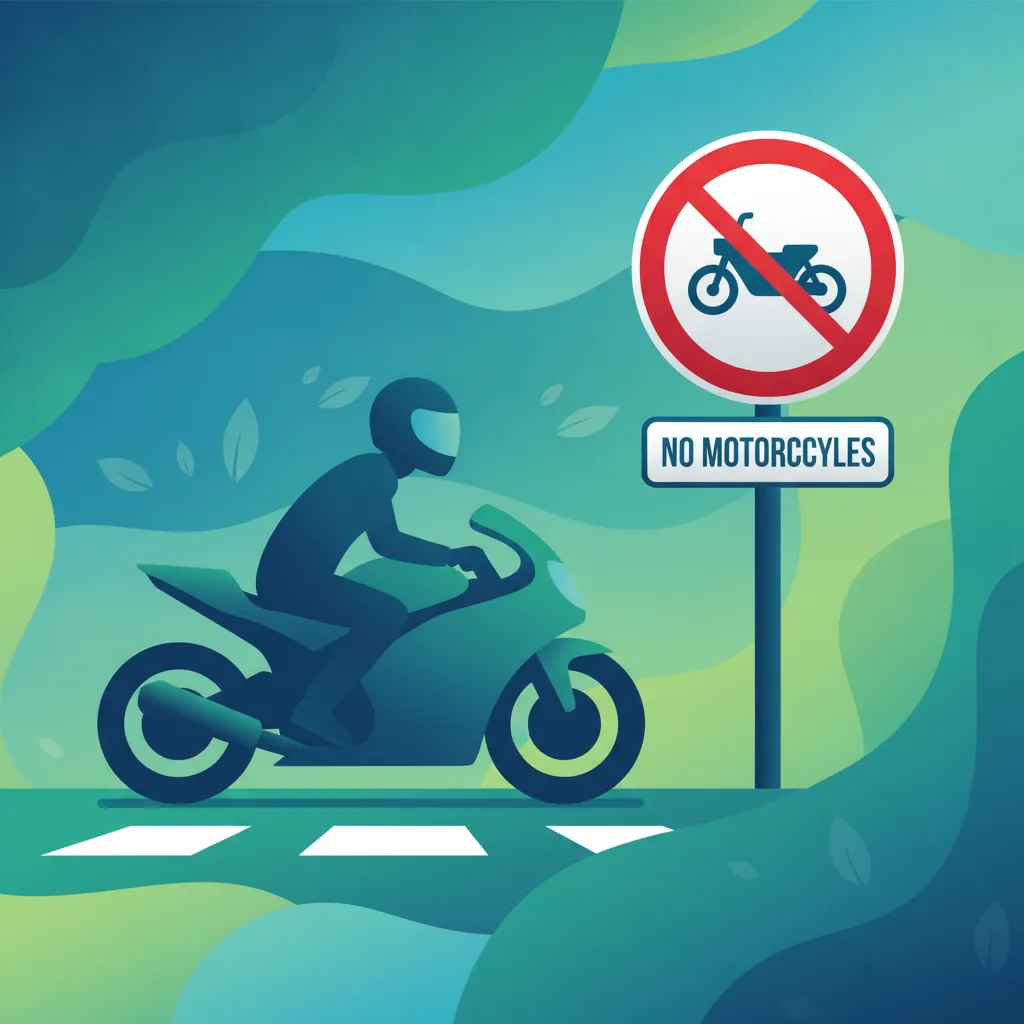
A red circular sign with a motorbike silhouette crossed out signifies "No Motorcycles." This sign explicitly forbids motorcycles from entering or using a particular road, lane, or area. These restrictions are put in place for various reasons, such as noise reduction in residential areas, safety on narrow bridges, or to maintain the integrity of specific traffic flows like bus lanes.
If you encounter a "No Motorcycles" sign, you must not proceed beyond it. Riders need to identify an alternative route. Failure to comply can result in fines and, in some cases, might lead to your vehicle being towed if it obstructs traffic or is parked illegally in a restricted zone.
Although not motorcycle-specific, "No Stopping" and "No Parking" signs are crucial for motorcyclists to understand. A red circle with a blue background and a red diagonal line (single line) indicates "No Stopping" at any time, not even for a moment to pick up or drop off passengers or goods. A red circle with a blue background and a red "P" struck through signifies "No Parking," meaning you cannot park there, but you may stop temporarily to load or unload.
Motorcyclists must comply with these signs just like other vehicles. Stopping even briefly in a "No Stopping" zone can lead to enforcement. Always look for designated motorcycle parking areas or general parking bays where stopping and parking are permitted.
Mandatory signs are circular with a blue background and typically a white pictogram or arrow. They require road users to perform a specific action, ensuring predictable traffic flow and safety. For motorcyclists, understanding and adhering to these instructions is as critical as obeying prohibitions.
Many mandatory signs dictate the direction traffic must take. These often feature white arrows on a blue background, indicating "Ahead Only," "Turn Left Ahead," "Turn Right Ahead," or "Pass This Side." For motorcyclists, making the correct turn or staying in the correct lane as mandated by these signs is essential to avoid conflicts with other traffic, especially at complex junctions or roundabouts.
Ignoring a compulsory turn sign can lead to dangerous manoeuvres, such as late lane changes or driving into oncoming traffic. Always plan your route and position yourself correctly well in advance of a junction.
Blue circular signs depicting a motorbike silhouette indicate a lane that is either dedicated for motorcycles or allows their use. It is crucial to check for supplementary plates below these signs, as they determine whether the lane's use is optional or mandatory.
A supplementary plate stating "Motorcycles shall use" or similar makes the lane's use compulsory for motorcyclists. Failure to use a mandatory motorcycle lane when available could result in a penalty and create confusion for other road users. Conversely, a plate stating "Motorcycles may use" or similar indicates that using the lane is optional. These lanes are often provided to improve safety for motorcyclists, such as offering a dedicated space at traffic lights or on high-speed carriageways.
A blue circular sign with a white number indicates a mandatory minimum speed in mph. While less common, these signs ensure that vehicles do not impede traffic flow by driving too slowly, which can be as dangerous as excessive speeding.
Motorcyclists must maintain at least the indicated speed when travelling on a stretch of road marked with a minimum speed sign, provided it is safe to do so. Falling below the minimum speed without a valid reason (e.g., heavy traffic, hazard) could lead to a fine, as it can create a rear-end collision risk, especially on dual carriageways or motorways.
The interpretation and obedience of regulatory signs can be influenced by various external factors. Motorcyclists need to consider these variations to ensure safe and lawful riding at all times.
Adverse weather conditions such as heavy rain, fog, or snow can significantly reduce the visibility of regulatory signs. Similarly, at night, even reflective signs can be harder to spot. Riders must anticipate these challenges and adjust their speed and behaviour earlier. Using appropriate headlight settings and increasing following distances become even more critical to allow enough time to identify signs and react safely.
Different road types present unique regulatory challenges and signage:
The condition of your motorcycle can also affect how you interact with regulatory signs. For example, if you are riding with a heavy load or a trailer, your braking distance will increase, requiring you to comply with speed limits and prohibitory signs even earlier. If your motorcycle develops a mechanical issue, such as compromised brakes, you may need to pull over safely rather than attempting to maintain a mandated speed or manoeuvre, prioritising safety over strict compliance in an emergency.
Regulatory signs often play a role in protecting vulnerable road users. When approaching areas with pedestrians, cyclists, or horse riders, mandatory signs requiring reduced speed or prohibiting overtaking take on even greater importance. For instance, a 'No Overtaking – Motorcycles' sign near a cycle path ensures motorcyclists do not endanger cyclists.
Always be aware that temporary signs, typically yellow with black markings, can override permanent regulatory signs. These are often used for road works, diversions, or special events. Riders must treat the most recent and clearly displayed sign as the prevailing instruction, even if it contradicts a permanent sign.
The core purpose of regulatory signs is to guide behaviour, and understanding the direct cause-and-effect relationships of compliance or non-compliance is essential for safe riding.
When a motorcyclist correctly interprets and obeys regulatory signs, several positive outcomes arise:
Conversely, failing to comply with regulatory signs can lead to serious negative consequences:
This lesson covers regulatory signs that are legally binding for motorcycle riders in Great Britain, distinguishing between prohibitory signs (red border, white/blue background) that forbid actions and mandatory signs (blue background, white pictogram) that require specific actions. Key prohibitory signs include No Entry, Speed Limits, No Motorcycles, and No Overtaking, while mandatory signs cover compulsory directions, dedicated motorcycle lanes, and minimum speeds. Motorcyclists must read supplementary plates carefully as they often modify the main sign's applicability. Non-compliance with regulatory signs carries legal penalties including fines, penalty points, and potential licence disqualification.
A short set of high-value points that capture the most important learning from this lesson.
Regulatory signs are legally enforceable commands, not suggestions, and non-compliance is a traffic offence under the Road Traffic Regulation Act 1984
Red-bordered circular signs prohibit actions (No Entry, Speed Limits, No Motorcycles, No Overtaking), while blue circular signs mandate specific actions or directions
Speed limit signs apply to all vehicles, but supplementary plates can impose specific reduced limits for motorcycles due to local hazards
No Motorcycles signs explicitly forbid motorcycles from certain roads, lanes, or areas for reasons like safety, noise, or traffic management
Mandatory motorcycle lanes may be compulsory or optional depending on supplementary plates, so always read the plate below the sign
Explore all units and lessons included in this driving theory course.
No Entry sign is a red circle with a white horizontal bar — no vehicle may pass it under any circumstances
No Stopping (blue background with red diagonal line) means exactly that — no stopping even briefly; No Parking allows temporary stops for loading/unloading
A red circle with a crossed-out motorbike silhouette explicitly prohibits motorcycles from that road or lane
Blue circular signs with arrows (Ahead Only, Turn Left/Right) are mandatory — you must follow the indicated direction
Temporary yellow signs override permanent signs — always obey the most recently displayed instruction
Assuming a blue motorcycle lane sign is always optional — mandatory lanes have supplementary plates stating 'Motorcycles shall use'
Confusing No Stopping and No Parking signs — they look similar but have different rules for temporary stops
Believing speed limits are only for cars — motorcycles must obey the same limits and any motorcycle-specific restrictions shown on supplementary plates
Proceeding past a No Entry sign when the rider believes it applies only to other vehicle types — it prohibits all vehicles including motorcycles
Ignoring minimum speed signs because they seem unusual — failing to maintain the indicated minimum speed can also result in penalties
Lesson content overview
A short set of high-value points that capture the most important learning from this lesson.
Regulatory signs are legally enforceable commands, not suggestions, and non-compliance is a traffic offence under the Road Traffic Regulation Act 1984
Red-bordered circular signs prohibit actions (No Entry, Speed Limits, No Motorcycles, No Overtaking), while blue circular signs mandate specific actions or directions
Speed limit signs apply to all vehicles, but supplementary plates can impose specific reduced limits for motorcycles due to local hazards
No Motorcycles signs explicitly forbid motorcycles from certain roads, lanes, or areas for reasons like safety, noise, or traffic management
Mandatory motorcycle lanes may be compulsory or optional depending on supplementary plates, so always read the plate below the sign
Explore all units and lessons included in this driving theory course.
No Entry sign is a red circle with a white horizontal bar — no vehicle may pass it under any circumstances
No Stopping (blue background with red diagonal line) means exactly that — no stopping even briefly; No Parking allows temporary stops for loading/unloading
A red circle with a crossed-out motorbike silhouette explicitly prohibits motorcycles from that road or lane
Blue circular signs with arrows (Ahead Only, Turn Left/Right) are mandatory — you must follow the indicated direction
Temporary yellow signs override permanent signs — always obey the most recently displayed instruction
Assuming a blue motorcycle lane sign is always optional — mandatory lanes have supplementary plates stating 'Motorcycles shall use'
Confusing No Stopping and No Parking signs — they look similar but have different rules for temporary stops
Believing speed limits are only for cars — motorcycles must obey the same limits and any motorcycle-specific restrictions shown on supplementary plates
Proceeding past a No Entry sign when the rider believes it applies only to other vehicle types — it prohibits all vehicles including motorcycles
Ignoring minimum speed signs because they seem unusual — failing to maintain the indicated minimum speed can also result in penalties
Explore search topics learners often look for when studying Regulatory Signs Specific to Motorcycles. These topics reflect common questions about road rules, driving situations, safety guidance, and lesson level theory preparation for learners in Great Britain.
Browse additional driving theory lessons that cover connected traffic rules, road signs, and common driving situations related to this topic. Improve your understanding of how different rules interact across everyday traffic scenarios.
Understand the meaning of triangular warning signs used on Great Britain roads. This guide explains how to identify potential hazards like bends, junctions, and crossings, helping you adapt your riding style and anticipate road conditions effectively to ensure safer travel across diverse road environments.
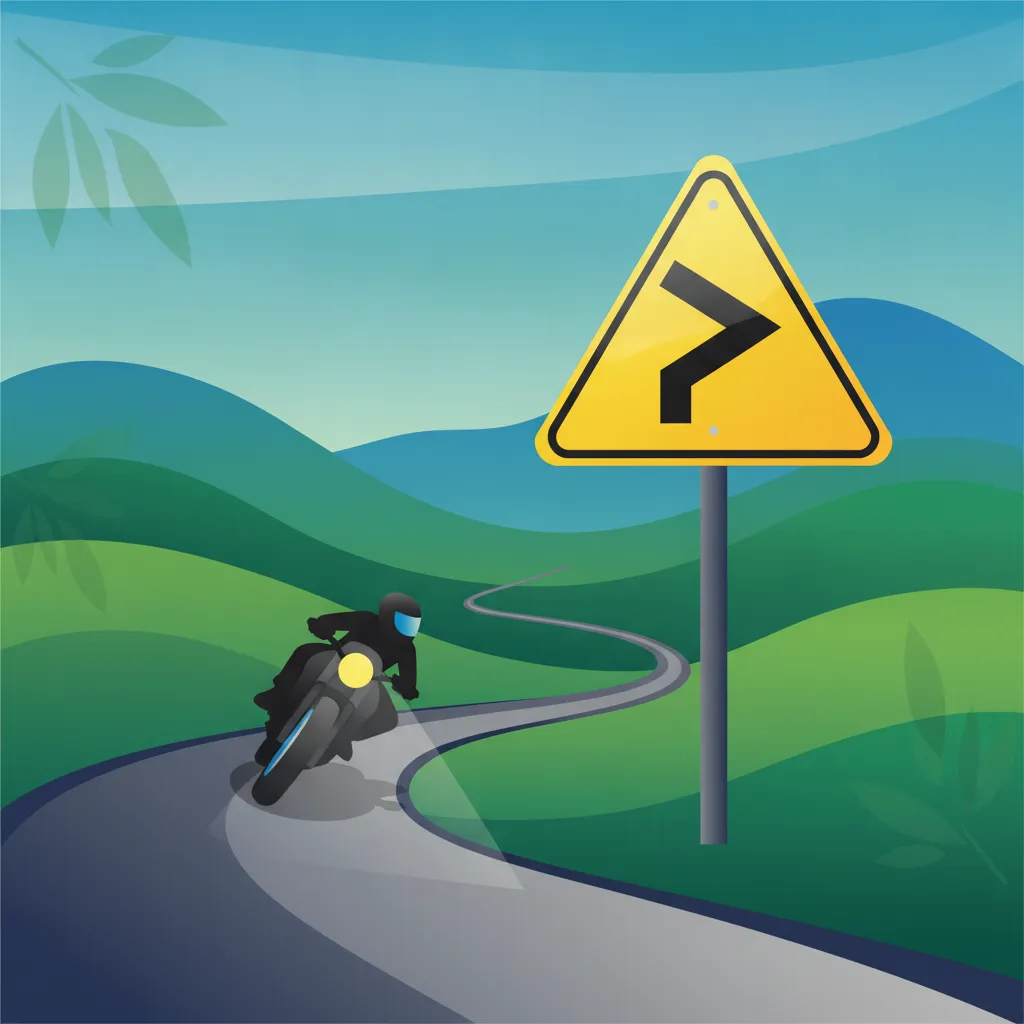
This lesson explains the function of warning signs, which are mostly triangular and alert road users to potential dangers ahead. You will learn to identify signs for bends, junctions, slippery surfaces, and other hazards particularly relevant to motorcyclists. Acting on these warnings allows a rider to adjust speed and position proactively, enhancing safety.

This lesson teaches you to interpret warning signs, which are typically triangular and designed to alert you to potential hazards ahead. You will learn the meanings of common signs indicating sharp curves, slippery surfaces, roadworks, or areas with frequent pedestrian or animal crossings. Understanding these signs is crucial for anticipating dangers and adjusting your speed and position defensively, which is especially important for vulnerable riders of AM vehicles.

This lesson teaches you to interpret warning signs, which are typically triangular with a red border. These signs are crucial for anticipating potential dangers, from changes in road layout to the presence of pedestrians or animals. By understanding these warnings, you can adjust your driving to safely navigate upcoming hazards.
Learn the official Highway Code rules regarding priority at junctions and roundabouts. This lesson covers correct lane positioning, how to interact with other road users, and the specific considerations for two-wheelers when navigating complex urban intersections and roundabouts in England, Scotland, and Wales.

This lesson clarifies who has priority at junctions, whether they are marked with signs and lines or are unmarked. It covers the fundamental rule for roundabouts in the UK: give priority to traffic approaching from your right. You will learn the correct procedures for approaching, signalling, and choosing the appropriate lane on roundabouts and at other junctions.

This lesson explains the critical rules of priority that govern traffic flow at junctions, roundabouts, and crossings throughout Great Britain. You will learn how to determine who has right-of-way at both marked and unmarked intersections, and the specific rules for giving way to traffic on roundabouts. The lesson also reinforces the hierarchy of road users from the Highway Code, ensuring you understand when to yield to pedestrians and other vulnerable users.

This lesson addresses the unique challenges of mini-roundabouts and large, multi-lane or spiral roundabouts. You will learn the subtle differences in rules and approach for mini-roundabouts and the importance of strict lane discipline on larger ones. The lesson stresses the need for advanced planning and awareness when navigating these complex junctions.
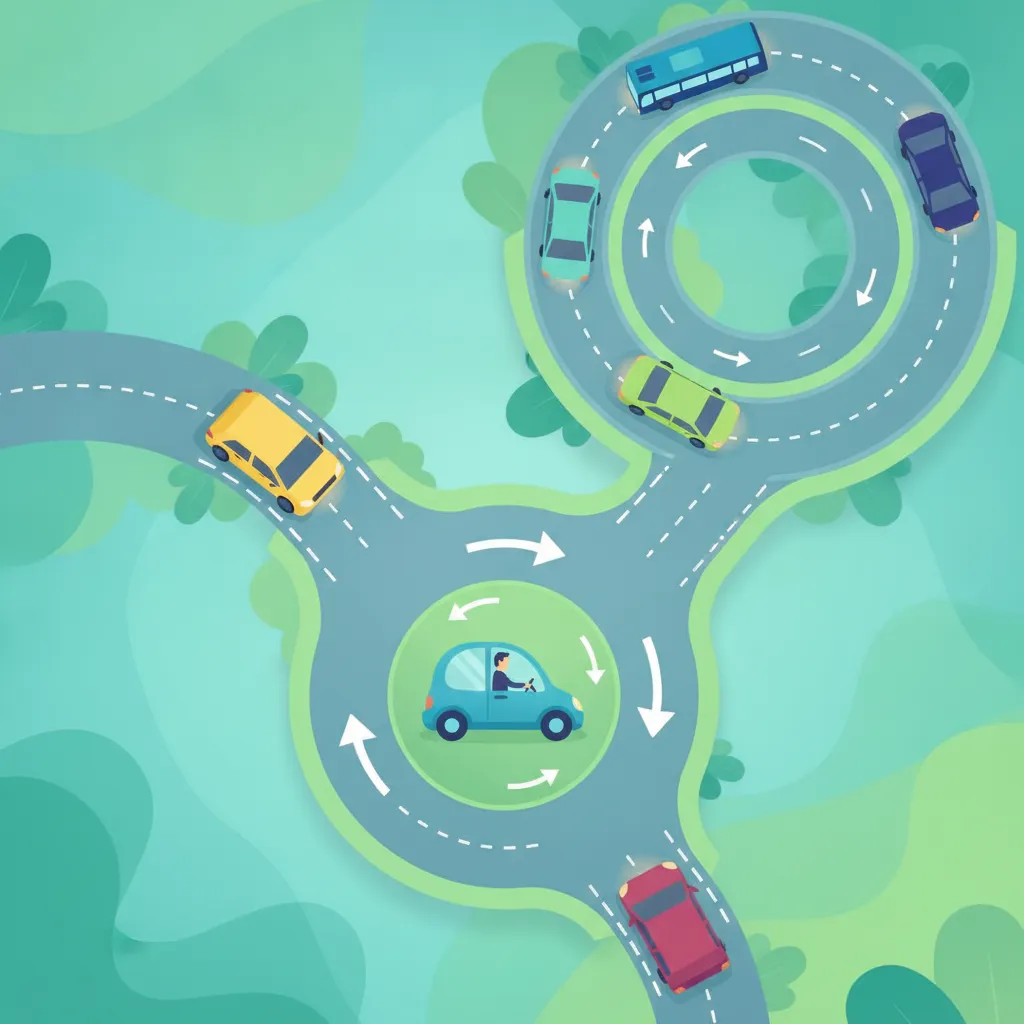
This lesson provides specific techniques for safely navigating the two main types of roundabouts in Great Britain. For multi-lane roundabouts, it covers how to choose the correct lane on approach, maintain your lane while circulating, and signal your exit correctly. It also explains the unique rules for mini-roundabouts, emphasizing the importance of giving way to traffic from the right and navigating them with caution due to their small size.

This lesson covers the operation of traffic light signals and the rules for approaching them safely. It also provides a detailed explanation of different pedestrian crossings, such as zebra, pelican, and toucan crossings, clarifying the specific rules and priority for each. You will learn to anticipate the actions of pedestrians and other vulnerable road users at these locations.

This lesson explains how to handle mini-roundabouts, which are common in urban and residential areas. The primary rule is to approach with caution and give priority to any traffic approaching from your right. You will also learn about correct signalling and the importance of being aware of cyclists and motorcyclists who may be harder to see.

This lesson details the priority rules for turning manoeuvres. When turning left, you generally have priority over traffic waiting to emerge from the side road. However, when turning right, you must give way to all oncoming traffic, positioning your vehicle safely in the centre of the road while you wait for a safe gap.

This lesson provides a step-by-step guide to dealing with roundabouts. It covers how to choose the correct lane on approach based on your destination, when and how to signal your intentions, and how to safely enter and exit the roundabout. Emphasis is placed on maintaining good observation and anticipating the actions of other drivers.

This lesson breaks down the process of navigating basic junctions. It emphasizes the importance of the Mirror-Signal-Manoeuvre (MSM) and Position-Speed-Look (PSL) routines. You will learn how to position your motorcycle correctly for turning, perform effective observation checks for traffic, and judge safe gaps before emerging.
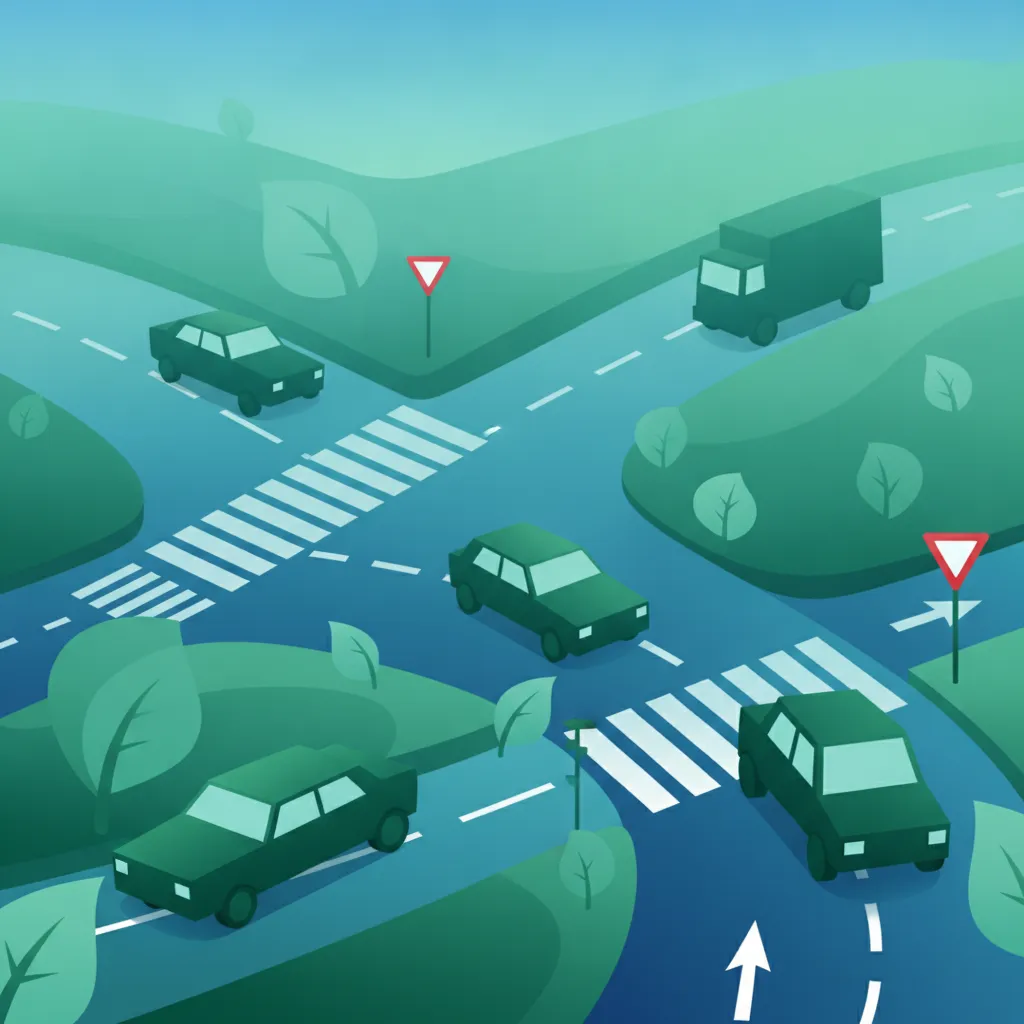
This lesson teaches the systematic approach to safely navigating junctions, emphasizing the importance of adjusting your speed and position well in advance. You will learn the 'Mirror-Signal-Manoeuvre' routine, how to perform effective all-round observation checks, and when to give way to other traffic. The content focuses on making safe judgments about gaps in traffic, a crucial skill for vulnerable AM riders when turning or emerging from a junction.
Find clear answers to common questions learners have about Regulatory Signs Specific to Motorcycles. Learn how the lesson is structured, which driving theory objectives it supports, and how it fits into the overall learning path of units and curriculum progression in Great Britain. These explanations help you understand key concepts, lesson flow, and exam focused study goals.
In Great Britain, circular signs are generally regulatory, meaning they give orders you must follow. Triangular signs are usually warning signs, designed to alert you to potential hazards ahead, such as junctions or bends.
Yes, a circular sign with a red border depicting a motorcycle indicates a prohibition for all two-wheeled motor vehicles. You must find an alternative route if you see this sign.
No, blue circular signs provide mandatory instructions, such as 'turn left' or 'ahead only'. Unlike blue information signs which are usually rectangular, these circular signs must be obeyed.
Signs are a core component of the theory test. You can expect multiple questions requiring you to identify specific regulatory signs and their implications for your position and speed on the road.
Dive into our comprehensive question bank to find exactly what you need for your Great Britain theory test. Use our advanced filters to pinpoint specific subjects or test your knowledge on challenging areas, ensuring you're fully prepared for success.