
This lesson focuses on the navigation of complex, multi-lane roundabouts common across Great Britain. It builds on your foundational understanding of priority rules to help you confidently select lanes and exit safely during your driving test.

Lesson content overview
Large roundabouts, often featuring multiple lanes and numerous exits, can appear daunting to new drivers. They demand a higher level of concentration, planning, and precise execution compared to smaller junctions. Mastering these complex intersections is essential for safe and efficient driving in Great Britain and is a key component of the Complete Theory for Great Britain Category B Learner Drivers curriculum. This lesson will provide a detailed guide to confidently navigating these challenging road features, ensuring you understand the necessary skills for your driving theory test and for safe driving on the roads.
Large and multi-lane roundabouts are designed to manage high volumes of traffic by allowing vehicles to flow continuously without the need for traditional traffic light stops at every junction. While efficient, their complexity arises from the need for drivers to make multiple decisions in a short timeframe, including lane selection, speed management, and accurate signalling. Misjudgements can lead to collisions, delays, and dangerous situations for all road users.
The principles discussed in previous lessons, such as understanding road markings, priority rules, and basic roundabout navigation, form the foundation for tackling these more complex scenarios. This chapter builds upon that knowledge, focusing on the specific challenges presented by roundabouts with more than one circulating lane or numerous exits. By distributing traffic across several lanes, these roundabouts reduce queue lengths but introduce additional decision points that require careful planning and execution.
Successfully navigating a large or multi-lane roundabout relies on adhering to several core principles. These principles help minimise conflict points, improve traffic flow, and, most importantly, prevent collisions. Each step is interconnected, contributing to a smooth and predictable driving experience.
Advance lane selection is the critical first step when approaching any multi-lane roundabout. It involves identifying and occupying the correct lane well before you enter the roundabout, based on road signs, markings, and your intended exit. This proactive approach significantly reduces the need for hazardous lane changes once inside the circulatory system.
Drivers should actively scan for advance signage that typically indicates which lane leads to which exit or range of exits. These signs may use arrows or destination names to guide you. For example, a sign might indicate that the left lane is for the first and second exits, while the right lane serves the third exit and beyond. Making this decision early allows you to adjust your speed and position smoothly, rather than attempting last-minute manoeuvres.
Once you have entered a multi-lane roundabout, strict lane discipline is paramount. This means staying within the lane you initially selected throughout your circulatory movement, unless specific road markings or signs explicitly indicate that a lane change is permitted or required. Unnecessary lane changes within a roundabout are a common cause of side-swipe collisions and can create unpredictable situations for other drivers.
Always observe the painted lane markings on the roundabout itself. Solid white lines usually indicate that lane changes are prohibited, while dashed lines might permit a change, provided it is safe to do so and guided by arrows. Maintaining your lane ensures that vehicles on adjacent lanes can also proceed predictably, reducing conflict and enhancing overall safety.
Effective signalling is crucial for communicating your intentions to other road users, allowing them to anticipate your movements and react accordingly. On large and multi-lane roundabouts, the timing of your signal is particularly important to avoid confusion. The standard rule is to signal your intended exit after you have passed the exit immediately preceding your desired one.
For example, if you plan to take the third exit, you should activate your left indicator (for a left turn) or right indicator (for a right turn, then switch to left when exiting) only after your vehicle has passed the second exit. This timing ensures that drivers waiting to enter the roundabout, or those circulating behind you, clearly understand which exit you intend to use. An early signal can mislead others into thinking you are taking an earlier exit, potentially causing them to pull out into your path or brake unnecessarily. Maintain your signal for at least 2-3 seconds before leaving the roundabout to give ample warning.
Beyond just selecting the correct lane on approach, your vehicle's positioning within that lane as you circulate the roundabout is also important for a smooth and safe exit. This is known as exit positioning. The goal is to align your vehicle's trajectory with the road geometry of your intended exit, minimising unnecessary steering adjustments or crossing of lane lines.
For most clockwise roundabouts in Great Britain, if you are taking an early exit (typically the first or second), you will likely be in an outer lane. For later exits (third, fourth, or beyond), you will generally use an inner lane. As you approach your intended exit, ensure you are positioned to smoothly transition into the exit slip road without drifting into adjacent lanes or forcing other drivers to react. The Highway Code provides specific guidance on lane usage for different exits.
Speed management is fundamental to safe roundabout navigation. A reduced speed on approach, while circulating, and when exiting provides crucial time for observation, decision-making, and reaction. Entering a large roundabout at excessive speed can drastically cut down your reaction time, making it difficult to select the correct lane, give way to circulating traffic, or respond to unexpected hazards.
Typically, speeds between 15-30 mph are appropriate for navigating large roundabouts, depending on their size, the prevailing conditions, and any posted speed limits. Gradually reduce your speed on the approach to allow for thorough observation of road signs, markings, and other traffic. Maintain a steady, controlled speed while circulating, and then gently accelerate as you leave the roundabout onto the main road, ensuring a safe merge with any ongoing traffic.
Road signage and markings are your primary guides when approaching large and multi-lane roundabouts. They provide essential information that dictates lane usage, warns of upcoming layouts, and indicates destinations. Learning to interpret these visual cues effectively and early is a cornerstone of safe navigation.
These are perhaps the most important signs for multi-lane roundabouts. They are often displayed on large gantries overhead or on the left-hand side of the road as you approach. They use arrows and text to clearly show which lane you need to be in for your desired exit or destination. For example:
Always follow these signs, even if your initial instinct for a smaller roundabout might differ. They supersede general rules in specific multi-lane configurations.
These signs alert you to the presence of a multi-lane roundabout well before you reach it, giving you time to prepare. They often depict the roundabout layout and may include initial guidance on lane usage.
These signs indicate the names of towns, cities, or specific locations accessible from each exit. Cross-referencing destination signs with lane direction signs ensures you are in the correct lane for your ultimate journey.
Ignoring or misinterpreting these signs is a common cause of driving errors on large roundabouts, leading to late lane changes, confusion, and potential collisions. Always take the time to read them carefully and make your lane decision well in advance.
Large roundabouts are not just about managing vehicle traffic; they also frequently interact with pedestrians and cyclists. Drivers must be acutely aware of vulnerable road users and adapt their driving to ensure their safety.
Cyclists often use the outer lane of roundabouts. In Great Britain, the Highway Code advises cyclists to take the primary position (in the centre of the lane) when approaching and negotiating roundabouts, especially if they feel it is safer to do so, to make themselves more visible and prevent drivers from trying to overtake them in the same lane. As a driver, you must be particularly vigilant for cyclists in the outer lane, especially when you are exiting.
Never cut across the path of a cyclist when you are exiting a roundabout. Always check your mirrors and perform a shoulder check (blind spot check) before moving towards an exit, even if you believe you are in the correct lane. Give cyclists ample space and be prepared to slow down or wait if necessary to allow them to proceed safely.
Many large roundabouts, particularly in urban areas, feature pedestrian crossings on the slip roads that lead off the roundabout. These crossings are often marked with zig-zag lines and may be zebra crossings, signal-controlled crossings, or simply unmarked courtesy crossings.
Highway Code Rule 225 states that drivers must give way to pedestrians on footway crossings at slip roads exiting a roundabout. This means if you are exiting a roundabout and there are pedestrians waiting to cross or already on the crossing, you must stop and allow them to pass safely before continuing your exit. Failing to do so can result in serious injury to pedestrians and legal penalties.
Navigating large and multi-lane roundabouts is governed by specific rules outlined in The Highway Code. Adherence to these regulations is mandatory for all drivers.
Even experienced drivers can make errors on multi-lane roundabouts. Awareness of common pitfalls can help Great Britain Category B learner drivers avoid them.
Driving conditions can significantly impact how you navigate large roundabouts. Safe driving involves adapting your approach based on the environment and specific circumstances.
The rules and principles for navigating large roundabouts are not arbitrary; they are rooted in driving physics, human psychology, and collision data.
Navigating large and multi-lane roundabouts is a fundamental skill for all Great Britain Category B learner drivers. It demands careful planning, precise execution, and a thorough understanding of The Highway Code. By consistently applying the principles of advance lane selection, strict lane discipline, correct signalling, and appropriate speed management, you can approach these complex junctions with confidence and ensure the safety of yourself and other road users. Remember to always scan for vulnerable road users and adapt your driving to the prevailing conditions. Mastery of these roundabouts is a clear sign of a competent and responsible driver.
Explore all units and lessons included in this driving theory course.
Lesson content overview
Explore all units and lessons included in this driving theory course.
Explore search topics learners often look for when studying Large Roundabouts and Multi‑Lane Roundabouts. These topics reflect common questions about road rules, driving situations, safety guidance, and lesson level theory preparation for learners in Great Britain.
Browse additional driving theory lessons that cover connected traffic rules, road signs, and common driving situations related to this topic. Improve your understanding of how different rules interact across everyday traffic scenarios.
Learn advanced strategies for navigating large, multi-lane roundabouts, including complex lane discipline, signalling, and dealing with specific Great Britain road conditions. Essential theory for confident driving.
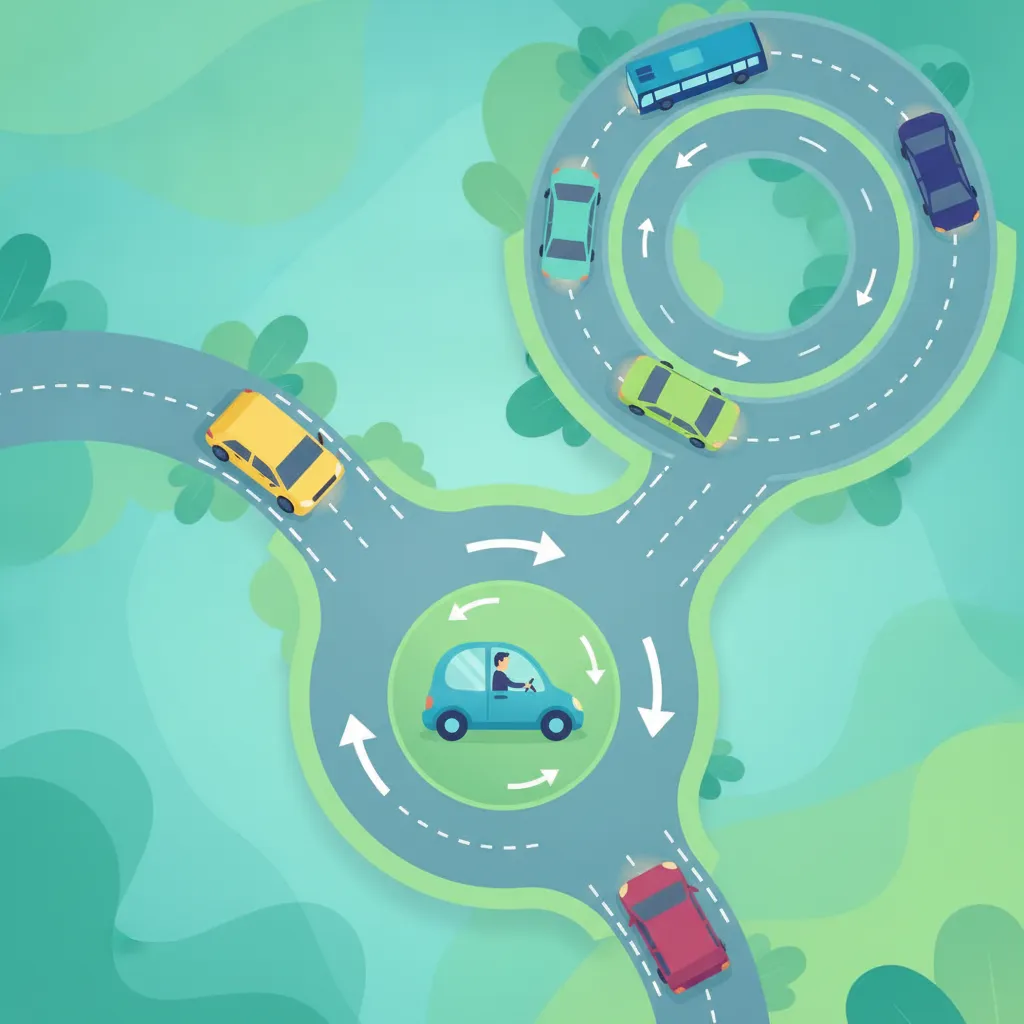
This lesson provides specific techniques for safely navigating the two main types of roundabouts in Great Britain. For multi-lane roundabouts, it covers how to choose the correct lane on approach, maintain your lane while circulating, and signal your exit correctly. It also explains the unique rules for mini-roundabouts, emphasizing the importance of giving way to traffic from the right and navigating them with caution due to their small size.

This lesson addresses the unique challenges of mini-roundabouts and large, multi-lane or spiral roundabouts. You will learn the subtle differences in rules and approach for mini-roundabouts and the importance of strict lane discipline on larger ones. The lesson stresses the need for advanced planning and awareness when navigating these complex junctions.
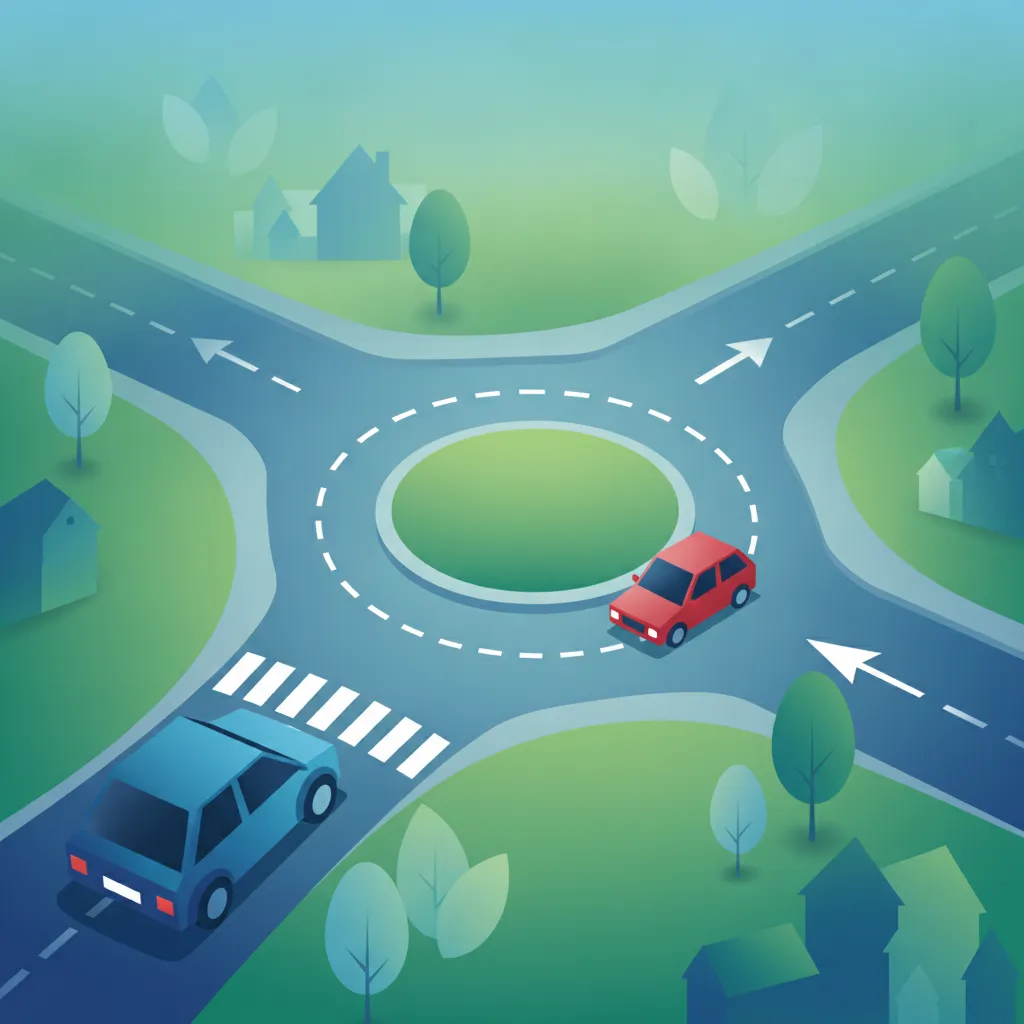
This lesson explains how to handle mini-roundabouts, which are common in urban and residential areas. The primary rule is to approach with caution and give priority to any traffic approaching from your right. You will also learn about correct signalling and the importance of being aware of cyclists and motorcyclists who may be harder to see.
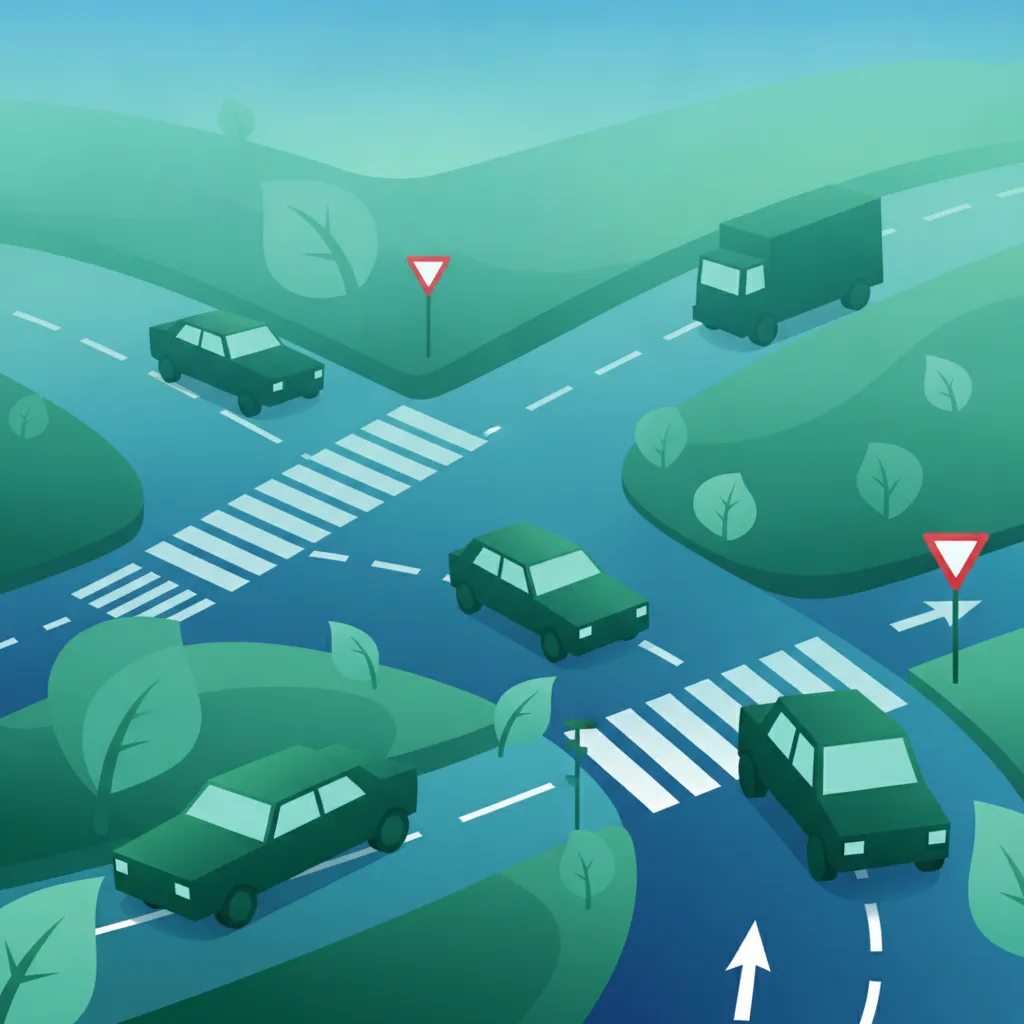
This lesson teaches the systematic approach to safely navigating junctions, emphasizing the importance of adjusting your speed and position well in advance. You will learn the 'Mirror-Signal-Manoeuvre' routine, how to perform effective all-round observation checks, and when to give way to other traffic. The content focuses on making safe judgments about gaps in traffic, a crucial skill for vulnerable AM riders when turning or emerging from a junction.

This lesson provides a step-by-step guide to dealing with roundabouts. It covers how to choose the correct lane on approach based on your destination, when and how to signal your intentions, and how to safely enter and exit the roundabout. Emphasis is placed on maintaining good observation and anticipating the actions of other drivers.

This lesson details how to safely navigate junctions controlled by traffic signals. It explains the meaning of filter arrows, which allow you to proceed in a specific direction even if the main light is red. You will also learn about respecting advanced stop lines for cyclists and how to approach a junction when the traffic lights are not working.

This lesson addresses the unique challenges of driving a large vehicle on rural roads. It provides techniques for positioning the vehicle through sharp bends and on narrow lanes, and for safely navigating unmarked or uncontrolled junctions. Learners will be taught to anticipate hidden hazards common in the countryside, such as slow-moving farm vehicles, animals on the road, and concealed entrances. The correct use of passing places and strategies for meeting oncoming traffic are also covered.

This lesson focuses on the markings that control traffic at intersections. It explains the primary rule of a yellow box junction: do not enter unless your exit is clear. You will also learn the difference between the solid white 'Stop' line and the broken 'Give Way' line, which dictate your priority over other traffic.

This lesson contrasts the challenges of different road types. It covers how to handle the hidden bends, poor surfaces, and unexpected hazards of rural roads. It then details the specific procedures for using dual carriageways and motorways, including using slip roads, adhering to strict lane discipline, and safely overtaking at high speeds.

This lesson covers the unique aspects of motorway driving, from joining and leaving the carriageway to the strict lane discipline of keeping to the left unless overtaking. It explains the features of smart motorways, such as variable speed limits and the meaning of a Red X symbol above a lane. The safe procedure for handling a breakdown is also a key topic.
Understand how to safely share large roundabouts with vulnerable road users like cyclists and pedestrians. Covers essential Highway Code rules for visibility, signalling, and yielding on GB roads.
This lesson explains how to handle mini-roundabouts, which are common in urban and residential areas. The primary rule is to approach with caution and give priority to any traffic approaching from your right. You will also learn about correct signalling and the importance of being aware of cyclists and motorcyclists who may be harder to see.
This lesson provides specific techniques for safely navigating the two main types of roundabouts in Great Britain. For multi-lane roundabouts, it covers how to choose the correct lane on approach, maintain your lane while circulating, and signal your exit correctly. It also explains the unique rules for mini-roundabouts, emphasizing the importance of giving way to traffic from the right and navigating them with caution due to their small size.
This lesson teaches the systematic approach to safely navigating junctions, emphasizing the importance of adjusting your speed and position well in advance. You will learn the 'Mirror-Signal-Manoeuvre' routine, how to perform effective all-round observation checks, and when to give way to other traffic. The content focuses on making safe judgments about gaps in traffic, a crucial skill for vulnerable AM riders when turning or emerging from a junction.

This lesson is dedicated to the safe interaction between large vehicles and the most vulnerable road users: pedestrians and cyclists. It highlights high-risk scenarios, such as left turns at junctions, where cyclists can be hidden in nearside blind spots. The content stresses the importance of anticipation, using signals clearly, and providing generous space at crossings, in cycle lanes, and within pedestrianized zones to prevent tragic accidents.

This lesson focuses on safe interaction with cyclists, a key aspect of urban driving for PCV operators. It details the rules for cycle lanes and advanced stop lines, and the correct procedure for overtaking cyclists, emphasizing the need to provide ample space. The content stresses the importance of frequent mirror checks to manage blind spots where cyclists can be hidden, especially when turning at junctions, to ensure their safety and comply with the Highway Code's road user hierarchy.
This lesson provides a step-by-step guide to dealing with roundabouts. It covers how to choose the correct lane on approach based on your destination, when and how to signal your intentions, and how to safely enter and exit the roundabout. Emphasis is placed on maintaining good observation and anticipating the actions of other drivers.
This lesson details how to safely navigate junctions controlled by traffic signals. It explains the meaning of filter arrows, which allow you to proceed in a specific direction even if the main light is red. You will also learn about respecting advanced stop lines for cyclists and how to approach a junction when the traffic lights are not working.

This lesson explains the critical rules of priority that govern traffic flow at junctions, roundabouts, and crossings throughout Great Britain. You will learn how to determine who has right-of-way at both marked and unmarked intersections, and the specific rules for giving way to traffic on roundabouts. The lesson also reinforces the hierarchy of road users from the Highway Code, ensuring you understand when to yield to pedestrians and other vulnerable users.

This lesson focuses on the safe interaction between cars and bicycles. It covers the importance of giving cyclists ample room when overtaking—at least 1.5 metres—and looking for them before turning or changing lanes. You will also learn about cyclist-specific infrastructure like cycle lanes and how to use the 'Dutch Reach' method to open your car door safely.
This lesson addresses the unique challenges of mini-roundabouts and large, multi-lane or spiral roundabouts. You will learn the subtle differences in rules and approach for mini-roundabouts and the importance of strict lane discipline on larger ones. The lesson stresses the need for advanced planning and awareness when navigating these complex junctions.
Find clear answers to common questions learners have about Large Roundabouts and Multi‑Lane Roundabouts. Learn how the lesson is structured, which driving theory objectives it supports, and how it fits into the overall learning path of units and curriculum progression in Great Britain. These explanations help you understand key concepts, lesson flow, and exam focused study goals.
Unless signs or markings indicate otherwise, use the left lane for the first exit (turning left), the right lane for the third exit or beyond (turning right), and the left or appropriate lane for straight ahead. Always check your mirrors and signal your intention clearly.
You must signal left after you have passed the exit before the one you intend to take. If you are taking the first exit, signal left from the approach.
Generally, you should select the correct lane on the approach and stay in it. However, if you must change lanes, ensure you signal your intention, check your mirrors, and observe your blind spot before moving into the new lane, provided it is safe to do so.
The examiner will assess your ability to position your car early and follow lane markings correctly. Failing to observe signs or moving erratically between lanes are common reasons for test failures, so mastering these rules now is vital.
Dive into our comprehensive question bank to find exactly what you need for your Great Britain theory test. Use our advanced filters to pinpoint specific subjects or test your knowledge on challenging areas, ensuring you're fully prepared for success.