
Driving in rain requires significant adjustments to speed, following distance, and observation. In Great Britain, the Highway Code (Rule 227) stresses the increased risks of reduced tyre grip, longer braking distances, and hydroplaning, all vital for theory test success and real-world road safety. You must also use headlights when visibility drops below 100 metres.
Theory topic content overview
Read the full theory topic guide for Driving in Rain with structured, easy-to-scan content built for learners in Great Britain. This detailed section explains the exact rule, meaning, traffic context, comparison points, and exam logic behind this British driving theory topic so you can study faster, understand the concept more clearly, and avoid common interpretation mistakes on the theory test.
Driving in rain is a frequent reality across Great Britain, and it presents a significant increase in risks compared to driving on dry roads. For your driving theory test and for safe practical driving, it's crucial to understand how wet conditions impact your vehicle's performance and your ability to see and react. The main challenges are:
Recognising and actively managing these compounded risks is fundamental for all drivers in the UK.
The most critical effect of rain is the reduction in friction between your tyres and the road. This 'loss of grip' is what underpins most wet weather driving hazards.
When it rains, the water on the road surface prevents your tyres from making full contact with the tarmac. This drastically reduces the grip needed to slow down or stop.
This doubling of stopping distance is a key piece of information for the Great Britain driving theory test and a fundamental rule of safe driving in the UK. Failing to account for this is a common cause of collisions in wet weather.
Hydroplaning, also known as aquaplaning in the UK, is a particularly dangerous phenomenon that can occur when driving in rain.
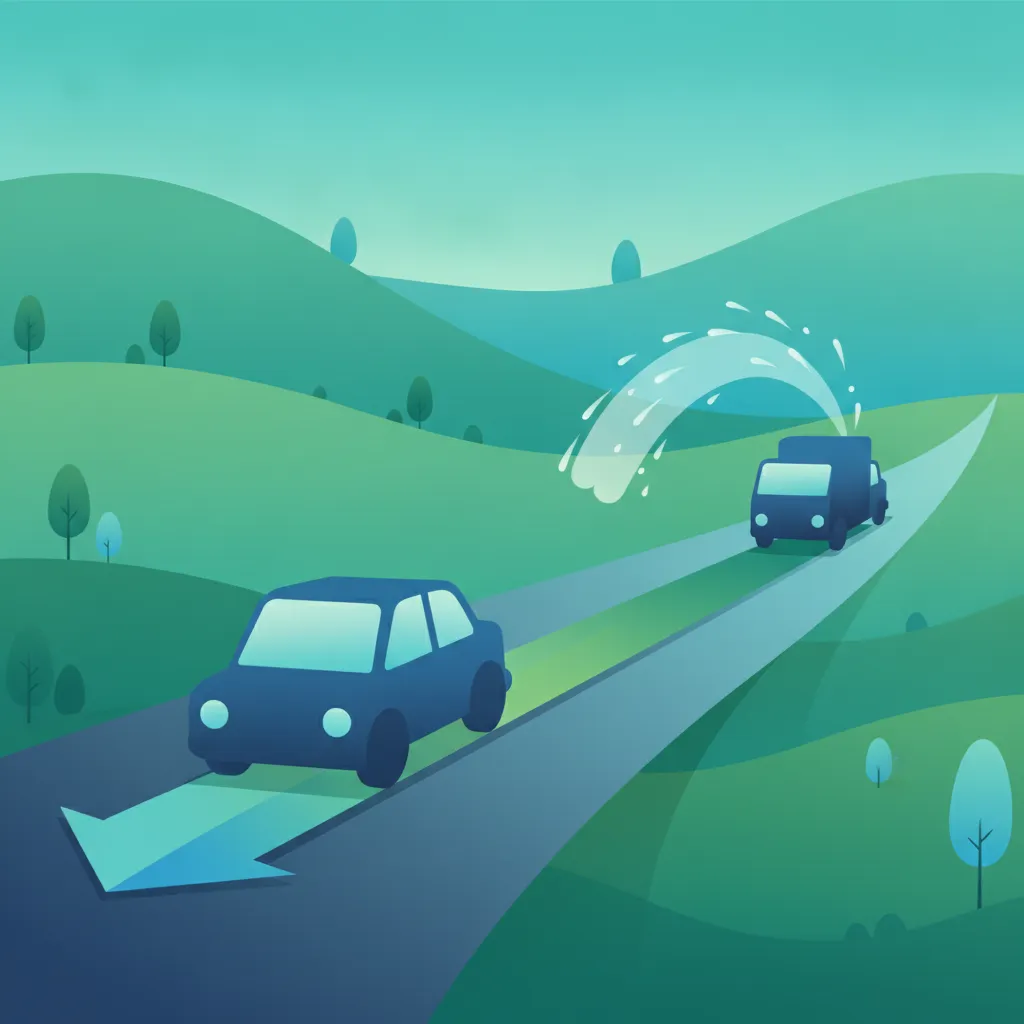
Hydroplaning happens when your tyres encounter more water than they can displace. Instead of cutting through the water to maintain contact with the road, a layer of water builds up beneath the tyres, causing them to lift off the road surface. When this occurs, you lose all steering and braking control, as your vehicle is essentially floating on water.
If you feel your steering becoming suddenly light or unresponsive, it probably means your tyres are losing grip on the road:
Rain significantly degrades visibility, making it harder for you to see hazards and for other road users to see you.
The Highway Code provides clear rules for light use in adverse weather:
Ensure your windscreen wipers are in good condition and switch them on as soon as rain starts. Use your demister to prevent windows from fogging up internally.
To drive safely in rain in the UK, you must proactively adjust your driving style.
Theory test questions frequently target knowledge about adverse weather, and practical driving instructors in Great Britain will expect you to demonstrate safe wet weather techniques. Common mistakes include:
Always remember the core principle for driving in rain in Great Britain: "Slow down, space out, and light up." Your stopping distances are at least double, so give yourself twice the room and halve your haste. Proactive adjustments to your speed and following distance, coupled with correct use of lighting, are your best defence against the increased risks of wet weather on UK roads.
Driving in rain across Great Britain requires significant adjustments to maintain safety, primarily because wet roads reduce tyre grip and at least double stopping distances according to Highway Code Rule 227. Hydroplaning poses a critical risk when tyres cannot displace water, and the correct response is to ease off the accelerator while keeping the steering straight until grip is restored. Visibility rules under Rule 226 require dipped headlights when you cannot see more than 100 metres ahead, and drivers should increase their following distance to at least a 4-second gap. Smooth, anticipatory driving with appropriately maintained tyres and functioning lights are essential for both passing the theory test and driving safely in Great Britain's wet weather conditions.
A short set of high-value points that capture the most important ideas from this theory explanation.
Stopping distances are at least double on wet roads compared to dry conditions, according to Highway Code Rule 227
Hydroplaning occurs when tyres lose contact with the road and you lose steering control; ease off the accelerator and keep the wheel straight to recover
You must use dipped headlights when visibility drops below 100 metres (328 feet) in rain
Increase your following distance to at least a 4-second gap in wet conditions compared to the 2-second rule for dry roads
Worn tyres significantly increase the risk of aquaplaning because they cannot effectively channel water away
Rule 226: Use dipped headlights (not full beam) when visibility is seriously reduced below 100 metres
Rule 227: Wet road stopping distances are at least double dry road stopping distances
If you aquaplane, ease off the accelerator smoothly, do not brake harshly, and keep steering straight until grip returns
Front and rear fog lights may only be used in seriously reduced visibility and must be switched off once visibility improves
After driving through deep water, lightly apply brakes several times to help dry them out and check they work
Assuming stopping distances are only slightly longer in rain rather than understanding they at least double
Using full beam headlights in heavy rain, which reflects off water particles and worsens visibility
Making sudden steering, braking, or acceleration inputs that can cause a skid on wet roads
Failing to anticipate reduced visibility from spray thrown up by lorries and buses on motorways
Not giving large vehicles adequate space when their spray may temporarily blind you
Start with a short, direct summary of Driving in Rain before reading the full explanation below.
When driving in rain in Great Britain, your stopping distance will be at least double that on dry roads due to reduced tyre grip. You must reduce your speed, increase your following distance, and use dipped headlights if visibility is seriously reduced (less than 100 metres). Be alert for spray from other vehicles and the risk of hydroplaning, where tyres lose contact with the road surface.
Review the most important terms, rule signals, and traffic concepts linked to Driving in Rain.
Explore related theory topic pages connected to Driving in Rain and continue with the next useful rule explanation.
See the common search queries learners use when trying to understand Driving in Rain in Great Britain.

Continue your journey to a successful Great Britain driving theory test by delving deeper into specific topics. Enhance your understanding of complex rules, review detailed explanations, and solidify your knowledge of the Highway Code, preparing you thoroughly for all aspects of the official DVSA exam. Start mastering key concepts today.
Great Britain Driving Theory TopicsTheory topic content overview
A short set of high-value points that capture the most important ideas from this theory explanation.
Stopping distances are at least double on wet roads compared to dry conditions, according to Highway Code Rule 227
Hydroplaning occurs when tyres lose contact with the road and you lose steering control; ease off the accelerator and keep the wheel straight to recover
You must use dipped headlights when visibility drops below 100 metres (328 feet) in rain
Increase your following distance to at least a 4-second gap in wet conditions compared to the 2-second rule for dry roads
Worn tyres significantly increase the risk of aquaplaning because they cannot effectively channel water away
Rule 226: Use dipped headlights (not full beam) when visibility is seriously reduced below 100 metres
Rule 227: Wet road stopping distances are at least double dry road stopping distances
If you aquaplane, ease off the accelerator smoothly, do not brake harshly, and keep steering straight until grip returns
Front and rear fog lights may only be used in seriously reduced visibility and must be switched off once visibility improves
After driving through deep water, lightly apply brakes several times to help dry them out and check they work
Assuming stopping distances are only slightly longer in rain rather than understanding they at least double
Using full beam headlights in heavy rain, which reflects off water particles and worsens visibility
Making sudden steering, braking, or acceleration inputs that can cause a skid on wet roads
Failing to anticipate reduced visibility from spray thrown up by lorries and buses on motorways
Not giving large vehicles adequate space when their spray may temporarily blind you
Start with a short, direct summary of Driving in Rain before reading the full explanation below.
When driving in rain in Great Britain, your stopping distance will be at least double that on dry roads due to reduced tyre grip. You must reduce your speed, increase your following distance, and use dipped headlights if visibility is seriously reduced (less than 100 metres). Be alert for spray from other vehicles and the risk of hydroplaning, where tyres lose contact with the road surface.
Review the most important terms, rule signals, and traffic concepts linked to Driving in Rain.
Explore related theory topic pages connected to Driving in Rain and continue with the next useful rule explanation.
See the common search queries learners use when trying to understand Driving in Rain in Great Britain.
Continue your journey to a successful Great Britain driving theory test by delving deeper into specific topics. Enhance your understanding of complex rules, review detailed explanations, and solidify your knowledge of the Highway Code, preparing you thoroughly for all aspects of the official DVSA exam. Start mastering key concepts today.
Great Britain Driving Theory TopicsUse this exam-focused revision tip to understand how Driving in Rain is likely to appear in theory questions for learners in Great Britain. This section helps you identify the most testable part of the rule, avoid common traps, and remember the concept more effectively during British driving theory exam preparation.
A common theory test trap focuses on wet weather. Remember that stopping distances are at least DOUBLE on wet roads, not just slightly increased. Also, always use dipped headlights if visibility is seriously reduced (under 100 metres) and maintain a significantly larger gap to the vehicle in front.
Read direct answers to the most common learner questions about Driving in Rain in Great Britain. This FAQ focuses on rule confusion, practical meaning, comparison with similar concepts, and the exact uncertainties that appear most often in British driving theory revision and exam preparation.
According to the Highway Code (Rule 227), stopping distances in wet weather in Great Britain will be at least double those required for stopping on dry roads.
You MUST use headlights when visibility is seriously reduced, generally when you cannot see for more than 100 metres (328 feet). Dipped headlights are usually appropriate in rain, as advised by the Highway Code (Rule 226).
Hydroplaning, also known as aquaplaning, occurs when your tyres lose contact with the road surface due to a layer of water, causing you to lose steering and braking control. To prevent it, reduce your speed, ensure your tyres have good tread, and avoid sudden steering or braking movements.
The Highway Code advises keeping 'well back' from the vehicle in front in wet weather. If spray is causing poor visibility, a greater separation distance, such as at least a 4-second time gap, is recommended.
If your steering becomes unresponsive, it likely means water is preventing your tyres from gripping the road (hydroplaning). Ease off the accelerator and slow down gradually without sudden braking or steering. Once your tyres regain grip, you can steer normally.
On motorways in heavy rain, specific rules are not added, but the general wet weather rules apply: reduce speed, increase following distance, use dipped headlights if visibility is seriously reduced, and be highly aware of spray and hydroplaning risks. Avoid using rear fog lights unless visibility is severely impacted, and switch them off once conditions improve.
Dive into our comprehensive question bank to find exactly what you need for your Great Britain theory test. Use our advanced filters to pinpoint specific subjects or test your knowledge on challenging areas, ensuring you're fully prepared for success.