
Driving at night presents distinct challenges that require careful attention and adapted driving techniques. Reduced visibility limits your perception of the road and potential hazards, while glare from other vehicles can temporarily impair your vision. Understanding these factors is crucial for maintaining safety and mastering the Code de la route principles for night driving.
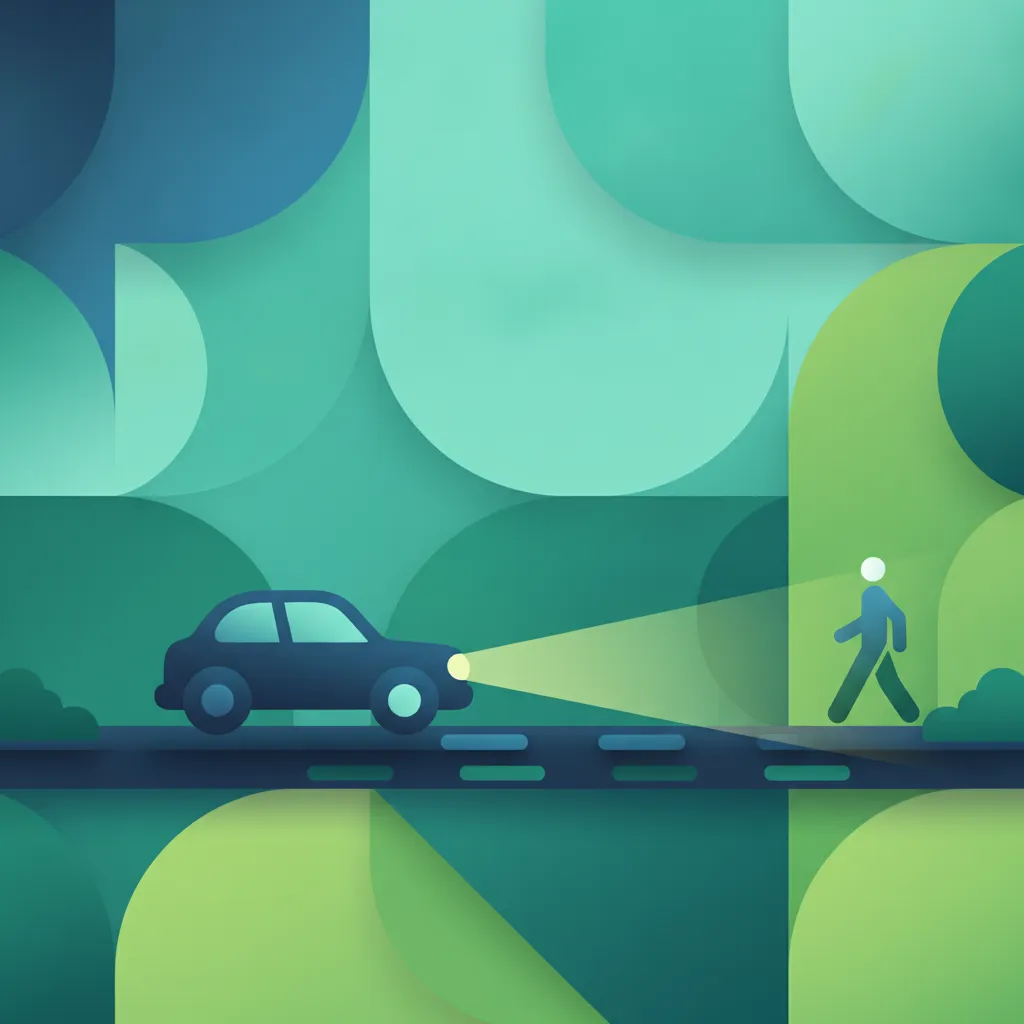
Theory topic content overview
Read the full theory topic guide for Night Driving Safety with structured, easy-to-scan content built for learners in France. This detailed section explains the exact rule, meaning, traffic context, comparison points, and exam logic behind this French driving theory topic so you can study faster, understand the concept more clearly, and avoid common interpretation mistakes on the theory test.
Driving at night introduces a unique set of challenges that significantly increase the demands on a driver. Unlike daytime conditions, darkness drastically reduces visibility, demanding precise adjustments to speed, observation, and hazard detection. For the French driving license theory exam (ETG), understanding these specific difficulties and how to mitigate them is crucial for safe driving and passing your permis de conduire tests.
The fundamental issue when driving at night is limited visibility. Your vision, aided only by your vehicle's headlights and any ambient lighting, is significantly restricted compared to daylight hours. This means:
This reduction in visibility directly impacts your ability to react safely, forming the basis of why night driving demands such careful attention within the Code de la route.
Understanding and adapting to night driving conditions is not just about avoiding a fine; it's a critical safety skill frequently assessed in the French driving theory exam.
Effective night driving requires a conscious shift in your approach behind the wheel.
This is arguably the most critical rule for safe night driving in France and elsewhere. You must be able to stop your vehicle safely within the distance you can clearly see ahead with your headlights.
The Code de la route has specific requirements for headlight use, vital for both seeing and being seen.
Several elements can further complicate driving at night:
French driving instructors and theory examiners highlight several frequent errors:
The official French driving theory emphasizes that the driver is responsible for adapting their driving to the conditions. For night driving, this means:
When driving at night, adopt a mental framework: "Your visible distance dictates your safe speed." Always ensure you can stop safely within the range of your headlights. Maintain pristine visibility, use your lights correctly according to the Code de la route, manage glare, and never underestimate the impact of fatigue. These principles are your best defense against the unique challenges of driving in darkness on French roads.
Night driving in France requires adapting your speed to match your visible distance, which is limited to approximately 30 meters with dipped beams or 100 meters with main beams. The Code de la route mandates dipped beam headlights from sunset to sunrise and strictly prohibits main beam use when other road users are present to avoid dazzling. Pedestrians and cyclists wearing dark clothing are particularly hazardous because they blend into the background and are detected late. Fatigue significantly compounds these risks, making slower speeds and heightened alertness essential for maintaining a safe stopping distance within your illuminated range.
A short set of high-value points that capture the most important ideas from this theory explanation.
Your visible distance—the range illuminated by your headlights—must always be greater than your stopping distance
Dipped beam headlights (feux de croisement) illuminate approximately 30 meters and are the mandatory default for night driving in France
Main beam headlights (feux de route) can illuminate up to 100 meters but are only permitted on unlit roads with no other road users present
Driving faster than your visible distance allows you to stop is the most dangerous and common night driving mistake
Glare management requires shifting your gaze slightly to the right edge of your lane when oncoming vehicles approach
Dipped beam range: ~30 meters; main beam range: ~100 meters
Switch to dipped beam immediately when approaching or following another vehicle to avoid dazzling
At night, safe speed is almost always lower than the posted speed limit due to reduced visibility
Pedestrians and cyclists in dark clothing are easily camouflaged and require extra caution, especially in urban areas
Driver fatigue is amplified at night due to natural circadian rhythms—pull over if you feel tired
Driving at the posted speed limit without adjusting speed to match reduced visible distance
Failing to switch from main beam to dipped beam when encountering oncoming traffic, dazzling other drivers
Confusing parking lights (feux de position) with driving lights—parking lights are for stationary vehicles only
Not actively scanning verges and roadside areas where pedestrians or animals may be camouflaged
Neglecting windshield and headlight cleanliness, which significantly reduces visibility effectiveness
Start with a short, direct summary of Night Driving Safety before reading the full explanation below.
Driving at night requires drivers to significantly adjust their speed and observation due to reduced visibility, headlight glare, and increased risk of fatigue. Your ability to detect hazards, pedestrians, and road signs is limited by the range of your headlights, necessitating slower speeds and heightened awareness to stop safely within your visible distance.
Review the most important terms, rule signals, and traffic concepts linked to Night Driving Safety.
Explore related theory topic pages connected to Night Driving Safety and continue with the next useful rule explanation.
See the common search queries learners use when trying to understand Night Driving Safety in France.

Continue your journey by exploring specific French driving theory topics, from road signs and priority rules to vehicle safety and administrative procedures. Deepen your understanding of the Code de la route and prepare effectively for your permis de conduire ETG exam to ensure success and safe driving practices.
French Driving Theory Topics & RulesTheory topic content overview
A short set of high-value points that capture the most important ideas from this theory explanation.
Your visible distance—the range illuminated by your headlights—must always be greater than your stopping distance
Dipped beam headlights (feux de croisement) illuminate approximately 30 meters and are the mandatory default for night driving in France
Main beam headlights (feux de route) can illuminate up to 100 meters but are only permitted on unlit roads with no other road users present
Driving faster than your visible distance allows you to stop is the most dangerous and common night driving mistake
Glare management requires shifting your gaze slightly to the right edge of your lane when oncoming vehicles approach
Dipped beam range: ~30 meters; main beam range: ~100 meters
Switch to dipped beam immediately when approaching or following another vehicle to avoid dazzling
At night, safe speed is almost always lower than the posted speed limit due to reduced visibility
Pedestrians and cyclists in dark clothing are easily camouflaged and require extra caution, especially in urban areas
Driver fatigue is amplified at night due to natural circadian rhythms—pull over if you feel tired
Driving at the posted speed limit without adjusting speed to match reduced visible distance
Failing to switch from main beam to dipped beam when encountering oncoming traffic, dazzling other drivers
Confusing parking lights (feux de position) with driving lights—parking lights are for stationary vehicles only
Not actively scanning verges and roadside areas where pedestrians or animals may be camouflaged
Neglecting windshield and headlight cleanliness, which significantly reduces visibility effectiveness
Start with a short, direct summary of Night Driving Safety before reading the full explanation below.
Driving at night requires drivers to significantly adjust their speed and observation due to reduced visibility, headlight glare, and increased risk of fatigue. Your ability to detect hazards, pedestrians, and road signs is limited by the range of your headlights, necessitating slower speeds and heightened awareness to stop safely within your visible distance.
Review the most important terms, rule signals, and traffic concepts linked to Night Driving Safety.
Explore related theory topic pages connected to Night Driving Safety and continue with the next useful rule explanation.
See the common search queries learners use when trying to understand Night Driving Safety in France.
Continue your journey by exploring specific French driving theory topics, from road signs and priority rules to vehicle safety and administrative procedures. Deepen your understanding of the Code de la route and prepare effectively for your permis de conduire ETG exam to ensure success and safe driving practices.
French Driving Theory Topics & RulesUse this exam-focused revision tip to understand how Night Driving Safety is likely to appear in theory questions for learners in France. This section helps you identify the most testable part of the rule, avoid common traps, and remember the concept more effectively during French driving theory exam preparation.
The French theory exam often tests your understanding of how darkness impacts hazard perception and safe stopping distances. Remember: your reaction time and the limited range of your headlights mean you must significantly reduce speed to stop within your visible distance. Do not rely on full beam headlights if other road users are present.
Read direct answers to the most common learner questions about Night Driving Safety in France. This FAQ focuses on rule confusion, practical meaning, comparison with similar concepts, and the exact uncertainties that appear most often in French driving theory revision and exam preparation.
The biggest challenges include significantly reduced visibility, making it harder to spot hazards like pedestrians, cyclists, or animals; glare from oncoming vehicle headlights; and an increased risk of driver fatigue affecting reaction times.
You must reduce your speed to ensure you can stop safely within the distance illuminated by your headlights. The faster you go, the longer your stopping distance, but your visible distance remains limited by your lights.
To minimize glare, avoid looking directly into oncoming headlights. Instead, focus your gaze slightly to the right edge of your lane to maintain your position on the road until the vehicle has passed.
In France, you must use dipped headlights (feux de croisement) when driving at night, or when visibility is poor. Full beam headlights (feux de route) can be used on unlit roads but must be switched to dipped when approaching other vehicles or following closely.
Yes, fatigue is more common at night, especially during long journeys. Tiredness severely impairs concentration, reaction time, and judgment, increasing accident risk. Plan regular breaks or avoid driving when tired.
Maintain a clean windshield, ensure your headlights are properly adjusted and clean, and actively scan the road ahead and sides. Look for subtle reflections or outlines that might indicate a hazard, and always assume there might be unseen obstacles.
While the fundamental rules of the Code de la route apply, the enforcement and emphasis on safe practices are heightened at night. Rules regarding headlight use, speed adaptation, and maintaining safe distances are critical due to the reduced visibility.
The visible distance refers to how far ahead you can clearly see the road and any potential hazards, primarily dictated by the range and intensity of your headlights and ambient light. Your speed should always allow you to stop within this distance.
Ready to focus your study? Use the practice search to find exactly the French driving theory questions you need for the Code de la route and permis de conduire ETG. Refine your knowledge on specific topics or challenging rules to boost your confidence and exam readiness.