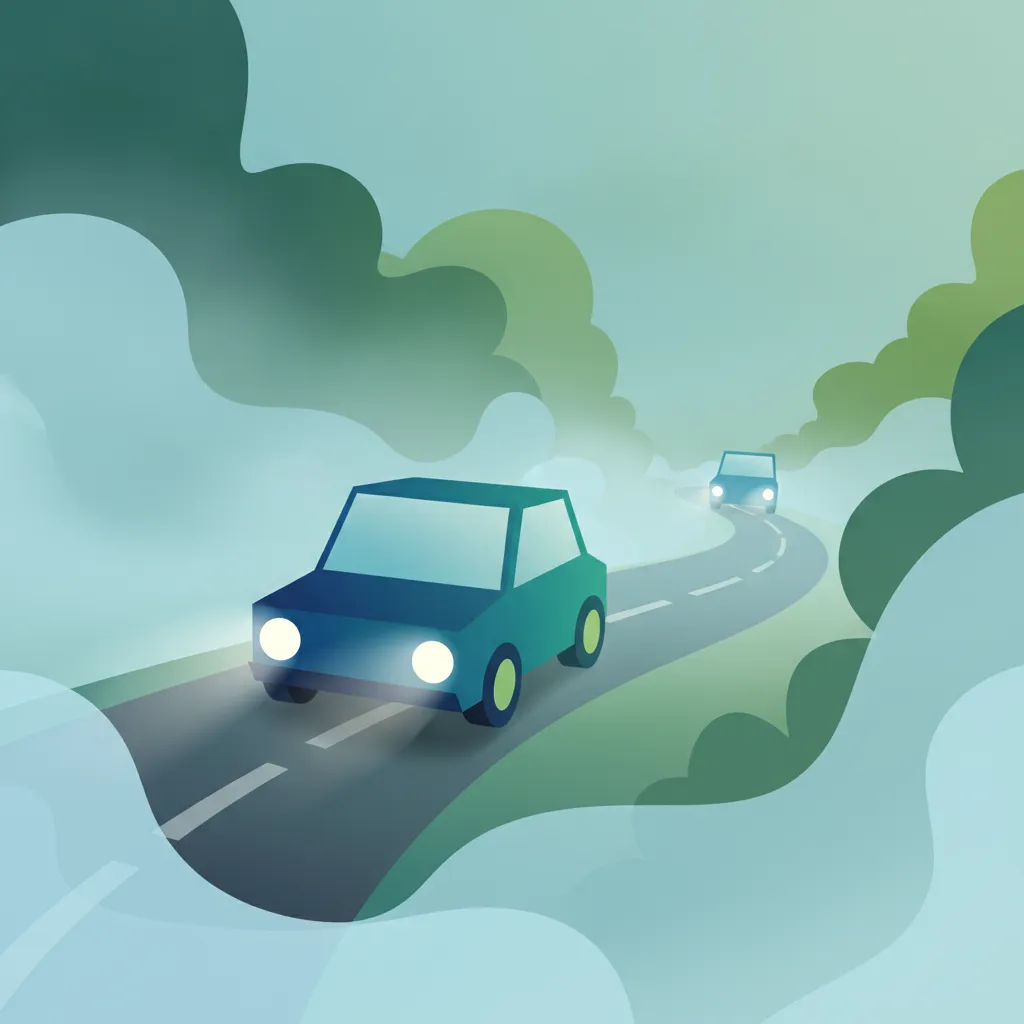
Driving in fog presents significant challenges due to severely reduced visibility, impacting your ability to perceive hazards and judge distances. This guide outlines the specific adjustments French drivers must make, from speed control and increased following distances to the correct use of vehicle lights, to navigate safely and comply with local regulations.
Theory topic content overview
Read the full theory topic guide for Driving in Fog with structured, easy-to-scan content built for learners in France. This detailed section explains the exact rule, meaning, traffic context, comparison points, and exam logic behind this French driving theory topic so you can study faster, understand the concept more clearly, and avoid common interpretation mistakes on the theory test.
Driving in fog dramatically reduces your visibility, creating extremely hazardous conditions that demand significant adjustments to your driving behavior and vehicle lighting according to the French Code de la route. The primary danger of driving in fog is the inability to see far enough ahead to react safely to hazards, making it impossible to stop within the distance you can see. This page details how French drivers must adapt to ensure safety and comply with regulations during foggy weather.
Fog is essentially a cloud at ground level, drastically limiting how far you can see. This reduction in visible distance impacts every aspect of driving:
The core principle for driving in fog is simple yet critical: you must be able to stop your vehicle within the distance you can see clearly ahead.
The Code de la route imposes strict requirements for driving in adverse weather conditions like fog, primarily focusing on speed control and correct lighting.
This is the single most important adjustment.
Using the correct lights ensures both that you can see and, crucially, that other drivers can see you.
Incorrect Lighting: Using only parking lights (feux de position) or main beam headlights (feux de route) in fog is dangerous and illegal. Main beams reflect off the fog particles, making visibility even worse for you.
Beyond the legal requirements, several practical strategies will help you drive safely in foggy conditions in France:
Drivers often make predictable errors in foggy conditions, leading to dangerous situations:
While fog, heavy rain, and snow all reduce visibility, the specific rules for lighting can differ slightly in France:
feux de croisement) and both front and rear fog lights (feux de brouillard avant et arrière). Remember the 50 km/h rule.feux de croisement) and front fog lights (feux de brouillard avant) if equipped. Rear fog lights (feux de brouillard arrière) are generally not used in heavy rain unless visibility is exceptionally low and resembles dense fog. This distinction is crucial for the French theory test.Mastering driving in fog for your French driving license theory test (ETG) and practical exam requires remembering three core principles:
Always prioritize safety over reaching your destination quickly. The Code de la route prioritizes your ability to adapt to conditions, and fog is a prime example of when that adaptation is critical.
Driving in fog requires fundamental adaptations to speed, lighting, and following distance based on the French Code de la route. The critical rule is that you must always be able to stop within your visible distance, which in dense fog (under 50 meters) means a strict 50 km/h maximum on all roads. Proper lighting involves mandatory dipped headlights in fog, optional front fog lights, and rear fog lights only in dense fog or heavy snow that must be switched off as soon as conditions improve. Common mistakes include speeding, incorrect fog light usage, tailgating, and over-reliance on automatic systems. The core principle for both theory and practical driving is adaptation: adjust every aspect of your driving to match the severely reduced visibility that fog creates.
A short set of high-value points that capture the most important ideas from this theory explanation.
Your speed must always allow you to stop completely within your visible distance, no matter what road you are on.
In France, when visibility drops below 50 meters, all vehicles on all roads must not exceed 50 km/h—this applies even on autoroutes.
Feux de croisement (dipped headlights) are mandatory in fog, not optional, because parking lights alone are insufficient.
Rear fog lights are only for dense fog or heavy snow and must be switched off immediately when visibility improves.
Increase your following distance to at least four seconds in fog to compensate for delayed perception and longer reaction time.
Rear fog lights are forbidden in light fog or rain—using them when not dense enough dazzles other drivers and is an error.
Main beam headlights (feux de route) make fog worse by reflecting off fog particles directly into your line of sight.
In heavy rain, use front fog lights if equipped but generally NOT rear fog lights, unlike the rule for dense fog.
Automatic light systems may fail to activate fog lights or may turn off dipped headlights—always verify manually.
If visibility drops to near zero on an autoroute, pull into the bande d'arrêt d'urgence, switch off headlights, and use hazard lights.
Assuming normal speed limits still apply on motorways during dense fog, ignoring the mandatory 50 km/h restriction.
Leaving rear fog lights switched on after the fog clears, blinding drivers behind you.
Using only parking lights (feux de position) in fog, which provide insufficient illumination and poor visibility to others.
Following the vehicle ahead too closely, not accounting for the significantly increased stopping distance needed in fog.
Relying entirely on automatic lighting systems without manually checking that correct lights are activated.
Start with a short, direct summary of Driving in Fog before reading the full explanation below.
When driving in fog, you must significantly reduce your speed to be able to stop within your visible distance. In France, this means adhering to specific lighting rules, often involving fog lights (feux de brouillard) if equipped, and ensuring you maintain an increased safety distance from other vehicles. Stay highly alert for unexpected obstacles and road users.
Review the most important terms, rule signals, and traffic concepts linked to Driving in Fog.
Explore related theory topic pages connected to Driving in Fog and continue with the next useful rule explanation.
See the common search queries learners use when trying to understand Driving in Fog in France.

Continue your journey by exploring specific French driving theory topics, from road signs and priority rules to vehicle safety and administrative procedures. Deepen your understanding of the Code de la route and prepare effectively for your permis de conduire ETG exam to ensure success and safe driving practices.
French Driving Theory Topics & RulesTheory topic content overview
A short set of high-value points that capture the most important ideas from this theory explanation.
Your speed must always allow you to stop completely within your visible distance, no matter what road you are on.
In France, when visibility drops below 50 meters, all vehicles on all roads must not exceed 50 km/h—this applies even on autoroutes.
Feux de croisement (dipped headlights) are mandatory in fog, not optional, because parking lights alone are insufficient.
Rear fog lights are only for dense fog or heavy snow and must be switched off immediately when visibility improves.
Increase your following distance to at least four seconds in fog to compensate for delayed perception and longer reaction time.
Rear fog lights are forbidden in light fog or rain—using them when not dense enough dazzles other drivers and is an error.
Main beam headlights (feux de route) make fog worse by reflecting off fog particles directly into your line of sight.
In heavy rain, use front fog lights if equipped but generally NOT rear fog lights, unlike the rule for dense fog.
Automatic light systems may fail to activate fog lights or may turn off dipped headlights—always verify manually.
If visibility drops to near zero on an autoroute, pull into the bande d'arrêt d'urgence, switch off headlights, and use hazard lights.
Assuming normal speed limits still apply on motorways during dense fog, ignoring the mandatory 50 km/h restriction.
Leaving rear fog lights switched on after the fog clears, blinding drivers behind you.
Using only parking lights (feux de position) in fog, which provide insufficient illumination and poor visibility to others.
Following the vehicle ahead too closely, not accounting for the significantly increased stopping distance needed in fog.
Relying entirely on automatic lighting systems without manually checking that correct lights are activated.
Start with a short, direct summary of Driving in Fog before reading the full explanation below.
When driving in fog, you must significantly reduce your speed to be able to stop within your visible distance. In France, this means adhering to specific lighting rules, often involving fog lights (feux de brouillard) if equipped, and ensuring you maintain an increased safety distance from other vehicles. Stay highly alert for unexpected obstacles and road users.
Review the most important terms, rule signals, and traffic concepts linked to Driving in Fog.
Explore related theory topic pages connected to Driving in Fog and continue with the next useful rule explanation.
See the common search queries learners use when trying to understand Driving in Fog in France.
Continue your journey by exploring specific French driving theory topics, from road signs and priority rules to vehicle safety and administrative procedures. Deepen your understanding of the Code de la route and prepare effectively for your permis de conduire ETG exam to ensure success and safe driving practices.
French Driving Theory Topics & RulesUse this exam-focused revision tip to understand how Driving in Fog is likely to appear in theory questions for learners in France. This section helps you identify the most testable part of the rule, avoid common traps, and remember the concept more effectively during French driving theory exam preparation.
Theory test questions often focus on correct lighting usage and speed adaptation in adverse weather. Remember that in France, front fog lights (feux de brouillard avant) are optional but rear fog lights (feux de brouillard arrière) are mandatory for dense fog, and speed limits are significantly reduced to 50 km/h if visibility drops below 50 meters.
Read direct answers to the most common learner questions about Driving in Fog in France. This FAQ focuses on rule confusion, practical meaning, comparison with similar concepts, and the exact uncertainties that appear most often in French driving theory revision and exam preparation.
The primary dangers include severely reduced visibility, making it difficult to see other vehicles, pedestrians, road signs, and obstacles, which increases the risk of collisions, especially rear-end accidents.
In France, front fog lights (feux de brouillard avant) may be used in fog, heavy rain, or snowfall. Rear fog lights (feux de brouillard arrière) must only be used in very dense fog or heavy snowfall, never in rain or light fog, as they can dazzle drivers behind you.
Yes, the Code de la route stipulates that when visibility is less than 50 meters due to fog or heavy precipitation, the speed limit for all vehicles is reduced to 50 km/h on all types of roads, including motorways (autoroutes).
You must significantly increase your following distance in fog. A good rule of thumb is to maintain a distance that allows you to stop safely within the area you can clearly see ahead, which will be much shorter in fog.
No, high beams should not be used in fog. Their light reflects off the fog droplets, creating a glare that further reduces your visibility rather than improving it. Use dipped headlights (feux de croisement) or fog lights instead.
Even on motorways, if visibility drops below 50 meters, the speed limit is automatically reduced to 50 km/h in France. You should also ensure your fog lights are correctly used and maintain extra caution.
Fog makes it very difficult to see road signs and markings, often only at the last moment. You should anticipate junctions and hazards by being familiar with your route and remaining highly vigilant.
Ready to focus your study? Use the practice search to find exactly the French driving theory questions you need for the Code de la route and permis de conduire ETG. Refine your knowledge on specific topics or challenging rules to boost your confidence and exam readiness.