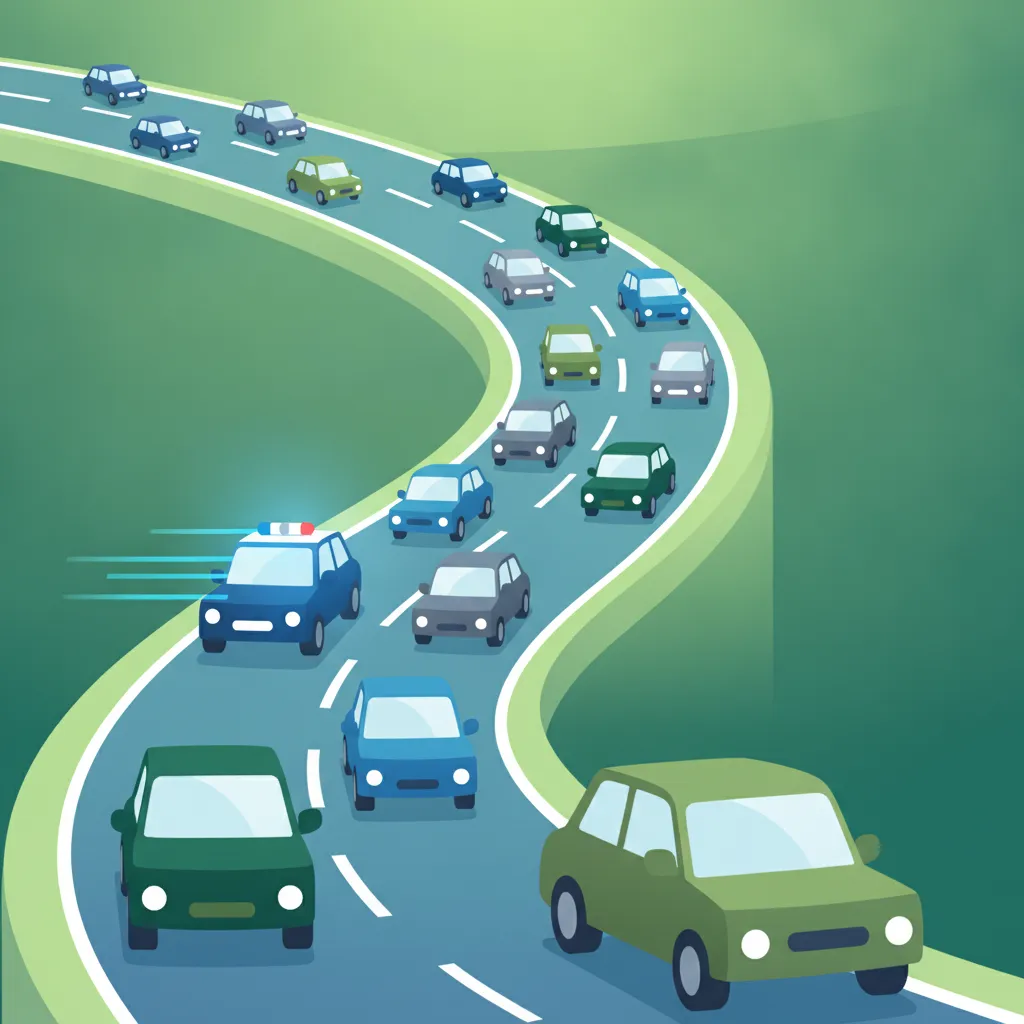
When an emergency vehicle is on an urgent mission in France, it will use distinct signals like flashing blue lights and sirens. As a driver, you have a crucial responsibility to react promptly and safely to ensure they can pass without obstruction. This involves understanding how to maneuver your vehicle to create a clear path, preventing delays that could impact critical situations.
Theory topic content overview
Read the full theory topic guide for Emergency Vehicle Priority with structured, easy-to-scan content built for learners in France. This detailed section explains the exact rule, meaning, traffic context, comparison points, and exam logic behind this French driving theory topic so you can study faster, understand the concept more clearly, and avoid common interpretation mistakes on the theory test.
In France, specific vehicles are granted special priority under the Code de la route when they are on an urgent mission (mission d'urgence). This means they are responding to a critical incident where speed and immediate access are vital. These vehicles include:
These vehicles signal their urgent mission by using distinct visual and audible warnings:
gyrophare bleu): These must be activated.sirène): This audible warning must also be used, especially in built-up areas or when approaching intersections.It's crucial to understand that a vehicle without these active signals is not on an urgent mission and does not have automatic priority, even if it's an emergency service vehicle. Your obligation to give way applies only when the signals are clearly active.
Understanding and correctly applying emergency vehicle priority rules is paramount for several reasons, both for road safety in France and for success in your Examen Théorique Général (ETG), the French theory test.
Code de la route): French law explicitly states your duty to facilitate the passage of emergency vehicles on urgent missions. Failure to do so can result in significant fines and penalty points on your permis de conduire.When you perceive an emergency vehicle approaching with flashing blue lights and/or a siren, your immediate and overriding priority is to facilitate its passage. The general principle is to move safely to the right side of the road (serrer à droite) and stop if necessary, creating a clear, unobstructed path.
Here's a step-by-step approach for various situations:
rétroviseurs) and blind spots (angles morts) to understand the traffic around you and ensure your actions won't create a new hazard. Avoid sudden braking or swerving.couloir de sécurité). This is especially important on autoroutes (motorways).rond-point): If you are approaching a roundabout and see/hear an emergency vehicle, try to stop before entering to keep the roundabout clear. If you are already in the roundabout, try to exit at the nearest safe exit and then pull over.Your response to an emergency vehicle needs to be dynamic and adapted to the specific conditions of French roads:
embouteillages), finding space can be challenging. Prioritise slow, controlled movements to create even a small gap, allowing the emergency vehicle to filter through.autoroutes, the expectation is to form a clear lane for passage.To ensure you respond correctly, distinguish these points:
1. Approaching a Busy Intersection in an Urban Area (Zone Urbaine):
You are approaching a traffic light showing green. You hear a siren and see flashing blue lights behind you. Instead of entering the intersection, you should slow down, check your mirrors, and pull over to the right before the white stop line. This keeps the intersection clear for the emergency vehicle to pass straight through or turn, regardless of your signal.
2. On an Autoroute with Heavy Traffic:
You are driving on a three-lane autoroute with a queue of vehicles. You hear a siren approaching from behind. Drivers in the rightmost lane should move as far right as possible (towards the hard shoulder), and those in the leftmost and middle lanes should move to the left. This creates a clear couloir de sécurité (safety corridor) in the middle lane, allowing emergency services to proceed.
3. Narrow Village Road (Route de Campagne):
You are driving on a narrow two-way road in a rural area when an ambulance approaches from the opposite direction. There's not enough room for both vehicles to pass. You should slow down, find the nearest safe place to pull over completely, even if it means carefully easing slightly onto a wide verge, and stop to allow the ambulance to pass.
The ETG exam frequently highlights common pitfalls in responding to emergency vehicles:
Rétroviseurs) and Blind Spots (Angles Morts): Moving without checking can put cyclists or motorcyclists in danger, or cause you to collide with another vehicle also attempting to move.For your permis de conduire and for safe driving in France, remember the core principles when dealing with emergency vehicles: Anticipate, Observe, and Act Safely and Predictably.
Your goal is always to provide a safe, clear, and unobstructed passage. Be aware of your surroundings, make controlled movements, and always prioritize safety over strict adherence to normal traffic signals when an emergency vehicle is on an urgent mission with its signals activated. This not only fulfills your legal obligation under the Code de la route but also contributes to the efficiency and safety of emergency services across France.
In France, emergency vehicles on urgent missions gain priority under the Code de la route only when both flashing blue lights (gyrophare bleu) and sirens are actively signaling. Drivers must immediately create a clear path by moving to the right, stopping if necessary, and never entering intersections or roundabouts when an emergency vehicle approaches. The correct procedure involves detecting signals early, assessing surroundings safely using mirrors and blind spots, creating passage through lane positioning or stopping, and waiting for all emergency vehicles to pass before rejoining traffic. This topic is a recurring ETG exam subject that tests hazard perception and the ability to make safe, decisive actions under pressure while prioritizing both legal compliance and overall road safety.
A short set of high-value points that capture the most important ideas from this theory explanation.
Emergency vehicles only have priority when both flashing blue lights (gyrophare bleu) AND siren are actively activated
Move safely to the right side of the road and stop if necessary to create an unobstructed path for emergency responders
At intersections, you must not enter even with a green light if an emergency vehicle needs to pass through
On multi-lane roads, create a central safety corridor (couloir de sécurité) by drivers moving to their respective left or right edges
Always check mirrors and blind spots before maneuvering, as sudden movements can create new hazards
Only vehicles with ACTIVE signals are on urgent missions; a police car simply patrolling has no automatic priority
Anticipate sirens before you see lights, especially around bends and in urban areas
On roundabouts, exit at the nearest safe exit then pull over rather than blocking the roundabout
Multiple emergency vehicles may follow the first one, so wait until all have passed before rejoining traffic
Stopping on pedestrian crossings, in tunnels, or on level crossings creates dangerous secondary hazards
Panic braking suddenly without checking mirrors first, which risks causing a rear-end collision
Moving without checking blind spots (angles morts), endangering cyclists or motorcyclists
Stopping in unsafe locations such as pedestrian crossings, tunnels, or level crossings
Assuming the emergency vehicle will simply navigate around you when you hear a distant siren
Following an emergency vehicle through traffic to skip ahead, which is both dangerous and illegal
Start with a short, direct summary of Emergency Vehicle Priority before reading the full explanation below.
When you see or hear an emergency vehicle (ambulance, police, fire truck) in France using flashing blue lights and/or a siren, you must immediately and safely create a clear path for it to pass. This often means slowing down, moving to the right side of the road, or stopping if necessary, always checking your mirrors and surroundings to avoid new hazards.
Review the most important terms, rule signals, and traffic concepts linked to Emergency Vehicle Priority.
Explore related theory topic pages connected to Emergency Vehicle Priority and continue with the next useful rule explanation.
See the common search queries learners use when trying to understand Emergency Vehicle Priority in France.

Continue your journey by exploring specific French driving theory topics, from road signs and priority rules to vehicle safety and administrative procedures. Deepen your understanding of the Code de la route and prepare effectively for your permis de conduire ETG exam to ensure success and safe driving practices.
French Driving Theory Topics & RulesTheory topic content overview
A short set of high-value points that capture the most important ideas from this theory explanation.
Emergency vehicles only have priority when both flashing blue lights (gyrophare bleu) AND siren are actively activated
Move safely to the right side of the road and stop if necessary to create an unobstructed path for emergency responders
At intersections, you must not enter even with a green light if an emergency vehicle needs to pass through
On multi-lane roads, create a central safety corridor (couloir de sécurité) by drivers moving to their respective left or right edges
Always check mirrors and blind spots before maneuvering, as sudden movements can create new hazards
Only vehicles with ACTIVE signals are on urgent missions; a police car simply patrolling has no automatic priority
Anticipate sirens before you see lights, especially around bends and in urban areas
On roundabouts, exit at the nearest safe exit then pull over rather than blocking the roundabout
Multiple emergency vehicles may follow the first one, so wait until all have passed before rejoining traffic
Stopping on pedestrian crossings, in tunnels, or on level crossings creates dangerous secondary hazards
Panic braking suddenly without checking mirrors first, which risks causing a rear-end collision
Moving without checking blind spots (angles morts), endangering cyclists or motorcyclists
Stopping in unsafe locations such as pedestrian crossings, tunnels, or level crossings
Assuming the emergency vehicle will simply navigate around you when you hear a distant siren
Following an emergency vehicle through traffic to skip ahead, which is both dangerous and illegal
Start with a short, direct summary of Emergency Vehicle Priority before reading the full explanation below.
When you see or hear an emergency vehicle (ambulance, police, fire truck) in France using flashing blue lights and/or a siren, you must immediately and safely create a clear path for it to pass. This often means slowing down, moving to the right side of the road, or stopping if necessary, always checking your mirrors and surroundings to avoid new hazards.
Review the most important terms, rule signals, and traffic concepts linked to Emergency Vehicle Priority.
Explore related theory topic pages connected to Emergency Vehicle Priority and continue with the next useful rule explanation.
See the common search queries learners use when trying to understand Emergency Vehicle Priority in France.
Continue your journey by exploring specific French driving theory topics, from road signs and priority rules to vehicle safety and administrative procedures. Deepen your understanding of the Code de la route and prepare effectively for your permis de conduire ETG exam to ensure success and safe driving practices.
French Driving Theory Topics & RulesUse this exam-focused revision tip to understand how Emergency Vehicle Priority is likely to appear in theory questions for learners in France. This section helps you identify the most testable part of the rule, avoid common traps, and remember the concept more effectively during French driving theory exam preparation.
In the ETG exam, questions about emergency vehicles often test your ability to react safely and predictably. Remember to always anticipate their needs, check your mirrors before moving, and never make sudden movements that could cause another hazard. Prioritize creating a clear, unobstructed path.
Read direct answers to the most common learner questions about Emergency Vehicle Priority in France. This FAQ focuses on rule confusion, practical meaning, comparison with similar concepts, and the exact uncertainties that appear most often in French driving theory revision and exam preparation.
In France, emergency vehicles on an urgent mission use flashing blue lights and often a two-tone or three-tone siren to alert other road users of their presence and need for priority.
The French Code de la route stipulates that all road users must facilitate the passage of emergency vehicles using their special warning devices (blue lights and siren). This means giving them priority and clearing their path.
Yes, if an emergency vehicle approaches from behind with its signals on, you should slow down, move as far to the right as safely possible (or to the nearest side on a one-way street), and stop if necessary to allow it to pass.
At an intersection, even if you have a green light, you must ensure the emergency vehicle can pass safely. This may require you to remain stopped or move cautiously aside, always being aware of other traffic.
Yes, when on an urgent mission and using their special warning devices, emergency vehicles are granted certain exemptions from standard traffic rules to ensure they can reach their destination quickly, provided it is safe to do so.
Absolutely. Before changing your position or slowing down, always check your mirrors to be aware of other vehicles around you, preventing further hazards or collisions.
While unintentional, blocking an emergency vehicle's path can have serious consequences. Always prioritize ensuring a clear passage, and if you realize you're in the way, calmly and safely move to clear the path.
Ready to focus your study? Use the practice search to find exactly the French driving theory questions you need for the Code de la route and permis de conduire ETG. Refine your knowledge on specific topics or challenging rules to boost your confidence and exam readiness.