
Driving after dark fundamentally alters the driving environment, reducing visibility and demanding a different approach from drivers. In Iceland, where daylight hours vary drastically with seasons, understanding night driving risks is crucial for safety. This page details how limited visibility, headlight glare, and driver fatigue increase accident risks and explains the adjustments necessary to maintain safety, particularly regarding vehicle lighting and speed.
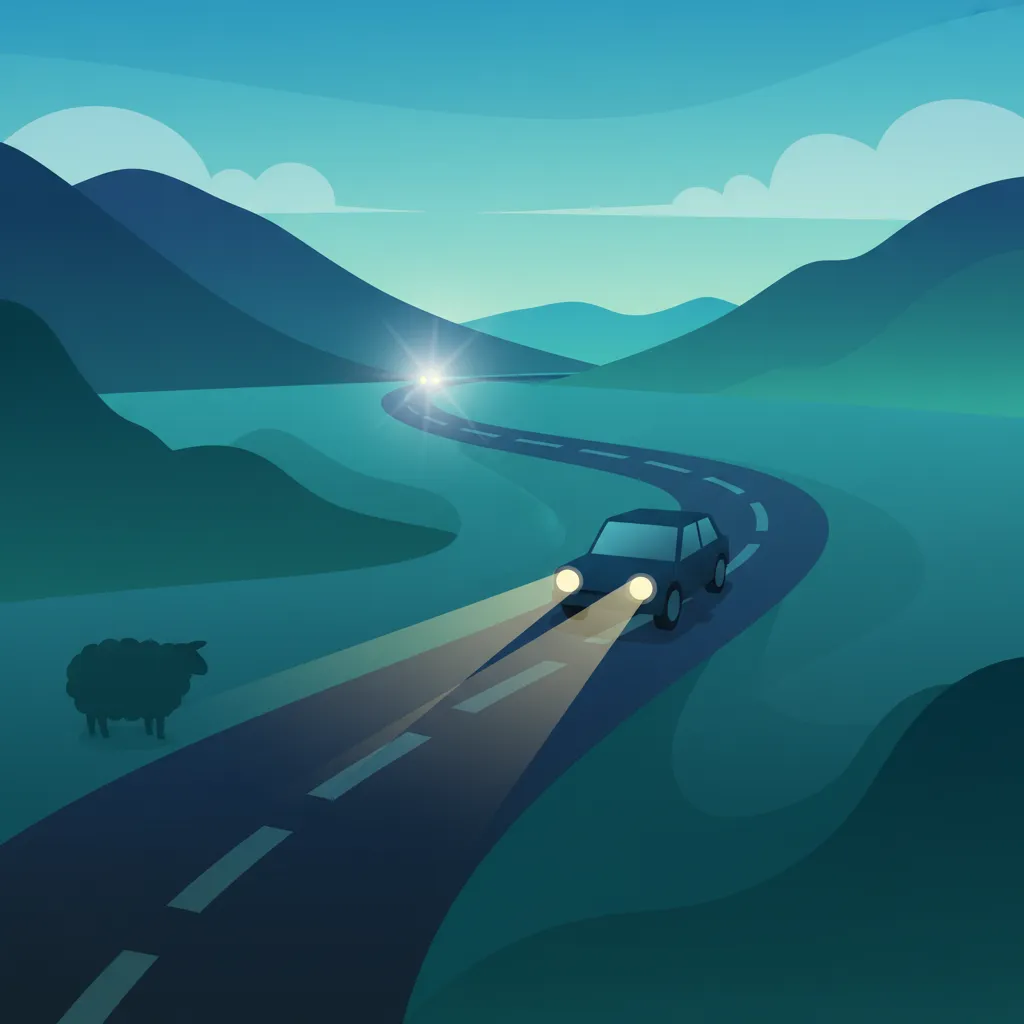
Theory topic content overview
Read the full theory topic guide for Night Driving Safety with structured, easy-to-scan content built for learners in Iceland. This detailed section explains the exact rule, meaning, traffic context, comparison points, and exam logic behind this Icelandic driving theory topic so you can study faster, understand the concept more clearly, and avoid common interpretation mistakes on the theory test.
Driving at night fundamentally transforms the driving environment. Your primary sense for navigating—sight—becomes severely limited, making it significantly harder to perceive depth, distance, colour, and movement. This reduced visibility means that even familiar roads present new challenges, and your reaction time to unexpected hazards must compensate for the darkness.
Unlike daytime driving where the world is illuminated by the sun, at night you rely almost entirely on your vehicle's headlights and any available street lighting. This creates a tunnel-vision effect, severely narrowing your field of vision and reducing the distance at which you can identify potential dangers such as pedestrians, cyclists, animals, or debris on the road.
In Iceland, understanding the challenges of night driving is particularly crucial due to several factors:
Driving in darkness introduces specific challenges that demand heightened awareness and adaptations:
Your headlights typically illuminate a limited distance ahead – perhaps 50-100 meters on low beam and 150-200 meters on high beam. This distance is significantly less than what you can see in daylight. Anything beyond this illuminated zone is essentially invisible until you are almost upon it. This makes:
Bright lights from oncoming vehicles or those behind you can cause temporary blindness, known as glare. When an oncoming car's headlights shine directly into your eyes, your pupils constrict, making it harder to see the road beyond their vehicle, or to the sides of it. This effect is compounded on dark roads where your eyes have adjusted to low light.
To mitigate glare:
Night driving often coincides with natural sleep cycles, leading to increased driver fatigue. Tiredness severely impairs your ability to concentrate, reduces your reaction time, and diminishes your judgment. Even minor fatigue can have serious consequences, making you less effective at managing the challenges of night driving. If you feel tired, pull over and rest, or switch drivers if possible.
To drive safely at night, especially in Iceland, you must actively adapt your driving behaviour.
This is the most critical principle for night driving. Your safe speed at night is not simply the posted speed limit, but rather a speed that allows you to stop your vehicle completely within the distance illuminated by your headlights. If you cannot see it, you cannot react to it in time.
Using your vehicle's lighting correctly is paramount:
It's important to distinguish between your ability to see the road and other road users, and your ability to be seen by them.
Learners and even experienced drivers often make specific mistakes when driving at night, which are particularly hazardous in Iceland:
Imagine driving on a dark, unlit road in rural Iceland in late autumn.
Safe night driving, particularly in Iceland, boils down to proactive adaptation and a clear understanding of your limitations. Always prioritize:
By integrating these practices, you significantly reduce the risks associated with driving after dark, ensuring a safer journey for yourself and others on Icelandic roads.
Night driving in Iceland fundamentally changes your ability to perceive hazards due to limited headlight range, glare, and natural fatigue cycles. Icelandic law mandates headlights at all times year-round, and your safe speed must always be tied to your visible stopping distance—you must be able to stop within what your headlights illuminate. Key adaptations include using low beam when traffic is present, switching to high beam on unlit roads, keeping all lights and windshields clean, and managing fatigue by pulling over when tired. Rural Icelandic roads with wildlife, gravel surfaces, and no lighting make these principles especially critical for safe driving.
A short set of high-value points that capture the most important ideas from this theory explanation.
Night driving fundamentally reduces your field of vision, making depth, distance, and movement perception significantly harder than daytime driving
Iceland requires headlights at all times, day or night, all year round—auto settings may not always engage proper low beam
Your safe speed at night must allow you to stop completely within the distance your headlights illuminate—if you cannot see it, you cannot react in time
Headlight glare temporarily blinds you; shift focus to the right lane edge while looking slightly past oncoming lights to recover faster
Iceland's rural unlit roads, gravel surfaces, and wildlife (sheep, reindeer) make night driving particularly hazardous compared to urban areas
Low beam illuminates roughly 50-100 meters; high beam extends to 150-200 meters—anything beyond is invisible until you are nearly upon it
Switch from high beam to low beam immediately when approaching oncoming traffic or following another vehicle
Front fog lights improve visibility in severe conditions; rear fog lights are very bright and only for thick fog to avoid dazzling following drivers
Driver fatigue is intensified during natural sleep cycle hours and dramatically reduces reaction time and judgment
Keep windshield and headlight lenses clean inside and out—dirt and streaks magnify glare and severely reduce night visibility
Driving at the posted speed limit on unlit roads, not accounting for the limited distance your headlights actually illuminate
Relying on 'Auto' headlight settings without confirming full low beam is engaged, especially in twilight or lighter fog conditions
Failing to use high beams on unlit roads when no oncoming traffic exists, unnecessarily reducing your visible stopping distance
Not dipping high beams when approaching oncoming vehicles or following other cars, temporarily blinding other drivers and creating significant hazards
Continuing to drive when fatigued on Iceland's monotonous rural roads where micro-sleeps can occur with fatal consequences
Start with a short, direct summary of Night Driving Safety before reading the full explanation below.
Driving at night significantly reduces a driver's field of vision, making it harder to spot hazards, pedestrians, and wildlife. Headlights provide limited illumination, and glare from oncoming traffic can temporarily blind drivers. It is essential to reduce speed, ensure your vehicle lights are correctly used (all year round in Iceland, headlights are mandatory), keep your windshield clean, and be extra vigilant for obstacles that might appear suddenly from the darkness. Fatigue is also a major factor, increasing reaction times.
Review the most important terms, rule signals, and traffic concepts linked to Night Driving Safety.
Explore related theory topic pages connected to Night Driving Safety and continue with the next useful rule explanation.
See the common search queries learners use when trying to understand Night Driving Safety in Iceland.

Ready to master Icelandic driving theory? Explore our comprehensive sections. Review road rules, traffic signs, and critical concepts. Build essential knowledge for confident and safe driving in Iceland. Start studying today.
Explore Icelandic Driving TheoryTheory topic content overview
A short set of high-value points that capture the most important ideas from this theory explanation.
Night driving fundamentally reduces your field of vision, making depth, distance, and movement perception significantly harder than daytime driving
Iceland requires headlights at all times, day or night, all year round—auto settings may not always engage proper low beam
Your safe speed at night must allow you to stop completely within the distance your headlights illuminate—if you cannot see it, you cannot react in time
Headlight glare temporarily blinds you; shift focus to the right lane edge while looking slightly past oncoming lights to recover faster
Iceland's rural unlit roads, gravel surfaces, and wildlife (sheep, reindeer) make night driving particularly hazardous compared to urban areas
Low beam illuminates roughly 50-100 meters; high beam extends to 150-200 meters—anything beyond is invisible until you are nearly upon it
Switch from high beam to low beam immediately when approaching oncoming traffic or following another vehicle
Front fog lights improve visibility in severe conditions; rear fog lights are very bright and only for thick fog to avoid dazzling following drivers
Driver fatigue is intensified during natural sleep cycle hours and dramatically reduces reaction time and judgment
Keep windshield and headlight lenses clean inside and out—dirt and streaks magnify glare and severely reduce night visibility
Driving at the posted speed limit on unlit roads, not accounting for the limited distance your headlights actually illuminate
Relying on 'Auto' headlight settings without confirming full low beam is engaged, especially in twilight or lighter fog conditions
Failing to use high beams on unlit roads when no oncoming traffic exists, unnecessarily reducing your visible stopping distance
Not dipping high beams when approaching oncoming vehicles or following other cars, temporarily blinding other drivers and creating significant hazards
Continuing to drive when fatigued on Iceland's monotonous rural roads where micro-sleeps can occur with fatal consequences
Start with a short, direct summary of Night Driving Safety before reading the full explanation below.
Driving at night significantly reduces a driver's field of vision, making it harder to spot hazards, pedestrians, and wildlife. Headlights provide limited illumination, and glare from oncoming traffic can temporarily blind drivers. It is essential to reduce speed, ensure your vehicle lights are correctly used (all year round in Iceland, headlights are mandatory), keep your windshield clean, and be extra vigilant for obstacles that might appear suddenly from the darkness. Fatigue is also a major factor, increasing reaction times.
Review the most important terms, rule signals, and traffic concepts linked to Night Driving Safety.
Explore related theory topic pages connected to Night Driving Safety and continue with the next useful rule explanation.
See the common search queries learners use when trying to understand Night Driving Safety in Iceland.
Ready to master Icelandic driving theory? Explore our comprehensive sections. Review road rules, traffic signs, and critical concepts. Build essential knowledge for confident and safe driving in Iceland. Start studying today.
Explore Icelandic Driving TheoryUse this exam-focused revision tip to understand how Night Driving Safety is likely to appear in theory questions for learners in Iceland. This section helps you identify the most testable part of the rule, avoid common traps, and remember the concept more effectively during Icelandic driving theory exam preparation.
The Icelandic driving theory exam often tests your understanding of how reduced visibility and headlight glare affect a driver's perception and reaction time. Remember to always adjust your speed to match your visible stopping distance and to know the mandatory headlight rules in Iceland.
Read direct answers to the most common learner questions about Night Driving Safety in Iceland. This FAQ focuses on rule confusion, practical meaning, comparison with similar concepts, and the exact uncertainties that appear most often in Icelandic driving theory revision and exam preparation.
The main dangers include reduced visibility, difficulty judging distances, glare from other vehicle's headlights, increased risk of encountering impaired drivers or wildlife, and higher chances of driver fatigue.
Reduced visibility shortens the distance at which you can identify hazards. This means you have less time to react to unexpected obstacles, pedestrians, or changes in road conditions, making appropriate speed adjustment critical.
Avoid looking directly into oncoming headlights. Instead, focus your gaze slightly to the right edge of your lane to maintain your orientation on the road until the vehicle passes. Also, ensure your own headlights are properly aligned and clean to avoid causing glare for others.
Yes, in Iceland, it is legally required for vehicle headlights to be on at all times, day or night, throughout the year. This ensures maximum visibility for your vehicle to other road users.
If you feel tired, pull over safely and take a break. A short nap (15-20 minutes) or a walk can help. Avoid driving long distances late at night if you are already fatigued, and consider sharing driving duties if possible.
You should always drive at a speed that allows you to stop safely within the distance illuminated by your headlights. This often means driving slower than the posted speed limit, especially on unlit roads or in adverse conditions.
Before driving at night, ensure all exterior lights (headlights, tail lights, brake lights, turn signals) are clean and working. Also, clean your windshield and mirrors to prevent streaks or dirt from further impairing your vision.
Utilize our advanced practice set search to pinpoint the exact Icelandic driving theory topics you need to review. Filter by subject, difficulty, or question type to create a highly effective study plan and ensure you are fully prepared for your official driving licence test in Iceland.