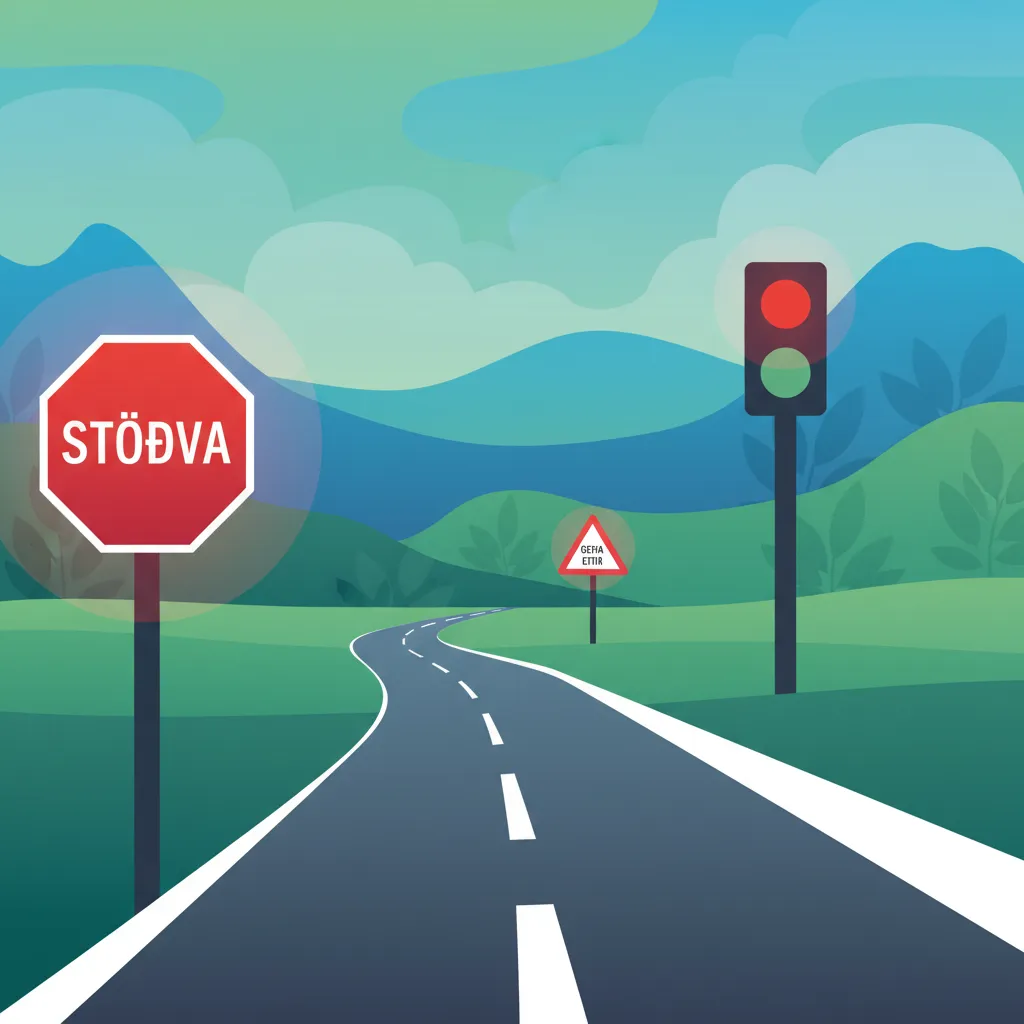
Navigate Iceland's roads with confidence by mastering visual traffic cues. This unit delves into the meaning and legal implications of all Icelandic road signs, traffic light signals, and pavement markings. Understanding these elements is fundamental to safe driving and passing your theory test.
Browse all lessons that make up Road Signs, Traffic Lights & Road Markings. Each lesson focuses on specific topics, learning objectives, and core concepts, helping you build essential knowledge and follow a clear, structured progression toward your study goals in Iceland.
This lesson categorizes Icelandic road signs into regulatory signs that dictate mandatory actions, warning signs that alert drivers to hazards, and informational signs that provide guidance. It explains the distinctive shapes and colour schemes for each category, such as circles for prohibitions and triangles for warnings. By mastering these conventions, students will be able to interpret sign intent instantly and adapt their driving behaviour accordingly to comply with legal obligations.
This lesson focuses on the operation of traffic lights in Iceland, describing standard three-phase cycles (red, amber, green) and variations such as flashing amber for yielding. Learners will also explore dedicated signals for pedestrians, cyclists, and turning movements, including arrow indications. The lesson explains how signal timing integrates with right-of-way rules at intersections, ensuring drivers can interpret and respond to each light state to maintain safety.
This lesson provides a comprehensive overview of the road markings found on Icelandic roads, from solid and broken lane lines to symbols indicating turning lanes and pedestrian crossings. The content details the visual meanings of each marking, such as solid lines indicating no crossing and broken lines permitting lane changes. Additionally, the lesson addresses the purpose of reflective markers and surface textures used in low-visibility or icy conditions, providing a framework for interpreting pavement cues.
Explore high-intent keywords and long-tail search topics learners use when researching Road Signs, Traffic Lights & Road Markings. These terms reflect how people search for reliable study materials, structured explanations, and unit-level theory preparation support in Iceland.
Find clear answers to the most common questions learners ask about Road Signs, Traffic Lights & Road Markings. Understand how the unit is organized, what learning goals it supports, and how it contributes to your study progression with structured explanations and practical guidance tailored for learners in Iceland.
Warning signs alert you to potential hazards ahead, often diamond-shaped with a red border. Regulatory signs instruct you on what you must or must not do, typically circular or rectangular with red borders or red lines, and are legally binding. Informational signs provide guidance or useful details, such as route numbers or points of interest, and are generally blue or green.
A flashing yellow traffic light in Iceland indicates caution. You should proceed with care, paying close attention to other traffic and pedestrians. It often means the intersection is uncontrolled, or the light system is about to change or is malfunctioning, so slow down and be prepared to stop if necessary.
In general, regulatory signs and traffic lights take precedence over road markings when there is a conflict. However, all visual cues work together to guide traffic. You must always pay attention to all signs, lights, and markings to ensure safe navigation. For instance, a temporary 'road closed' sign would override lane markings indicating you should proceed.
Temporary road works signs are often orange or yellow to indicate a temporary situation. They convey instructions or warnings specific to the construction or maintenance area and take precedence over permanent signs or markings within that zone. Always follow the instructions on temporary signs for your safety and that of the workers.
Disregarding traffic lights or road signs can lead to serious accidents and significant penalties. In Iceland, this can result in fines, demerit points on your licence, and potentially licence suspension or revocation, depending on the severity and consequences of the violation. It is crucial to always adhere to these traffic controls.
Yes, Iceland uses specific markings to designate bicycle lanes and paths. These often include painted lines, bicycle symbols, and sometimes different coloured surfacing. Drivers must respect these markings and yield to cyclists where appropriate, ensuring their safety and adherence to traffic laws.
All included lessons
Lessons in Road Signs, Traffic Lights & Road Markings
See who benefits most from studying Road Signs, Traffic Lights & Road Markings. This overview explains how the unit supports different learning needs, what level of knowledge is helpful before starting, and how it fits into the overall study path in Iceland.
This unit is essential for all learner drivers preparing for the Icelandic Category B driving theory exam. It is particularly beneficial for those who need a clear, comprehensive understanding of visual traffic controls, including beginners and individuals needing a refresher on road sign meanings and their legal weight.

Begin preparing for your Icelandic driving licence exam today by exploring our full range of organised courses. Select a curriculum path that suits your learning style and start mastering traffic rules, road signs, and essential driving safety with confidence and expert guidance.
Explore Driving Theory CoursesExplore all units and lessons included in this driving theory course.
Begin preparing for your Icelandic driving licence exam today by exploring our full range of organised courses. Select a curriculum path that suits your learning style and start mastering traffic rules, road signs, and essential driving safety with confidence and expert guidance.
Explore Driving Theory Courses