
This lesson guides you through the crucial road markings that protect vulnerable road users, specifically pedestrians and cyclists in Ireland. Mastering these rules is essential for your Category B theory test and ensures you can navigate shared urban spaces with confidence and safety.

Lesson content overview
Road markings are some of the most critical visual cues on Irish roads. They act as continuous, silent regulators of traffic, defining boundaries, assigning right-of-way, and creating dedicated protective zones for the road's most vulnerable users: pedestrians and cyclists.
For anyone preparing for the Official Irish Driver Theory Test (Category B), mastering the visual language of these markings is not just a requirement for passing the exam—it is a foundational skill for preventing collisions, avoiding penalty points, and sharing the road responsibly. This lesson covers the precise designs, legal rules, and safety principles behind pedestrian crossings, protective white zigzag lines, cycle lanes, and advanced stop lines (ASLs).
Pedestrian crossings are dedicated corridors designed to allow people to cross busy carriageways safely. As a motorist, you must understand the different types of crossings, how they are controlled, and your exact legal obligations when approaching them.
A zebra crossing is easily identified by its distinctive pattern of alternating thick white and black stripes painted across the road, parallel to the flow of traffic.
When approaching a zebra crossing, you must exercise extreme caution. The law states that you must yield the right-of-way to any pedestrian who has stepped onto, or is about to step onto, the crossing.
Crucial Exam Concept: Do not simply wait for a pedestrian to be in the middle of the road. If a pedestrian is standing at the edge of the kerb and clearly intends to cross, you must slow down, bring your vehicle to a complete and smooth stop behind the white stop line, and allow them to cross safely.
Scan ahead: Look for the flashing Belisha beacons and check the sides of the road for pedestrians approaching the crossing.
Check your mirrors: Assess the speed and distance of the traffic behind you before you begin to slow down.
Decelerate early: Gently reduce your speed to signal your intention to stop to both the pedestrians and drivers behind you.
Stop completely: Bring your vehicle to a halt behind the solid white stop line, keeping your handbrake engaged if you are stationary for more than a few seconds.
Do not wave pedestrians across: Let them make their own decision to cross. Waving them forward can coax them into danger if another vehicle is overtaking or approaching from the opposite direction.
A Pelican crossing (Pedestrian Light Controlled crossing) is a signal-controlled pedestrian crossing. Unlike zebra crossings, the movement of pedestrians and vehicles is regulated by standard traffic lights paired with push-button control units on the pavement.
The signal sequence at a Pelican crossing is unique and differs from standard junction traffic lights because of the introduction of a flashing amber phase.
The specific light phase at a Pelican crossing where motorists must yield to pedestrians currently on the crossing, but are legally permitted to drive through if the crossing is entirely clear of people.
A Toucan crossing is designed as a shared crossing for both pedestrians and cyclists (the name comes from "two-can" cross). They are typically wider than Pelican crossings to accommodate both groups simultaneously.
On the approach to and exit from pedestrian crossings, you will see highly visible white zigzag lines painted on the road surface. These markings are not decorative; they designate a high-risk safety zone where strict rules apply to protect pedestrians from being obscured by vehicles.
The primary purpose of white zigzag lines is to maintain an unobstructed field of vision between approaching drivers and pedestrians waiting at the kerb.
You must not overtake the leading vehicle when approaching a pedestrian crossing within the zone defined by the white zigzag markings. This applies to both moving and stationary vehicles.
If a vehicle ahead of you has stopped to let a pedestrian cross, overtaking that vehicle is exceptionally dangerous. The driver in the adjacent lane may not see the pedestrian crossing in front of the stopped car, leading to catastrophic side-impact collisions.
You must not park or stop your vehicle within the white zigzag lines for any reason other than waiting for pedestrians to cross or complying with the traffic signals. This means you cannot stop to drop off passengers, park to run into a shop, or wait with your hazard lights on.
A vehicle parked on zigzag lines blocks the view of the crossing for other motorists and conceals pedestrians—particularly children, elderly individuals, or wheelchair users—who are waiting to step into the roadway.
To support sustainable transport and protect cyclists, Irish roads feature dedicated cycle infrastructure. For the Driver Theory Test, you must distinguish between mandatory cycle lanes and advisory cycle lanes, as your legal permissions to enter or park in these zones differ significantly.
A mandatory cycle lane is bounded by a solid, unbroken white line painted on the road surface.
A reserved lane for bicycles, delineated by a solid white line, which motorists are legally prohibited from driving or parking in during its active hours.
An advisory cycle lane is marked by a broken (dashed) white line on the road surface.
| Feature | Mandatory Cycle Lane | Advisory Cycle Lane |
|---|---|---|
| Line Type | Solid (Unbroken) White Line | Broken (Dashed) White Line |
| Can Motorists Enter? | No, strictly prohibited. | Only when necessary and safe. |
| Can Motorists Park? | No, prohibited 24/7 or during signed hours. | No, prohibited during active hours. |
| Primary Safety Purpose | Full physical segregation from motor vehicles. | Guided spacing on shared or narrow roads. |
An Advanced Stop Line (ASL), colloquially known as a "bike box," is a traffic management tool used at signalised junctions to give cyclists a safe, visible head start when the traffic light changes from red to green.
An ASL consists of two distinct stop lines separated by a marked reservoir area:
Understanding road markings in a classroom environment is different from reacting to them under real-world driving conditions. Let's look at how weather, lighting, and complex road scenarios change your responsibilities.
Heavy rain, dense fog, and snow can quickly obscure painted road markings.
When driving in heavy, stop-and-start urban traffic, you must plan your positioning to keep crossings clear.
Cyclists may need to leave their designated cycle lanes unexpectedly. As a driver, you must anticipate these movements.
Failing to comply with pedestrian crossing and cycle lane markings carries legal penalties under Irish road traffic legislation. These regulations are designed to deter dangerous driving behaviors before they cause serious injury.
Continuous Learning: As a driver, it is your responsibility to remain aware of amendments to the Road Traffic Acts. Regular updates are published by the Road Safety Authority (RSA) to continuously improve safety for pedestrians and cyclists.
This lesson covers the essential road markings that protect pedestrians and cyclists in Ireland. You must know how to identify and respond correctly to zebra, pelican, and toucan crossings, each with distinct visual markers and signal sequences. White zigzag lines create mandatory no-overtaking and no-parking zones. Mandatory cycle lanes (solid white) are strictly prohibited to motorists, while advisory lanes (broken white) allow entry only when necessary. Advanced Stop Lines position cyclists ahead of traffic at lights to improve visibility and prevent left-hook collisions. Understanding these markings is critical for both passing the Category B theory test and driving safely in shared urban environments.
A short set of high-value points that capture the most important learning from this lesson.
Zebra crossings require you to stop when a pedestrian is on or about to step onto the crossing, not just when they are halfway across.
Pelican crossings include a flashing amber phase where you must yield to pedestrians still on the crossing but may proceed if it is completely clear.
Toucan crossings have no flashing amber phase—motorists must wait for green even if the crossing appears empty, and cyclists may ride across.
White zigzag lines near any crossing create a strict safety zone where both overtaking and parking are strictly prohibited.
Mandatory cycle lanes (solid white line) cannot be entered or parked in by motorists, while advisory cycle lanes (broken white line) may only be crossed when absolutely necessary.
Explore all units and lessons included in this driving theory course.
Zebra crossings = Belisha beacons (flashing amber globes) + no signals; Pelican = traffic lights + flashing amber; Toucan = shared + no flashing amber.
White zigzag lines = no overtaking AND no parking under any circumstances except yielding to pedestrians.
Mandatory cycle lane = solid white line = never enter; Advisory cycle lane = broken white line = enter only when unavoidable.
At ASLs (bike boxes), stop behind the rear line—never encroach into the cyclist reservoir between the two stop lines.
At toucan crossings, cyclists do not need to dismount and can ride across when their signal is green.
Assuming you can proceed during flashing amber at a Pelican crossing without checking if pedestrians are still crossing.
Believing that parking on white zigzag lines is permissible with hazard lights on or for quick drop-offs.
Confusing mandatory and advisory cycle lanes when deciding whether it is legal to drive or park in them.
Encroaching on an Advanced Stop Line reservoir, which obscures cyclists and creates a left-hook collision risk.
Treating zebra crossings as optional—failing to stop when a pedestrian is waiting at the kerb with clear intent to cross.
Lesson content overview
A short set of high-value points that capture the most important learning from this lesson.
Zebra crossings require you to stop when a pedestrian is on or about to step onto the crossing, not just when they are halfway across.
Pelican crossings include a flashing amber phase where you must yield to pedestrians still on the crossing but may proceed if it is completely clear.
Toucan crossings have no flashing amber phase—motorists must wait for green even if the crossing appears empty, and cyclists may ride across.
White zigzag lines near any crossing create a strict safety zone where both overtaking and parking are strictly prohibited.
Mandatory cycle lanes (solid white line) cannot be entered or parked in by motorists, while advisory cycle lanes (broken white line) may only be crossed when absolutely necessary.
Explore all units and lessons included in this driving theory course.
Zebra crossings = Belisha beacons (flashing amber globes) + no signals; Pelican = traffic lights + flashing amber; Toucan = shared + no flashing amber.
White zigzag lines = no overtaking AND no parking under any circumstances except yielding to pedestrians.
Mandatory cycle lane = solid white line = never enter; Advisory cycle lane = broken white line = enter only when unavoidable.
At ASLs (bike boxes), stop behind the rear line—never encroach into the cyclist reservoir between the two stop lines.
At toucan crossings, cyclists do not need to dismount and can ride across when their signal is green.
Assuming you can proceed during flashing amber at a Pelican crossing without checking if pedestrians are still crossing.
Believing that parking on white zigzag lines is permissible with hazard lights on or for quick drop-offs.
Confusing mandatory and advisory cycle lanes when deciding whether it is legal to drive or park in them.
Encroaching on an Advanced Stop Line reservoir, which obscures cyclists and creates a left-hook collision risk.
Treating zebra crossings as optional—failing to stop when a pedestrian is waiting at the kerb with clear intent to cross.
Explore search topics learners often look for when studying Pedestrian Crossings and Cyclist Lanes Markings. These topics reflect common questions about road rules, driving situations, safety guidance, and lesson level theory preparation for learners in Ireland.
Browse additional driving theory lessons that cover connected traffic rules, road signs, and common driving situations related to this topic. Improve your understanding of how different rules interact across everyday traffic scenarios.
Understand the legal principles of priority at junctions and roundabouts. This guide explains how to identify right-of-way, yield at stop and yield signs, and navigate complex intersections safely according to the official Irish Rules of the Road.

Uncontrolled junctions represent a high-risk scenario because they lack physical signs, lines, or lights to dictate priority. This lesson covers the crucial 'priority to the right' principle, where you must yield to any traffic approaching from your right-hand side. You will learn the importance of reducing your speed, preparing to stop, and verifying the intentions of other drivers at these equal-status crossings.
Right-of-way rules establish a clear order of precedence when the paths of two or more vehicles cross. This lesson explains how traffic on a major road has priority over traffic emerging from a minor road, and the general rule of yielding to oncoming vehicles when turning right. You will develop a solid understanding of how to approach intersections defensively, assessing speed and distance to make safe decisions.
This lesson teaches the fundamental principles of priority and right-of-way at controlled and uncontrolled intersections across Ireland. It explains the legal obligations at yield signs, stop lines, and when meeting oncoming traffic turning across your lane. Motorcyclists will learn to carefully verify other drivers' intentions rather than assuming they will yield the correct right-of-way.
This lesson covers the absolute rules of priority that regulate junctions, roundabouts, and pedestrian crossings in Ireland. It teaches riders when they must yield, who has right-of-way, and how to read Stop and Yield signs correctly. Understanding these priority hierarchies prevents collisions and maintains orderly, predictable movement at busy junctions.

Stop and yield signs require drivers to surrender right-of-way to crossing traffic, but they command different physical actions. This lesson explains that a stop sign mandates a complete, absolute halt behind the line, whereas a yield sign requires you to slow down and stop only if other traffic is approaching. You will learn how to manage restricted visibility at junctions and how to creep forward safely when clear.

Navigating multi-lane roundabouts requires precise lane selection, continuous scanning, and timely signaling. This lesson teaches you the 'clock rule' for determining which lane to enter, how to yield to traffic already on the roundabout from your right, and when to activate your left indicator to exit. Mastering these procedures minimizes lane-drift accidents and ensures a seamless flow of traffic on busy roundabouts.

This lesson details the sequential steps required to approach and exit junctions safely under the Irish driving rules. It teaches riders how to select the correct lane, utilize mirrors, apply early signals, and reduce speed appropriately. Effective observation strategies are highlighted to help riders identify crossing pedestrians or approaching side traffic.

This lesson focuses on the safe approach and execution of turns at T-junctions, staggered intersections, and blind crossroads. It explains the critical mirror-signal-manoeuvre routine and how to select the best position for maximum visibility to cross-traffic. Motorcyclists will learn to identify potential hazards like vehicles pulling out suddenly or turning across their direct path.
No-overtaking zones are marked in areas with restricted visibility, such as approaching bends, humps, or narrow bridges. This lesson details how continuous solid white lines legally prohibit passing, along with the very narrow exceptions allowed under Irish law. You will learn to identify these high-risk areas from visual markings, ensuring you never initiate a passing manoeuvre that puts oncoming traffic in immediate danger.
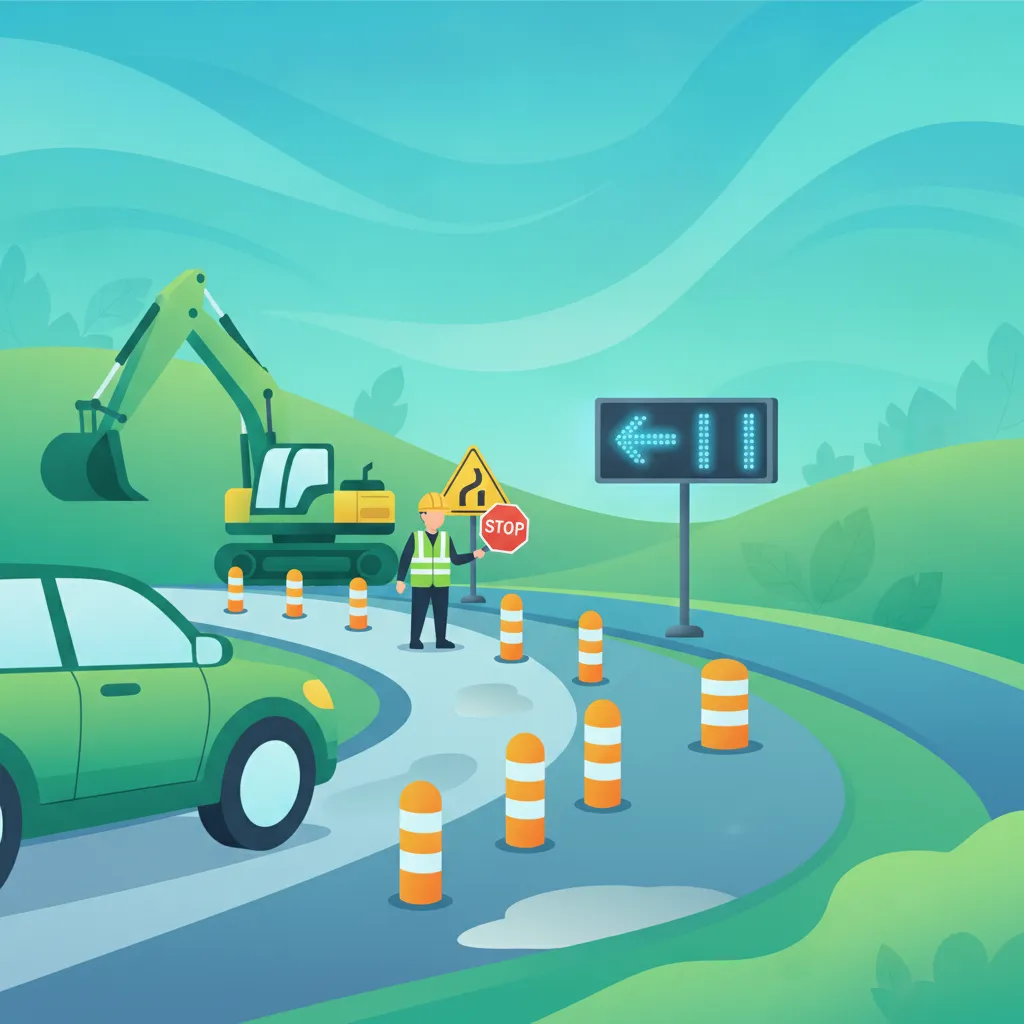
Road construction zones feature dynamic hazards, including changed lane configurations, temporary barriers, and workers near live traffic. This lesson details how to follow temporary signage, navigate narrow chicanes, and obey 'Stop-Go' flag systems or temporary traffic lights. You will understand the legal requirement to obey temporary speed limits, which are strictly enforced to protect both motorists and road crews.
Learn to identify and anticipate risks involving pedestrians and cyclists in dense urban traffic. This explanation covers defensive driving strategies, blind spot management, and adjusting speed to safely share the road with vulnerable users in various Irish weather and light conditions.

This lesson covers the rules governing zebra, pelican, and toucan pedestrian crossings, focusing on driver obligations and rider safety. It details how to interact safely with cyclists, personal mobility devices, and pedestrians in busy urban sectors. Motorcyclists will learn to scan pavement edges, yield right-of-way, and maintain safe overtaking distances when passing slower road users.

Bus stops often intersect with designated bicycle lanes and busy walking pathways, creating high-risk conflict areas for drivers. This lesson trains drivers to check blind spots for oncoming cyclists before pulling into or exiting public stop bays. It emphasizes yielding right-of-way to passengers crossing the road, preventing collision risks in active urban transport hubs.
Find clear answers to common questions learners have about Pedestrian Crossings and Cyclist Lanes Markings. Learn how the lesson is structured, which driving theory objectives it supports, and how it fits into the overall learning path of units and curriculum progression in Ireland. These explanations help you understand key concepts, lesson flow, and exam focused study goals.
The white zigzag lines indicate an area where you must not park, stop, or overtake. They are designed to keep the view of the crossing clear for both the driver and the pedestrians, and stopping here can lead to a failure in your driving test.
Yes. At a zebra crossing, pedestrians have priority once they step onto the crossing. At a toucan or pelican crossing, traffic is controlled by lights, and you must only proceed when the signal allows, while always remaining alert for pedestrians who may still be crossing.
No, you must not drive or park in a mandatory cycle track marked by a continuous white line. You should only cross it if you need to access a property or turn into a side road, and only when it is safe to do so.
Advanced stop lines, often called bike boxes, provide a safe space for cyclists to wait ahead of motor traffic. Drivers must stop at the first line and not enter the cycle-marked area, ensuring cyclists are more visible when the lights turn green.
Use the practice question search tool to pinpoint specific topics, road signs, or rules you need to master for your official Driver Theory Test. Refine your study strategy and ensure comprehensive preparation for all aspects of the Irish driving exam. Start your focused revision now and build confidence for your learner permit test.