
Navigating the challenges of overtaking slow vehicles like agricultural machines and trucks on Italian provincial roads requires specific knowledge. This article breaks down the legal obligations under Art. 141 CdS, paragraph 8, emphasizing the duties of slow vehicles to yield and the precautions drivers must take. Prepare for your Italian theory test by understanding these critical safety rules and common hazards encountered on rural and secondary routes.
Article content overview
Navigating Italy's diverse road network, particularly its single-carriageway provincial roads (strade provinciali or SP roads), often presents unique challenges. Among the most common and potentially hazardous situations is encountering and overtaking slow-moving vehicles. This is not merely a matter of patience; it’s governed by specific articles of the Italian Codice della Strada, with a direct impact on your driving theory exam success. Understanding the legal obligations of both the driver of the slow vehicle and the driver wishing to overtake is paramount for ensuring safety and avoiding disruptions to traffic flow. We will delve into the nuances of Article 141, paragraph 8 of the Codice della Strada, explore common hazards on Italian rural and mountain roads, and explain how the piazzola system aids in managing these situations.
The core principle governing the interaction between faster and slower traffic on single-carriageway roads in Italy is found in Article 141 of the Codice della Strada, specifically in paragraph 8. This article places a clear obligation on drivers of certain slow-moving vehicles to facilitate the passage of vehicles behind them. It states that drivers of heavy goods vehicles, agricultural machinery, and any other vehicle whose speed is significantly lower than the general traffic flow must, when a queue of more than three vehicles forms behind them, move as far to the right as possible. Furthermore, if road conditions permit, they must stop or slow down sufficiently to allow the following traffic to overtake safely. This rule is designed to prevent significant traffic congestion and potential frustration that could lead to dangerous overtaking manoeuvres by impatient drivers.
The obligation isn't absolute; it's triggered by the formation of a queue of more than three vehicles, implying that a single car behind might not necessitate an immediate pull-over. However, the spirit of the law is about maintaining efficient and safe traffic flow. Drivers of slow vehicles must also be constantly aware of their surroundings, checking their mirrors for approaching traffic and assessing whether it is safe and feasible to move to the right or stop. This proactive approach is a key aspect tested in the Italian driving theory exams, focusing on a driver's responsibility to manage their vehicle's impact on overall traffic conditions.
Remember, the formation of a queue of more than three vehicles is the trigger for the slow-moving vehicle’s obligation to yield. This specific detail is often tested in theory exam questions, so ensure you recall it accurately.
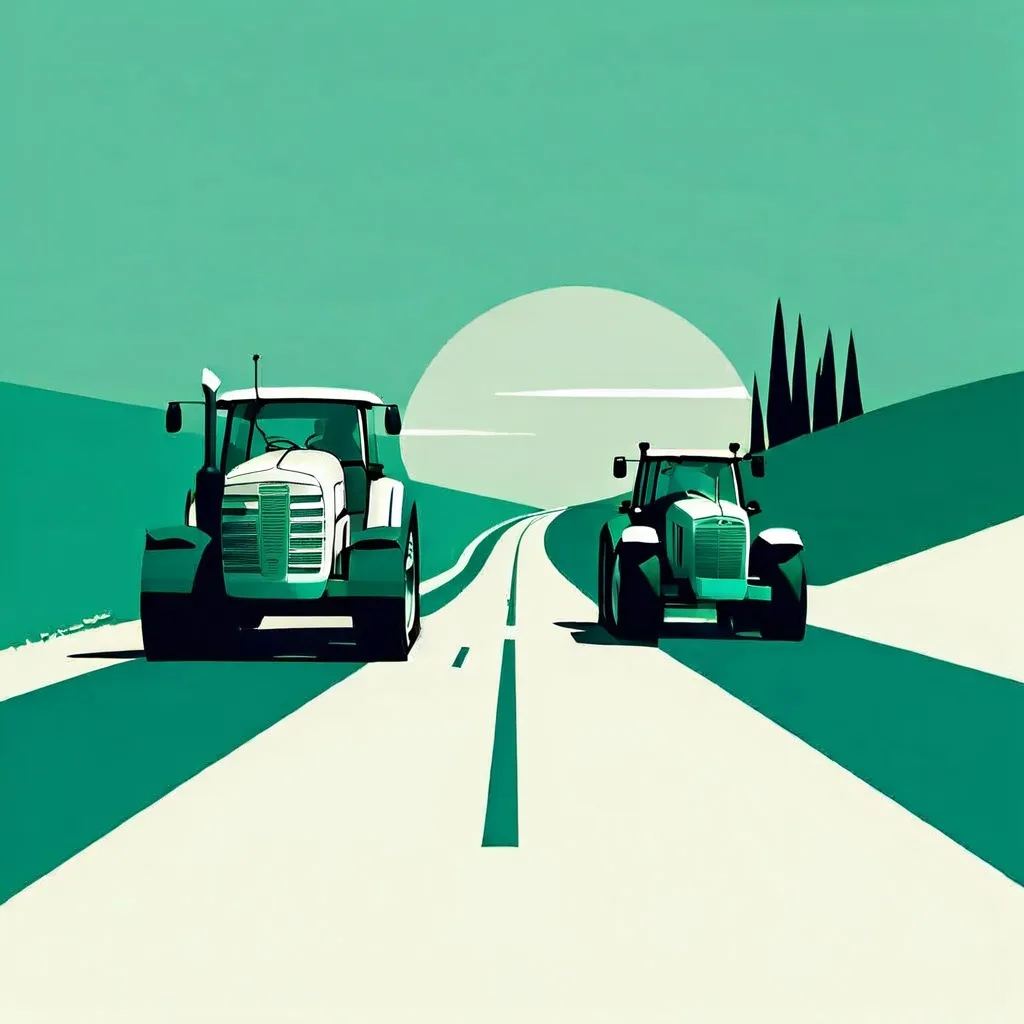
In the context of Italian roads, "slow-moving vehicles" encompasses a broad category, with agricultural machinery and large transport vehicles being particularly common on provincial and rural routes. Agricultural vehicles, such as tractors (trattori), combine harvesters (mietitrebbie), and other specialized machinery, are frequently encountered, especially in regions with significant agricultural activity. These vehicles often have restricted maximum speeds by design, dictated by their purpose and construction. For instance, wheeled agricultural machines using pneumatic tires are typically limited to 40 km/h, while those with metal tracks or other systems might be restricted to 15 km/h, as outlined in Article 57 of the Codice della Strada. They are also required to display a specific slow-moving vehicle sign to warn other road users of their reduced speed capabilities.
Large trucks (autocarri) and buses (autobus), particularly those carrying heavy loads or navigating steep inclines, also fall under this category. Their sheer size and weight mean they will naturally move at a much slower pace than typical passenger cars, especially on winding or uphill sections. The legal requirement to facilitate overtaking applies equally to them. Drivers of these vehicles must be attentive to traffic building up behind them and actively seek opportunities to allow others to pass, thereby preventing dangerous situations and maintaining journey times for other road users.
When you see a vehicle displaying the slow-moving vehicle sign, be prepared to adjust your speed and expect it to travel significantly slower than the posted speed limits. This is a crucial aspect of defensive driving on Italian roads.
Overtaking on single-carriageway Italian provincial roads (strade provinciali or SP) carries inherent risks that demand extreme caution and a thorough understanding of the local road environment. Unlike well-maintained motorways (autostrade) or dual carriageways, many provincial roads are narrow, winding, and may lack a hard shoulder. Visibility can be severely restricted by bends, crests, roadside vegetation, or even buildings in rural settlements. This means that judging the safety of an overtaking manoeuvre requires more than just assessing the speed of the vehicle in front; it critically involves anticipating oncoming traffic that may appear suddenly around a blind corner.
Furthermore, the presence of large vehicles, such as agricultural machinery or long-haul trucks, can exacerbate these hazards. They occupy a significant portion of the road, leaving very little space for an overtaking vehicle. Oncoming traffic, especially larger vehicles like buses or trucks, can create a significant wind buffeting effect and may force the overtaking driver to hug the centre line more closely than is comfortable, increasing the risk of a head-on collision. The surfaces of some provincial roads can also be uneven or have potholes, which can make it difficult to maintain a stable speed and trajectory during an overtake. Therefore, a decision to overtake should only be made when visibility is perfect for a considerable distance in both directions and when there is ample space to complete the manoeuvre without any risk.
Piazzola: Facilitating OvertakesOn certain types of Italian roads, particularly the winding and often steep mountain roads (strade di montagna), a specific infrastructure element is designed to assist with the management of slow-moving traffic: the piazzola. A piazzola is a designated roadside lay-by or pull-over area. These are strategically placed to allow slower vehicles to move off the main carriageway, enabling faster traffic to pass safely. For drivers of slow vehicles, especially those operating on mountain roads where overtaking opportunities are scarce, utilizing a piazzola is not just courteous but often a necessity dictated by common sense and the spirit of Article 141.
When encountering a slow-moving vehicle on such roads, drivers should be observant for these piazzole. If the slow vehicle is followed by more than three vehicles and there is a piazzola ahead, the driver of the slow vehicle is expected to pull into it to allow the queue to pass. For the driver wishing to overtake, the presence of a piazzola offers a potential safe haven to wait if an immediate overtake is not possible, or it confirms that the slow vehicle driver is aware of the traffic behind them and is likely to use the next available piazzola. The effective use of piazzole by both slow-moving vehicles and faster traffic is a critical aspect of safe driving on Italy’s more challenging rural and mountain routes.
Never assume that a piazzola is a safe overtaking spot. Always ensure that the slow vehicle has fully vacated the carriageway and that you have a clear view of oncoming traffic before commencing an overtake, even if a piazzola is present.
The topic of overtaking slow vehicles on Italian single-carriageway roads is a frequent subject in the official theory test. Questions often focus on specific scenarios, the trigger for the obligation to yield (more than three vehicles), and the hazards associated with these types of roads. You might encounter questions about the legal speed limits for agricultural machinery or what to do when you are driving a slow vehicle yourself. Pay close attention to the wording of these questions, as they are designed to test your understanding of the nuances of Italian traffic law and safe driving practices.
It is crucial to internalize not just the rules but also the reasoning behind them. The exam will assess your ability to apply these rules in practical situations, considering factors like visibility, road conditions, and the type of vehicle involved. Understanding the Italian terminology, such as trattore, mietitrebbia, strada provinciale, and piazzola, will also be beneficial.
On Italian single-carriageway roads, drivers of slow-moving vehicles—including agricultural machinery and heavy trucks—must yield by moving right or using a piazzola when more than three vehicles queue behind them, as specified by Article 141, paragraph 8 of the Codice della Strada. Agricultural vehicles display a slow-moving sign and have specific speed limits, while overtaking on provincial roads carries significant hazards due to narrow lanes, blind corners, and limited visibility. The piazzola system on mountain roads is designed to facilitate safe passing, but drivers must always verify the carriageway is clear before overtaking. Understanding these rules and the specific legal thresholds is essential for both safe driving and passing the Italian driving theory exam.
A short set of high-value points that capture the most important ideas from this article.
Article 141, paragraph 8 of the Codice della Strada obliges slow-moving vehicle drivers to yield when a queue of more than three vehicles forms behind them
Agricultural machinery like trattori and mietitrebbie displays a specific slow-moving vehicle sign and has distinct speed limits (40 km/h with pneumatic tires, 15 km/h with metal tracks)
Overtaking on Italian provincial roads demands extreme caution due to narrow lanes, blind corners, poor visibility, and uneven surfaces
Piazzole are strategically placed lay-bys on mountain and winding roads that slow vehicles must use to allow faster traffic to pass
The specific trigger of 'more than three vehicles' is a frequently tested detail in Italian driving theory exams
The queue threshold that activates the slow vehicle's legal obligation is strictly 'more than three' vehicles
Slow-moving vehicles must pull into piazzole when available and road conditions permit, not just when absolutely required
Agricultural vehicles are limited to 40 km/h (pneumatic tires) or 15 km/h (tracked systems) under Article 57 CdS
Overtaking decisions on provincial roads require clear visibility in both directions before committing to the manoeuvre
Heavy goods vehicles, agricultural machinery, and any vehicle significantly slower than general traffic flow are subject to the yielding obligation
Assuming the yielding obligation applies for just one or two vehicles behind—the trigger is specifically 'more than three'
Attempting to overtake near a piazzola without confirming the slow vehicle has fully vacated the carriageway
Judging overtaking safety only by the vehicle ahead's speed without checking visibility for oncoming traffic around bends and crests
Confusing general overtaking rules with the specific slow-vehicle yielding obligation under Article 141 para. 8
Underestimating the wind buffeting effect and space required when overtaking large vehicles like trucks and buses on narrow roads
Article content overview
A short set of high-value points that capture the most important ideas from this article.
Article 141, paragraph 8 of the Codice della Strada obliges slow-moving vehicle drivers to yield when a queue of more than three vehicles forms behind them
Agricultural machinery like trattori and mietitrebbie displays a specific slow-moving vehicle sign and has distinct speed limits (40 km/h with pneumatic tires, 15 km/h with metal tracks)
Overtaking on Italian provincial roads demands extreme caution due to narrow lanes, blind corners, poor visibility, and uneven surfaces
Piazzole are strategically placed lay-bys on mountain and winding roads that slow vehicles must use to allow faster traffic to pass
The specific trigger of 'more than three vehicles' is a frequently tested detail in Italian driving theory exams
The queue threshold that activates the slow vehicle's legal obligation is strictly 'more than three' vehicles
Slow-moving vehicles must pull into piazzole when available and road conditions permit, not just when absolutely required
Agricultural vehicles are limited to 40 km/h (pneumatic tires) or 15 km/h (tracked systems) under Article 57 CdS
Overtaking decisions on provincial roads require clear visibility in both directions before committing to the manoeuvre
Heavy goods vehicles, agricultural machinery, and any vehicle significantly slower than general traffic flow are subject to the yielding obligation
Assuming the yielding obligation applies for just one or two vehicles behind—the trigger is specifically 'more than three'
Attempting to overtake near a piazzola without confirming the slow vehicle has fully vacated the carriageway
Judging overtaking safety only by the vehicle ahead's speed without checking visibility for oncoming traffic around bends and crests
Confusing general overtaking rules with the specific slow-vehicle yielding obligation under Article 141 para. 8
Underestimating the wind buffeting effect and space required when overtaking large vehicles like trucks and buses on narrow roads
Explore related topics, search based questions, and concepts that learners often look up when studying Overtaking Slow Vehicles in Italy. These themes reflect real search intent and help you understand how this topic connects to wider driving theory knowledge in Italy.
Find clear and practical answers to common questions learners often have about Overtaking Slow Vehicles in Italy. This section helps explain difficult points, remove confusion, and reinforce the key driving theory concepts that matter for learners in Italy.
Article 141, paragraph 8 of the CdS mandates that drivers of slow-moving vehicles must pull as far right as possible and, where conditions permit, allow following traffic to overtake when a queue of more than three vehicles has formed behind them. This ensures traffic flow and safety.
Slow vehicles typically include heavy goods vehicles (camion), agricultural machinery (macchine agricole like trattori and mietitrebbie), construction equipment, and any vehicle operating significantly below the posted speed limit that impedes traffic.
Italian provincial roads often feature poor sightlines, narrow lanes, no hard shoulders, and can have oncoming heavy traffic. Overtaking slow vehicles on these roads requires extreme caution due to these visibility and space limitations.
A 'piazzola' is a roadside lay-by or pull-over area, commonly found on mountain or winding roads. Slow-moving vehicles may use these designated areas to temporarily stop, allowing following traffic to overtake safely.
Yes, agricultural vehicles (macchine agricole) are often required to display a specific slow-moving vehicle sign to alert other road users to their reduced speed, which is crucial for hazard perception.
Refine your search or explore related Italian driving theory articles to build a stronger foundation for your exam. Dive deeper into specific traffic regulations, road signs, and practical driving scenarios that are essential for passing your official licence test.