
Braking distance is the physical space your vehicle covers from when you hit the brakes until it comes to a complete halt. This page breaks down the critical factors influencing this distance in France, from your speed to road grip, and helps you understand its importance for the permis de conduire exam. It's distinct from reaction distance, forming a crucial part of overall stopping distance.
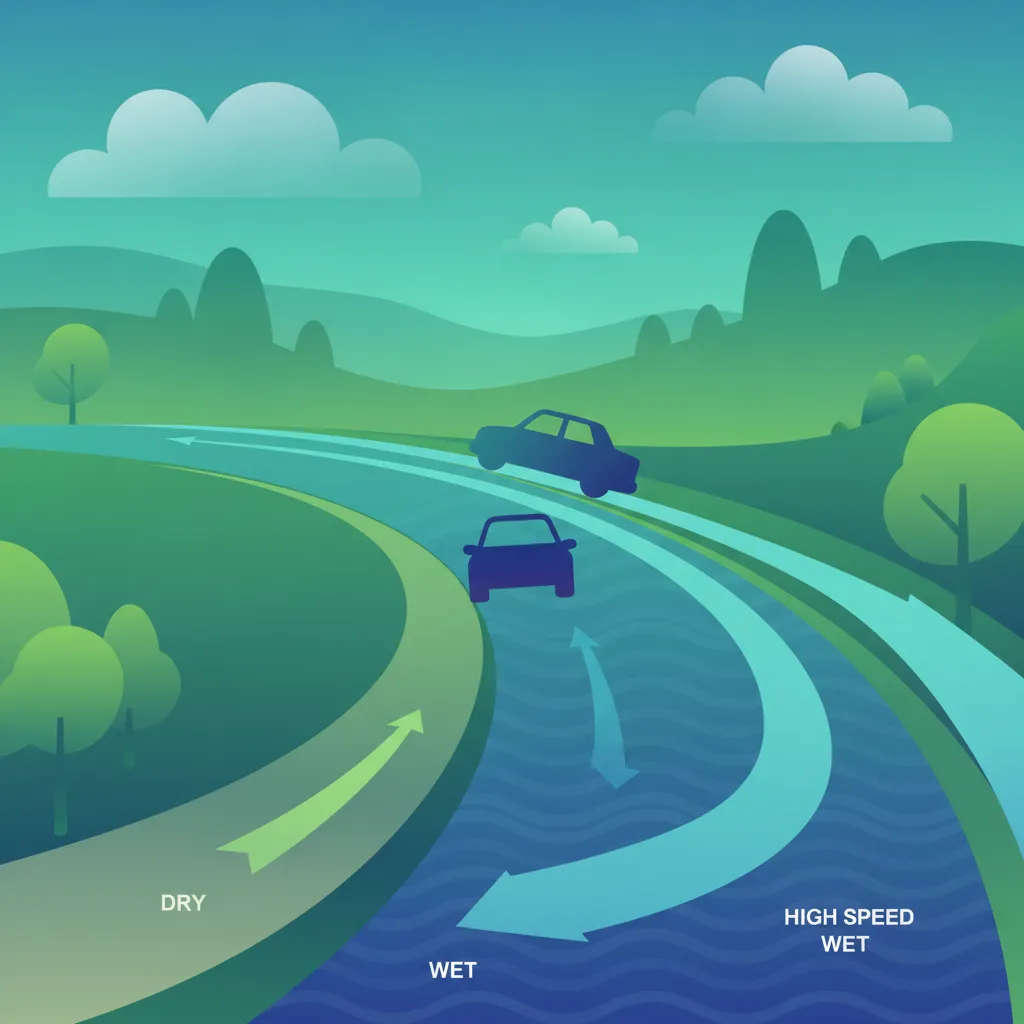
Theory topic content overview
Read the full theory topic guide for Braking Distance with structured, easy-to-scan content built for learners in France. This detailed section explains the exact rule, meaning, traffic context, comparison points, and exam logic behind this French driving theory topic so you can study faster, understand the concept more clearly, and avoid common interpretation mistakes on the theory test.
Braking distance, known in French as distance de freinage, is the specific stretch a vehicle covers from the moment a driver fully engages the brake pedal until the vehicle comes to a complete, absolute halt. It is a critical component of safe driving and a foundational concept within the Code de la route for obtaining your permis de conduire in France. This physical distance depends entirely on the vehicle's kinetic energy, the effectiveness of the brakes, and the grip available between the tires and the road surface.
Understanding distance de freinage is not just a theoretical exercise; it's directly linked to road safety and success in your French driving theory exam (ETG).
distances de sécurité (safe following distances).permis de conduire theory test (Code de la route) frequently includes questions about stopping distances, especially differentiating distance de freinage from distance de réaction (reaction distance) and how various factors like speed and weather impact them.autoroutes or in varied weather conditions found across France, correctly estimating braking capabilities is essential for anticipating potential dangers and adjusting your driving style proactively.When you apply the brakes, the braking system converts the vehicle's kinetic (motion) energy into thermal energy (heat) through friction between the brake pads and discs/drums. This process gradually slows the wheels until the vehicle stops. The efficiency of this energy conversion directly affects how quickly your vehicle can come to a halt and, therefore, your distance de freinage.
The core principle to remember is that a vehicle in motion possesses inertia, meaning it resists changes to its state of motion. Overcoming this inertia requires force (from the brakes) applied over time and distance.
Several critical elements dictate your distance de freinage on French roads:
Vitesse): This is the most significant factor. The kinetic energy of a vehicle increases with the square of its speed. This means doubling your speed (e.g., from 50 km/h to 100 km/h) can quadruple your braking distance under identical conditions. This exponential relationship is crucial for French theory exam questions.Adhérence): The adhérence or grip between your tires and the road is paramount.
Route Mouillée): Rain drastically reduces adhérence, extending distance de freinage significantly. The Code de la route strongly advises increasing distances de sécurité in these conditions.Verglas ou Neige): These conditions offer extremely low grip, multiplying braking distances by a factor of 8 to 10 or even more, making gentle braking and reduced speeds absolutely vital.État des Pneus): Worn tires (pneus usés) with insufficient tread depth reduce grip, especially on wet or slippery surfaces, directly increasing distance de freinage. Correct tire pressure is also essential for optimal contact with the road.État du Système de Freinage): Well-maintained brakes are essential. Worn brake pads, faulty calipers, air in the brake lines, or a failing ABS (Anti-lock Braking System) can all compromise braking efficiency and extend distance de freinage.Charge du Véhicule): A heavier vehicle (with passengers or cargo) has more inertia, requiring more force and thus a greater distance de freinage to stop. This is particularly relevant for commercial vehicles or when carrying holiday luggage across France.This is a common point of confusion for permis de conduire candidates in France and is frequently tested. It's vital to differentiate:
Reaction Distance (Distance de Réaction): This is the distance your vehicle travels from the moment you perceive a hazard until you actually apply the brakes. It depends on driver factors like alertness, fatigue, and alcohol/drug consumption. At 50 km/h, the typical reaction distance is about 15 metres.
Braking Distance (Distance de Freinage): As explained, this is the distance from the moment brakes are applied until the vehicle stops. It depends on vehicle speed, road conditions, and vehicle maintenance.
Stopping Distance (Distance d'Arrêt): This is the total distance your vehicle travels from the moment you perceive a hazard until it comes to a complete stop. It is the sum of reaction distance and braking distance.
Distance d'arrêt = Distance de réaction + Distance de freinage
Understanding this relationship is fundamental for the Code de la route exam.
Rond-Point (Roundabout) in Rain: You are driving at 50 km/h on a main road approaching a rond-point in a French town. If it starts raining, your distance de freinage will significantly increase. You must begin braking earlier and more gently than you would on dry roads, and ensure a greater distance de sécurité from the car in front.Autoroute: You are travelling at 130 km/h on a dry autoroute. A sudden hazard appears. Even with quick reaction, your braking distance alone will be substantial. If the autoroute surface is wet, that distance will extend dramatically, highlighting the danger of excessive speed and insufficient distances de sécurité.distance de freinage will be longer, even on dry, flat roads. Descending a mountain pass further complicates this, requiring careful gear selection and controlled braking to prevent brake fade.distance de freinage increases with speed. They might assume doubling speed doubles braking distance, rather than quadrupling it.distances de sécurité adequately for wet, icy, or gravelly roads. The Code de la route heavily penalises this oversight.pneus usés) are a major hazard and will drastically increase distance de freinage, especially in adverse weather common in France.distance de freinage with distance d'arrêt during exam questions, leading to incorrect answers.distance de freinage on slippery surfaces; it merely helps prevent wheel lock-up.In France, the Code de la route places significant emphasis on distances de sécurité (safe following distances), which are directly calculated based on distance de freinage and distance de réaction. French driving education stresses that while speed limits are maximums, the safe speed is always dictated by conditions that impact your distance de freinage. This includes:
Météo): Expect Code de la route questions specifically addressing increased distance de freinage on route mouillée (wet roads). The rule of thumb for distances de sécurité often involves doubling the dry weather gap in rain.État du Véhicule): Regular maintenance is not just a recommendation; it's a legal requirement and crucial for ensuring your vehicle can achieve its optimal distance de freinage.Anticipation): French driving theory encourages proactive driving, which means anticipating hazards well in advance to minimise the need for emergency braking and provide more distance de freinage if needed.Mastering distance de freinage means more than just knowing a definition; it's about developing an instinct for how far your vehicle will travel before stopping in any given situation on French roads. Always think:
distance de freinage capabilities?adhérence and thus my distance de freinage?distance de sécurité ahead to account for both my reaction time and the necessary distance de freinage?By internalising these principles, you enhance your safety, perform better in your permis de conduire exam, and become a more responsible driver in France.
Start with a short, direct summary of Braking Distance before reading the full explanation below.
Braking distance is the distance a vehicle travels after the driver engages the brakes until the vehicle is fully stopped. It is heavily influenced by your vehicle's speed, the condition of the road surface (e.g., dry, wet, icy), and the state of your tires and braking system. In France, understanding these factors is vital for safety and accurately estimating safe following distances.
Review the most important terms, rule signals, and traffic concepts linked to Braking Distance.
Explore related theory topic pages connected to Braking Distance and continue with the next useful rule explanation.
See the common search queries learners use when trying to understand Braking Distance in France.

Continue your journey by exploring specific French driving theory topics, from road signs and priority rules to vehicle safety and administrative procedures. Deepen your understanding of the Code de la route and prepare effectively for your permis de conduire ETG exam to ensure success and safe driving practices.
French Driving Theory Topics & RulesTheory topic content overview
Start with a short, direct summary of Braking Distance before reading the full explanation below.
Braking distance is the distance a vehicle travels after the driver engages the brakes until the vehicle is fully stopped. It is heavily influenced by your vehicle's speed, the condition of the road surface (e.g., dry, wet, icy), and the state of your tires and braking system. In France, understanding these factors is vital for safety and accurately estimating safe following distances.
Review the most important terms, rule signals, and traffic concepts linked to Braking Distance.
Explore related theory topic pages connected to Braking Distance and continue with the next useful rule explanation.
See the common search queries learners use when trying to understand Braking Distance in France.
Continue your journey by exploring specific French driving theory topics, from road signs and priority rules to vehicle safety and administrative procedures. Deepen your understanding of the Code de la route and prepare effectively for your permis de conduire ETG exam to ensure success and safe driving practices.
French Driving Theory Topics & RulesUse this exam-focused revision tip to understand how Braking Distance is likely to appear in theory questions for learners in France. This section helps you identify the most testable part of the rule, avoid common traps, and remember the concept more effectively during French driving theory exam preparation.
A common trap in the French driving theory exam is confusing braking distance with total stopping distance. Remember that braking distance starts after you've reacted and applied the brakes. Always consider factors like rain or ice on French roads, as these conditions drastically extend the distance needed to stop safely.
Read direct answers to the most common learner questions about Braking Distance in France. This FAQ focuses on rule confusion, practical meaning, comparison with similar concepts, and the exact uncertainties that appear most often in French driving theory revision and exam preparation.
Braking distance refers to the space your vehicle covers from the instant you apply the brakes to the point it stops completely. It does not include the time it takes for you to react.
In France, as with any country, braking distance increases exponentially with speed. Doubling your speed can roughly quadruple your braking distance, a critical rule for safety and the Code de la route.
Key factors include high speed, wet or icy road surfaces, worn tires, heavy vehicle load, and faulty braking systems. These reduce grip and stopping efficiency.
Braking distance is only the distance covered during active braking. Stopping distance is the total distance, encompassing both your reaction distance (time to perceive and react) and the subsequent braking distance.
Wet roads significantly reduce tire grip, leading to a much longer braking distance. The French Code de la route emphasizes increasing safety distances in such conditions to compensate for reduced adhesion.
The French theory exam (ETG) will test your understanding of the relationship between speed, road conditions, and braking distance, rather than specific numerical distances. The principle of increasing safety margins in adverse conditions is key.
Yes, a heavier vehicle or one with a significant load will generally require a longer braking distance due to increased inertia, especially relevant for commercial vehicles in France.
Ready to focus your study? Use the practice search to find exactly the French driving theory questions you need for the Code de la route and permis de conduire ETG. Refine your knowledge on specific topics or challenging rules to boost your confidence and exam readiness.