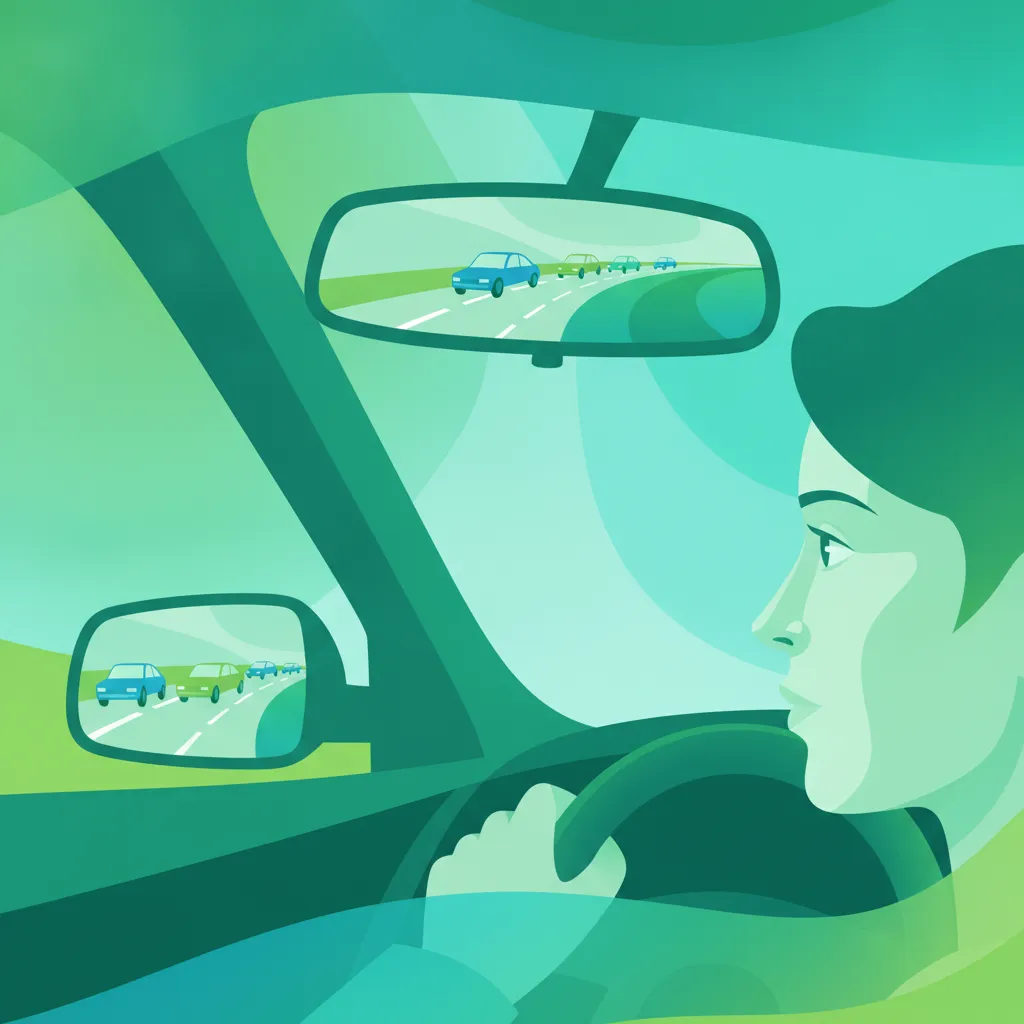
Mirror checks are fundamental to maintaining situational awareness on French roads, allowing drivers to monitor traffic behind and to the sides of their vehicle. This page details the proper use of your interior rear-view mirror and exterior side mirrors, explaining when and why these observations are critical for safe maneuvers and anticipating hazards. Mastering these techniques is essential for both daily driving and success in your French driving tests.
Theory topic content overview
Read the full theory topic guide for Mirror Checks with structured, easy-to-scan content built for learners in France. This detailed section explains the exact rule, meaning, traffic context, comparison points, and exam logic behind this French driving theory topic so you can study faster, understand the concept more clearly, and avoid common interpretation mistakes on the theory test.
Mirror checks refer to the essential practice of routinely scanning your vehicle's mirrors to maintain a comprehensive awareness of the surrounding traffic environment. This continuous observation involves using both your interior rear-view mirror and your exterior side mirrors to monitor vehicles behind and to the sides. In French driving theory, known as the Code de la route, mirror checks are fundamental to anticipating the actions of other road users, identifying potential hazards, and ensuring the safety of all maneuvers.
This proactive observation technique is not merely about "looking"; it's about actively processing information from your mirrors to make informed decisions. It forms a cornerstone of defensive driving, allowing you to react safely and prevent collisions, a critical skill for passing your permis de conduire exams and for daily driving on French roads.
Mastering mirror checks is vital for several reasons, particularly within the context of French driving:
Effective mirror checks involve more than just a quick glance. They require a deliberate, systematic approach.
This is a fundamental principle in French driving instruction and a key component tested in the permis de conduire. It dictates the order of operations for any change in direction or speed:
Crucially, mirrors always come before signaling and before the maneuver itself. This sequence is designed to ensure you only signal and act when you've confirmed the road ahead and behind is clear.
You should be checking your mirrors almost continuously, but specific situations demand immediate checks:
Drivers typically use three mirrors, each serving a distinct purpose:
This mirror provides a direct view of traffic directly behind your vehicle. It's best for:
These mirrors show traffic to the sides and rear-quarter of your vehicle. They are crucial for:
This is arguably the most important distinction in mirror checks for French driving. Blind spots are areas around your vehicle that cannot be seen in any of your mirrors. These are often areas to the side and slightly behind your vehicle.
To compensate for blind spots, especially before changing lanes or making turns, you must perform a direct visual check (contrôle visuel direct or coup d'œil) by briefly looking over your shoulder in the direction you intend to move. This quick head turn is vital for spotting vehicles like scooters or bicycles that could be hidden by your vehicle's pillars. Failing to check your angles morts is a serious error in the permis de conduire practical exam.
The frequency and intensity of your mirror checks should adapt to various conditions:
Many permis de conduire candidates lose points or even fail due to common errors related to mirror checks:
For French drivers, mastering mirror checks is about developing a habit of continuous, intelligent observation. Always remember the Mirrors-Signal-Maneuver (MSM) sequence and never neglect your blind spot checks (angles morts) with a coup d'œil. Your mirrors are your extra set of eyes, allowing you to see what's happening all around your vehicle. By consistently applying these techniques, you'll become a safer, more confident driver on French roads, prepared for both the permis de conduire exam and real-world traffic scenarios.
Start with a short, direct summary of Mirror Checks before reading the full explanation below.
Mirror checks involve routinely scanning your interior rear-view mirror and exterior side mirrors to maintain awareness of surrounding traffic. This continuous observation helps French drivers anticipate the actions of other road users, identify potential hazards, and execute maneuvers like changing lanes, braking, or turning safely. Regular, timely mirror checks are a core component of defensive driving and are heavily emphasized in French driving theory for the permis de conduire.
Review the most important terms, rule signals, and traffic concepts linked to Mirror Checks.
Explore related theory topic pages connected to Mirror Checks and continue with the next useful rule explanation.
See the common search queries learners use when trying to understand Mirror Checks in France.

Continue your journey by exploring specific French driving theory topics, from road signs and priority rules to vehicle safety and administrative procedures. Deepen your understanding of the Code de la route and prepare effectively for your permis de conduire ETG exam to ensure success and safe driving practices.
French Driving Theory Topics & RulesTheory topic content overview
Start with a short, direct summary of Mirror Checks before reading the full explanation below.
Mirror checks involve routinely scanning your interior rear-view mirror and exterior side mirrors to maintain awareness of surrounding traffic. This continuous observation helps French drivers anticipate the actions of other road users, identify potential hazards, and execute maneuvers like changing lanes, braking, or turning safely. Regular, timely mirror checks are a core component of defensive driving and are heavily emphasized in French driving theory for the permis de conduire.
Review the most important terms, rule signals, and traffic concepts linked to Mirror Checks.
Explore related theory topic pages connected to Mirror Checks and continue with the next useful rule explanation.
See the common search queries learners use when trying to understand Mirror Checks in France.
Continue your journey by exploring specific French driving theory topics, from road signs and priority rules to vehicle safety and administrative procedures. Deepen your understanding of the Code de la route and prepare effectively for your permis de conduire ETG exam to ensure success and safe driving practices.
French Driving Theory Topics & RulesUse this exam-focused revision tip to understand how Mirror Checks is likely to appear in theory questions for learners in France. This section helps you identify the most testable part of the rule, avoid common traps, and remember the concept more effectively during French driving theory exam preparation.
In the French theory exam (ETG), questions often test your knowledge of observation routines. Remember that mirror checks always *precede* signaling and *precede* any maneuver (e.g., changing lanes, turning, braking). Thinking 'Mirrors First' can help you recall the correct sequence for safety and exam success.
Read direct answers to the most common learner questions about Mirror Checks in France. This FAQ focuses on rule confusion, practical meaning, comparison with similar concepts, and the exact uncertainties that appear most often in French driving theory revision and exam preparation.
Mirror checks are vital in France to maintain constant awareness of traffic, especially on busy roads and autoroutes, enabling you to react safely to changing conditions and preventing collisions during maneuvers. They are a core part of safe driving under the Code de la route.
The 'mirror-signal-maneuver' (MSM) routine, often called 'Rétroviseur-Signalisation-Manœuvre' in French driving education, emphasizes that you must check your mirrors *before* signaling and *before* executing any change in direction or speed, such as changing lanes or turning.
You should check your mirrors before braking to assess if there are vehicles closely behind you, especially motorcyclists or cyclists, allowing you to adjust your braking force and warn others if necessary to prevent a rear-end collision.
To check blind spots, quickly turn your head to glance over your shoulder in the direction you intend to move, confirming no vehicles are hidden from your mirrors. This 'contrôle direct' is crucial before changing lanes or turning, particularly on multi-lane roads or roundabouts.
Yes, constant, routine mirror checks are essential even when driving straight on an autoroute. This helps you monitor following distances, identify faster-approaching vehicles, and be ready for emergency braking or lane changes while maintaining overall traffic awareness.
The interior rear-view mirror gives you a central view of traffic directly behind you. Exterior side mirrors (left and right) provide views of traffic to your sides and slightly behind, helping with lane awareness and blind spot identification, especially for vehicles in adjacent lanes.
Adverse weather like rain or fog can obscure mirrors, reducing visibility. In such conditions, drivers in France must increase the frequency of their mirror checks, rely more on direct observation for blind spots, and adjust speed to compensate for reduced awareness.
Ready to focus your study? Use the practice search to find exactly the French driving theory questions you need for the Code de la route and permis de conduire ETG. Refine your knowledge on specific topics or challenging rules to boost your confidence and exam readiness.