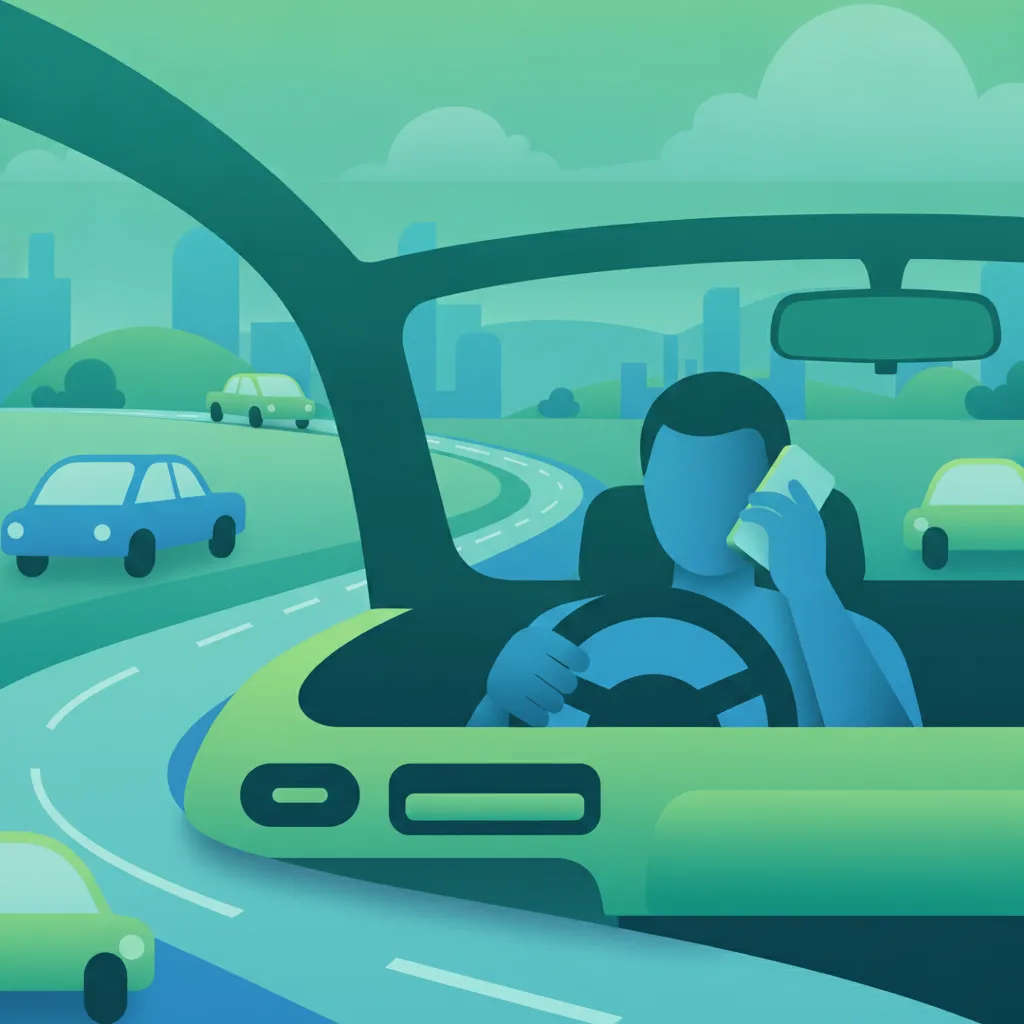
Driving demands constant focus, and any mobile phone interaction diverts essential attention from the road. This section details how different forms of phone-related distraction compromise your reaction time and hazard perception, leading to increased accident risk. Understanding these dangers is crucial for passing your French driving exam and ensuring road safety.
Theory topic content overview
Read the full theory topic guide for Phone Use Dangers with structured, easy-to-scan content built for learners in France. This detailed section explains the exact rule, meaning, traffic context, comparison points, and exam logic behind this French driving theory topic so you can study faster, understand the concept more clearly, and avoid common interpretation mistakes on the theory test.
Using a mobile phone while driving fundamentally clashes with the principle of continuous attention required to operate a vehicle safely. It introduces multiple forms of distraction that divert your focus, hands, and eyes from the primary task of driving. This compromises your ability to perceive hazards, make timely decisions, and react effectively, drastically increasing the risk of accidents on French roads.
The Code de la route in France takes a very strict stance on mobile phone use because even a momentary lapse in concentration can have severe consequences, especially given the varied and often dense traffic conditions.
The danger of mobile phone use behind the wheel isn't just a theoretical concern; it's a leading cause of traffic accidents, directly impacting key driving skills:
For the permis de conduire theory exam (ETG), understanding these impacts is crucial. Questions often focus on the type of distraction and its specific consequence.
Mobile phones pose a unique threat because they often combine three distinct types of distraction simultaneously:
This occurs when your eyes are off the road, focused on your phone screen rather than the traffic, road signs, or vulnerable road users.
This involves taking one or both hands off the steering wheel to hold, dial, text, or manipulate your phone.
This is when your mind is occupied by the conversation or content on your phone, rather than the immediate driving task.
It's the combination of these three types of distraction that makes mobile phone use so uniquely hazardous. One form of distraction often leads to another (e.g., looking at a screen (visual) to dial (manual) while thinking about the call (cognitive)).
In France, the Code de la route is very clear and strict regarding mobile phone use while driving:
The spirit of French road safety legislation is that nothing should interfere with a driver's continuous and undivided attention to the task of driving.
Consider these common scenarios where phone use becomes catastrophic:
Learners taking their permis de conduire often make assumptions that lead to dangerous habits:
The most critical takeaway for safe driving in France, and indeed anywhere, is that driving is a single-task activity that demands 100% of your attention.
To ensure safety and comply with the Code de la route:
By internalizing the severe impact of mobile phone distractions on reaction time and hazard perception, you not only prepare effectively for your French driving theory exam but also become a safer, more responsible driver on French roads.
Start with a short, direct summary of Phone Use Dangers before reading the full explanation below.
Using a mobile phone while driving is highly dangerous because it creates visual, manual, and cognitive distractions. These distractions significantly slow down your reaction time, reduce your awareness of traffic and hazards, and drastically increase the risk of accidents. French road safety regulations strictly prohibit phone use at the wheel to ensure continuous driver attention and prevent serious incidents on the roads.
Review the most important terms, rule signals, and traffic concepts linked to Phone Use Dangers.
Explore related theory topic pages connected to Phone Use Dangers and continue with the next useful rule explanation.
See the common search queries learners use when trying to understand Phone Use Dangers in France.

Continue your journey by exploring specific French driving theory topics, from road signs and priority rules to vehicle safety and administrative procedures. Deepen your understanding of the Code de la route and prepare effectively for your permis de conduire ETG exam to ensure success and safe driving practices.
French Driving Theory Topics & RulesTheory topic content overview
Start with a short, direct summary of Phone Use Dangers before reading the full explanation below.
Using a mobile phone while driving is highly dangerous because it creates visual, manual, and cognitive distractions. These distractions significantly slow down your reaction time, reduce your awareness of traffic and hazards, and drastically increase the risk of accidents. French road safety regulations strictly prohibit phone use at the wheel to ensure continuous driver attention and prevent serious incidents on the roads.
Review the most important terms, rule signals, and traffic concepts linked to Phone Use Dangers.
Explore related theory topic pages connected to Phone Use Dangers and continue with the next useful rule explanation.
See the common search queries learners use when trying to understand Phone Use Dangers in France.
Continue your journey by exploring specific French driving theory topics, from road signs and priority rules to vehicle safety and administrative procedures. Deepen your understanding of the Code de la route and prepare effectively for your permis de conduire ETG exam to ensure success and safe driving practices.
French Driving Theory Topics & RulesUse this exam-focused revision tip to understand how Phone Use Dangers is likely to appear in theory questions for learners in France. This section helps you identify the most testable part of the rule, avoid common traps, and remember the concept more effectively during French driving theory exam preparation.
In the French driving theory exam (ETG), questions about mobile phone use often test your understanding of different distraction types (visual, manual, cognitive) and their direct impact on reaction time and hazard perception. Remember, even a quick glance at your phone can mean traveling dozens of meters without full awareness, making prevention crucial.
Read direct answers to the most common learner questions about Phone Use Dangers in France. This FAQ focuses on rule confusion, practical meaning, comparison with similar concepts, and the exact uncertainties that appear most often in French driving theory revision and exam preparation.
Mobile phones cause visual distraction (looking away from the road), manual distraction (hands off the wheel), and cognitive distraction (mental focus on conversation instead of driving).
Using a phone significantly slows a driver's reaction time, making it harder to respond quickly to sudden hazards or changes in traffic conditions.
While some hands-free systems are technically allowed (e.g., integrated car systems), cognitive distraction still occurs. The Code de la route emphasizes full attention, and even hands-free calls can divert mental focus, increasing accident risk.
The French Code de la route strictly prohibits holding a mobile phone in your hand while driving. This includes reading messages, checking GPS on a handheld device, or making calls without an integrated hands-free system.
Studies indicate that drivers distracted by mobile phones are significantly more likely to be involved in a collision, including rear-end crashes and lane departures.
No, French law considers you to be driving even when stopped in traffic or at a red light. You are not permitted to use a handheld phone in these situations.
Using a handheld phone while driving in France can result in a fine and a deduction of points from your driving license (permis de conduire).
Distraction, especially from a mobile phone, reduces a driver's ability to notice and correctly interpret potential hazards on the road, increasing the chance of an unexpected event becoming an accident.
Ready to focus your study? Use the practice search to find exactly the French driving theory questions you need for the Code de la route and permis de conduire ETG. Refine your knowledge on specific topics or challenging rules to boost your confidence and exam readiness.