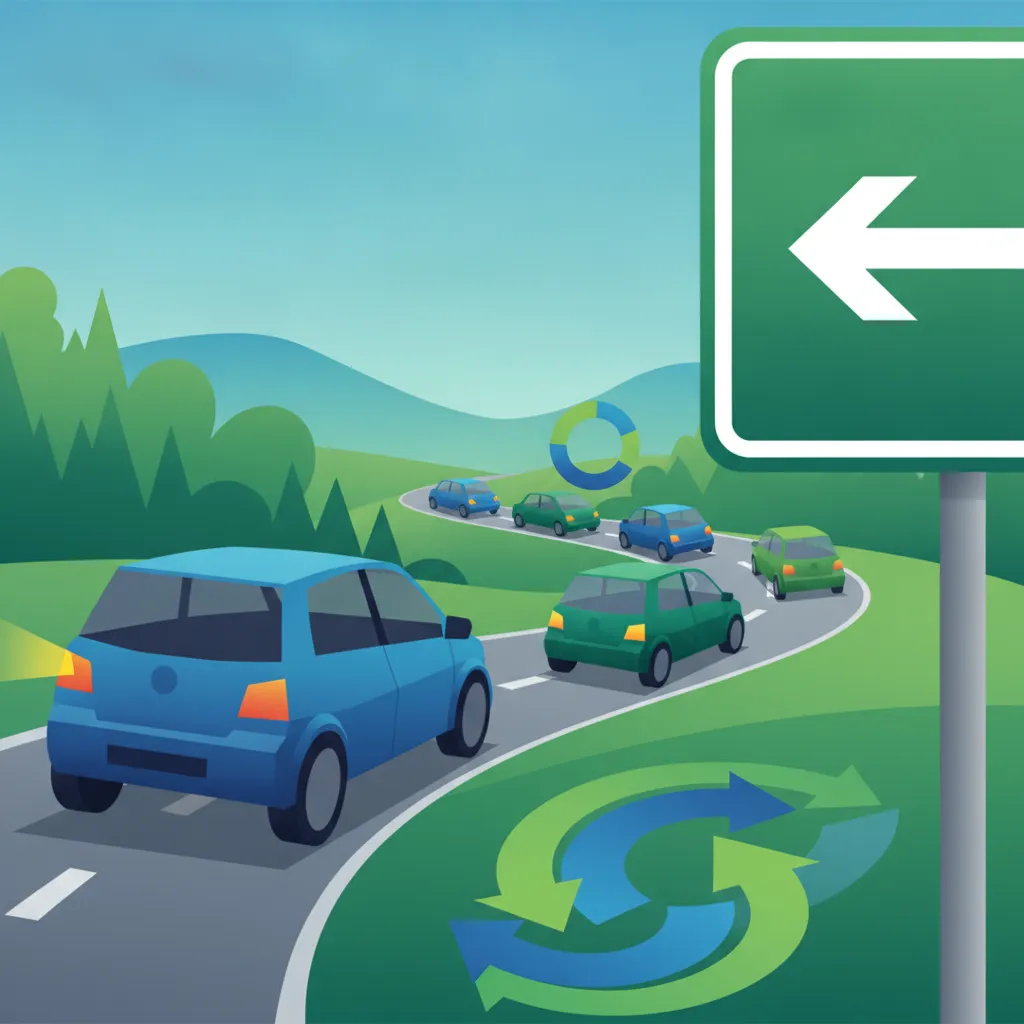
Signalling, or using your vehicle's turn indicators, is a fundamental aspect of communicating your intentions to other road users. In France, the Code de la route specifies when and how you must signal to ensure smooth traffic flow and prevent dangerous situations. This includes early and clear communication before changing direction, lanes, or interacting with roundabouts.
Theory topic content overview
Read the full theory topic guide for Signalling on French Roads with structured, easy-to-scan content built for learners in France. This detailed section explains the exact rule, meaning, traffic context, comparison points, and exam logic behind this French driving theory topic so you can study faster, understand the concept more clearly, and avoid common interpretation mistakes on the theory test.
Signalling, using your vehicle's turn indicators or "clignotants" in French, is a fundamental aspect of communicating your intentions to other road users. As defined by the Code de la route in France, it is your primary means of informing those around you—drivers, cyclists, and pedestrians—about your planned changes in direction or position. Think of it as speaking the "language of the road," allowing others to anticipate your actions and react accordingly.
This crucial communication tool enhances predictability, contributes significantly to road safety, and is a key skill rigorously assessed in the French permis de conduire (driving license) theory exam (ETG) and practical test.
Effective signalling is not merely a formality; it's a critical safety measure and a legal obligation under the Code de la route. For drivers in France, its importance is amplified by several factors:
autoroutes, and at complex rond-points (roundabouts) found throughout France.autoroutes or navigating dense city traffic.Code de la route mandates signalling before any significant change in direction or lane. Failure to signal, or signalling incorrectly, can result in a fine and points deducted from your permis de conduire.Permis de Conduire Exam Success: Both the theoretical ETG exam and the practical driving test place a strong emphasis on correct and timely signalling. Learners frequently lose points for errors related to signalling, especially at roundabouts.Code de la route in PracticeThe Code de la route specifies when and how you must use your turn signals. The general principle is to signal before initiating a manoeuvre, giving other road users ample time to react.
autoroutes.Autoroute: When entering a main road or an autoroute from an acceleration lane, signalling is mandatory. This informs drivers on the main road of your intention to join traffic flow, allowing them to adjust if necessary.Rond-point): This is a critical point of confusion for many learners in France. You must signal your exit from a rond-point using the right turn indicator. If you are going straight or taking the first exit, you should signal before entering the roundabout or as you pass the exit before yours. If taking a later exit, signal as you pass the exit before your intended one.The effectiveness of your signalling isn't just about switching it on; it's also about how other factors might influence its reception:
autoroutes or routes nationales, you need to signal even earlier to give faster-moving traffic more time to react.rond-points or complex urban intersections require particularly precise and timely signalling to avoid miscommunication.It's crucial to understand what signalling is and is not:
Code de la route for specific situations or if indicators fail), turn indicators are your primary and most effective way to communicate.Let's look at how signalling plays out in common French driving situations:
Autoroute: As you accelerate in the merging lane (voie d'insertion), activate your left turn signal well in advance. This tells drivers already on the autoroute that you intend to merge, allowing them to adjust their speed or change lanes to facilitate your entry.Rond-point: If you are taking the third exit (left turn) on a multi-lane roundabout, you might initially signal left upon entering. As you pass the second exit, you must cancel your left signal and activate your right signal to indicate your departure on the third exit. This is a common test point in the French driving exam.Route Nationale: On a two-way route nationale, before you move into the opposing lane to overtake, activate your left signal. After safely passing and checking your mirrors, signal right to indicate your return to your original lane.Permis de Conduire Exam & Daily DrivingMany learners find signalling deceptively simple, leading to common errors that can be penalised during the permis de conduire exam:
rond-point, or signalling incorrectly (e.g., signalling right upon entry when going straight, or signalling left when taking the first or second exit).Code de la route & ETGThe emphasis in French driving education and the Code de la route is strongly on anticipation and communication. Signalling is seen as a fundamental act of courtoisie (courtesy) and responsibility on the road.
The ETG (theory exam) frequently includes scenario-based questions where you must identify the correct signalling behaviour. Practical driving lessons in France dedicate significant time to mastering roundabout signalling, which is often more nuanced than in other countries due to varied roundabout designs and specific Code de la route interpretations. Familiarity with these specific French conventions is vital for your permis de conduire success. Remember, correct signalling is not just a rule, but a habit that actively contributes to safer and smoother driving across France.
Always remember: your turn signal is your voice on the road. By using it correctly, early, and consistently, you are actively communicating your intentions, allowing other road users to anticipate your movements, and contributing significantly to the safety and fluidity of French traffic. Make clear, timely signalling a core habit from your very first driving lesson.
Start with a short, direct summary of Signalling on French Roads before reading the full explanation below.
Signalling involves using your vehicle's turn indicators to inform other drivers and road users of your planned movements. In France, this is legally required before initiating any significant change in direction, such as turning, changing lanes, merging onto a road, or exiting a roundabout. It ensures predictability, enhances road safety, and is a key skill assessed in the French driving license theory exam.
Review the most important terms, rule signals, and traffic concepts linked to Signalling on French Roads.
Explore related theory topic pages connected to Signalling on French Roads and continue with the next useful rule explanation.
See the common search queries learners use when trying to understand Signalling on French Roads in France.

Continue your journey by exploring specific French driving theory topics, from road signs and priority rules to vehicle safety and administrative procedures. Deepen your understanding of the Code de la route and prepare effectively for your permis de conduire ETG exam to ensure success and safe driving practices.
French Driving Theory Topics & RulesTheory topic content overview
Start with a short, direct summary of Signalling on French Roads before reading the full explanation below.
Signalling involves using your vehicle's turn indicators to inform other drivers and road users of your planned movements. In France, this is legally required before initiating any significant change in direction, such as turning, changing lanes, merging onto a road, or exiting a roundabout. It ensures predictability, enhances road safety, and is a key skill assessed in the French driving license theory exam.
Review the most important terms, rule signals, and traffic concepts linked to Signalling on French Roads.
Explore related theory topic pages connected to Signalling on French Roads and continue with the next useful rule explanation.
See the common search queries learners use when trying to understand Signalling on French Roads in France.
Continue your journey by exploring specific French driving theory topics, from road signs and priority rules to vehicle safety and administrative procedures. Deepen your understanding of the Code de la route and prepare effectively for your permis de conduire ETG exam to ensure success and safe driving practices.
French Driving Theory Topics & RulesUse this exam-focused revision tip to understand how Signalling on French Roads is likely to appear in theory questions for learners in France. This section helps you identify the most testable part of the rule, avoid common traps, and remember the concept more effectively during French driving theory exam preparation.
Many learners lose points by signalling too late or forgetting to signal when exiting a roundabout. Always activate your turn signal well in advance of the maneuver and remember to switch it off afterwards; early and correct use is key for the French driving exam.
Read direct answers to the most common learner questions about Signalling on French Roads in France. This FAQ focuses on rule confusion, practical meaning, comparison with similar concepts, and the exact uncertainties that appear most often in French driving theory revision and exam preparation.
The main purpose of signalling in France is to clearly inform other road users of your intended movements, thereby preventing confusion, improving traffic flow, and significantly enhancing road safety.
You must use your turn signals before any significant change of direction, including turning at an intersection, changing lanes, merging into traffic, overtaking, moving away from a parked position, or exiting a roundabout.
Yes, it is always necessary to signal your intentions, even if no other vehicles are immediately visible. Road situations can change quickly, and signalling is a legal requirement as well as a best practice for safety.
You should activate your turn signal well in advance of the maneuver, giving other road users ample time (several seconds) to anticipate your actions and react safely. Signalling too late can be as dangerous as not signalling at all.
Yes, when exiting a roundabout in France, you must signal your intention to exit to the right. This communicates your departure to vehicles waiting to enter and other drivers within the roundabout.
Forgetting to signal a required maneuver is a violation of the Code de la route and can result in penalties, including a fine and potential loss of points on your permis de conduire (driving license).
Yes, you must always signal your intention to change lanes on an autoroute (motorway), both when moving to an adjacent lane and when re-entering your original lane after overtaking.
Ready to focus your study? Use the practice search to find exactly the French driving theory questions you need for the Code de la route and permis de conduire ETG. Refine your knowledge on specific topics or challenging rules to boost your confidence and exam readiness.