
This lesson guides you through the critical safety procedures required when encountering road maintenance zones and handling vehicle breakdowns. You will learn the specific protocols for professional goods vehicle drivers to navigate active work sites and manage roadside emergencies on Irish roads according to the Rules of the Road.
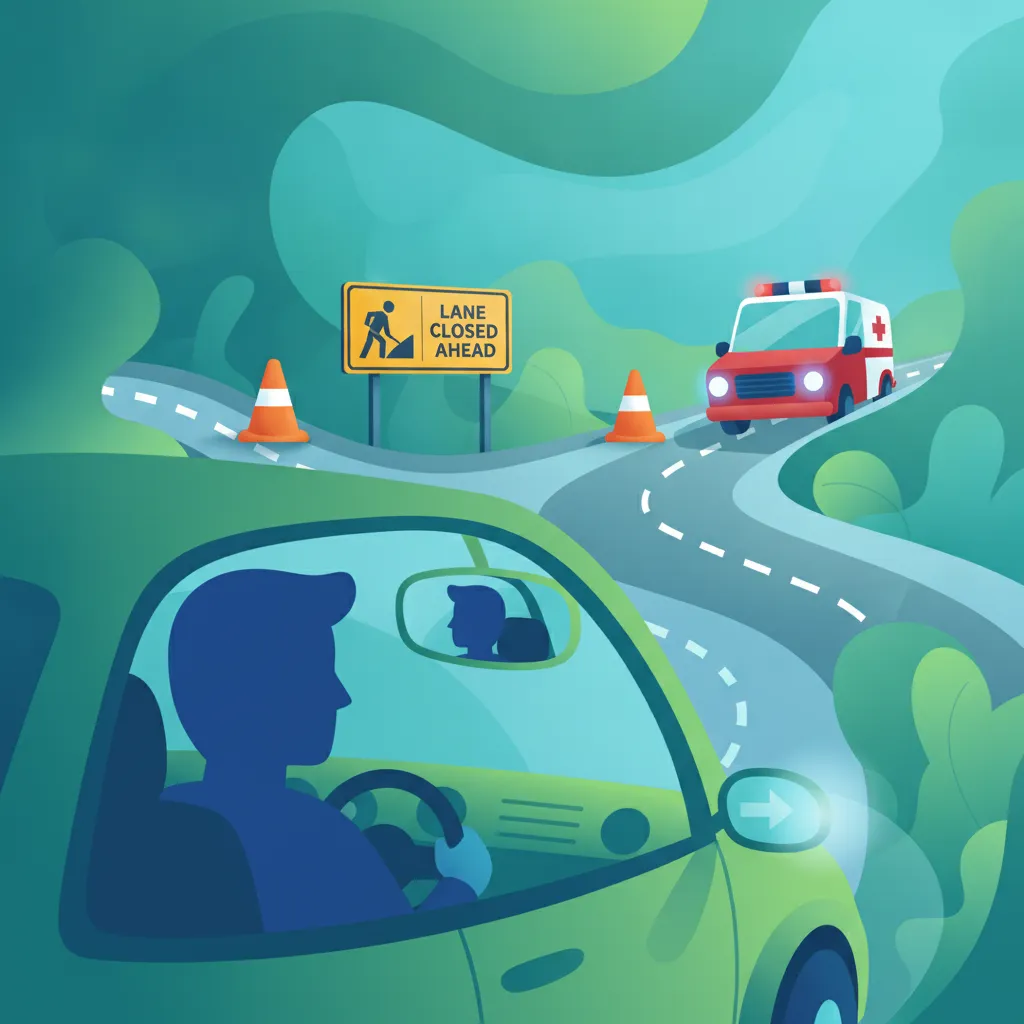
Lesson content overview
As a professional driver operating a heavy goods vehicle (HGV) under a Category C licence in Ireland, you are responsible for managing a vehicle of significant size, weight, and braking momentum. Navigating temporary roadworks and handling unexpected emergency breakdowns require exceptional defensive driving skills, acute hazard perception, and a strict adherence to the Road Safety Authority (RSA) standards.
This lesson provides a comprehensive guide to safe driving practices, legal obligations, and emergency procedures when encountering roadworks, temporary traffic management systems, and mechanical breakdowns.
Temporary Traffic Management (TTM) refers to the coordinated system of temporary signs, road markings, physical barriers, and specialized personnel deployed to control traffic flow and secure a workspace on or adjacent to a public road.
The primary objective of TTM is dual-fold:
For Category C drivers, TTM zones represent high-risk environments. A rigid truck demands significantly more lateral space and has a much wider turning radius than a passenger car. Consequently, any reduction in lane width or sudden change in alignment requires immediate speed reduction and heightened spatial awareness.
Roadworks zones are dynamic environments where road layouts can change daily. Defensive driving in these areas involves anticipating hazards before they materialize and adapting your vehicle control strategies.
In temporary layouts, lanes are frequently narrowed, and the hard shoulder may be temporarily converted into a running lane (contraflow).
HGV Lateral Clearence: Rigid trucks can be up to 2.55 metres wide (excluding mirrors). In narrowed lanes, which may only be 3.0 metres wide in roadworks zones, your margin for error is extremely small. Maintain a central position within your designated lane and avoid hugging the temporary barriers or the lane markings.
When driving a heavy vehicle, you must increase your following distance inside roadworks zones. The standard "two-second rule" for dry roads should be extended to at least four seconds, and even further in adverse weather or poor light conditions. Sudden braking by a leading vehicle in a confined roadworks lane can lead to a catastrophic rear-end collision if your heavy vehicle does not have sufficient stopping distance.
In Ireland, temporary roadworks signs are easily distinguishable by their bright orange background with black symbols or text. This distinct colour coding alerts drivers that normal road rules have been modified.
A common and highly dangerous mistake among drivers is assuming that temporary signs are merely advisory or that they do not apply when no active work is visible. Roadworks zones often contain hidden hazards, such as uneven road surfaces, raised ironwork, temporary steel barriers, or loose chippings. These hazards can destabilize a heavy goods vehicle even if no workers are present on site.
Temporary speed limits are legally binding and are heavily enforced on Irish roads, including motorways (M-roads) and national routes (N-roads).
A legally enforceable maximum speed limit displayed within a red circle on an orange background. Exceeding this limit is a serious traffic offence that results in penalty points and financial fines.
In many single-carriageway roadworks or emergency diversions, traffic flow is managed manually by authorized traffic controllers using handheld "Stop/Go" signs or flag signals.
Under Irish traffic law, the directions given by an authorized traffic controller or flagman override all other traffic signs, signals, and road markings.
The hard shoulder is the lane adjacent to the main carriageway on motorways and dual carriageways, marked by a solid white line. It is designed strictly for emergency use and must never be treated as a running lane or a convenient parking spot.
You are only permitted to enter and stop on the hard shoulder in the following circumstances:
Stopping on the hard shoulder to use a mobile phone, look at a map, rest, or check secure cargo is strictly illegal and highly dangerous. For non-emergency needs, you must use designated motorway service areas or lay-bys.
Some modern Irish motorways feature dedicated Emergency Stop Areas (ESAs), which are short, recessed lay-bys off the hard shoulder. If your vehicle experiences a technical issue and you can safely reach an ESA, you should do so, as these areas provide a greater physical buffer from high-speed motorway traffic.
If your heavy goods vehicle experiences a mechanical breakdown, tyre blowout, or other critical failure on a high-speed road, you must act rapidly and methodically to protect yourself, your vehicle, and other road users.
Signal Your Intention Immediately: Activate your hazard warning lights at the first sign of a mechanical issue to alert following traffic that your vehicle is moving slowly or experiencing difficulties.
Position the Vehicle Safely: Gradually steer the vehicle onto the hard shoulder or into an Emergency Stop Area. Park as far to the left as possible, away from the active running lanes. If you are on a gradient, turn your front wheels toward the verge or kerb to prevent the vehicle from rolling onto the highway.
Secure the Vehicle: Apply the parking brake (handbrake) firmly. Shut down the engine and switch off all auxiliary power units, but leave your hazard warning lights and sidelights switched on to maximize visibility.
Exit the Cabin Safely: Put on a high-visibility vest or jacket before exiting. Always exit the cab using the passenger-side door (the side facing away from the active traffic lanes). Never step directly out into the live motorway lanes.
Position Warning Triangles: If it is safe to do so, place your warning triangles to alert oncoming drivers. Walk along the verge or behind the safety barrier—never walk on the active carriageway or the hard shoulder itself if you can avoid it.
Retreat to a Safe Location: Once the vehicle is secured and warned, you and any passengers must move up the embankment and stand behind the safety barrier. Never stand behind or directly in front of your broken-down vehicle, as a rear-end collision from a passing vehicle could crush you.
Contact Emergency Services: Call emergency services (999 or 112) or your company’s designated roadside recovery operator. Provide exact coordinates, mile marker references, or notable landmarks.
Warning triangles are reflective safety devices designed to give advanced physical warning to oncoming drivers that a stationary hazard lies ahead.
Under Irish road safety regulations, when a vehicle is stopped on the road due to an emergency, warning devices must be deployed at specific safety distances depending on the road layout and design speed.
Recovering a broken-down Category C vehicle requires specialist heavy recovery equipment and highly coordinated operations. Professional drivers must act as key coordinators during the initial phases of this process.
When calling for assistance, you must provide clear and precise details to ensure the recovery team dispatches the correct class of towing or repair vehicle:
When the recovery team arrives, you must obey all instructions from the recovery operator and safety personnel. Heavy recovery operations on public highways are high-risk maneuvers. Do not assist with rigging, towing connections, or lifting operations unless explicitly instructed to do so by the recovery professional. Remain in a safe designated zone behind the roadside safety barriers throughout the entire recovery process.
Operating a heavy commercial vehicle means that mistakes or oversights carry severe safety and legal consequences. Below are several critical violations and complex edge cases to avoid:
Many drivers mistakenly believe they can pull onto the hard shoulder to make a quick phone call, adjust their load straps, or take a mandatory tachograph tachometer rest break. This is a serious legal violation. The hard shoulder is an exceptionally high-risk area; stationary vehicles are highly susceptible to being struck by distracted or drifting drivers.
If your vehicle has broken down due to an electrical fault, leaving high-draw auxiliary systems running can completely drain the vehicle batteries, disabling your emergency hazard warning lights. Ensure only essential safety lights (hazard lights and sidelights) remain active.
Roadworks zones often feature temporary steel plates covering excavations or fresh asphalt with reduced skid resistance. When rain or fog is present, the combination of narrowed lanes and slick surfaces significantly increases the risk of jackknifing or sideswipe collisions. You must reduce your speed well below the posted temporary limit to compensate for these conditions.
Placing a warning triangle exactly 45 metres behind your vehicle is ineffective if that location falls directly after a sharp blind bend or just over the crest of a hill. You must exercise professional judgment: place the triangle in a position where oncoming drivers will see it before they enter the hazard zone or lose visibility of the road ahead.
Understanding the physical and behavioral relationships during roadworks and emergency scenarios is essential for safe driving decisions:
| Term / Concept | Legal Status / Irish Standard | Core Safety Purpose |
|---|---|---|
| Temporary Traffic Management (TTM) | Mandatory regulatory system | Protects vulnerable roadside workers and guides drivers safely through altered road layouts. |
| Temporary Speed Limit | Legally binding; overrides permanent limits | Reduces kinetic energy and stopping distances in highly confined, hazard-prone roadworks zones. |
| Traffic Controller / Flagman | Signals take legal precedence over all signs | Provides dynamic, real-time control of traffic flow in single-lane bottlenecks or hazard zones. |
| Hard Shoulder | Emergency use only; illegal to use for non-emergencies | Provides a safe, clear space to stop in the event of an immediate mechanical or medical emergency. |
| Warning Triangle | Mandatory safety equipment for commercial vehicles | Provides physical, highly reflective advance warning to oncoming traffic of a stationary road hazard. |
| Emergency Stop Area (ESA) | Designated safe stopping bays | Recesses broken-down vehicles away from the hard shoulder, creating a larger safety buffer. |
Explore all units and lessons included in this driving theory course.
Lesson content overview
Explore all units and lessons included in this driving theory course.
Explore search topics learners often look for when studying Navigating Roadworks and Emergency Situations. These topics reflect common questions about road rules, driving situations, safety guidance, and lesson level theory preparation for learners in Ireland.
Browse additional driving theory lessons that cover connected traffic rules, road signs, and common driving situations related to this topic. Improve your understanding of how different rules interact across everyday traffic scenarios.
Understand how to identify and mitigate risks when operating large vehicles in congested urban environments. This theory lesson covers common interaction hazards with vulnerable road users, narrow street navigation, and professional defensive driving techniques required for safe urban distribution and deliveries.

This lesson addresses the unique environmental and logistical challenges faced during delivery stops in commercial town and city centers. It covers the legal frameworks governing municipal loading zones, double-parking hazards, and temporary pedestrian-only street restrictions. Drivers will acquire practical skills for managing traffic build-up, utilizing visual spotters, and securing the vehicle while unloading cargo.

Heavy vehicles require continuous visual scanning to identify small or slow-moving road users who may enter the path of travel. This lesson explores the typical behaviors of young children, elderly pedestrians, and visually impaired road users. Drivers will build strong hazard perception skills to anticipate sudden movements, ensuring they can brake safely and avoid serious accidents.

This lesson focuses on managing the interactions between commercial goods vehicles and non-motorized or lightweight commuters. It outlines defensive driving techniques to utilize when overtaking cyclists, navigating pedestrian crossings, or negotiating shared junctions in Irish cities. Drivers will examine common cyclist behaviors at roundabouts and understand how to maintain massive safety margins to protect lives.

Safeguarding vulnerable road users requires more than simple obedience to traffic signs; it demands a defensive driving mindset. This lesson summarizes safe practices, including scanning far ahead in urban areas, keeping massive safety margins in wet weather, and executing thorough blind spot checks before reversing. By anticipating the unpredictable movements of others, you can prevent accidents and support a safe road culture.

Driving large vehicles through dense city traffic requires outstanding lane discipline, spatial awareness, and consistent patience. This lesson teaches drivers how to utilize public bus corridors, manage tight yellow box intersections, and handle narrow city streets. It focuses on predicting traffic pattern shifts to maintain service timetables while minimizing fuel waste and driver stress.

Irish rural routes are often narrow, lacking central markings, and bordered by tall hedges that restrict forward visibility on sharp bends. This lesson teaches drivers how to negotiate blind curves, anticipate slow-moving agricultural machinery, and respond to wandering farm animals. Drivers will learn to regulate vehicle speed proactively, maintaining a safe stopping margin in rural areas.

Children often struggle to judge heavy vehicle speeds accurately, while elderly pedestrians may possess limited mobility or hearing impairments. This lesson addresses these unique risks, explaining how to adjust driving patterns in residential neighborhoods and near shopping districts. Drivers will learn to maintain a high safety margin, ensuring they can yield quickly to vulnerable road users.

Maintaining an extensive buffer zone ahead of a large passenger vehicle is critical to ensuring enough space for emergency maneuvers. This lesson teaches the time-gap method, detailing how following distances must double on wet roads or increase with full passenger loads. It builds hazard anticipation skills, teaching drivers to read distant traffic cues and react early to hazards.

Proactive hazard perception involves constantly scanning the road ahead to identify potential dangers before they turn into actual emergencies. This lesson covers active scanning techniques, helping you look far ahead, check mirrors regularly, and identify subtle risk clues such as exhaust smoke from parked cars or children playing near kerbs. Anticipating these developments gives you the time to adjust speed and position safely.

This lesson explains the location, depth, and angle of the severe blind spots surrounding a standard heavy goods vehicle. It provides step-by-step guidance on setting up primary side mirrors, wide-angle lenses, and close-proximity front-view mirrors to eliminate blind areas. Drivers will learn systematic visual checking routines to ensure complete situational awareness before initiating any maneuver, lane shift, or turn.
Learn the specific legal requirements and safety standards for heavy goods vehicles on high-speed Irish roads. This guide explains lane discipline, hard shoulder limitations, and the correct procedures for entering and exiting motorways to ensure professional compliance and road safety.
This lesson describes the legal regulations and driving conventions for operating heavy commercial vehicles on motorways and high-speed dual carriageways. It explains specific Irish motorway rules, including bans on heavy goods vehicles occupying the outer overtaking lanes. Drivers will learn to manage high-speed slip-road merging, maintain safe spacing buffers, and anticipate long-range changes in overall traffic flow.

This lesson outlines the legal and safety requirements for maintaining proper lane discipline on multi-lane roads, roundabouts, and motorways in Ireland. It teaches drivers how to account for lane width, manage trailer off-tracking, and position the cab to prevent encroachment on neighboring lanes. Drivers will master safe lane-changing strategies, signaling protocols, and traffic merging techniques.
Motorways are designed for safe, high-speed travel, but require strict adherence to lane discipline and specific regulations. This lesson explains that the left lane is for normal driving, while middle and right lanes are strictly for overtaking slower traffic. You will learn how to identify motorway exits, use the hard shoulder during absolute emergencies, and understand the legal restrictions placed on learner permit holders.

Large passenger vehicles must maintain consistent lane positioning to prevent side-swipe incidents and sustain smooth urban traffic patterns. This lesson covers standard lane selection rules, safe overtaking procedures, and how to use designated public transit corridors correctly. Drivers will learn the importance of checking mirrors continuously and planning lane changes well in advance.

This lesson focuses on the technical skills required to navigate steep hills and prolonged descents without losing vehicle control. It explains the mechanics of engine braking, correct low-gear selection, and how gravity affects heavily loaded vehicles on downward slopes. Drivers will study safety techniques to prevent kinetic runaway situations and learn how to manage vehicle speed defensively.

Motorway transport requires consistent forward planning, strict speed restriction compliance, and clear mirror checks before exiting lanes. This lesson details the rules of joining and leaving motorways, navigating toll plazas safely, and managing breakdowns on the hard shoulder. Drivers will learn to balance high-speed travel with passenger stability, ensuring a comfortable, secure ride.

This lesson addresses the mechanical dynamics of turning long-wheelbase and articulated commercial vehicles at intersections, junctions, and roundabouts. It covers the necessity of deep cornering lines, early mirror checks, and correct signaling to warn vulnerable road users of wide turn maneuvers. Drivers will learn how to minimize rear cut-in and ensure the entire vehicle clears urban obstacles safely.
This lesson addresses the unique environmental and logistical challenges faced during delivery stops in commercial town and city centers. It covers the legal frameworks governing municipal loading zones, double-parking hazards, and temporary pedestrian-only street restrictions. Drivers will acquire practical skills for managing traffic build-up, utilizing visual spotters, and securing the vehicle while unloading cargo.

This lesson explores the safe operation of heavy transport vehicles during severe meteorological hazards typical of the Irish climate. It teaches techniques for adjusting speed and doubling following distances to prevent loss of steering traction and control on waterlogged or icy roadways. Drivers will understand how to manage lateral aerodynamic forces from crosswinds on high-sided goods vehicles.
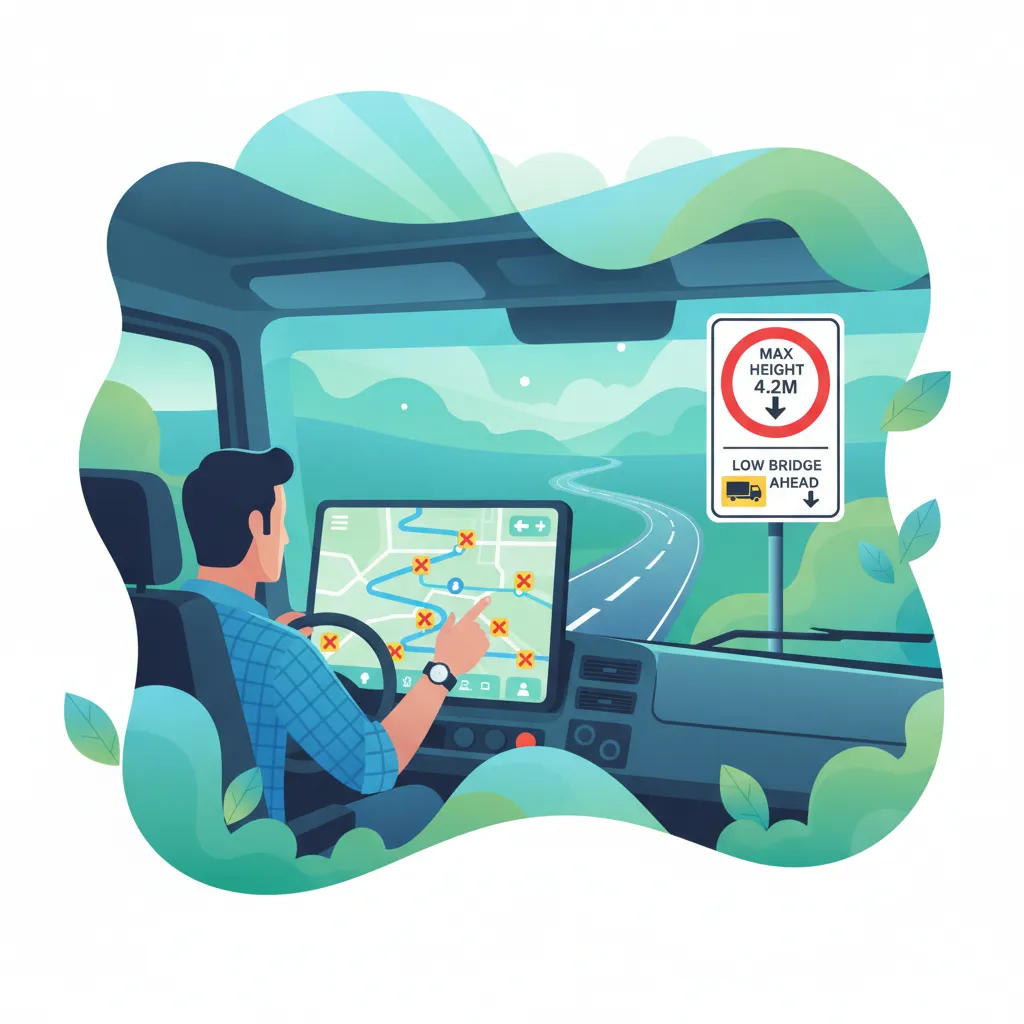
This lesson teaches professional drivers how to systematically map out travel routes that are compatible with heavy vehicle dimensions. It covers the limitations of consumer-grade GPS systems and emphasizes the use of specialized truck navigation systems that account for low bridges and load restrictions. Drivers will also learn to plan for congestion, access timing regulations, and proper entrance paths into commercial zones.
Find clear answers to common questions learners have about Navigating Roadworks and Emergency Situations. Learn how the lesson is structured, which driving theory objectives it supports, and how it fits into the overall learning path of units and curriculum progression in Ireland. These explanations help you understand key concepts, lesson flow, and exam focused study goals.
Always follow the explicit signage and temporary lane markings provided. If the lane is too narrow for your vehicle dimensions, you must wait for a clear gap or follow the instructions of traffic management personnel, ensuring you do not clip barriers or hazard objects.
You must place the warning triangle at a sufficient distance behind your vehicle—usually 50 to 100 metres on open roads—to give oncoming traffic ample warning. Ensure you stay clear of moving traffic when deploying it.
Yes, temporary speed limits displayed at roadworks are mandatory. You must strictly adhere to these limits, as they are designed to protect both the road workers and the drivers navigating the restricted road layout.
Switch on hazard lights, move as far to the left as possible, and exit the vehicle from the passenger side away from traffic. Use a mobile phone or emergency telephone to contact the motorway patrol or emergency services immediately.
Use the practice question search tool to pinpoint specific topics, road signs, or rules you need to master for your official Driver Theory Test. Refine your study strategy and ensure comprehensive preparation for all aspects of the Irish driving exam. Start your focused revision now and build confidence for your learner permit test.