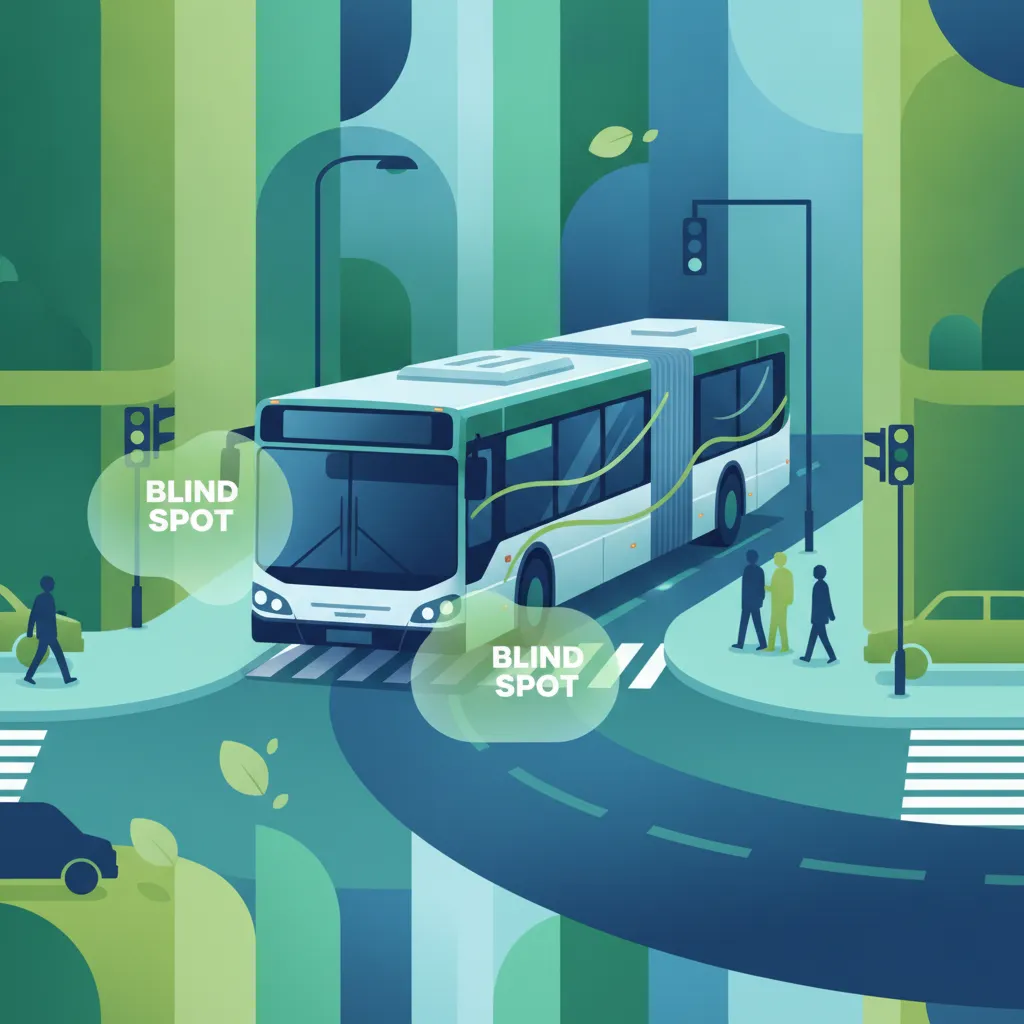
This unit delves into the critical low-speed, high-risk manoeuvres essential for professional bus drivers in Austria. You'll master safe turning techniques, understand swept paths, and learn best practices for reversing, navigating busy terminals, and handling articulated vehicles or those with trailers, all crucial for the Category D licence exam.
Browse all lessons that make up Turning, Blind Spots, Reversing, Terminals and Combination Vehicles. Each lesson focuses on specific topics, learning objectives, and core concepts, helping you build essential knowledge and follow a clear, structured progression toward your study goals in Austria.
When a long vehicle turns, the rear wheels follow a shorter path than the front wheels, creating a 'swept path'. This lesson explains how to position the vehicle correctly before a turn to allow for this off-tracking and avoid mounting the kerb or hitting obstacles. It also covers the outward movement of the vehicle's rear (tail swing), which poses a danger to anything alongside the bus.
Passive mirror use is not enough. This lesson teaches active, systematic scanning techniques, including moving your head to look around A-pillars and using all available mirrors and cameras in a set sequence. The focus is on building a constant mental map of the space around the vehicle, especially before any change of direction or speed, to account for unseen pedestrians or cyclists.
Reversing is statistically one of the most dangerous manoeuvres. This lesson outlines a strict safety protocol: get out and check the area first, use a competent banksman (marshal) whenever possible, and proceed at a slow walking pace. It also covers the use of reversing cameras and alarms as aids, but stresses they are no substitute for a thorough physical check and direct assistance.
Bus stations and depots are complex, hazardous environments. This lesson covers the unique challenges, such as navigating tight spaces with other buses moving, adhering to site-specific speed limits and traffic flow systems, and being highly aware of staff and passengers walking in operational areas. Safe positioning in designated bays is a key focus.
Adding a trailer (Category DE/D1E) changes a vehicle's handling characteristics significantly. This lesson introduces key concepts, such as the increased turning circle, the effect of trailer swing, and the complexities of braking with the extra weight and length. It provides a theoretical foundation for understanding how to safely manage a combination vehicle, particularly during low-speed manoeuvres.
Incorrectly coupling a trailer can lead to catastrophic failure. This lesson provides a detailed, step-by-step guide for safely attaching and detaching a trailer. It covers aligning the vehicle, securing the coupling mechanism, connecting brake and electrical lines, and performing a series of crucial safety checks (like a tug test) before moving off.
Explore high-intent keywords and long-tail search topics learners use when researching Turning, Blind Spots, Reversing, Terminals and Combination Vehicles. These terms reflect how people search for reliable study materials, structured explanations, and unit-level theory preparation support in Austria.
Find clear answers to the most common questions learners ask about Turning, Blind Spots, Reversing, Terminals and Combination Vehicles. Understand how the unit is organized, what learning goals it supports, and how it contributes to your study progression with structured explanations and practical guidance tailored for learners in Austria.
Swept path refers to the total space a vehicle occupies when turning, including the front and rear overhangs and the path of the wheels. For Category D drivers in Austria, understanding swept path is crucial to avoid collisions with curbs, other vehicles, or infrastructure when making turns, especially in tight urban environments or bus terminals. This knowledge is frequently tested in the theory exam.
When reversing a bus or coach in Austria, prioritize extensive observation using mirrors and cameras, and ideally, utilize a banksman (a person guiding the manoeuvre). Always reverse slowly, be aware of pedestrians and other vehicles, and ensure the path is clear. The theory exam will focus on your understanding of these procedures and hazard awareness during reversing.
Combination vehicles present unique challenges due to their length, articulation points, and altered handling characteristics. The main challenges involve understanding how the trailer or rear section tracks differently than the towing vehicle, increased turning radius, and specific braking behaviours. The Austrian theory test for D/DE licences covers these complexities to ensure passenger safety.
The theory test for bus drivers in Austria assesses your knowledge of safe manoeuvring in confined, busy areas like terminals and depots. Questions will cover anticipating pedestrian and vehicle movements, adhering to specific site speed limits and rules, effective communication, and maintaining a clear overview of the entire area to prevent accidents.
While both are considered combination vehicles, articulated buses move as one unit, whereas trailer combinations (like D1E or DE) involve a separate trailer. The core principles of understanding joint movement, turning circles, and braking distances apply to both, but the specific dynamics differ. Your Austrian Category D theory studies will cover these distinctions.
Buses, especially Category D vehicles, have significantly larger blind spots than cars. During low-speed manoeuvres like turning and reversing, these blind spots can easily conceal pedestrians, cyclists, or smaller vehicles, leading to serious accidents. Mastering blind spot awareness and using all available aids, including mirrors and potentially a banksman, is critical for safety and is a key focus for the Austrian theory exam.
All included lessons
Lessons in Turning, Blind Spots, Reversing, Terminals and Combination Vehicles
See who benefits most from studying Turning, Blind Spots, Reversing, Terminals and Combination Vehicles. This overview explains how the unit supports different learning needs, what level of knowledge is helpful before starting, and how it fits into the overall study path in Austria.
This unit is designed for individuals pursuing their Austrian Category D driving licence for buses and coaches. It is particularly beneficial for those who need to refine their understanding of complex, low-speed manoeuvres, which are often a point of difficulty in the theory exam and crucial for professional passenger transport operations.

Ready to systematically master Austrian driving theory? Explore our diverse range of structured courses and find the perfect learning path for your license category. Start building your knowledge foundation and preparing confidently for your official driving theory exam in Austria.
Browse Theory CurriculumExplore all units and lessons included in this driving theory course.
Ready to systematically master Austrian driving theory? Explore our diverse range of structured courses and find the perfect learning path for your license category. Start building your knowledge foundation and preparing confidently for your official driving theory exam in Austria.
Browse Theory Curriculum