
As a professional bus driver in Austria, preparedness for the unexpected is paramount. This unit equips you with the critical knowledge to manage vehicle breakdowns, fires, passenger incidents, and emergency evacuations. Learn essential first aid and accident scene management to ensure the safety and well-being of your passengers in any critical situation.
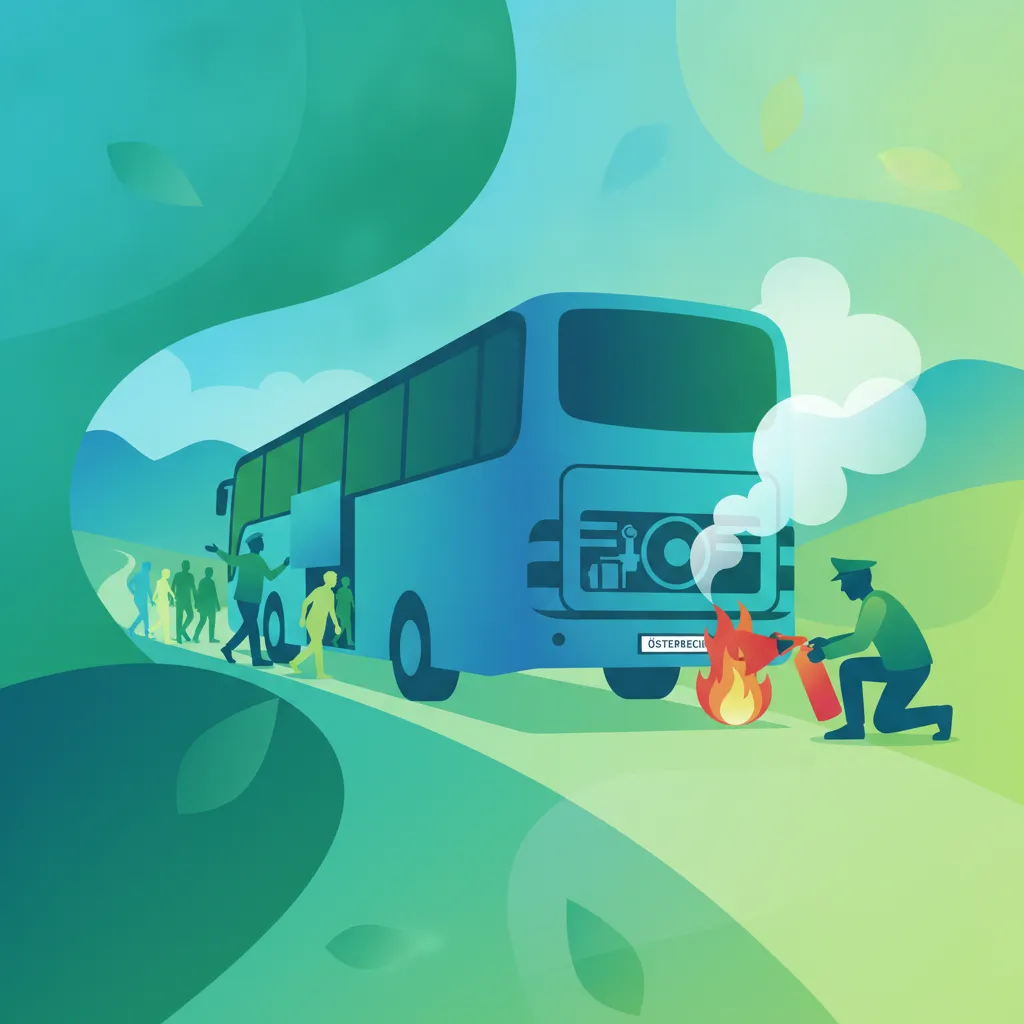
Browse all lessons that make up Breakdowns, Fire, Passenger Incidents, Evacuation, First Aid and Emergencies. Each lesson focuses on specific topics, learning objectives, and core concepts, helping you build essential knowledge and follow a clear, structured progression toward your study goals in Austria.
A breakdown requires a calm, systematic response to keep everyone safe. This lesson details the procedure: move to the safest possible location, activate hazard lights, secure the vehicle, and deploy warning triangles. It emphasizes the importance of moving passengers to a safe place away from the vehicle, especially on a motorway, before contacting your company or the breakdown services.
A vehicle fire is a critical emergency requiring immediate and decisive action. This lesson prioritizes the rapid and safe evacuation of all passengers to an upwind location. It then covers a basic assessment of the fire and the correct technique for using a fire extinguisher on a small, accessible fire if it is safe to do so, while stressing that personal safety comes first.
When a passenger becomes ill, the driver's role is to facilitate professional medical help as quickly as possible. This lesson covers how to safely stop the vehicle, make an emergency call to 112 with clear location and patient information, and provide basic comfort and reassurance. It clarifies that the driver's role is not to diagnose but to manage the scene and get help.
In a serious incident, a swift and orderly evacuation can save lives. This lesson teaches the principles of taking command, giving clear and simple instructions, and directing passengers to the nearest safe exit. It covers the importance of assisting those with mobility issues and guiding everyone to a safe assembly point away from the vehicle and any traffic.
As the driver involved or first on the scene, you have specific duties. This lesson covers the initial steps: securing your own vehicle, warning approaching traffic, and making the emergency call. It reinforces the legal requirement in Austria for all drivers to form an emergency corridor ('Rettungsgasse') in standing traffic to allow clear access for emergency vehicles.
While not a substitute for a full first aid course, this lesson provides a critical overview of the immediate actions a driver can take to help an injured person. It covers assessing a casualty for danger, response, and breathing, and the basic principles of controlling severe bleeding and placing an unconscious person in the recovery position. The primary goal is to preserve life until professional help arrives.
Explore high-intent keywords and long-tail search topics learners use when researching Breakdowns, Fire, Passenger Incidents, Evacuation, First Aid and Emergencies. These terms reflect how people search for reliable study materials, structured explanations, and unit-level theory preparation support in Austria.
Find clear answers to the most common questions learners ask about Breakdowns, Fire, Passenger Incidents, Evacuation, First Aid and Emergencies. Understand how the unit is organized, what learning goals it supports, and how it contributes to your study progression with structured explanations and practical guidance tailored for learners in Austria.
The absolute priority is your safety and that of your passengers. If possible, steer the vehicle to the right emergency lane (Pannenstreifen). Switch on hazard warning lights immediately. Do not stand behind or in front of the vehicle on the roadway. Instead, safely exit the vehicle on the side away from traffic and wait behind the safety barrier, if available.
A Rettungsgasse is crucial for emergency services. On multi-lane roads, drivers in the leftmost lane must move as far left as possible, and drivers in other lanes must move as far right as possible. As a bus driver, adhere to this principle to create space for ambulances, fire engines, and police.
Only use the fire extinguisher if the fire is small and contained, and you can do so without endangering yourself or your passengers. Locate the nearest extinguisher, ensure it's the correct type for the fire (e.g., electrical, liquid), and aim at the base of the flames. If the fire is spreading or involves the engine, prioritize immediate evacuation and alert emergency services.
Your primary role is to ensure the scene is safe, call emergency services (144 for ambulance, 122 for fire brigade, 133 for police), and provide basic assistance until help arrives. This includes checking for consciousness, ensuring an open airway, and performing CPR if necessary and you are trained. Do not move an injured person unless there is immediate danger, such as fire.
Instruct passengers calmly but firmly. If safe to do so, open doors. If evacuation is necessary due to danger (fire, unstable vehicle), direct passengers to exit quickly and orderly via the nearest safe exits, including emergency exits. Guide them to a safe assembly point away from the vehicle and any hazards. Ensure everyone has alighted before you leave.
Passenger duty of care means you are legally and morally responsible for your passengers' safety. In an emergency, this translates to making decisions that prioritize their well-being, ensuring clear communication, and taking all reasonable steps to prevent further harm, including proper evacuation and first aid provision.
All included lessons
Lessons in Breakdowns, Fire, Passenger Incidents, Evacuation, First Aid and Emergencies
See who benefits most from studying Breakdowns, Fire, Passenger Incidents, Evacuation, First Aid and Emergencies. This overview explains how the unit supports different learning needs, what level of knowledge is helpful before starting, and how it fits into the overall study path in Austria.
This unit is essential for all individuals pursuing an Austrian Category D (Bus & Coach) driving licence. It is particularly crucial for drivers who may encounter challenging road conditions or high passenger volumes, preparing them for real-world emergency scenarios and the specific demands of professional passenger transport in Austria.

Ready to systematically master Austrian driving theory? Explore our diverse range of structured courses and find the perfect learning path for your license category. Start building your knowledge foundation and preparing confidently for your official driving theory exam in Austria.
Browse Theory CurriculumExplore all units and lessons included in this driving theory course.
Ready to systematically master Austrian driving theory? Explore our diverse range of structured courses and find the perfect learning path for your license category. Start building your knowledge foundation and preparing confidently for your official driving theory exam in Austria.
Browse Theory Curriculum