
This lesson introduces the unique handling characteristics required for driving combination vehicles, such as articulated buses or vehicles towing trailers under Category DE and D1E. You will gain a theoretical understanding of how increased length and weight impact your vehicle control, preparing you for the advanced driving scenarios featured in the Austrian professional bus driver theory exam.

Lesson content overview
Operating a bus or coach (Category D) is a significant responsibility, and adding a trailer transforms the vehicle into a combination vehicle, requiring an entirely new set of skills and theoretical understanding. This lesson provides a comprehensive introduction to the dynamics, legal requirements, and safe operational practices for combination vehicles in the Austrian Driving Theory Course for Bus & Coach Licence (Category D), specifically for categories DE and D1E. Understanding these principles is fundamental to ensuring the safety of passengers, other road users, and the vehicle itself.
A combination vehicle, in the context of Category DE or D1E, refers to a passenger-carrying bus or coach (the "prime mover") towing a trailer or semi-trailer. This configuration significantly alters the vehicle's characteristics, impacting everything from acceleration and braking to steering and spatial awareness. The DE licence permits driving a Category D vehicle with a trailer over 750 kg maximum authorised mass (MAM), while D1E applies to Category D1 vehicles (mini-buses) with similar trailers.
The primary reason for attaching a trailer to a bus is often to increase cargo capacity for passenger luggage, sports equipment, or other goods, especially for long-distance journeys, tourist operations, or specific service routes. However, this convenience comes with a heightened demand for driver skill and vigilance.
The addition of a trailer introduces several critical factors that change how a vehicle behaves on the road:
Ignoring these differences can lead to dangerous situations, including collisions, loss of control, and legal penalties. Therefore, a thorough theoretical understanding is paramount before gaining practical experience.
The physics governing combination vehicles dictates that they behave differently from single units. Professional drivers must internalize these dynamics to anticipate vehicle reactions and respond safely.
Mass distribution refers to how the total weight of the combination vehicle (prime mover, trailer, passengers, and cargo) is allocated across all axles. Proper mass distribution is vital for safe operation, affecting traction, braking efficiency, and stability.
If a trailer is overloaded, or its load is improperly distributed (e.g., too much weight at the rear, making it "rear-heavy"), it can lead to dangerous trailer sway or instability. Conversely, a front-heavy trailer might put excessive weight on the coupling, affecting the prime mover's steering and braking performance. Axle loads must always remain within the manufacturer's and legal limits to prevent damage to the vehicle and infrastructure, and to ensure safe handling. Drivers must consider the position of the centre of gravity for both the prime mover and the trailer. A higher centre of gravity, often a risk with certain cargo types, increases the likelihood of rollovers during sharp turns or on uneven terrain.
Inertia is the resistance of any physical object to any change in its state of motion, including changes to its speed, or direction of motion. Momentum is the product of mass and velocity. For combination vehicles, the significantly increased mass means much greater inertia and momentum.
This greater inertia means that more force is required to accelerate the vehicle from a standstill or to change its direction. Crucially, it also means that much more force, and consequently more distance, is required to bring the vehicle to a stop. This is a critical factor for safety, as emergency braking situations demand a full understanding of the vehicle's capabilities.
One of the most profound implications of increased inertia and momentum is the extended stopping distance. A bus with a fully loaded trailer will take considerably longer to stop than the same bus operating solo, even with perfectly functioning brakes. This necessitates a proactive approach to driving: maintaining greater following distances, anticipating traffic flow, and initiating braking earlier than one might with a smaller vehicle.
The turn radius is the minimum circular path a vehicle must follow during a turn. With a trailer attached, the overall length of the combination vehicle increases, which in turn increases the required turn radius. The "swept path" refers to the total area covered by the entire vehicle combination, including any trailer swing, from the outermost point of the front to the innermost point of the rear.
Drivers must anticipate this larger swept path and adjust their approach to turns, intersections, and roundabouts accordingly. Failing to do so can lead to the trailer running over curbs, colliding with street furniture, or encroaching into adjacent lanes or onto pedestrian areas.
To navigate a turn safely, a combination vehicle driver must often approach the intersection wider than a solo vehicle. This might mean starting the turn later (for a right turn) or swinging slightly into an adjacent lane (for a left turn, where legally permitted and safe to do so) to ensure the trailer clears the inner corner. This requires meticulous planning and awareness of surrounding traffic.
Trailer swing, also known as off-tracking, is a critical phenomenon where the trailer's wheels follow a tighter, different path than the prime mover's wheels during a turn. This is caused by the articulation point (the hitch) between the two vehicles. The rear of the trailer will "cut the corner" more sharply than the front of the bus.
Off-tracking poses a significant risk of collision with objects on the inside of the turn, such as lampposts, traffic signs, parked cars, or even vulnerable road users like pedestrians and cyclists. Drivers must actively counteract off-tracking by adjusting their entry and exit points into turns. For example, when making a right turn, the driver might need to steer the bus slightly to the left before turning right to give the trailer more room on the inside.
One of the most vital safety aspects of combination vehicle operation is the proper functioning and synchronization of the braking systems between the prime mover and the trailer. Most modern combination vehicles utilize air brake systems that are designed to apply braking force simultaneously and proportionally to both units.
Synchronization ensures that the trailer's brakes engage effectively alongside the bus's brakes. Without proper synchronization, severe safety hazards can arise. If the bus brakes too hard relative to the trailer, the trailer's momentum can push the bus from behind, leading to instability or, in extreme cases, jackknifing. Conversely, if the trailer brakes too hard or locks up, it can pull the combination abruptly, also causing loss of control.
Jackknifing occurs when the trailer folds in on the prime mover, creating an acute angle, often due to aggressive or unsynchronized braking, especially on slippery surfaces. It's a highly dangerous situation that can lead to severe accidents.
Proper brake system maintenance, regular inspection, and understanding how to apply brakes smoothly and progressively are crucial for preventing jackknifing. Drivers must always perform a brake test after coupling a trailer to ensure the trailer's brakes are functioning correctly and are synchronized with the bus.
Operating combination vehicles in Austria is subject to strict legal frameworks designed to ensure road safety and protect infrastructure. Drivers holding a Category DE or D1E licence must be fully aware of these regulations.
Austrian traffic law (StVZO) dictates specific maximum dimensions and weight limits for combination vehicles. Exceeding these limits is illegal and can lead to significant fines, vehicle impoundment, and safety risks.
For Category DE, the maximum permissible length of the trailer is typically 6.5 metres, and the total length of the combination vehicle (bus plus trailer) must not exceed 25.25 metres. For Category D1E, the prime mover itself has a length limit of 8 metres, and the trailer length is also typically restricted to 6.5 metres. These limits are crucial for ensuring vehicles can safely navigate roads, bridges, and tunnels without obstruction.
The Gross Combination Weight (GCW) is the maximum total weight of the prime mover, trailer, all passengers, and cargo combined. This limit is set by both the vehicle manufacturer and national regulations. Overloading the combination vehicle compromises braking performance, accelerates wear and tear, and increases the risk of accidents dueating to instability or structural failure. Drivers must ensure they do not exceed the GCW before departing.
Combination vehicles, due to their increased mass and length, are often subject to lower speed limits than solo buses. In Austria, for example, the general speed limit for combination vehicles with a Category D or D1 prime mover and a trailer is typically 80 km/h on motorways and rural roads, unless otherwise indicated by signage. In urban areas, the general limit of 50 km/h still applies.
Adhering to these reduced speed limits is not just a legal requirement but a fundamental safety measure. It provides the driver with more reaction time and ensures that the vehicle can be brought to a stop within a safe distance.
To operate a combination vehicle in categories DE or D1E in Austria, a driver must hold the corresponding licence extension. This typically requires additional theoretical and practical training beyond the standard Category D or D1 licence. Regular medical checks and adherence to professional driver qualifications are also mandatory. Furthermore, coupling devices must meet national safety standards and undergo regular inspections to prevent accidental uncoupling and ensure load security.
Safe operation of a combination vehicle goes beyond understanding the theory; it requires disciplined application of specific driving techniques.
Effective speed management is paramount. Always adjust your speed downwards, especially before turns, steep gradients, or challenging road sections. Remember that the momentum of a heavier vehicle means that sudden changes in speed or direction are more dangerous and harder to correct. Gradual acceleration and deceleration are key to maintaining stability and passenger comfort.
Adding a trailer significantly expands blind spots. Standard bus mirrors, while comprehensive, may not provide adequate visibility of the trailer's sides and rear, especially during turns. It is crucial to adjust all mirrors (main and wide-angle) to maximize visibility around the entire combination. Additional mirrors specifically designed for combination vehicles may be necessary. Regularly checking mirrors, scanning the road, and anticipating potential hazards in blind spots are critical habits.
While Lesson 7.6 provides detailed procedures for coupling and uncoupling, it's essential to reiterate the importance of safety checks here. Before every journey, and especially after coupling, a thorough inspection is mandatory. This includes verifying the secure engagement of the coupling device, checking the electrical and pneumatic connections (for brakes and lights), and performing a full brake test to ensure trailer brakes are functional and synchronized. Neglecting these steps can lead to the trailer detaching or critical systems failing during transit.
Visually confirm the coupling device is fully engaged and locked.
Check all electrical connections for lights and ABS/EBS (if applicable).
Verify pneumatic (air brake) lines are correctly connected and pressurized.
Conduct a static brake test to ensure trailer brakes respond correctly.
Confirm all safety chains or cables are correctly attached.
Real-world driving conditions demand adaptability and a deep understanding of how combination vehicle dynamics interact with the environment.
Urban environments present particular challenges due to tight spaces, numerous obstacles, and other road users. When approaching intersections or roundabouts with a combination vehicle:
Wet roads, ice, snow, or strong winds dramatically reduce grip and can exacerbate the handling challenges of combination vehicles.
Mountainous terrain and steep gradients pose unique challenges for combination vehicles, particularly concerning braking and power management.
Understanding common pitfalls is crucial for avoiding them. Drivers of DE/D1E vehicles frequently encounter situations that can lead to violations or accidents.
| Violation | Why Wrong | Correct Behavior | Consequence |
|---|---|---|---|
| Ignoring trailer off-track clearance at a tight bend | Leads to collision with roadside objects, pedestrians, or other vehicles | Reduce speed, anticipate the turn, adjust the entry point (swing out slightly), and maintain appropriate distance | Accident, injury, legal penalties, property damage |
| Relying solely on prime mover brakes | Causes extended stopping distance, brake fade, and potential jackknifing | Ensure trailer brakes are fully functional and synchronized with the prime mover's brakes before departure | Loss of control, increased stopping distance, collision |
| Exceeding speed limits for DE/D1E vehicles | Overwrites safety margins for longer stopping distances and reduced maneuverability | Adhere strictly to reduced speed limits for combination vehicles on all road types | Fines, increased accident risk, licence points |
| Overloading the trailer beyond permissible weight | Exceeds axle load limits, compromises handling, and overstresses components | Verify load weights, distribute cargo evenly, and respect all legal weight limits for the combination | Vehicle damage, fines, unsafe operation, structural damage |
| Coupling without checking safety locks | Risk of accidental uncoupling while moving, leading to uncontrolled trailer | Perform a full coupling inspection, visually verify lock engagement, and conduct a functional brake test | Uncontrolled trailer separation, severe accident |
| Taking a turn at the same radius as a solo bus | Underestimates the swept path requirements of the trailer | Begin the turn earlier, use a wider path, or reduce speed significantly to allow the trailer to track safely | Trailing vehicle may hit curbs, obstacles, or encroach other lanes |
| Neglecting to adjust mirrors for trailer presence | Reduces rear and side visibility, increasing blind spots | Adjust side mirrors outward, utilize additional rear-view mirrors as needed, and perform frequent mirror checks | Missed obstacles, rear collisions, lane change accidents |
| Driving with a trailer brake warning light illuminated | Indicates a malfunction, rendering the vehicle unsafe to proceed | Stop the vehicle immediately, inspect and repair trailer brakes before resuming the journey | Potential brake failure, accidents, legal consequences |
| Not accounting for increased stopping distance in adverse weather | Wet or icy conditions further increase braking distance, reducing safety margin | Increase following distance significantly, reduce speed further, and anticipate much longer stopping times | Skid, collision, loss of control |
| Using a trailer longer than allowed for D1E classification | Violates legal dimensions, potentially causing safety issues and infrastructure damage | Verify trailer length adheres to D1E limits (typically up to 6.5 metres) for legal compliance | Fines, vehicle suitability issues, route restrictions |
Operating combination vehicles in the DE and D1E categories requires a comprehensive understanding of their unique dynamics and strict adherence to safety protocols and legal requirements.
This lesson forms a theoretical foundation for safely managing a combination vehicle. It builds upon previous lessons regarding turning, blind spot management, and reversing, and prepares drivers for the complexities of navigating bus terminals and undertaking long-distance coach operations with a trailer.
This lesson covers the essential theory for driving combination vehicles (DE/D1E) in Austria, focusing on how trailers alter vehicle dynamics through increased mass, length, and a shifted centre of gravity. Key physics concepts include inertia and its effect on braking distance, off-tracking and swept path during turns, and the critical importance of brake synchronization to prevent jackknifing. The lesson also details Austrian legal requirements including maximum trailer dimensions (typically 6.5 metres for DE/D1E), Gross Combination Weight limits, and specific reduced speed limits. Safe operation requires meticulous pre-departure safety checks, adjusted mirror settings for expanded blind spots, and adaptive driving techniques for adverse weather, steep gradients, and urban environments with tight spaces.
A short set of high-value points that capture the most important learning from this lesson.
Adding a trailer fundamentally changes a vehicle's handling by increasing mass, length, and altering the centre of gravity, requiring entirely different driving techniques.
Off-tracking means the trailer's wheels follow a tighter path than the prime mover's front wheels, causing the trailer to cut corners and requiring a wider turn approach.
Extended stopping distances due to increased inertia mean combination vehicle drivers must maintain greater following distances and brake earlier.
Brake system synchronization between the prime mover and trailer is critical to prevent dangerous jackknifing during deceleration.
Austrian law sets specific speed limits for combination vehicles (typically 80 km/h on motorways and rural roads, 50 km/h in urban areas) and strict weight and dimension limits under StVZO.
Explore all units and lessons included in this driving theory course.
Jackknifing is when the trailer folds against the prime mover during braking, usually caused by unsynchronized or aggressive braking on slippery surfaces.
Off-tracking and trailer swing refer to the rear of the trailer cutting inside the turn path compared to the prime mover, increasing collision risk on the inside of corners.
Gross Combination Weight (GCW) is the total weight of the bus, trailer, passengers, and cargo combined, which must never exceed legal limits.
Pre-departure coupling safety checks must verify the coupling device is locked, electrical and pneumatic connections are secure, and a brake test confirms trailer brake synchronization.
Mirror adjustment for combination vehicles requires maximizing visibility around the entire bus and trailer combination, as blind spots expand significantly with the added length.
Approaching turns using the same path and radius as a solo bus, underestimating the swept path requirements of the trailer.
Relying solely on the prime mover's brakes without ensuring trailer brakes are functional and synchronized, leading to extended stopping distances or jackknifing.
Exceeding the reduced speed limits specifically applicable to DE/D1E combination vehicles, which reduces safety margins for the longer stopping distances.
Neglecting pre-departure coupling safety checks, particularly failing to verify the coupling device is fully engaged and locked.
Driving with the trailer brake warning light illuminated, which indicates a critical brake malfunction that makes the combination unsafe to operate.
Lesson content overview
A short set of high-value points that capture the most important learning from this lesson.
Adding a trailer fundamentally changes a vehicle's handling by increasing mass, length, and altering the centre of gravity, requiring entirely different driving techniques.
Off-tracking means the trailer's wheels follow a tighter path than the prime mover's front wheels, causing the trailer to cut corners and requiring a wider turn approach.
Extended stopping distances due to increased inertia mean combination vehicle drivers must maintain greater following distances and brake earlier.
Brake system synchronization between the prime mover and trailer is critical to prevent dangerous jackknifing during deceleration.
Austrian law sets specific speed limits for combination vehicles (typically 80 km/h on motorways and rural roads, 50 km/h in urban areas) and strict weight and dimension limits under StVZO.
Explore all units and lessons included in this driving theory course.
Jackknifing is when the trailer folds against the prime mover during braking, usually caused by unsynchronized or aggressive braking on slippery surfaces.
Off-tracking and trailer swing refer to the rear of the trailer cutting inside the turn path compared to the prime mover, increasing collision risk on the inside of corners.
Gross Combination Weight (GCW) is the total weight of the bus, trailer, passengers, and cargo combined, which must never exceed legal limits.
Pre-departure coupling safety checks must verify the coupling device is locked, electrical and pneumatic connections are secure, and a brake test confirms trailer brake synchronization.
Mirror adjustment for combination vehicles requires maximizing visibility around the entire bus and trailer combination, as blind spots expand significantly with the added length.
Approaching turns using the same path and radius as a solo bus, underestimating the swept path requirements of the trailer.
Relying solely on the prime mover's brakes without ensuring trailer brakes are functional and synchronized, leading to extended stopping distances or jackknifing.
Exceeding the reduced speed limits specifically applicable to DE/D1E combination vehicles, which reduces safety margins for the longer stopping distances.
Neglecting pre-departure coupling safety checks, particularly failing to verify the coupling device is fully engaged and locked.
Driving with the trailer brake warning light illuminated, which indicates a critical brake malfunction that makes the combination unsafe to operate.
Explore search topics learners often look for when studying Introduction to Driving Combination Vehicles (DE/D1E). These topics reflect common questions about road rules, driving situations, safety guidance, and lesson level theory preparation for learners in Austria.
Browse additional driving theory lessons that cover connected traffic rules, road signs, and common driving situations related to this topic. Improve your understanding of how different rules interact across everyday traffic scenarios.
Learn the essential driving theory for combination vehicles (DE/D1E) in Austria. Understand critical dynamics like trailer swing, increased stopping distances, and advanced maneuvering techniques for safe operation on Austrian roads.

This lesson focuses on the phenomenon of off-tracking, where the rear wheels of a trailer follow a path inside that of the tractor's wheels during a turn. It explains how to anticipate this effect and allow extra space when cornering to avoid running over curbs, signs, or other roadside objects. Managing off-tracking is a key skill for navigating intersections and roundabouts.

This lesson provides a foundational overview of towing a trailer with a Category B vehicle. It explains the basics of the coupling process, the importance of safety checks, and the principles of correct load distribution for stability. The content clarifies the legal framework, outlining the weight limits that apply to a standard B license and explaining when the B96 or BE permit extensions are required for heavier combinations.

This lesson introduces the different classifications of trailers used in Austria, including drawbar trailers (Anhänger) and semi-trailers (Sattelanhänger/Auflieger). It explains their key structural differences, typical uses, and the types of coupling systems they employ. Understanding these types is the first step in learning to operate combination vehicles.
Incorrectly coupling a trailer can lead to catastrophic failure. This lesson provides a detailed, step-by-step guide for safely attaching and detaching a trailer. It covers aligning the vehicle, securing the coupling mechanism, connecting brake and electrical lines, and performing a series of crucial safety checks (like a tug test) before moving off.

This lesson provides a step-by-step guide to the process of safely coupling a trailer to a tractor unit (Kuppeln). It covers aligning the vehicles, securing the mechanical lock (e.g., fifth wheel), and correctly connecting the air and electrical lines. A thorough safety check after coupling is mandatory to prevent trailer separation.

This lesson explains the physics of an articulated vehicle and the factors that can lead to a jackknife, where the trailer swings out and folds against the tractor. It discusses common causes, such as improper braking on slippery surfaces or excessive speed in a turn. Learners will understand the crucial preventative measures to avoid this dangerous loss of control.

This lesson provides guidance on how to strategically distribute a load across both the main vehicle and its trailer. It covers planning the placement of cargo to maintain a stable centre of gravity for the entire combination. This holistic approach to loading is crucial for safe handling and adhering to individual vehicle and axle weight limits.

This lesson explains the critical importance of properly securing any load, whether inside the vehicle, on a roof rack, or in a trailer. It covers the principles of correct weight distribution to maintain the vehicle's center of gravity and stability. Learners will understand the legal requirements and best practices for using tie-downs and other securing methods to prevent items from shifting or falling, which could create a serious hazard on the road.

This lesson addresses the complex task of reversing a combination vehicle. It explains the principles of reverse articulation and how steering inputs have an opposite effect on the trailer's direction. The lesson provides strategies for using mirrors and, if available, a spotter to safely and accurately back the trailer into a desired position.
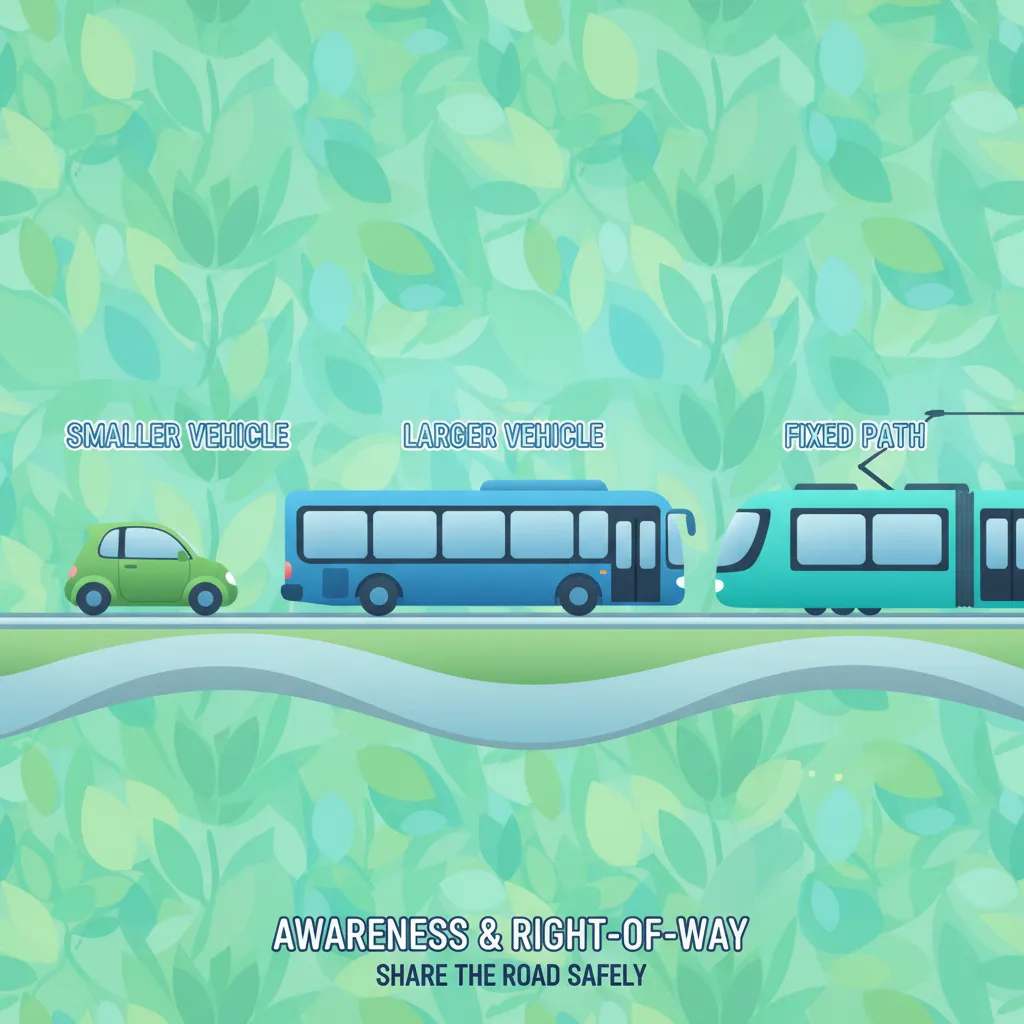
This lesson provides specific guidance for sharing the road with different types of vehicles in Austria. It covers the dangers of large vehicle blind spots, the rules for navigating near buses and dedicated tram tracks, and common conflict points at intersections. Understanding the behavior and limitations of other vehicles is key to safely navigating complex urban environments.
Understand the specific Austrian legal requirements and common pitfalls when driving combination vehicles (DE/D1E). This lesson covers weight limits, speed restrictions, and how to avoid dangerous situations like jackknifing.

This lesson consolidates the legal restrictions on the maximum dimensions and weight for different vehicle combinations in Austria. It covers how to read signs indicating these limits and the importance of compliance for route planning. Adhering to these regulations is essential for legal operation and avoiding fines.
This lesson provides a foundational overview of towing a trailer with a Category B vehicle. It explains the basics of the coupling process, the importance of safety checks, and the principles of correct load distribution for stability. The content clarifies the legal framework, outlining the weight limits that apply to a standard B license and explaining when the B96 or BE permit extensions are required for heavier combinations.

This lesson details the general traffic rules applicable to heavy goods vehicles on Austrian roads, highlighting differences from passenger car regulations. It covers key topics such as right-of-way at intersections, specific rules for overtaking, maintaining proper lane discipline, and adhering to designated speed limits. Understanding these rules is critical for safe integration into mixed traffic.
This lesson introduces the different classifications of trailers used in Austria, including drawbar trailers (Anhänger) and semi-trailers (Sattelanhänger/Auflieger). It explains their key structural differences, typical uses, and the types of coupling systems they employ. Understanding these types is the first step in learning to operate combination vehicles.

This lesson details the legal ramifications of operating an overloaded heavy vehicle in Austria, which include significant fines and penalty points. It also emphasizes the severe safety risks, such as compromised braking performance and increased mechanical stress on the vehicle. Understanding these consequences reinforces the importance of strict adherence to weight limits.
This lesson provides guidance on how to strategically distribute a load across both the main vehicle and its trailer. It covers planning the placement of cargo to maintain a stable centre of gravity for the entire combination. This holistic approach to loading is crucial for safe handling and adhering to individual vehicle and axle weight limits.
This lesson provides specific guidance for sharing the road with different types of vehicles in Austria. It covers the dangers of large vehicle blind spots, the rules for navigating near buses and dedicated tram tracks, and common conflict points at intersections. Understanding the behavior and limitations of other vehicles is key to safely navigating complex urban environments.
This lesson focuses on the legal restrictions concerning a heavy vehicle's dimensions, including maximum height, width, and length. It teaches drivers how to interpret road signs and supplemental plates that indicate these limits. This knowledge is crucial for route planning, especially when navigating under bridges, through tunnels, and on restricted roads.
This lesson provides an overview of the legal framework governing heavy vehicle drivers in Austria. It details the potential penalties for violations, including fines, penalty points, and the risk of licence suspension. A clear understanding of these consequences reinforces the importance of compliant and responsible driving.
This lesson addresses the specific challenges of interacting with larger vehicles like buses and trams in an urban environment. It explains how to signal intentions clearly and predictably to avoid conflicts in shared spaces. Key topics include safely crossing tram tracks and maintaining awareness around public transport stops.
Find clear answers to common questions learners have about Introduction to Driving Combination Vehicles (DE/D1E). Learn how the lesson is structured, which driving theory objectives it supports, and how it fits into the overall learning path of units and curriculum progression in Austria. These explanations help you understand key concepts, lesson flow, and exam focused study goals.
Because the trailer follows a tighter path than the towing vehicle, a phenomenon known as off-tracking or swept path. You must swing wider at the start of a turn to ensure the rear of the trailer clears curbs and obstacles, a key concept for your theory exam.
The primary risk is 'jackknifing', where the trailer pushes the towing vehicle out of alignment, especially on slippery roads or during emergency braking. You must learn to brake progressively and maintain a greater distance to ensure stability.
The theory exam for DE/D1E includes specific questions on coupling/uncoupling, trailer stability, and the legal constraints of towing in Austria. This lesson provides the foundational mechanics required to answer these technical scenario-based questions.
Yes, tail swing is significant. While the front wheels turn, the rear end of the bus or trailer can swing out horizontally, potentially hitting pedestrians or objects. You must monitor this movement via mirrors at all times.
Refine your study plan by searching for specific Austrian driving theory practice sets. Pinpoint questions related to particular road rules, signs, or challenge levels, and begin practicing immediately to reinforce your knowledge and excel in your official exam with confidence. Get started with focused revision today.