
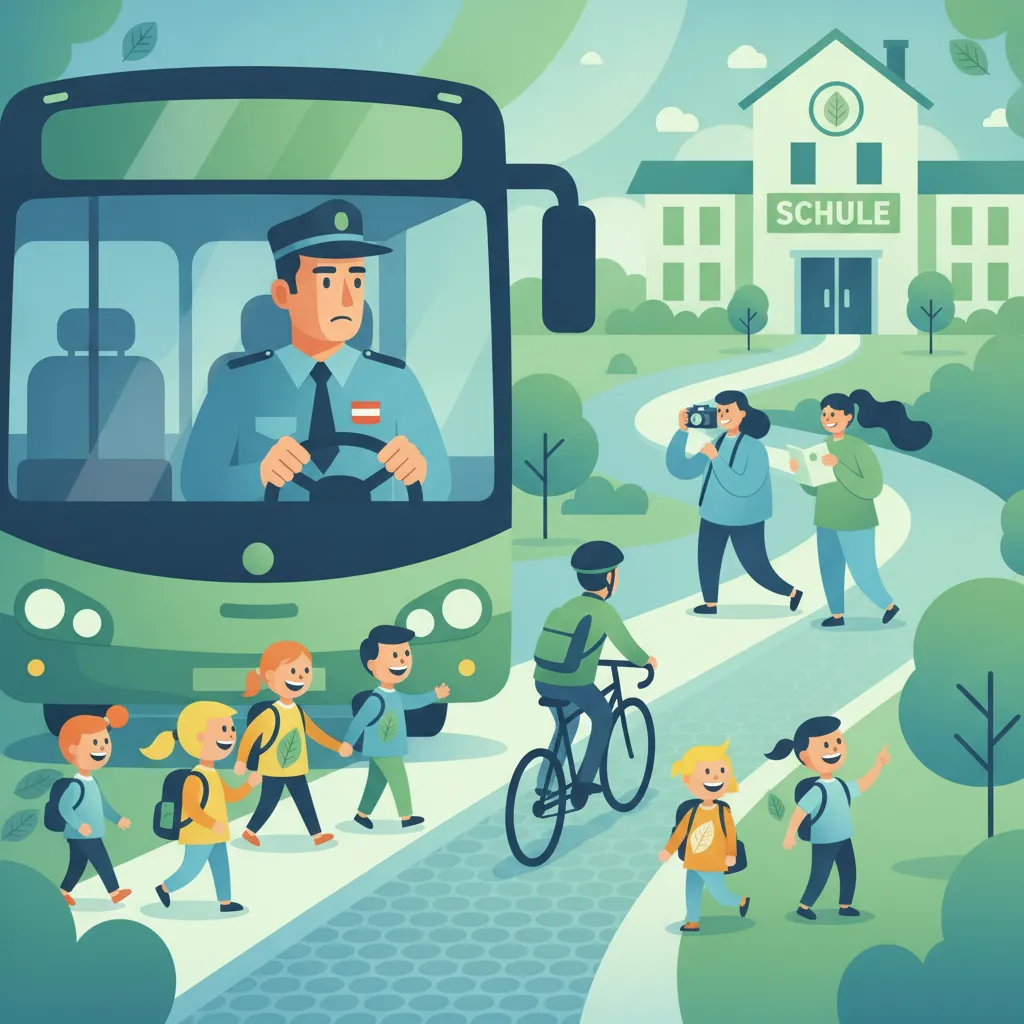
As a professional bus and coach driver in Austria, your paramount responsibility is safeguarding vulnerable road users. This unit focuses on recognizing and expertly navigating high-risk areas like school zones, busy tourist spots, and crowded urban stops. You will learn proactive strategies to anticipate the movements of children, pedestrians, cyclists, and e-scooter riders, ensuring you are always prepared to prevent accidents and uphold your duty of care.
Browse all lessons that make up Schools, Pedestrians, Cyclists, Tourists and High-Risk Stop Areas. Each lesson focuses on specific topics, learning objectives, and core concepts, helping you build essential knowledge and follow a clear, structured progression toward your study goals in Austria.
Transporting children carries the highest level of responsibility. This lesson covers the specific Austrian rules for school buses, including the use of warning signs and lights. It focuses on developing a mindset of extreme caution, anticipating that children may run into the road unexpectedly, and managing the chaotic traffic environment often found around schools during drop-off and pick-up times.
Pedestrians have absolute priority on marked crossings in Austria, and a bus driver must always be ready to give way. This lesson covers the rules for approaching and stopping for pedestrians, and highlights the risk of pedestrians being hidden by the vehicle's structure. It also stresses the danger of passengers crossing the road after alighting from your bus.
Cyclists and e-scooter riders are highly vulnerable and can be hard to see from a high driving position. This lesson focuses on the critical danger points, such as making right turns across cycle lanes and checking blind spots before pulling away from a stop. It teaches the importance of giving ample space when overtaking and anticipating their movements in busy city traffic.
Driving in tourist hotspots in cities like Salzburg or alpine resorts requires extra patience and vigilance. This lesson explores common unpredictable behaviours, such as pedestrians stepping into the road to take photos or groups of tourists being unaware of traffic. It teaches drivers to slow down, be prepared for anything, and use communication tools like the horn sparingly and appropriately.
Not all bus stops are created equal. This lesson trains you to assess a stop's environment and identify potential hazards, such as poor sightlines, proximity to a busy junction, or frequent presence of vulnerable road users. It encourages a proactive approach, where the driver heightens their observation and slows their approach when dealing with these known high-risk locations.
Explore high-intent keywords and long-tail search topics learners use when researching Schools, Pedestrians, Cyclists, Tourists and High-Risk Stop Areas. These terms reflect how people search for reliable study materials, structured explanations, and unit-level theory preparation support in Austria.
Find clear answers to the most common questions learners ask about Schools, Pedestrians, Cyclists, Tourists and High-Risk Stop Areas. Understand how the unit is organized, what learning goals it supports, and how it contributes to your study progression with structured explanations and practical guidance tailored for learners in Austria.
In Austria, driving near schools requires extreme caution. You must always be prepared for children to appear unexpectedly. Look for 'school zone' signs (Schulzone) and observe reduced speed limits, typically 30 km/h. Be extra vigilant for children crossing roads, often without looking. Yield to any pedestrians, especially children, entering or about to enter a crossing. Your primary duty is to protect them, even if it means stopping suddenly.
Cyclists and e-scooter riders are vulnerable road users. Maintain a safe distance when overtaking them, ideally at least 1.5 meters, and check your mirrors thoroughly before and during the manoeuvre. Be aware that they may ride unpredictably or suddenly change direction. At intersections, give them ample space and be prepared for them to proceed even if you have priority. Understand that they may use cycle paths or the main roadway depending on local regulations.
A bus stop becomes a high-risk area due to the concentration of vulnerable road users like pedestrians, often including children and the elderly, and cyclists. Boarding and alighting passengers can be distracted. Visibility can be reduced, especially at busy urban stops or those near junctions. Tourist areas may also present unpredictable behaviour. Drivers must approach all stops with heightened awareness, scanning for hazards before, during, and after stopping.
Anticipation is key. For children, assume they might dart into the road suddenly. Scan playgrounds, parks, and school entrances for signs of activity. For tourists, they might be less familiar with local traffic rules or distracted by sightseeing. Be patient, reduce speed in tourist hotspots, and be prepared for sudden stops or movements. Defensive driving means expecting the unexpected from these groups.
The duty of care for a bus driver means prioritizing the safety of everyone outside the vehicle, especially vulnerable road users. This involves driving defensively, anticipating potential hazards, yielding when necessary, and maintaining safe distances. It means understanding that your large vehicle poses a greater risk, and therefore, you must exercise a higher degree of caution and awareness around pedestrians, cyclists, and others.
Yes, the Austrian theory exam for Category D includes questions on vulnerable road users, school zones, and high-risk areas. You can expect scenario-based questions that test your ability to identify hazards and choose the safest course of action, particularly concerning children, pedestrians, and cyclists. Understanding these specific risks and rules is crucial for passing.
All included lessons
Lessons in Schools, Pedestrians, Cyclists, Tourists and High-Risk Stop Areas
See who benefits most from studying Schools, Pedestrians, Cyclists, Tourists and High-Risk Stop Areas. This overview explains how the unit supports different learning needs, what level of knowledge is helpful before starting, and how it fits into the overall study path in Austria.
This unit is crucial for all aspiring Category D licence holders in Austria, particularly those preparing for the theory exam. It is especially beneficial for drivers who may have less experience with urban traffic, school zones, or managing interactions with pedestrians and cyclists, providing targeted knowledge to enhance safety and exam performance.

Ready to systematically master Austrian driving theory? Explore our diverse range of structured courses and find the perfect learning path for your license category. Start building your knowledge foundation and preparing confidently for your official driving theory exam in Austria.
Browse Theory CurriculumExplore all units and lessons included in this driving theory course.
Ready to systematically master Austrian driving theory? Explore our diverse range of structured courses and find the perfect learning path for your license category. Start building your knowledge foundation and preparing confidently for your official driving theory exam in Austria.
Browse Theory Curriculum