
This lesson explores the essential techniques for maintaining a safe gap between you and the vehicle in front, a crucial skill for both the Category B theory test and real-world safety. You will learn how to apply the two-second rule in clear conditions and how to adjust your following distance in the wet, icy, or dark conditions often encountered on British roads.
Lesson content overview
Maintaining a safe following distance is one of the most fundamental principles of defensive driving and a cornerstone for collision avoidance. For Great Britain Category B learner drivers, understanding and consistently applying the correct following distance is crucial for passing your theory test and, more importantly, for safe driving throughout your life. This lesson delves into the practical methods and critical factors that influence how much space you should keep between your vehicle and the one ahead, ensuring you have ample time to react and stop safely.
A safe following distance is the gap, both spatial and temporal, that a driver must maintain behind another vehicle. This distance allows you to bring your vehicle to a complete stop without colliding if the vehicle in front suddenly slows down or stops. It’s a dynamic concept, constantly needing adjustment based on speed, road conditions, weather, and your vehicle's characteristics.
The primary purpose of a safe following distance is to prevent rear-end collisions. These types of accidents are common and often result from drivers not leaving enough space to react to unexpected events. An adequate gap gives you the necessary time for:
Without sufficient space, any sudden braking by the vehicle ahead could lead to an unavoidable collision, risking injury to occupants, damage to vehicles, and potential legal consequences.
While it might seem intuitive to think of following distance in terms of car lengths, this method is unreliable because the actual distance represented by a "car length" changes drastically with speed. Instead, professional driving guidance in Great Britain, including the Highway Code, advocates for a time-based metric. This means calculating the time it takes for your vehicle to reach a point on the road that the vehicle ahead has just passed. A time-based gap automatically adjusts for your speed: the faster you go, the greater the physical distance will be for the same time interval, providing a truly safe margin.
The Two-Second Rule is the standard minimum time gap recommended for maintaining a safe following distance under normal, dry road conditions. It provides a simple, universal method that accounts for both your reaction time and the vehicle's braking capability. This rule is easy to remember and apply consistently, regardless of your speed.
Applying the two-second rule involves a simple observation technique:
Identify a fixed landmark: As the vehicle in front of you passes a fixed, stationary object on the side of the road (e.g., a road sign, a bridge, a tree, a lamppost), begin counting.
Count "one thousand and one, one thousand and two": These words take approximately two seconds to say naturally.
Check your position: If your vehicle reaches the same fixed landmark before you finish counting "one thousand and two," you are following too closely. You need to drop back and increase your distance.
Maintain the gap: Adjust your speed to ensure you always maintain at least a two-second gap. If the vehicle ahead speeds up, you must also increase your speed to re-establish the gap, or if it slows down, reduce your speed.
Practice counting the two-second rule in various driving conditions to make it second nature. Consistency is key to safety.
Understanding the practical meaning of the two-second rule helps visualise the space needed. While the time remains constant, the physical distance increases with speed:
The two-second rule is a minimum for ideal conditions. However, driving conditions are rarely ideal. Factors such as wet roads, ice, fog, and even your vehicle's load can drastically alter stopping distances and require you to extend your following gap. This is a critical aspect of dynamic following distance, where you continuously assess and adjust your safety margin.
When road conditions reduce tyre grip or visibility, the standard two-second rule is insufficient. The Four-Second Rule dictates that you should double your minimum following distance to at least four seconds. This applies in conditions such as:
Many drivers underestimate the impact of wet roads on braking distance. Braking distances can be doubled on wet surfaces compared to dry roads. Always err on the side of caution.
For example, at 30 mph in heavy rain, a four-second gap would be approximately 88 feet (about 27 metres), providing the crucial extra buffer for reduced braking efficiency.
Snow and ice represent the most challenging road conditions for maintaining control and stopping. In these situations, braking distances can increase by as much as ten times compared to dry roads. Therefore, you must significantly extend your following distance.
In such extreme conditions, smooth and gentle actions are paramount. Sudden braking or steering can easily lead to a skid.
Reduced visibility, whether due to fog, heavy rain, or driving at night, directly impacts your perception-reaction time. You need more time to see a hazard and react to it.
Beyond weather, other factors can necessitate an increase in your safe following distance. Being aware of these situations allows for a truly dynamic and adaptive approach to road safety.
In congested urban areas or stop-and-go traffic, speeds may be lower, but the unpredictable nature of traffic flow demands a slightly larger buffer than the two-second rule. The Highway Code recommends a three-second rule in these environments. This provides more leeway for:
At 20 mph (approximately 32 km/h) in city traffic, a three-second gap is roughly 88 feet (about 27 metres), allowing safe braking and preventing tail-gating in dense conditions.
The weight of your vehicle directly affects its braking performance. A heavier vehicle carries more inertia, meaning it takes longer and travels further to stop, even with the same braking force.
Always check your vehicle's owner's manual for specific recommendations on braking with heavy loads or when towing.
When following vulnerable road users such as motorcyclists, cyclists, or even pedestrians (when they are on the road or near crossings), it is crucial to allow an even greater margin of safety.
To truly master dynamic following distance, it's important to understand the underlying principles of vehicle dynamics and human factors that determine stopping capabilities.
Reaction time is the period between recognising a hazard and initiating the physical response (e.g., applying the brakes). For an alert, sober driver, this typically averages around 1.0 to 1.5 seconds. However, several factors can significantly increase this time:
A longer reaction time directly translates to a greater reaction distance (the distance your vehicle travels during your reaction time). This is why a longer following distance is essential when any of these factors are present.
Braking distance is the distance your vehicle travels from the moment you apply the brakes until it comes to a complete stop. This distance is influenced by:
Your tyres are the only part of your vehicle that touches the road, making their condition paramount for safety. Tyre grip is directly related to the tyre tread depth and overall condition.
Poor tyre condition will require you to increase your following distance, treating the conditions as if they were wet or low-grip, even on a seemingly dry road.
The Highway Code provides clear guidance and rules regarding following distance, which are legally enforceable or represent best practice for safe driving.
Failure to adhere to these principles can lead to penalties, including fines and points on your licence, and increases your insurance premiums significantly.
Even experienced drivers can make mistakes regarding following distance. Being aware of these common pitfalls can help you develop safer habits:
Truly safe driving involves more than just following rules; it requires continuous assessment and adaptation. Here are some advanced strategies for dynamic following distance:
This lesson teaches the two-second rule as the minimum following gap in dry conditions, using a simple counting method to fixed landmarks. The key principle is that time-based measurement automatically scales with speed, making it more reliable than car lengths. In wet conditions, the gap must double to four seconds, while ice, snow, fog, and night driving demand even greater distances. Additional factors including vehicle load, towing, and driver alertness further influence the appropriate gap, requiring continuous assessment and adjustment.
A short set of high-value points that capture the most important learning from this lesson.
The two-second rule is the minimum time gap in dry conditions, achieved by counting 'one thousand and one, one thousand and two' to a fixed landmark the vehicle ahead passes.
Increase your gap to at least four seconds in wet conditions because braking distance roughly doubles on wet roads compared to dry surfaces.
Following distance must be dynamic—adjust your gap based on weather, visibility, vehicle load, and your own alertness.
Time-based measurement is more reliable than car lengths because it automatically increases with speed, ensuring proportional safety margins.
In snow aim for a five-second gap, and in ice a six-second gap minimum, as braking distances can increase tenfold.
Explore all units and lessons included in this driving theory course.
At 30 mph a two-second gap is roughly 3 car lengths; at 60 mph it becomes approximately 6 car lengths, showing why time is better than fixed distances.
Wet roads, icy surfaces, heavy rain, fog, and night driving all require extended following gaps beyond the standard two-second minimum.
Heavily loaded vehicles and those towing trailers need at least one to two additional seconds because added weight increases stopping distance.
Urban and heavy traffic conditions warrant a three-second gap rather than two, due to unpredictable stops and frequent lane changes.
Driver factors such as fatigue, distraction, and age can extend reaction time beyond the typical 1.0–1.5 seconds, necessitating a larger safety margin.
Assuming a fixed number of car lengths is always sufficient, without accounting for how stopping distance increases exponentially with speed.
Failing to increase the gap when conditions are wet, icy, or visibility is reduced, treating adverse weather as if conditions were dry.
Tailgating—following closer than the two-second minimum—which leaves no room to react if the vehicle ahead brakes suddenly.
Not considering that a loaded vehicle or one towing requires significantly longer stopping distance than an empty vehicle.
Driving while distracted or fatigued, which increases reaction time beyond normal values and makes standard gaps unsafe.
Lesson content overview
A short set of high-value points that capture the most important learning from this lesson.
The two-second rule is the minimum time gap in dry conditions, achieved by counting 'one thousand and one, one thousand and two' to a fixed landmark the vehicle ahead passes.
Increase your gap to at least four seconds in wet conditions because braking distance roughly doubles on wet roads compared to dry surfaces.
Following distance must be dynamic—adjust your gap based on weather, visibility, vehicle load, and your own alertness.
Time-based measurement is more reliable than car lengths because it automatically increases with speed, ensuring proportional safety margins.
In snow aim for a five-second gap, and in ice a six-second gap minimum, as braking distances can increase tenfold.
Explore all units and lessons included in this driving theory course.
At 30 mph a two-second gap is roughly 3 car lengths; at 60 mph it becomes approximately 6 car lengths, showing why time is better than fixed distances.
Wet roads, icy surfaces, heavy rain, fog, and night driving all require extended following gaps beyond the standard two-second minimum.
Heavily loaded vehicles and those towing trailers need at least one to two additional seconds because added weight increases stopping distance.
Urban and heavy traffic conditions warrant a three-second gap rather than two, due to unpredictable stops and frequent lane changes.
Driver factors such as fatigue, distraction, and age can extend reaction time beyond the typical 1.0–1.5 seconds, necessitating a larger safety margin.
Assuming a fixed number of car lengths is always sufficient, without accounting for how stopping distance increases exponentially with speed.
Failing to increase the gap when conditions are wet, icy, or visibility is reduced, treating adverse weather as if conditions were dry.
Tailgating—following closer than the two-second minimum—which leaves no room to react if the vehicle ahead brakes suddenly.
Not considering that a loaded vehicle or one towing requires significantly longer stopping distance than an empty vehicle.
Driving while distracted or fatigued, which increases reaction time beyond normal values and makes standard gaps unsafe.
Explore search topics learners often look for when studying Following Distance, Two‑Second Rule, and Variable Conditions. These topics reflect common questions about road rules, driving situations, safety guidance, and lesson level theory preparation for learners in Great Britain.
Browse additional driving theory lessons that cover connected traffic rules, road signs, and common driving situations related to this topic. Improve your understanding of how different rules interact across everyday traffic scenarios.
Explore how vehicle load, towing, driver fatigue, and distractions impact your reaction and braking distances. Understand advanced strategies for maintaining safe gaps in complex traffic situations for your theory.
This lesson addresses the serious danger of driver fatigue, a major cause of incidents involving commercial vehicles. It details the complex EU and GB domestic rules on drivers' hours, including driving limits and required rest periods. Learners will be taught to recognize the physical and mental signs of fatigue and understand the importance of taking quality rest to maintain alertness and ensure their own safety and that of others.

This lesson explores how to maintain safe following distances specific to large passenger vehicles, accounting for their higher inertia and longer braking distances. It covers time-gap calculations, such as the four-second rule, and dynamic following distance adjustments based on speed and road conditions. Emphasis is placed on avoiding tailgating, ensuring a sufficient safety buffer is always present, and developing an awareness of convoy driving scenarios where multiple large vehicles are present.

This lesson reinforces the vital safety rule of maintaining an adequate following distance from the vehicle ahead. It explains why the standard 'two-second rule' must be extended for heavy vehicles, especially in poor weather or when heavily laden, to account for longer stopping distances. You will learn practical methods for judging a safe gap in various traffic situations, creating a crucial safety buffer to react to unforeseen hazards.

This lesson explains that driving while tired can be as dangerous as drink driving, significantly slowing your reactions and reducing concentration. It teaches you to recognise the signs of fatigue, such as yawning or wandering thoughts. The only real cure for tiredness is sleep, so the lesson stresses the importance of taking proper breaks—at least 15 minutes for every two hours of driving.

This lesson addresses the serious safety risk of driver fatigue. It explains the warning signs of tiredness and provides strategies for managing it through proper rest and lifestyle choices. The content details the legal requirements under the drivers' hours and working time directive regulations, including the correct use of the tachograph to record rest periods. Maintaining good health, diet, and sleep hygiene is emphasized as fundamental to ensuring a driver is always fit to be on the road.
This lesson explains that safe driving often requires travelling at a speed lower than the legal limit. It covers how to adjust your speed for adverse conditions such as rain, which can double your stopping distance, or fog, which severely reduces visibility. The goal is to always be able to stop safely in the distance you can see to be clear.

This lesson covers the principles of safe loading to prevent items from shifting or falling and causing a hazard. It explains that any load must be securely fastened and must not obstruct your view. You will also learn how overloading or distributing weight incorrectly can dangerously affect the vehicle's steering, braking, and overall stability.

This lesson explores how a passenger vehicle’s physical dimensions and weight influence its dynamic stability, handling, and manoeuvring capabilities. It covers the impact of length, width, wheelbase, and turning radius on cornering and route choice. The content also examines centre of gravity, load distribution, and the effects of inertia that influence braking and acceleration, which are essential concepts for safe operation in confined urban environments and at tight junctions.

This lesson addresses the critical importance of child safety in school transport zones and around school buses. It covers the specific regulations, such as 20 mph speed limits and stopping restrictions indicated by zigzag lines. Learners will focus on the unpredictable nature of children and the need for heightened vigilance and readiness to stop unexpectedly. The content also includes procedures for the safe transport of pupils, ensuring their security both inside and outside the vehicle.
Learn how to safely increase your following distance in wet, icy, or foggy conditions. Understand the impact of road surface and visibility on stopping distances for your Great Britain driving theory.
This lesson explains that safe driving often requires travelling at a speed lower than the legal limit. It covers how to adjust your speed for adverse conditions such as rain, which can double your stopping distance, or fog, which severely reduces visibility. The goal is to always be able to stop safely in the distance you can see to be clear.

This lesson provides essential advice for driving when weather conditions are poor. It explains how rain can cause aquaplaning and why you must double your following distance. You will also learn techniques for driving in icy conditions, including gentle use of controls to avoid skidding, and the correct use of lights in fog.
This lesson reinforces the vital safety rule of maintaining an adequate following distance from the vehicle ahead. It explains why the standard 'two-second rule' must be extended for heavy vehicles, especially in poor weather or when heavily laden, to account for longer stopping distances. You will learn practical methods for judging a safe gap in various traffic situations, creating a crucial safety buffer to react to unforeseen hazards.
This lesson prepares you for the challenges of countryside driving. It emphasizes that the national speed limit on these roads is often too fast for the conditions. You will learn how to approach sharp bends, use passing places on single-track roads, and anticipate hazards like slow-moving tractors, horse riders, or mud on the road surface.
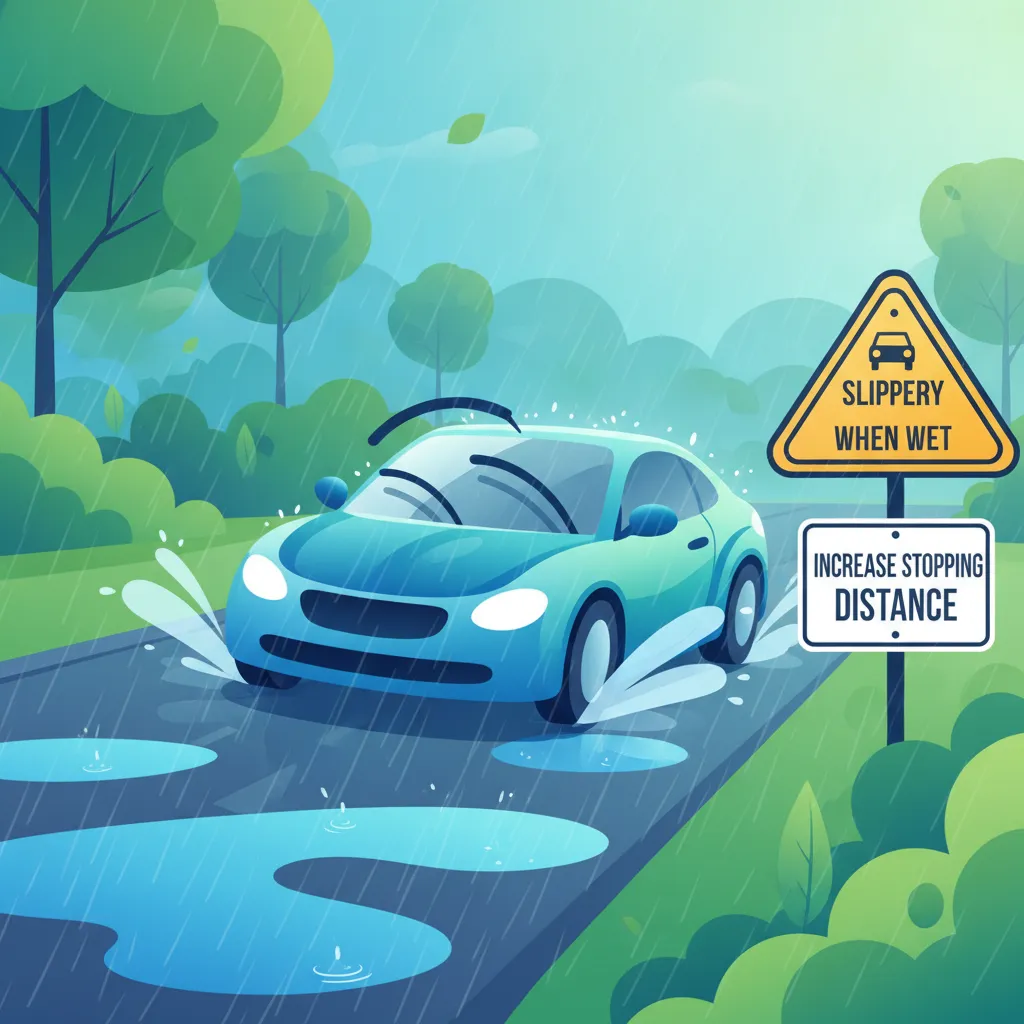
This lesson explains how different weather conditions impact the handling and stability of a large passenger vehicle. It covers the risks of aquaplaning in heavy rain, the effect of high winds on vehicle stability, and the severe reduction in visibility caused by fog. Learners will understand how ice and snow dramatically increase stopping distances and require extremely gentle control inputs to prevent skidding. Strategies for adapting speed and increasing following distances are emphasized.

This lesson explains the functions and legal requirements for all exterior vehicle lights. You will learn when it is appropriate to use dipped and main beam headlights, the specific conditions for using fog lights, and the correct application of hazard warning lights. Proper use of lighting is vital for seeing and being seen by other road users.
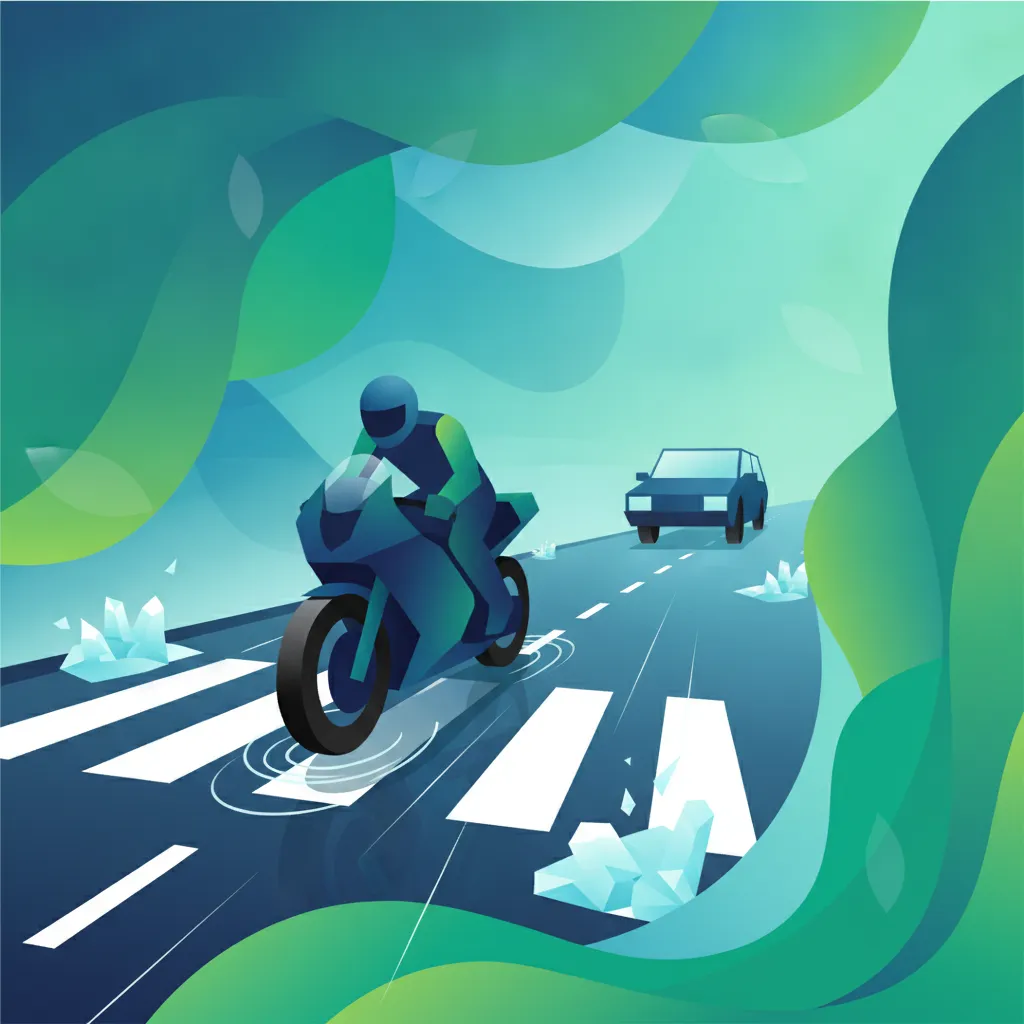
This lesson provides essential advice for riding safely in adverse weather conditions that reduce tyre grip. You will learn how rain, ice, and wet leaves dramatically increase braking distances and affect handling. Key strategies covered include reducing speed, increasing following distances, making smooth control inputs, and anticipating slippery areas to maintain control and avoid skidding on compromised road surfaces.
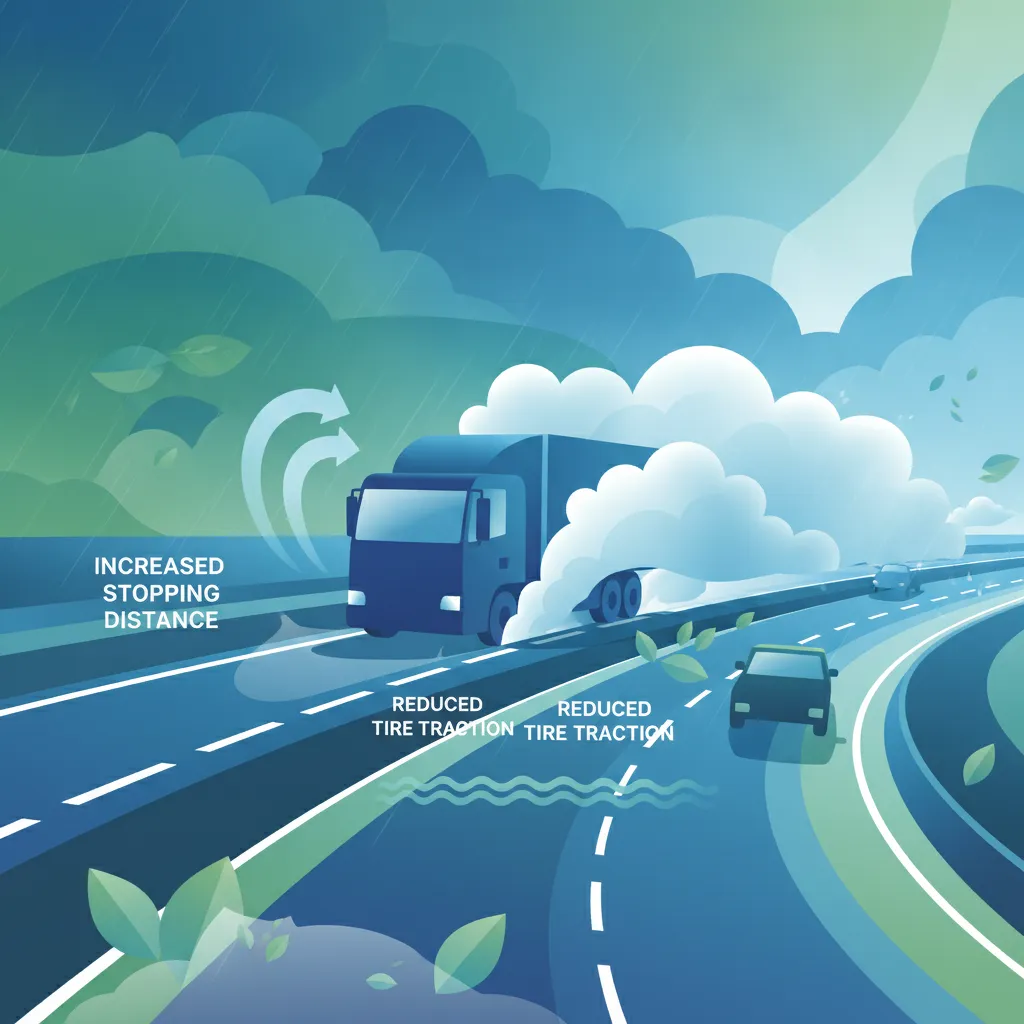
This lesson details how different adverse weather conditions uniquely affect the handling and stability of a heavy goods vehicle. It covers the increased stopping distances in rain, reduced visibility in fog, severe traction loss on ice, and the dangerous effect of strong crosswinds on high-sided vehicles. You will learn specific techniques for adjusting speed, increasing following distances, and using vehicle controls smoothly to maintain safety in challenging weather.
This lesson explores how to maintain safe following distances specific to large passenger vehicles, accounting for their higher inertia and longer braking distances. It covers time-gap calculations, such as the four-second rule, and dynamic following distance adjustments based on speed and road conditions. Emphasis is placed on avoiding tailgating, ensuring a sufficient safety buffer is always present, and developing an awareness of convoy driving scenarios where multiple large vehicles are present.

This lesson addresses the unique challenges of driving a large vehicle on rural roads. It provides techniques for positioning the vehicle through sharp bends and on narrow lanes, and for safely navigating unmarked or uncontrolled junctions. Learners will be taught to anticipate hidden hazards common in the countryside, such as slow-moving farm vehicles, animals on the road, and concealed entrances. The correct use of passing places and strategies for meeting oncoming traffic are also covered.
Find clear answers to common questions learners have about Following Distance, Two‑Second Rule, and Variable Conditions. Learn how the lesson is structured, which driving theory objectives it supports, and how it fits into the overall learning path of units and curriculum progression in Great Britain. These explanations help you understand key concepts, lesson flow, and exam focused study goals.
Yes, the two-second rule is a time-based measurement. Because your speed increases with distance, the gap automatically widens as your speed increases, ensuring you always have a proportionate amount of time to react.
On wet roads, your tyres have less grip, which significantly increases your vehicle's braking distance. Doubling your time gap to four seconds accounts for this loss of friction.
Do not speed up to pull away. Instead, increase the distance between you and the vehicle in front to give yourself more space to brake gently if necessary, reducing the risk of a multi-vehicle collision.
No. The two-second rule is a 'gap' to allow for reaction time. Total stopping distance is the sum of thinking distance and braking distance, which is a broader concept covered in your theory test.
Dive into our comprehensive question bank to find exactly what you need for your Great Britain theory test. Use our advanced filters to pinpoint specific subjects or test your knowledge on challenging areas, ensuring you're fully prepared for success.