
This lesson explores the essential physics and techniques for managing a large goods vehicle when faced with challenging weather conditions like heavy rain, ice, or high winds. As part of our comprehensive Category C curriculum, you will learn how to maintain stability and control, ensuring you are prepared for both the DVSA theory exam and real-world professional driving safety.

Lesson content overview
Operating a heavy goods vehicle (HGV) demands exceptional skill and awareness, particularly when faced with challenging weather conditions. This lesson, part of your Professional Goods Vehicle Theory for Great Britain - Category C Licence, focuses on how severe rain, ice, snow, and strong crosswinds impact HGV dynamics and the strategies professional drivers must employ to maintain control and ensure safety. Understanding these principles is crucial for preventing collisions, managing cargo, and complying with stringent road safety regulations.
The fundamental principles governing vehicle movement are dramatically altered when adverse weather reduces the friction between tyres and the road. A heavy vehicle's substantial mass and often higher centre of gravity (CoG) magnify these effects, demanding a proactive and informed approach from the driver.
Traction refers to the maximum grip available between a vehicle's tyres and the road surface, which is essential for accelerating, braking, and steering. In ideal dry conditions, the road offers a high coefficient of friction, allowing for effective control. However, substances like water, ice, or snow significantly reduce this friction, leading to a diminished traction limit.
When tyres exceed this reduced traction limit, they begin to slip, causing a loss of control. Professional HGV drivers must meticulously manage throttle, brake, and steering inputs to keep the forces generated within the available traction limits, preventing dangerous skids or spins.
A heavy vehicle possesses considerable momentum, which is the product of its mass and velocity. In low-traction environments, this high momentum translates into a much greater challenge to stop or change direction. Reducing speed is the primary method for managing this kinetic energy, as it must be dissipated without overwhelming the limited grip available.
Weight transfer is another critical dynamic, where the vehicle's load shifts between its axles during acceleration, braking, or cornering. For instance, during braking, weight shifts forward, increasing the load and potentially the grip on the front axle, but simultaneously reducing it on the rear. Conversely, acceleration shifts weight rearward. Abrupt inputs can cause an excessive weight transfer, leading to an axle losing traction prematurely. Smooth, progressive control inputs are vital to prevent such sudden shifts and maintain balanced grip across all axles.
Strong crosswinds exert significant lateral (sideways) aerodynamic forces on the large side area of an HGV, especially those with tall loads or towing trailers. This force can create a yaw moment, attempting to rotate the vehicle around its vertical axis and pushing it off its intended path.
For drivers, this means a constant need for steering correction and a heightened risk of trailer sway, particularly on exposed roads, bridges, or when emerging from sheltered areas. Reducing speed lessens the aerodynamic force and improves stability, making the vehicle less susceptible to sudden gusts.
Each type of adverse weather presents unique challenges to HGV control, demanding specific adaptations in driving technique.
Heavy rain saturates the road surface, dramatically reducing tyre grip and increasing stopping distances. The most significant hazard in these conditions is aquaplaning, also known as hydroplaning. This occurs when a wedge of water builds up between the tyre and the road, lifting the tyre off the surface and causing a complete loss of contact.
When aquaplaning, the vehicle may feel light, and steering inputs will have no effect. The primary cause is typically a combination of excessive speed, insufficient tyre tread depth, and significant water accumulation. To mitigate this risk, drivers must reduce speed substantially in wet conditions, especially when approaching standing water. Maintaining correct tyre pressure and adequate tread depth (a legal minimum of 1.6 mm) are also paramount.
In heavy rain, reduce your speed significantly and maintain an increased following distance. Drive smoothly, avoiding sudden braking, acceleration, or steering inputs to minimise the risk of aquaplaning.
Ice and snow represent the most severe reductions in tyre-road friction, making skidding a constant threat. On these surfaces, stopping distances can increase by ten times or more compared to dry roads.
Skidding is the loss of tyre grip, causing the vehicle to slide. This can manifest as:
To prevent skids on ice or snow, drivers must use extremely gentle and progressive inputs for steering, acceleration, and braking. Starting in a higher gear can help prevent wheel spin, and maintaining a slow, steady speed is crucial. Any sudden movement can easily break the limited available traction.
Beyond traction challenges, heavy rain, snow, and fog significantly reduce visibility. This directly impacts a driver's ability to perceive hazards and react in time. In these conditions, appropriate lighting (e.g., dipped headlights, fog lights) is essential, and speed must be reduced further to allow for adequate stopping distance within the visible range.
Proactive and smooth driving techniques are the cornerstone of safe HGV operation in adverse conditions.
The cardinal rule for driving HGVs in low-traction conditions is to apply all control inputs — steering, acceleration, and braking — with extreme smoothness and progression.
Remember that even with advanced electronic aids like ABS and ESC, smooth driver inputs are still paramount. These systems assist, but they cannot defy the laws of physics or compensate for reckless driving.
Engine braking involves using the engine's resistance to slow the vehicle, typically by selecting a lower gear. This technique is invaluable in adverse conditions, particularly on descents or when slowing down on slippery surfaces.
By downshifting early and gradually, drivers can control speed without over-relying on the service brakes, which can easily cause wheel lock-up or overheating (brake fade) in heavy vehicles. This allows the service brakes to remain cool and ready for emergency situations. Correct gear selection also prevents excessive engine torque from breaking traction during acceleration or gradient climbing.
Anticipate the descent well in advance and assess the road conditions (e.g., ice, snow, heavy rain).
Before starting the descent, select a lower gear than you would use for a dry, flat road. This will vary depending on the gradient and load.
Allow the engine's compression to naturally slow the vehicle. Avoid sudden downshifts that could cause the drive wheels to spin.
If additional braking is required, apply the service brake gently and progressively, modulating pressure as needed to prevent wheel lock.
Maintain a safe, controlled speed throughout the descent, ready to react to changes in road surface or visibility.
In adverse conditions, stopping distances for HGVs increase dramatically due to reduced traction. Therefore, professional drivers must significantly increase their following distance from other vehicles. The "two-second rule" (or often "four-second rule" for HGVs in good conditions) should be extended to at least six to ten seconds in heavy rain, ice, or snow. This provides crucial extra time and space to react to sudden braking or unexpected hazards without relying on hard braking, which is risky in low-traction environments.
Modern HGVs are equipped with sophisticated electronic systems designed to assist drivers in maintaining control. Understanding their function and limitations is vital.
The Anti-lock Braking System (ABS) prevents the wheels from locking up during hard braking by rapidly modulating brake pressure to each wheel. This allows the driver to maintain steering control even under emergency braking. While ABS significantly improves safety, it does not shorten stopping distances on extremely slippery surfaces like ice; it primarily prevents skidding and maintains steerability.
Electronic Stability Control (ESC), sometimes referred to as Electronic Stability Program (ESP), is an advanced safety system that helps prevent skids and rollovers. It continuously monitors the driver's steering input against the vehicle's actual movement. If it detects a loss of control (e.g., understeer or oversteer), it automatically applies the brakes to individual wheels and may reduce engine power to help steer the vehicle back onto its intended path.
The Traction Control System (TCS) is often integrated with ABS and ESC. Its primary function is to prevent wheel spin under acceleration by reducing engine torque or applying braking to the slipping wheel. This helps maintain traction, especially when starting on slippery surfaces or accelerating out of a bend.
These systems are powerful aids but have limitations. They cannot overcome the laws of physics or compensate for excessive speed on black ice. Drivers must understand that these systems assist rather than replace careful and appropriate driving techniques.
For HGVs towing trailers, trailer sway control systems (sometimes part of ESC or a dedicated system like Sprinter) are crucial. These systems detect the onset of dangerous trailer oscillations (sway) and automatically intervene by selectively applying the brakes to the trailer wheels or reducing engine power to stabilise the combination. This is particularly important in strong crosswinds or during emergency manoeuvres on slippery roads.
The condition of your HGV, especially its tyres and load, plays a critical role in how it performs in adverse weather.
Tyres are the only point of contact between the vehicle and the road, making their condition paramount for traction.
The way cargo is loaded and secured directly affects an HGV's stability and dynamics, especially in adverse conditions.
Professional Category C licence holders are bound by specific rules and regulations designed to enhance safety in adverse conditions.
Highway Code Rule 116 mandates that drivers must reduce their speed when visibility, road surface, or weather conditions make it unsafe to continue at normal speeds. This is a fundamental principle in adverse weather. Rule 127 further reinforces this, stating that a driver must never "out-run their tyres," meaning they must not drive faster than the available grip allows.
Regulation 40 of the Road Vehicles (Construction and Use) Regulations 1986 stipulates that HGVs must be equipped with functional ABS and, where fitted, ESC, and these systems must be used appropriately. Drivers must ensure these critical safety systems are operational before commencing a journey.
Highway Code Rule 140 specifically addresses crosswinds, requiring drivers to be aware of them and reduce speed, especially for high-sided vehicles. Ignoring these warnings can lead to dangerous vehicle drift and lane departure.
Many incidents in adverse weather stem from common errors in judgment or technique:
Let's consider how these principles apply in real-world driving situations.
Mastering HGV dynamics in adverse conditions for your Professional Goods Vehicle Theory for Great Britain - Category C Licence involves a holistic approach:
By internalising these principles, you will be well-equipped to navigate challenging environments safely and professionally, upholding the high standards expected of a Category C goods vehicle driver.
This lesson covers the essential physics and techniques for managing an HGV in adverse weather conditions including heavy rain, ice, snow, and crosswinds. Key concepts include how reduced traction affects vehicle control, the dangers of aquaplaning and skidding (including understeer and oversteer), and why smooth, progressive control inputs are critical for staying within traction limits. The lesson also explains the function and limitations of safety systems (ABS, ESC, TCS, trailer sway control), tyre maintenance requirements, proper engine braking technique, and relevant Highway Code rules. Understanding these principles prepares Category C candidates for both the DVSA theory exam and real-world professional driving safety.
A short set of high-value points that capture the most important learning from this lesson.
Heavy vehicles' substantial mass and momentum make them far harder to control when traction is reduced by wet, icy, or snowy surfaces.
Smooth, progressive inputs for steering, acceleration, and braking are essential to keep forces within the limited traction available in adverse conditions.
Engine braking is preferred over service brakes on slippery descents because it controls speed without risking wheel lock-up or brake fade.
ABS prevents wheel lock to maintain steering control but does not shorten stopping distances on extremely slippery surfaces like ice.
Reducing speed significantly before entering adverse conditions is both a legal requirement under Highway Code Rule 116 and the primary method for managing kinetic energy.
Explore all units and lessons included in this driving theory course.
Highway Code Rule 116 mandates speed reduction when visibility, road surface, or weather make normal speeds unsafe.
The legal minimum tyre tread depth for HGVs in Great Britain is 1.6 mm across the central three-quarters of the tread breadth.
During braking, weight transfers forward (reducing rear axle grip); during acceleration, weight transfers backward (reducing front axle grip).
In heavy rain, ice, or snow, extend your following distance to at least six to ten seconds to account for dramatically increased stopping distances.
Electronic Stability Control detects skids and applies brakes to individual wheels, but it cannot overcome physics or compensate for driving beyond the traction limit.
Driving at normal speeds in heavy rain or on icy roads, which drastically increases the risk of aquaplaning, skidding, and collisions.
Using sudden or abrupt braking, acceleration, or steering inputs on slippery surfaces, which easily overwhelms limited traction and causes loss of control.
Over-relying on electronic aids like ABS and ESC while believing they can compensate for excessive speed or poor technique.
Operating with worn tyres, incorrect tyre pressure, or an improperly secured high load, all of which dramatically reduce stability.
Over-using service brakes on long slippery descents, leading to brake fade and loss of stopping effectiveness when needed most.
Lesson content overview
A short set of high-value points that capture the most important learning from this lesson.
Heavy vehicles' substantial mass and momentum make them far harder to control when traction is reduced by wet, icy, or snowy surfaces.
Smooth, progressive inputs for steering, acceleration, and braking are essential to keep forces within the limited traction available in adverse conditions.
Engine braking is preferred over service brakes on slippery descents because it controls speed without risking wheel lock-up or brake fade.
ABS prevents wheel lock to maintain steering control but does not shorten stopping distances on extremely slippery surfaces like ice.
Reducing speed significantly before entering adverse conditions is both a legal requirement under Highway Code Rule 116 and the primary method for managing kinetic energy.
Explore all units and lessons included in this driving theory course.
Highway Code Rule 116 mandates speed reduction when visibility, road surface, or weather make normal speeds unsafe.
The legal minimum tyre tread depth for HGVs in Great Britain is 1.6 mm across the central three-quarters of the tread breadth.
During braking, weight transfers forward (reducing rear axle grip); during acceleration, weight transfers backward (reducing front axle grip).
In heavy rain, ice, or snow, extend your following distance to at least six to ten seconds to account for dramatically increased stopping distances.
Electronic Stability Control detects skids and applies brakes to individual wheels, but it cannot overcome physics or compensate for driving beyond the traction limit.
Driving at normal speeds in heavy rain or on icy roads, which drastically increases the risk of aquaplaning, skidding, and collisions.
Using sudden or abrupt braking, acceleration, or steering inputs on slippery surfaces, which easily overwhelms limited traction and causes loss of control.
Over-relying on electronic aids like ABS and ESC while believing they can compensate for excessive speed or poor technique.
Operating with worn tyres, incorrect tyre pressure, or an improperly secured high load, all of which dramatically reduce stability.
Over-using service brakes on long slippery descents, leading to brake fade and loss of stopping effectiveness when needed most.
Explore search topics learners often look for when studying Managing Heavy Vehicle Dynamics in Adverse Conditions. These topics reflect common questions about road rules, driving situations, safety guidance, and lesson level theory preparation for learners in Great Britain.
Browse additional driving theory lessons that cover connected traffic rules, road signs, and common driving situations related to this topic. Improve your understanding of how different rules interact across everyday traffic scenarios.
Learn essential driving techniques for managing heavy vehicle dynamics in adverse weather like rain, ice, and high winds. Understand traction loss, aquaplaning, and control strategies for Category C drivers in Great Britain.
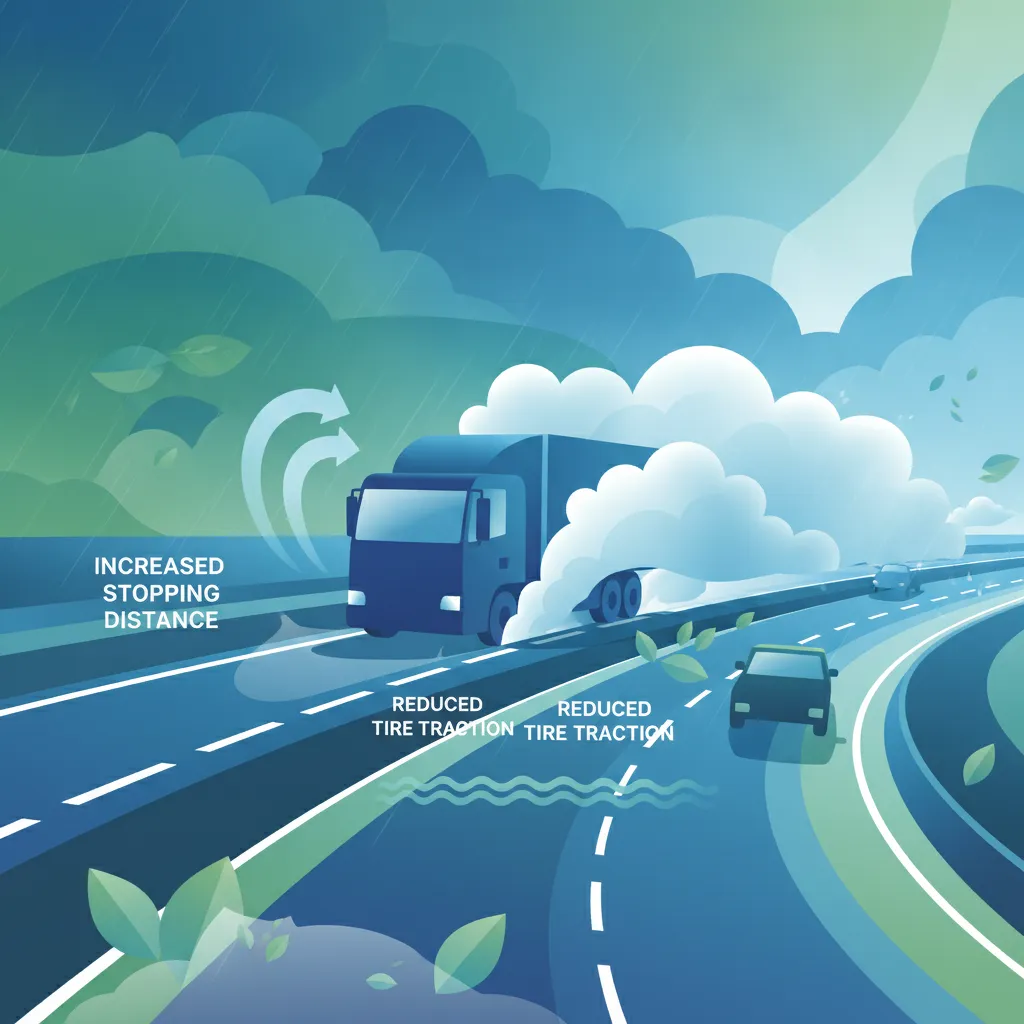
This lesson details how different adverse weather conditions uniquely affect the handling and stability of a heavy goods vehicle. It covers the increased stopping distances in rain, reduced visibility in fog, severe traction loss on ice, and the dangerous effect of strong crosswinds on high-sided vehicles. You will learn specific techniques for adjusting speed, increasing following distances, and using vehicle controls smoothly to maintain safety in challenging weather.
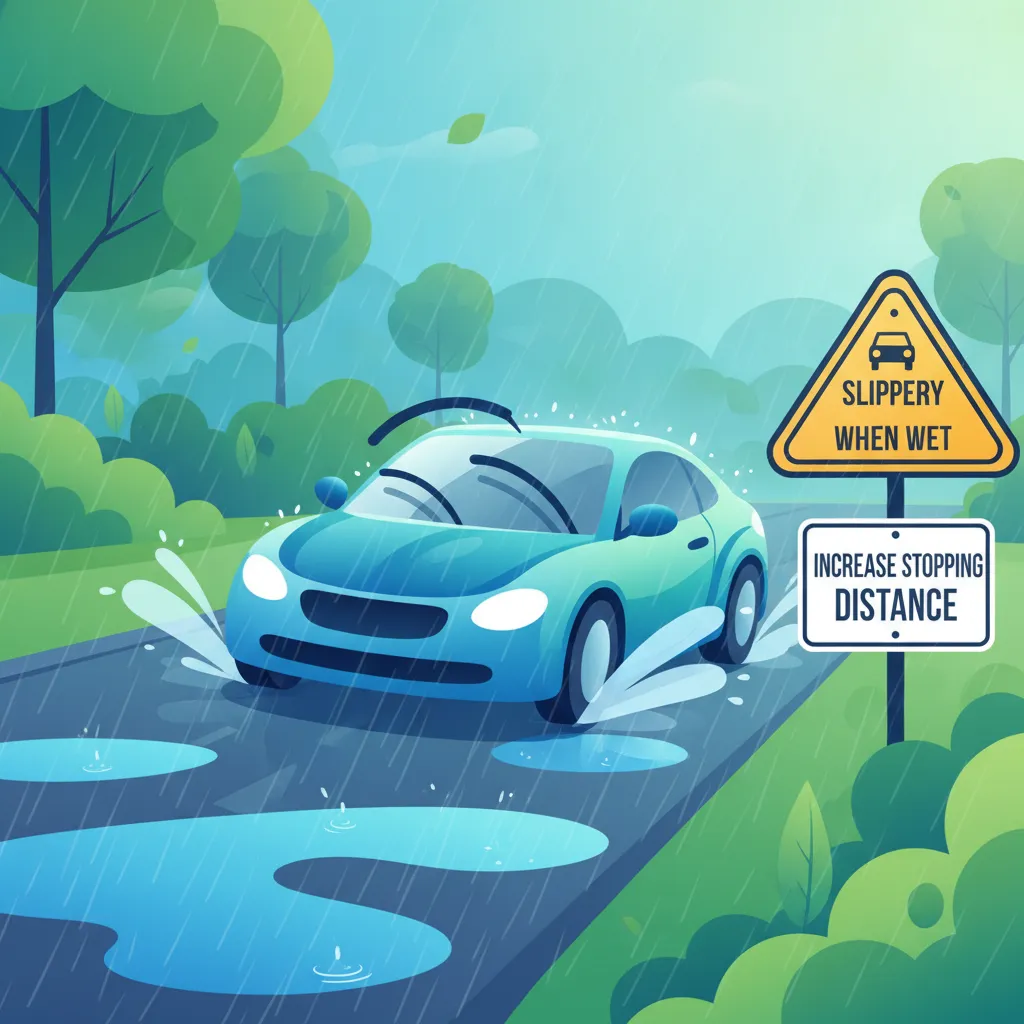
This lesson explains how different weather conditions impact the handling and stability of a large passenger vehicle. It covers the risks of aquaplaning in heavy rain, the effect of high winds on vehicle stability, and the severe reduction in visibility caused by fog. Learners will understand how ice and snow dramatically increase stopping distances and require extremely gentle control inputs to prevent skidding. Strategies for adapting speed and increasing following distances are emphasized.

This lesson provides essential advice for driving when weather conditions are poor. It explains how rain can cause aquaplaning and why you must double your following distance. You will also learn techniques for driving in icy conditions, including gentle use of controls to avoid skidding, and the correct use of lights in fog.
This lesson provides essential advice for riding safely in adverse weather conditions that reduce tyre grip. You will learn how rain, ice, and wet leaves dramatically increase braking distances and affect handling. Key strategies covered include reducing speed, increasing following distances, making smooth control inputs, and anticipating slippery areas to maintain control and avoid skidding on compromised road surfaces.

This lesson reinforces the vital safety rule of maintaining an adequate following distance from the vehicle ahead. It explains why the standard 'two-second rule' must be extended for heavy vehicles, especially in poor weather or when heavily laden, to account for longer stopping distances. You will learn practical methods for judging a safe gap in various traffic situations, creating a crucial safety buffer to react to unforeseen hazards.

This lesson focuses on the specific rules and best practices for driving HGVs on motorways in Great Britain. It covers mandatory speed limits for goods vehicles, lane discipline including restrictions on using the outside lane, and procedures for safely joining and leaving the motorway. The lesson also includes up-to-date information on driving on smart motorways, including understanding the signs and using emergency refuge areas correctly.

This lesson explains the functions and legal requirements for all exterior vehicle lights. You will learn when it is appropriate to use dipped and main beam headlights, the specific conditions for using fog lights, and the correct application of hazard warning lights. Proper use of lighting is vital for seeing and being seen by other road users.

This lesson addresses the unique challenges of operating a large goods vehicle in congested urban and city environments. It focuses on techniques for navigating narrow streets, making tight turns, and safely accessing delivery points while being highly aware of vulnerable road users like pedestrians and cyclists. The importance of exceptional observation, low-speed control, and clear communication with other road users is heavily emphasized to minimize risk in these complex settings.
Understand the common errors and risks associated with driving heavy goods vehicles in adverse weather. Learn how to avoid them to maintain safety and control on wet, icy, or windy roads.
This lesson details how different adverse weather conditions uniquely affect the handling and stability of a heavy goods vehicle. It covers the increased stopping distances in rain, reduced visibility in fog, severe traction loss on ice, and the dangerous effect of strong crosswinds on high-sided vehicles. You will learn specific techniques for adjusting speed, increasing following distances, and using vehicle controls smoothly to maintain safety in challenging weather.
This lesson provides essential advice for driving when weather conditions are poor. It explains how rain can cause aquaplaning and why you must double your following distance. You will also learn techniques for driving in icy conditions, including gentle use of controls to avoid skidding, and the correct use of lights in fog.
This lesson explains how different weather conditions impact the handling and stability of a large passenger vehicle. It covers the risks of aquaplaning in heavy rain, the effect of high winds on vehicle stability, and the severe reduction in visibility caused by fog. Learners will understand how ice and snow dramatically increase stopping distances and require extremely gentle control inputs to prevent skidding. Strategies for adapting speed and increasing following distances are emphasized.
This lesson explains the functions and legal requirements for all exterior vehicle lights. You will learn when it is appropriate to use dipped and main beam headlights, the specific conditions for using fog lights, and the correct application of hazard warning lights. Proper use of lighting is vital for seeing and being seen by other road users.
This lesson reinforces the vital safety rule of maintaining an adequate following distance from the vehicle ahead. It explains why the standard 'two-second rule' must be extended for heavy vehicles, especially in poor weather or when heavily laden, to account for longer stopping distances. You will learn practical methods for judging a safe gap in various traffic situations, creating a crucial safety buffer to react to unforeseen hazards.
This lesson provides essential advice for riding safely in adverse weather conditions that reduce tyre grip. You will learn how rain, ice, and wet leaves dramatically increase braking distances and affect handling. Key strategies covered include reducing speed, increasing following distances, making smooth control inputs, and anticipating slippery areas to maintain control and avoid skidding on compromised road surfaces.
This lesson focuses on the specific rules and best practices for driving HGVs on motorways in Great Britain. It covers mandatory speed limits for goods vehicles, lane discipline including restrictions on using the outside lane, and procedures for safely joining and leaving the motorway. The lesson also includes up-to-date information on driving on smart motorways, including understanding the signs and using emergency refuge areas correctly.

This lesson addresses the unique challenges of driving a large vehicle on rural roads. It provides techniques for positioning the vehicle through sharp bends and on narrow lanes, and for safely navigating unmarked or uncontrolled junctions. Learners will be taught to anticipate hidden hazards common in the countryside, such as slow-moving farm vehicles, animals on the road, and concealed entrances. The correct use of passing places and strategies for meeting oncoming traffic are also covered.
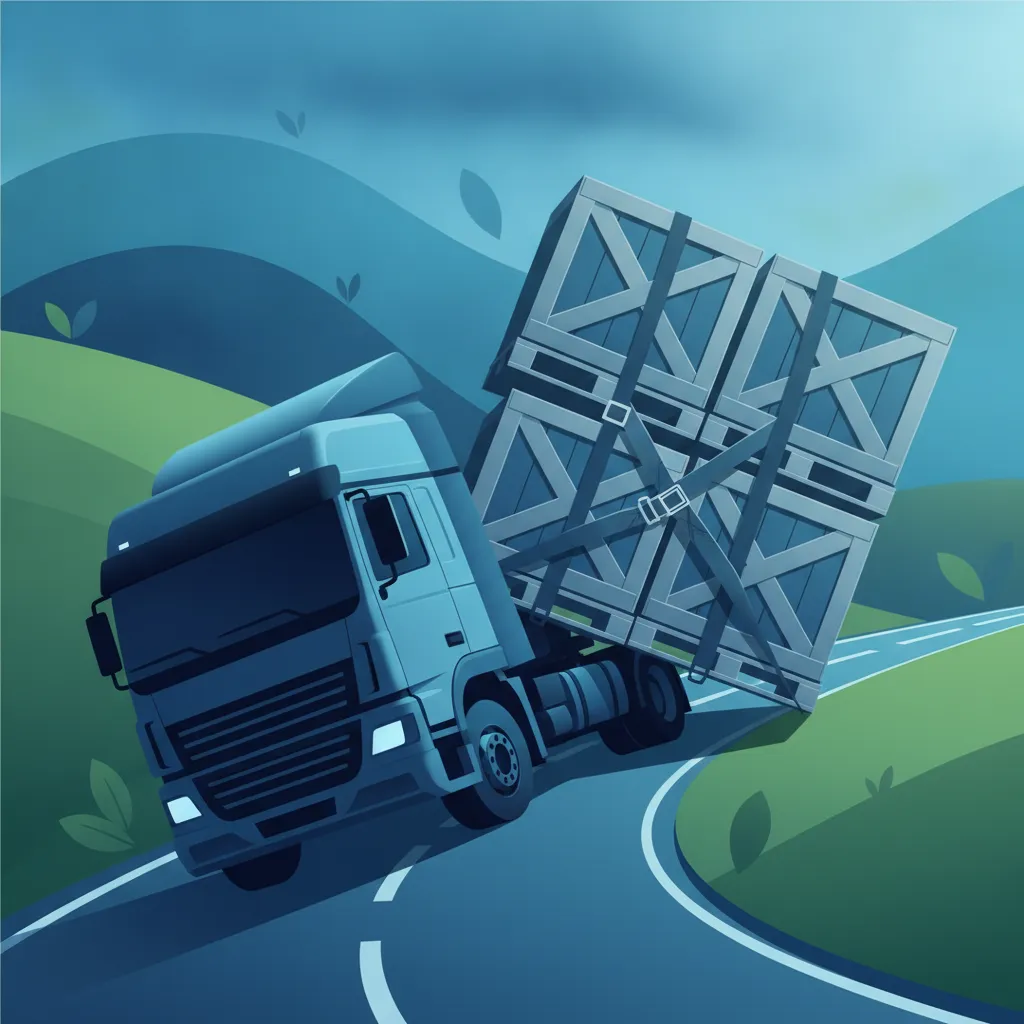
This lesson covers the principles of safe loading to prevent items from shifting or falling and causing a hazard. It explains that any load must be securely fastened and must not obstruct your view. You will also learn how overloading or distributing weight incorrectly can dangerously affect the vehicle's steering, braking, and overall stability.
Find clear answers to common questions learners have about Managing Heavy Vehicle Dynamics in Adverse Conditions. Learn how the lesson is structured, which driving theory objectives it supports, and how it fits into the overall learning path of units and curriculum progression in Great Britain. These explanations help you understand key concepts, lesson flow, and exam focused study goals.
While large vehicles have more weight to press tyres onto the road, the increased surface area of the tyres and speed can still lead to a total loss of grip. Once a heavy vehicle begins to aquaplane, the massive momentum makes it significantly harder to regain steering control compared to a car.
ESC systems detect when a vehicle is losing directional control and automatically apply individual brakes or reduce engine power to help keep you on your intended path. It is a vital safety aid, but it does not override the laws of physics if your speed is inappropriate for the road conditions.
When driving in high winds, you must reduce your speed and keep a firm grip on the steering wheel, anticipating gusts especially when exiting tunnels or passing large structures. Be extra cautious when your vehicle is lightly loaded, as the larger side profile makes you more susceptible to being blown off course.
Using powerful engine braking or retarders on very slippery surfaces like black ice can sometimes cause the drive wheels to lose traction, leading to a jack-knife situation. You should be cautious and ensure your speed is adjusted well in advance.
Dive into our comprehensive question bank to find exactly what you need for your Great Britain theory test. Use our advanced filters to pinpoint specific subjects or test your knowledge on challenging areas, ensuring you're fully prepared for success.