
This lesson provides critical instruction on managing the momentum of heavy goods vehicles on steep inclines and descents. You will learn to use auxiliary braking systems and proper gear selection to maintain vehicle control and prevent brake fade, which is a key component of your professional Category C training.
Lesson content overview
Driving a heavy goods vehicle (HGV) presents unique challenges, especially when navigating steep inclines and descents. The sheer mass and momentum of a Category C vehicle demand advanced driving techniques to maintain control, prevent accidents, and ensure the longevity of critical components. This lesson delves into the principles of gradient control, the effective use of engine braking and auxiliary retarders, and strategic gear selection for safe and efficient operation on varying road slopes. Mastering these techniques is fundamental for any professional goods vehicle driver in Great Britain.
A gradient refers to the slope or steepness of a road, commonly expressed as a percentage or in degrees. A positive gradient indicates an uphill climb, while a negative gradient signifies a downhill descent. For heavy vehicles, even seemingly gentle gradients can significantly impact speed, braking effectiveness, and fuel consumption.
The slope of a road, indicating its steepness, expressed as a percentage (rise over run multiplied by 100) or in degrees. Positive gradients are uphill, and negative gradients are downhill.
Understanding gradient assessment is the first step towards safe control. Drivers must recognize the length and steepness of an upcoming incline or decline to anticipate the required adjustments to speed and gear. Neglecting to assess gradients properly can lead to a loss of momentum uphill or dangerous acceleration downhill, potentially resulting in critical safety issues.
The primary concern when descending a gradient in a heavy goods vehicle is the risk of brake fade. This occurs when continuous application of the service brakes causes them to overheat, leading to a significant reduction or complete loss of braking efficiency. The substantial weight of HGVs means they build up kinetic energy rapidly on descents, placing immense strain on the braking system.
Proper gradient control prevents brake fade by distributing the braking effort across the engine and dedicated auxiliary systems, thereby preserving the service brakes for emergency stops. It also ensures vehicle stability, prevents excessive wear on brake components, and allows the driver to maintain safe stopping distances under all conditions. For Category C licence holders, this proactive management is not just a best practice; it's a critical safety requirement.
While service brakes are crucial for bringing a vehicle to a stop, they are not designed for continuous speed control on long or steep descents. Relying solely on service brakes in such situations can quickly lead to overheating and a dangerous loss of braking power. This is where auxiliary braking systems, particularly engine braking and retarders, become indispensable for heavy goods vehicles.
Service brakes operate by creating friction between brake pads and discs (or shoes and drums) to convert the vehicle's kinetic energy into heat. While effective for slowing and stopping, their heat dissipation capacity is limited. On a long downhill, constant use can cause the brake components to reach extremely high temperatures, leading to brake fade and even mechanical failure.
Auxiliary braking systems, on the other hand, are designed to supplement or reduce the load on the service brakes. They use different mechanisms to slow the vehicle, allowing the service brakes to remain cool and ready for when they are truly needed. Integrating these systems into your driving strategy ensures a layered approach to speed control, significantly enhancing safety and vehicle longevity.
Engine braking, also known as compression braking, uses the engine's natural resistance to slow the vehicle. When the driver lifts off the accelerator while the vehicle is in gear, the engine acts as a compressor, drawing air in and compressing it. The energy required to do this slows the crankshaft, and thus the vehicle, without relying on the service brakes.
This technique is most effective in lower gears, where the engine's revolutions per minute (RPM) are higher, generating more resistance. For diesel engines, specialized compression brakes (often referred to as "Jake brakes" after a prominent manufacturer) enhance this effect by opening exhaust valves at the top of the compression stroke, releasing compressed air and preventing power generation. This creates a powerful braking force independent of the service brakes.
A braking technique that utilises the engine's internal resistance to slow a vehicle, typically by downshifting to a lower gear or by employing a compression release mechanism.
While highly effective, compression brakes can be noisy. Consequently, their use is often prohibited in residential areas or other noise-sensitive zones. Drivers must always look out for signage indicating such restrictions.
Retarders are dedicated auxiliary braking devices designed specifically for heavy vehicles to provide continuous speed control without using the service brakes. They convert kinetic energy into heat in a controlled manner, preventing overheating of the main braking system.
An auxiliary braking device, separate from the service brakes, that provides continuous deceleration for heavy vehicles by converting kinetic energy into heat, often used on long descents.
Several types of retarders are commonly found on Category C vehicles:
An exhaust brake works by creating back pressure in the engine's exhaust system. A valve in the exhaust manifold closes, restricting the flow of exhaust gases. This restriction increases pressure within the cylinders, which in turn creates resistance against the engine's pistons, slowing the crankshaft and thus the vehicle. Exhaust brakes are generally less powerful than compression brakes or hydraulic retarders but are effective for moderate descents or to maintain speed.
As mentioned, compression brakes (often generically called "Jake brakes") are a more advanced form of engine brake. They operate by altering the engine's valve timing to turn the power-producing diesel engine cylinders into power-absorbing air compressors. This process provides substantial braking force, particularly at higher engine RPMs, making them highly effective on steep descents. Due to their noise output, drivers must be vigilant for "No Engine Brake" signs.
Hydraulic retarders use fluid resistance to slow the vehicle. They typically consist of a rotor and a stator within a casing filled with oil. When activated, the oil is pumped into the casing, and the rotation of the rotor through the oil creates resistance, converting kinetic energy into heat within the fluid. This heat is then dissipated through a cooling system. Hydraulic retarders offer smooth, powerful, and continuous braking, making them ideal for long and severe descents. Many modern HGVs are equipped with them due to their efficiency and controlled operation.
When using any type of retarder, it is crucial to monitor any associated temperature gauges. Overheating a retarder can lead to a loss of its effectiveness or even damage to the unit. Always consult your vehicle's manufacturer guidelines for proper operation and monitoring.
Gear selection is a fundamental aspect of gradient control for heavy goods vehicles, impacting both ascending and descending performance. Choosing the correct gear ensures the engine operates within its optimal RPM range, providing the necessary power for climbs or the crucial resistance for descents.
When approaching an uphill gradient, especially with a heavy load, anticipate the need for a lower gear. Selecting a lower gear (higher gear ratio) increases the torque delivered to the drive wheels, allowing the engine to maintain momentum without struggling or stalling. If the vehicle's speed begins to drop significantly in a higher gear, it indicates that the engine is not producing enough torque, and an earlier downshift would have been beneficial.
For effective climbing, aim to keep the engine RPMs within its power band (typically 1200–1800 rpm for diesel HGVs). Downshift proactively as the vehicle approaches the incline, rather than waiting for it to lose significant speed.
Over-revving the engine by staying in too low a gear can waste fuel and cause unnecessary wear. Conversely, letting the engine "lug" (operate at too low an RPM in too high a gear) can strain components and lead to a loss of power. Smooth, timely gear changes are essential for efficient and safe ascending.
The principle of "use the same gear going down as you would going up" is a good rule of thumb for heavy vehicles on descents. By selecting a low gear, you maximize the engine's resistance, effectively using the engine as a brake. This technique significantly reduces the burden on the service brakes.
The gear chosen should be low enough to keep the vehicle's speed under control without requiring constant service brake application, yet not so low as to cause the engine to over-rev. Drivers should select this gear before commencing the descent, while the vehicle is still on level ground or at the very beginning of the slope. This allows for a controlled entry into the gradient at a safe speed.
For vehicles with manual transmissions, rev matching is a crucial skill, particularly when downshifting on gradients. Rev matching involves briefly increasing engine RPM to match the rotational speed of the transmission input shaft with the output shaft speed before engaging the clutch. This synchronizes engine speed with road speed in the new, lower gear, resulting in a smooth shift.
Without rev matching, a sudden downshift can cause a jolt to the drivetrain, potential loss of traction (especially on slippery surfaces), and increased wear on the clutch and transmission. Practising smooth, rev-matched downshifts ensures better vehicle control and prolongs the life of mechanical components.
Effective speed management on gradients is about anticipation, planning, and continuous adjustment. It involves more than just reacting to the gradient; it requires a proactive strategy to maintain safety and control at all times.
One of the most critical aspects of gradient speed management is to reduce your speed before entering a long or steep descent. Once a heavy vehicle gains momentum on a downhill, it becomes significantly harder to slow down, and the risk of brake fade increases rapidly.
Before the descent, use your service brakes and auxiliary systems (if appropriate) to bring the vehicle's speed down to a level that can be safely maintained primarily by engine braking and retarders. This initial speed reduction sets you up for a controlled and safe descent, preventing the need for heavy, continuous service brake application.
Many steep or challenging gradients, particularly on rural or mountain roads, will feature advisory speed limits. These are recommended maximum speeds for safely navigating the specific conditions of the gradient. While often not legally enforceable by speed cameras unless accompanied by statutory speed limit signs, they represent expert assessment of safe speeds for heavy vehicles.
A recommended maximum speed for a specific road section or condition, such as a steep gradient, intended to enhance safety but not legally binding unless explicitly enforced by a statutory sign or camera.
Professional drivers should treat advisory speed limits with the utmost respect. Disregarding them significantly increases the risk of losing control, especially if unexpected hazards arise or road conditions deteriorate. Always adjust your speed to conditions, even if it means driving slower than the advisory limit.
Preventing brake fade is paramount for safety on gradients. The key lies in minimizing the use of service brakes for sustained deceleration. Here are essential techniques:
Operating a Category C vehicle safely on gradients in Great Britain involves adhering to specific legal requirements and guidelines. These regulations are designed to ensure public safety, minimize environmental impact, and maintain road infrastructure.
The UK Highway Code provides essential guidance for all drivers, with specific implications for heavy goods vehicles.
As noted earlier, certain types of engine brakes, particularly compression release brakes (Jake brakes), can generate considerable noise. Local authorities in Great Britain may impose restrictions on their use in noise-sensitive areas, such as residential zones, near schools, or hospitals. These restrictions are typically indicated by specific road signs.
Ignoring a "No Engine Brake" sign is a violation of local regulations and can result in fines and penalties. Drivers must be aware of their vehicle's auxiliary braking capabilities and the specific rules governing their use in different environments. When in a restricted zone, rely on judicious gear selection and intermittent service braking to control your speed.
The Road Vehicles (Construction and Use) Regulations 1986 and subsequent DVSA guidelines mandate that all vehicle components, including auxiliary braking systems, must be in good working order. Regular maintenance and pre-journey checks are crucial. This includes:
A faulty auxiliary braking system can compromise your ability to control the vehicle safely on gradients. Any defects should be reported and rectified immediately.
Gradient control is rarely performed in isolation; it must be adapted to a variety of real-world conditions. Factors such as weather, vehicle load, and the presence of other road users all influence the optimal strategy.
Wet, icy, or snowy conditions significantly reduce tyre grip and braking effectiveness. On gradients, this demands even greater caution:
A fully loaded HGV has significantly more kinetic energy and inertia than an empty one. This amplifies the challenges of gradient control:
Your gradient control strategy must also consider the environment:
Understanding common pitfalls can help professional drivers avoid dangerous situations and legal repercussions when driving on gradients. Adopting best practices ensures safe, efficient, and compliant operation of Category C vehicles.
A prevalent mistake is relying solely on service brakes for prolonged periods on long, steep descents. This inevitably leads to brake fade, which significantly extends stopping distances and can result in a complete loss of braking ability. Best Practice: Always engage engine braking and auxiliary retarders proactively to manage speed. Use service brakes only for brief, firm applications followed by full release to allow cooling.
Another error is entering a descent at too high a speed, forcing aggressive and continuous braking. Best Practice: Assess the gradient's steepness and length well in advance, and reduce your speed to a safe, controlled level before starting the descent.
Ignoring "No Engine Brake" signs in noise-sensitive zones is a common violation. This not only causes disturbance to residents but can also lead to fixed penalty notices and potential prosecution. Best Practice: Always observe road signage restricting engine brake use. In such areas, control your speed using gear selection and intermittent service braking.
Failure to adhere to advisory speed limits on steep descents, even if not strictly enforced by cameras, is also a serious error. While not always directly illegal, it shows a disregard for safety guidance and dramatically increases accident risk. Best Practice: Treat advisory speed limits as mandatory for safe operation, especially with a heavy vehicle.
Improper gear selection, such as over-revving the engine during a downshift, can cause excessive strain on the drivetrain and potentially lead to a loss of traction, especially on slippery surfaces. Best Practice: Master rev-matching techniques for manual transmissions to ensure smooth, controlled downshifts. Maintain engine RPMs within the manufacturer's recommended operating range.
Neglecting load distribution can exacerbate instability, particularly when descending. A poorly secured or unevenly distributed load can shift, affecting the vehicle's centre of gravity and increasing the risk of jackknifing or rollover. Best Practice: Always ensure your cargo is properly secured and evenly distributed across the axles before commencing any journey, especially one involving significant gradients.
Continuous monitoring of your vehicle's behaviour, brake temperatures, and engine RPMs is crucial. Never assume your vehicle will perform identically across different gradients or under varying load and weather conditions.
Gradient control for heavy goods vehicles requires understanding how auxiliary braking systems manage kinetic energy on steep inclines and descents. Engine braking and retarders reduce reliance on service brakes, preventing dangerous brake fade through compression release, exhaust restriction, or hydraulic resistance mechanisms. Strategic gear selection maintains engine resistance while rev matching ensures smooth manual transmission operation during downshifts. Drivers must comply with Highway Code rules, observe noise-sensitive zone restrictions, and treat advisory speed limits as mandatory safety guidance. Heavy vehicle operators must account for load conditions, weather factors, and road characteristics when managing gradient control.
A short set of high-value points that capture the most important learning from this lesson.
Engine braking and retarders are your primary tools for controlling speed on descents, preserving service brakes for emergencies
Select the same gear going down as you would going up to maximise engine resistance and vehicle control
Reduce speed before entering a steep descent, not during it, to prevent dangerous momentum buildup
Three main types of retarders (exhaust, compression/Jake brake, hydraulic) provide different levels of braking force for varying gradient severity
Always obey 'No Engine Brake' signs in noise-sensitive areas like residential zones and near hospitals
Explore all units and lessons included in this driving theory course.
Brake fade is caused by continuous service brake use on descents, leading to loss of stopping power due to overheating
Rev matching synchronises engine speed with wheel speed during downshifts to prevent drivetrain jolt and traction loss
A loaded HGV builds more kinetic energy and requires earlier braking initiation than an empty vehicle
Advisory speed limits on steep gradients represent expert safety guidance even when not legally enforced
Compression brakes can cause drive-wheel lockup on slippery surfaces due to aggressive torque
Relying solely on service brakes for prolonged descent control, which leads to brake fade and dangerous loss of braking
Entering a descent at excessive speed, making speed reduction harder and accelerating brake overheating
Disregarding 'No Engine Brake' signs, which violates local noise regulations and can result in fines
Downshifting without rev matching, causing drivetrain stress, traction loss, and increased wear on components
Failing to assess gradient length and steepness in advance, resulting in inadequate preparation for the descent
Lesson content overview
A short set of high-value points that capture the most important learning from this lesson.
Engine braking and retarders are your primary tools for controlling speed on descents, preserving service brakes for emergencies
Select the same gear going down as you would going up to maximise engine resistance and vehicle control
Reduce speed before entering a steep descent, not during it, to prevent dangerous momentum buildup
Three main types of retarders (exhaust, compression/Jake brake, hydraulic) provide different levels of braking force for varying gradient severity
Always obey 'No Engine Brake' signs in noise-sensitive areas like residential zones and near hospitals
Explore all units and lessons included in this driving theory course.
Brake fade is caused by continuous service brake use on descents, leading to loss of stopping power due to overheating
Rev matching synchronises engine speed with wheel speed during downshifts to prevent drivetrain jolt and traction loss
A loaded HGV builds more kinetic energy and requires earlier braking initiation than an empty vehicle
Advisory speed limits on steep gradients represent expert safety guidance even when not legally enforced
Compression brakes can cause drive-wheel lockup on slippery surfaces due to aggressive torque
Relying solely on service brakes for prolonged descent control, which leads to brake fade and dangerous loss of braking
Entering a descent at excessive speed, making speed reduction harder and accelerating brake overheating
Disregarding 'No Engine Brake' signs, which violates local noise regulations and can result in fines
Downshifting without rev matching, causing drivetrain stress, traction loss, and increased wear on components
Failing to assess gradient length and steepness in advance, resulting in inadequate preparation for the descent
Explore search topics learners often look for when studying Gradient Control and Engine Braking. These topics reflect common questions about road rules, driving situations, safety guidance, and lesson level theory preparation for learners in Great Britain.
Browse additional driving theory lessons that cover connected traffic rules, road signs, and common driving situations related to this topic. Improve your understanding of how different rules interact across everyday traffic scenarios.
Explore the specific challenges and techniques for controlling heavy goods vehicles on steep gradients during adverse weather such as rain, ice, or snow. Understand how to adapt braking, speed, and gear selection for safety on challenging Great Britain roads.

This lesson equips drivers with strategies for maintaining control of a heavy vehicle during adverse weather conditions like heavy rain, ice, snow, and strong crosswinds. It covers the physics of traction loss, aquaplaning, and skidding, and explains how to use smooth inputs for steering, acceleration, and braking. The function of electronic stability control systems and other driver aids is also discussed as part of a proactive approach to safety in challenging environments.

This lesson details how different adverse weather conditions uniquely affect the handling and stability of a heavy goods vehicle. It covers the increased stopping distances in rain, reduced visibility in fog, severe traction loss on ice, and the dangerous effect of strong crosswinds on high-sided vehicles. You will learn specific techniques for adjusting speed, increasing following distances, and using vehicle controls smoothly to maintain safety in challenging weather.

This lesson provides essential advice for driving when weather conditions are poor. It explains how rain can cause aquaplaning and why you must double your following distance. You will also learn techniques for driving in icy conditions, including gentle use of controls to avoid skidding, and the correct use of lights in fog.
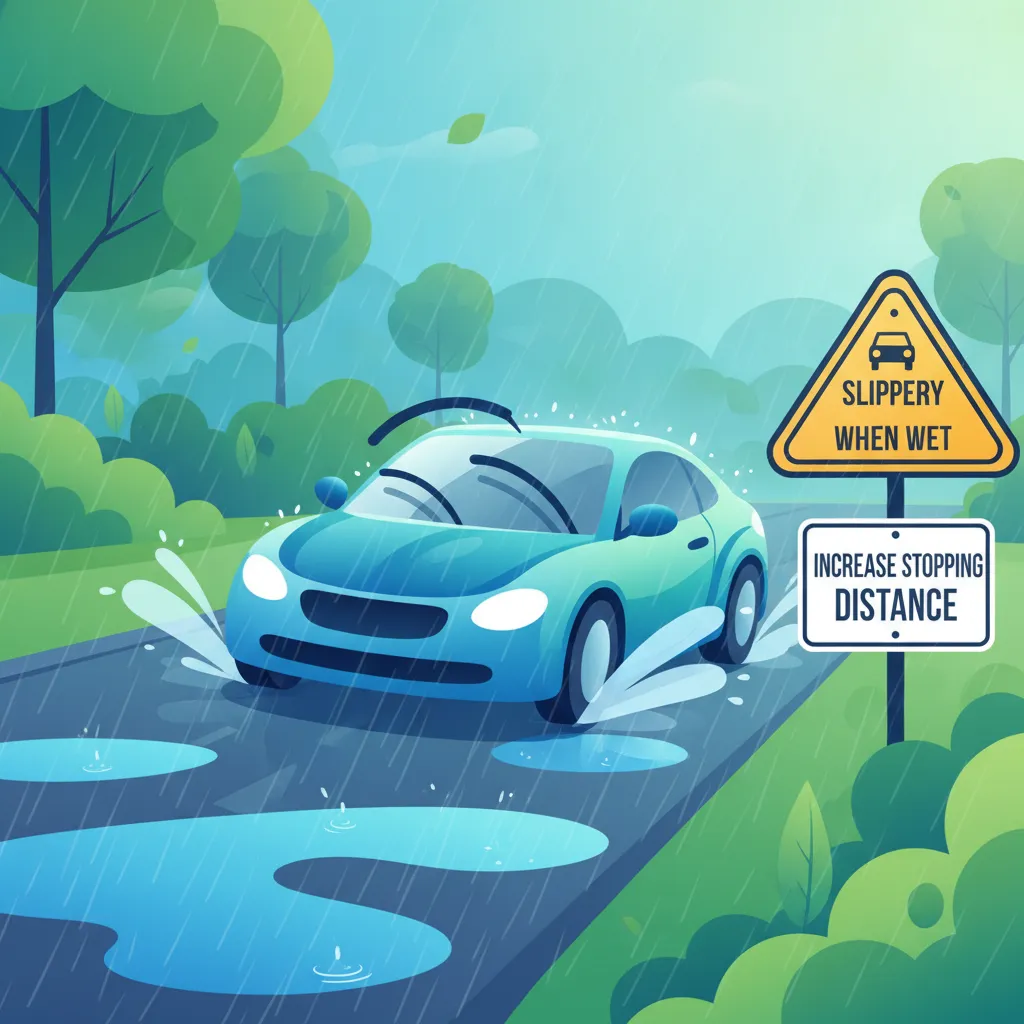
This lesson explains how different weather conditions impact the handling and stability of a large passenger vehicle. It covers the risks of aquaplaning in heavy rain, the effect of high winds on vehicle stability, and the severe reduction in visibility caused by fog. Learners will understand how ice and snow dramatically increase stopping distances and require extremely gentle control inputs to prevent skidding. Strategies for adapting speed and increasing following distances are emphasized.
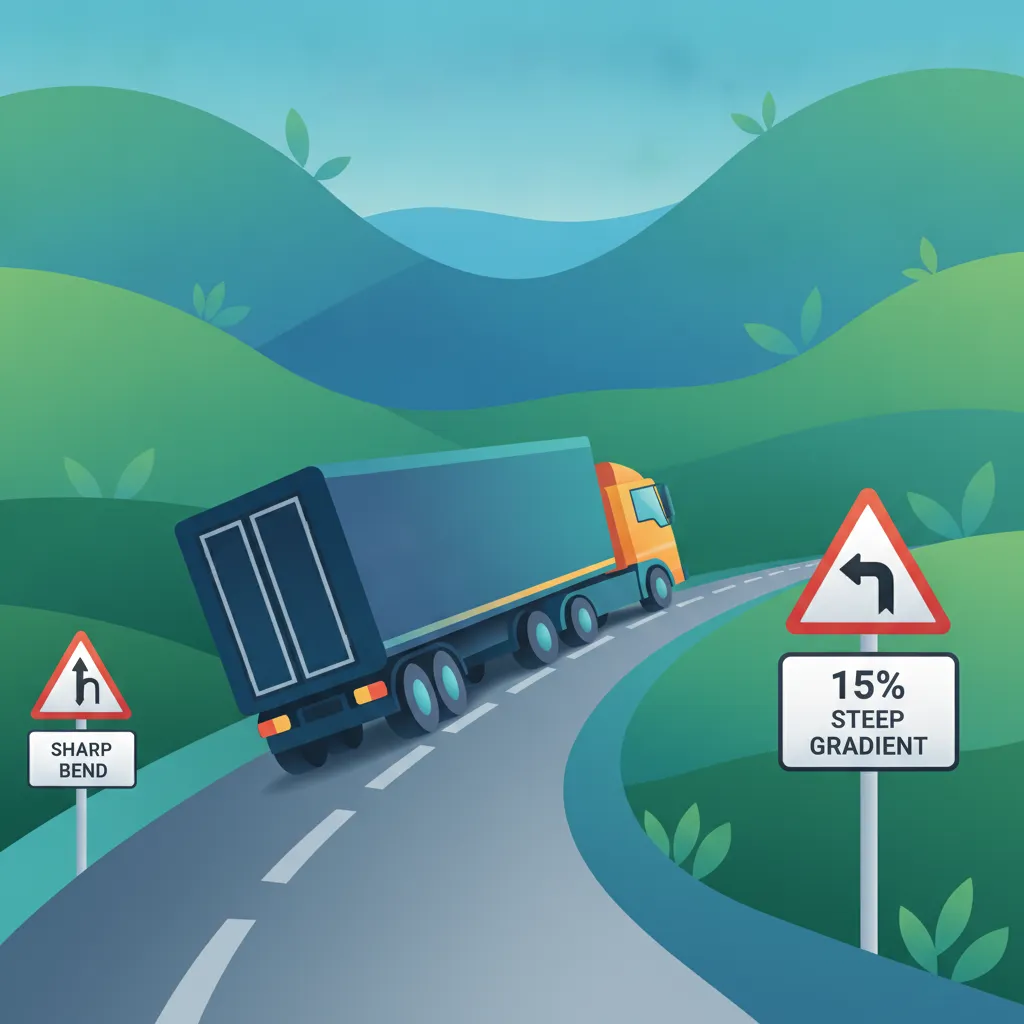
This lesson focuses on the principles of effective speed management for heavy goods vehicles, which extends beyond simply obeying the statutory speed limits. It covers how to adapt speed based on vehicle weight, load stability, road gradients, and prevailing traffic and weather conditions. You will also learn about the function of mandatory speed limiters and how intelligent use of speed and cruise control can significantly improve fuel efficiency and safety.
This lesson provides essential advice for riding safely in adverse weather conditions that reduce tyre grip. You will learn how rain, ice, and wet leaves dramatically increase braking distances and affect handling. Key strategies covered include reducing speed, increasing following distances, making smooth control inputs, and anticipating slippery areas to maintain control and avoid skidding on compromised road surfaces.
Learn about typical errors drivers make when managing steep gradients with heavy goods vehicles. Understand how to avoid brake fade, maintain vehicle stability, and ensure legal compliance on inclines and declines in Great Britain, focusing on theoretical understanding.

This lesson reinforces the vital safety rule of maintaining an adequate following distance from the vehicle ahead. It explains why the standard 'two-second rule' must be extended for heavy vehicles, especially in poor weather or when heavily laden, to account for longer stopping distances. You will learn practical methods for judging a safe gap in various traffic situations, creating a crucial safety buffer to react to unforeseen hazards.
This lesson equips drivers with strategies for maintaining control of a heavy vehicle during adverse weather conditions like heavy rain, ice, snow, and strong crosswinds. It covers the physics of traction loss, aquaplaning, and skidding, and explains how to use smooth inputs for steering, acceleration, and braking. The function of electronic stability control systems and other driver aids is also discussed as part of a proactive approach to safety in challenging environments.
This lesson focuses on the principles of effective speed management for heavy goods vehicles, which extends beyond simply obeying the statutory speed limits. It covers how to adapt speed based on vehicle weight, load stability, road gradients, and prevailing traffic and weather conditions. You will also learn about the function of mandatory speed limiters and how intelligent use of speed and cruise control can significantly improve fuel efficiency and safety.
This lesson details how different adverse weather conditions uniquely affect the handling and stability of a heavy goods vehicle. It covers the increased stopping distances in rain, reduced visibility in fog, severe traction loss on ice, and the dangerous effect of strong crosswinds on high-sided vehicles. You will learn specific techniques for adjusting speed, increasing following distances, and using vehicle controls smoothly to maintain safety in challenging weather.
This lesson explains the critical concept of the centre of gravity (CG) and its direct impact on a vehicle's stability and rollover risk. It details how high or unstable loads raise the CG, making the vehicle more susceptible to tipping during cornering or sudden maneuvers. Learners will study techniques to assess and manage this risk, including adjusting speed and driving style, which is especially important for vehicles carrying liquid or hanging loads.
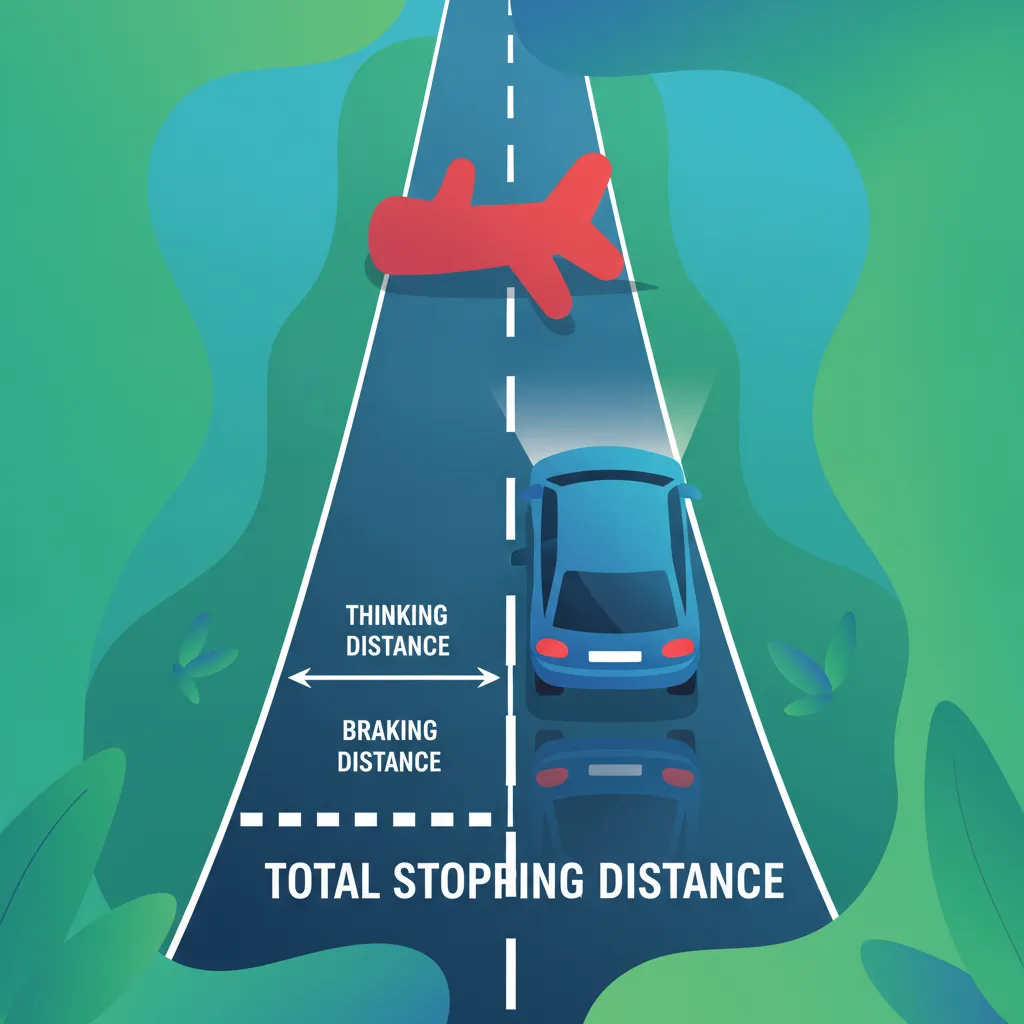
This lesson provides a detailed examination of the powerful air braking systems found on most heavy goods vehicles, including ABS and EBS. It explains the components of total stopping distance—thinking distance and braking distance—and how they are affected by speed, mass, and road conditions. The concept of brake fade, its causes, and prevention methods are also covered, along with the importance of regular brake inspections for maintaining safety.

This lesson provides a detailed map of the significant blind spots located to the front, sides, and rear of a typical heavy goods vehicle. It explains the purpose of the different classes of mirrors and how to adjust them correctly for maximum visibility. Learners will be taught effective scanning techniques—'mirror-signal-manoeuvre'—to actively check these zones before changing position, ensuring they are aware of any hidden hazards or other road users.

Reversing is one ofthe highest-risk maneuvers for an HGV driver. This lesson provides a structured guide to reversing safely, covering the 'get out and look' principle, effective use of all mirrors, and the use of reversing cameras and alarms. It stresses the importance of using a trained banksman (signaller) whenever possible, using agreed signals, and maintaining a slow, controlled speed throughout the maneuver to prevent accidents.

This lesson addresses the serious danger of driver fatigue, a major cause of incidents involving commercial vehicles. It details the complex EU and GB domestic rules on drivers' hours, including driving limits and required rest periods. Learners will be taught to recognize the physical and mental signs of fatigue and understand the importance of taking quality rest to maintain alertness and ensure their own safety and that of others.
This lesson covers the principles of safe loading to prevent items from shifting or falling and causing a hazard. It explains that any load must be securely fastened and must not obstruct your view. You will also learn how overloading or distributing weight incorrectly can dangerously affect the vehicle's steering, braking, and overall stability.
Find clear answers to common questions learners have about Gradient Control and Engine Braking. Learn how the lesson is structured, which driving theory objectives it supports, and how it fits into the overall learning path of units and curriculum progression in Great Britain. These explanations help you understand key concepts, lesson flow, and exam focused study goals.
Relying solely on service brakes causes them to overheat and eventually fail, a phenomenon known as brake fade. Auxiliary systems like engine brakes or retarders must be used to manage speed so the service brakes remain cool and effective for emergencies.
An engine brake, or exhaust brake, uses the engine's internal pressure to create resistance, slowing the vehicle without using the friction-based service brakes. It is a critical tool for maintaining a steady, safe speed on long descents.
Yes, you should always select a lower gear before reaching the top of a steep descent. This uses the engine's compression to help control speed and keeps the vehicle in a manageable state, reducing the need for constant braking.
Yes, the DVSA theory test often includes questions about vehicle technology and the correct use of retarders and engine brakes to ensure safe operation. Understanding these systems is vital for passing both your theory exam and your practical driving assessment.
Dive into our comprehensive question bank to find exactly what you need for your Great Britain theory test. Use our advanced filters to pinpoint specific subjects or test your knowledge on challenging areas, ensuring you're fully prepared for success.