Navigating road work on the Autobahn requires strict adherence to temporary guidance systems and reduced speed limits. This article breaks down the legal requirements for identifying lane closures, following orange Leitbaken, and understanding the high-risk transition zones where most accidents occur. Learn how to navigate these areas safely to avoid common mistakes in your theory exam and maintain compliance with the StVO.
Article content overview
Driving on the German Autobahn requires constant vigilance, especially when you encounter temporary traffic guidance systems. Construction zones, often referred to as "Baustellen," are a frequent reality on federal motorways. Navigating these areas safely and legally requires a solid understanding of how lane closures are implemented, what specific signs indicate, and how the interaction between permanent and temporary markings works.
When a lane closure is planned, German authorities employ a standardized system to alert drivers well in advance. You will often see overhead gantry signs displaying reduced speed limits that step down progressively, such as from 120 km/h to 100 km/h, then 80 km/h, and finally 60 km/h. Following these speed limits is mandatory, and they are frequently enforced by automated systems, including average speed cameras known as "Streckenradar."
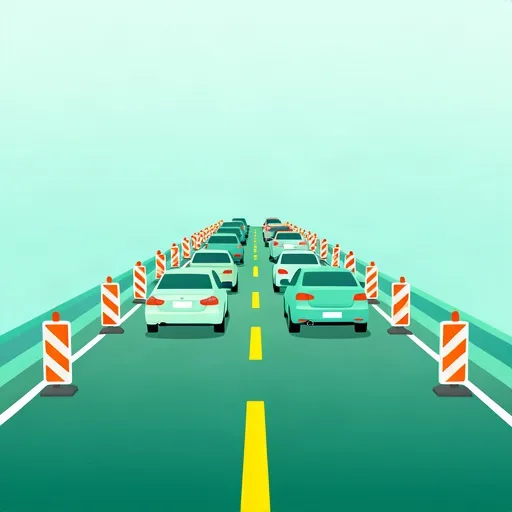
The most critical visual indicators in a construction zone are the orange Leitbaken. These are approximately one-meter-tall delineator posts with white reflective surfaces and orange warning stripes. Unlike permanent white lane markings, the orange lines and Leitbaken take precedence. When you see these orange markers, they define the legal lane. Driving outside of the area delineated by these markers—such as onto the hard shoulder or across the edge of the construction area—is strictly prohibited and extremely dangerous.
Statistical data confirms that the transition zone, where the full width of the road begins to narrow into the construction corridor, is the most high-risk area for accidents. Many drivers fail to anticipate the narrowing, leading to late braking or unsafe lane-changing maneuvers. As a learner, you must recognize this as a critical hazard perception scenario. Always reduce your speed early, increase your following distance, and prepare for potential sudden stops.
If you are merging into a reduced number of lanes, you must apply the "Reißverschlussverfahren," or zipper merging principle. This rule dictates that when a lane ends or is blocked, vehicles from the ending lane must be allowed to merge into the continuing lane one by one. This is not just a polite suggestion; it is a legal requirement that keeps traffic flowing smoothly and prevents the erratic lane changes that often cause collisions.
Drivers must activate their headlights when entering construction zones with narrow lanes or reduced visibility, even during daylight hours. This is required under §17 StVO, as the tight surroundings and potential for glare or low-light conditions in these corridors mimic tunnel-like environments.
In a construction zone, the space between the Leitbaken defines your legal driving path. If the lane is narrowed to a width that is barely wider than your vehicle, you must remain centered and avoid aggressive steering. In the event of a breakdown, you should try to steer your vehicle to a designated emergency bay, as the narrow shoulders in construction zones offer very little protection from passing traffic.
Understanding the difference between permanent and temporary markings is a core part of the theory exam. Remember that orange markings always override permanent white ones. If you are ever in doubt about the lane configuration, focus entirely on the orange guidance systems and the overhead gantry signals.
A mandatory merging rule where vehicles in an ending lane are allowed to join the main flow of traffic one by one at the point of the lane closure, alternating with vehicles in the continuing lane.
German construction zones use standardized temporary systems that override permanent road markings, with orange Leitbaken defining your legal driving path. Mandatory speed limits on overhead gantry signs step down progressively and are enforced by average speed cameras. The transition zone where lanes narrow is the most dangerous area, requiring early speed reduction and increased following distance. The zipper merging principle (Reißverschlussverfahren) is a legal requirement when lanes end, and headlights must be activated under StVO §17 even during daylight. Understanding these rules is essential for both theory exam success and safe real-world driving on German motorways.
A short set of high-value points that capture the most important ideas from this article.
Orange Leitbaken and temporary markings always take precedence over permanent white lane markings in construction zones
Progressive speed limits displayed on overhead gantry signs are mandatory and enforced by automated systems including Streckenradar
The transition zone where lanes narrow into the construction corridor is statistically the highest-risk area for accidents
The zipper merging principle (Reißverschlussverfahren) is a legal requirement, not optional, when lanes end
Headlights must be activated when entering construction zones under StVO §17, even during daylight hours
Leitbaken are orange and white delineator posts approximately one meter tall that define the legal driving path
When orange temporary markings conflict with permanent white lines, always follow the orange guidance
Speed reductions in construction zones typically step down progressively from 120 km/h through 100, 80, to 60 km/h
Reißverschlussverfahren requires alternating one-for-one merges at the exact point where the lane ends
In construction zones, the space between Leitbaken is your legal lane; driving outside this area is prohibited and dangerous
Driving outside the boundaries set by orange Leitbaken or using the hard shoulder in narrow zones
Reducing speed too late when approaching the transition zone, leading to emergency braking
Failing to activate headlights when entering construction zones, violating StVO §17
Attempting to merge early instead of using the zipper principle at the lane closure point
Ignoring overhead gantry signs that indicate lane closures and mandatory speed limits
Article content overview
A short set of high-value points that capture the most important ideas from this article.
Orange Leitbaken and temporary markings always take precedence over permanent white lane markings in construction zones
Progressive speed limits displayed on overhead gantry signs are mandatory and enforced by automated systems including Streckenradar
The transition zone where lanes narrow into the construction corridor is statistically the highest-risk area for accidents
The zipper merging principle (Reißverschlussverfahren) is a legal requirement, not optional, when lanes end
Headlights must be activated when entering construction zones under StVO §17, even during daylight hours
Leitbaken are orange and white delineator posts approximately one meter tall that define the legal driving path
When orange temporary markings conflict with permanent white lines, always follow the orange guidance
Speed reductions in construction zones typically step down progressively from 120 km/h through 100, 80, to 60 km/h
Reißverschlussverfahren requires alternating one-for-one merges at the exact point where the lane ends
In construction zones, the space between Leitbaken is your legal lane; driving outside this area is prohibited and dangerous
Driving outside the boundaries set by orange Leitbaken or using the hard shoulder in narrow zones
Reducing speed too late when approaching the transition zone, leading to emergency braking
Failing to activate headlights when entering construction zones, violating StVO §17
Attempting to merge early instead of using the zipper principle at the lane closure point
Ignoring overhead gantry signs that indicate lane closures and mandatory speed limits
Explore related topics, search based questions, and concepts that learners often look up when studying German Construction Zone Driving Rules. These themes reflect real search intent and help you understand how this topic connects to wider driving theory knowledge in Germany.
Find clear and practical answers to common questions learners often have about German Construction Zone Driving Rules. This section helps explain difficult points, remove confusion, and reinforce the key driving theory concepts that matter for learners in Germany.
Permanent road markings are white, whereas temporary markings used during construction work are orange. In a construction zone, the temporary orange markings take precedence over any existing white lines.
The Reißverschlussverfahren is a mandatory merging technique used when a lane ends. Drivers in the closing lane must merge into the adjacent lane one by one at the point of obstruction, like a zipper, to maintain traffic flow.
Yes, under §17 StVO, you must use your headlights if visibility is restricted, which is often the case in narrowed construction corridors with reduced lighting or tunnel-like conditions, even during daylight hours.
No. The orange Leitbaken define the legal traffic corridor. Driving outside these markers, such as on the hard shoulder or against the barrier, is prohibited and extremely dangerous.
Yes, temporary 'Streckenradar' or mobile speed cameras are frequently placed in construction zones to enforce lower speed limits throughout the entire length of the work site.
Didn't find what you were looking for? Continue your German driving theory preparation by exploring related articles, specific road sign categories, or in-depth guides on complex traffic situations. Deepen your understanding before the official test.