
Turning is a fundamental driving maneuver that requires careful attention to detail and coordination with your surroundings. In Germany, specific rules govern how drivers must observe, signal, position their vehicle, and yield to ensure safety, particularly at intersections where conflicts often arise with pedestrians and cyclists. This guide breaks down the process to help you execute turns correctly and confidently.
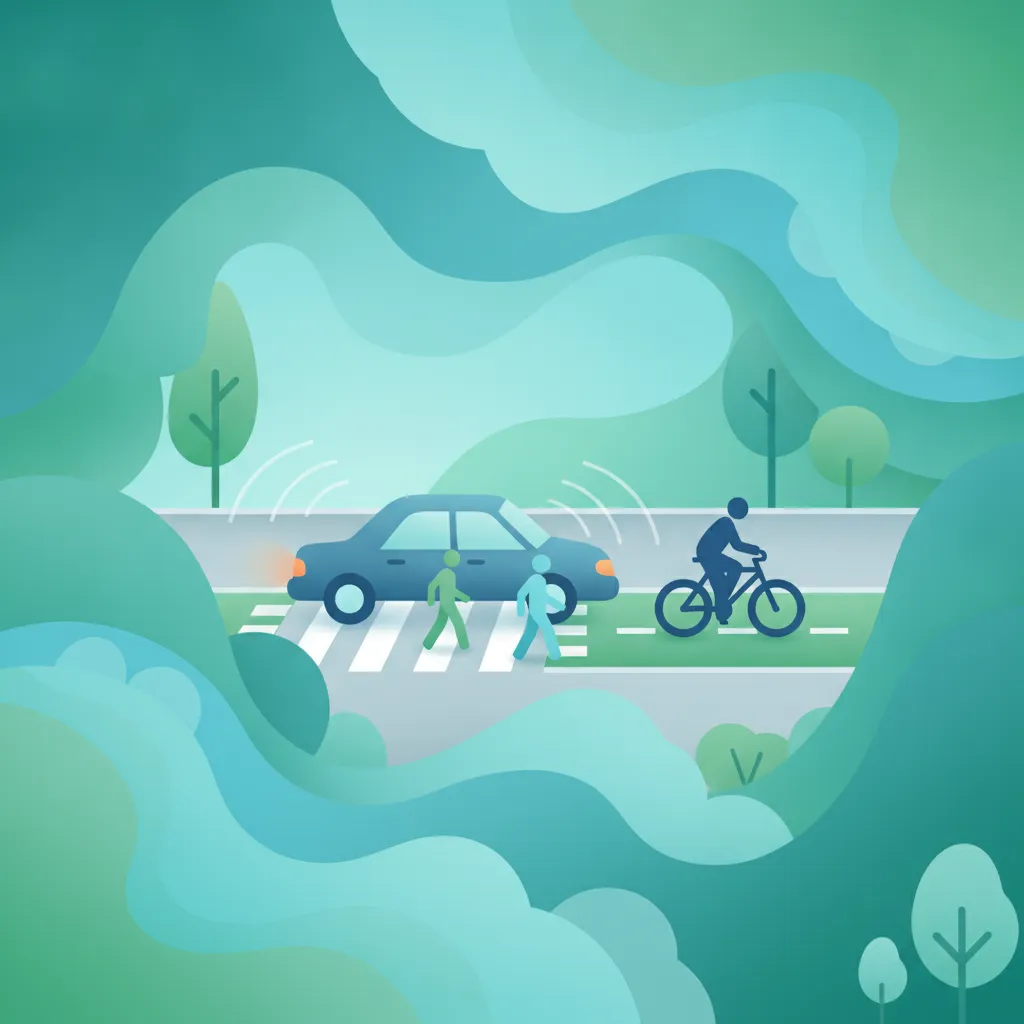
Theory topic content overview
Read the full theory topic guide for Safe Turning with structured, easy-to-scan content built for learners in Germany. This detailed section explains the exact rule, meaning, traffic context, comparison points, and exam logic behind this German driving theory topic so you can study faster, understand the concept more clearly, and avoid common interpretation mistakes on the theory test.
Abbiegen)Safe turning, known as Abbiegen in German traffic law, is a fundamental driving maneuver that involves changing your vehicle's direction onto another road or into an entrance, while ensuring the safety of all other road users. It's more than just steering; it's a coordinated sequence of observation, signalling, precise vehicle positioning, and, critically in Germany, yielding to those who have priority. The goal is to execute the turn smoothly and predictably, preventing conflicts and potential collisions, especially at intersections which are common conflict points.
Proper turning technique is essential for several reasons:
Straßenverkehrs-Ordnung (StVO), sets clear rules for turning. Non-compliance can lead to fines, points, and, in severe cases, driving bans.Performing a safe turn in Germany follows a clear sequence, often summarized by "Observe, Signal, Position, Yield, Maneuver" (OSPYM).
Umschauen)Before any turn, a comprehensive observation is mandatory:
Schulterblick) to scan your blind spots for cyclists, motorcyclists, or small vehicles that might be alongside you and invisible in your mirrors. This is especially vital before turning right.Radweg (cycle paths) or on the roadway, both ahead and alongside your vehicle. Their presence heavily influences your yielding obligations.Blinklicht setzen)Activate your indicator (Blinklicht) well in advance of your turn to inform other road users of your intentions. This gives them time to react and adjust. A good rule of thumb is to signal before braking or significantly changing your position.
Einordnen)Your lane positioning communicates your intent and prepares you for the turn.
Vorfahrt gewähren, Rücksicht nehmen)This is one of the most critical aspects of safe turning in Germany, and a frequent exam topic. According to StVO § 9 (Abbiegen, Wenden und Rückwärtsfahren):
"Wer abbiegt, muss entgegenkommenden Verkehr, Fahrräder, die auf Radwegen die Fahrbahn kreuzen, und Fußgänger durchlassen." (Anyone turning must give way to oncoming traffic, cyclists crossing the roadway on cycle paths, and pedestrians.)
This means:
Radweg (cycle paths) who are continuing straight across your path.Vorfahrt (priority) signs explicitly grant you priority, or if you can clearly see that yielding is not necessary and your maneuver won't endanger or significantly hinder anyone.Abbiegevorgang)Several factors influence the safe execution of a turn:
Blinklicht setzen) does not grant you priority. You must still yield to road users who have the right-of-way.Vorfahrt gewähren) means being prepared to stop if necessary, but you don't always have to come to a complete halt if the way is clear and you can proceed without hindering anyone.You are approaching an intersection in a German city, intending to turn right. The traffic light is green. To your immediate right, there's a marked Radweg (cycle path) running parallel to your direction of travel.
Schulterblick (head check) specifically for cyclists on the Radweg who might be continuing straight. If a cyclist is approaching or already on the path, you must yield to them. Wait until they have passed before completing your turn. Also, watch for pedestrians crossing the street you are entering.You are turning left at an intersection. There is oncoming traffic, and a tram line runs straight through the intersection.
Schulterblick: Failing to check blind spots, especially for cyclists and small vehicles, is a very common and dangerous mistake.Always remember that turning is a privilege that comes with significant responsibility, especially in Germany where the protection of vulnerable road users is paramount. Adopt the habit of O-S-P-Y-M with a strong emphasis on Vorfahrt gewähren (yielding).
By consistently applying these principles, you will master safe turning maneuvers, pass your German driving theory and practical tests, and contribute to safer roads for everyone.
Safe turning in German traffic (Abbiegen) is governed by StVO § 9 and requires following the OSPYM method: thorough observation including Schulterblick for blind spots, early signalling with the Blinker, correct lane positioning, mandatory yielding to oncoming vehicles, cyclists on crossing Radweg, and pedestrians, and finally executing the turn smoothly at safe speed. The critical rule is that indicating your intention never grants priority; you must always yield to those with the right-of-way unless a green arrow light specifically grants it. Turning right particularly demands vigilance for cyclists on parallel paths and pedestrians at crossings.
A short set of high-value points that capture the most important ideas from this theory explanation.
Safe turning in Germany follows the OSPYM sequence: Observe, Signal, Position, Yield, and Maneuver
According to StVO § 9, drivers turning must always yield to oncoming traffic, cyclists on crossing Radweg, and pedestrians
Signalling your intention with a Blinker does not grant priority; you must still yield to those with right-of-way
Right turns carry a higher risk of conflict with cyclists on parallel paths and pedestrians at crossings
The Schulterblick (head check) is mandatory to detect cyclists and motorcycles in blind spots that mirrors cannot show
When turning left, yield to oncoming traffic going straight or turning right; when turning right, yield to pedestrians and cyclists crossing your path
A green arrow light grants priority and exempts you from normal yielding obligations; a solid green still requires yielding
Yielding means being prepared to stop, not necessarily coming to a complete halt if the path is clearly clear
Position right for right turns (near curb with clearance for cyclists) and left for left turns (centre lane or dedicated left-turn lane)
The Abbiegen rule applies whenever you change direction onto another road or into an entrance, not just at intersections
Skipping the Schulterblick before turning right, missing cyclists on the Radweg who are invisible in mirrors
Assuming the Blinker gives priority and proceeding without checking if others have the right-of-way
Failing to yield to pedestrians when turning right, particularly at crossings with no traffic lights
Positioning incorrectly in the lane, such as turning from the centre when a right turn requires staying to the right edge
Entering a turn at excessive speed, reducing control and increasing risk of skidding or hitting the curb
Start with a short, direct summary of Safe Turning before reading the full explanation below.
To perform a safe turn in German traffic, always begin by thoroughly observing your surroundings, including mirrors and blind spots, for all road users. Clearly signal your intention to turn well in advance. Position your vehicle correctly within your lane to indicate your intended path and avoid conflicts. Finally, yield to any pedestrians, cyclists, or vehicles with priority before completing your turn smoothly and at an appropriate speed.
Review the most important terms, rule signals, and traffic concepts linked to Safe Turning.
Explore related theory topic pages connected to Safe Turning and continue with the next useful rule explanation.
See the common search queries learners use when trying to understand Safe Turning in Germany.

Solidify your understanding of German road rules. Explore specific theory topics in detail, from priority rules to complex Autobahn situations. Review key concepts and prepare thoroughly for every aspect of your official driving license theory examination.
German Driving Theory TopicsTheory topic content overview
A short set of high-value points that capture the most important ideas from this theory explanation.
Safe turning in Germany follows the OSPYM sequence: Observe, Signal, Position, Yield, and Maneuver
According to StVO § 9, drivers turning must always yield to oncoming traffic, cyclists on crossing Radweg, and pedestrians
Signalling your intention with a Blinker does not grant priority; you must still yield to those with right-of-way
Right turns carry a higher risk of conflict with cyclists on parallel paths and pedestrians at crossings
The Schulterblick (head check) is mandatory to detect cyclists and motorcycles in blind spots that mirrors cannot show
When turning left, yield to oncoming traffic going straight or turning right; when turning right, yield to pedestrians and cyclists crossing your path
A green arrow light grants priority and exempts you from normal yielding obligations; a solid green still requires yielding
Yielding means being prepared to stop, not necessarily coming to a complete halt if the path is clearly clear
Position right for right turns (near curb with clearance for cyclists) and left for left turns (centre lane or dedicated left-turn lane)
The Abbiegen rule applies whenever you change direction onto another road or into an entrance, not just at intersections
Skipping the Schulterblick before turning right, missing cyclists on the Radweg who are invisible in mirrors
Assuming the Blinker gives priority and proceeding without checking if others have the right-of-way
Failing to yield to pedestrians when turning right, particularly at crossings with no traffic lights
Positioning incorrectly in the lane, such as turning from the centre when a right turn requires staying to the right edge
Entering a turn at excessive speed, reducing control and increasing risk of skidding or hitting the curb
Start with a short, direct summary of Safe Turning before reading the full explanation below.
To perform a safe turn in German traffic, always begin by thoroughly observing your surroundings, including mirrors and blind spots, for all road users. Clearly signal your intention to turn well in advance. Position your vehicle correctly within your lane to indicate your intended path and avoid conflicts. Finally, yield to any pedestrians, cyclists, or vehicles with priority before completing your turn smoothly and at an appropriate speed.
Review the most important terms, rule signals, and traffic concepts linked to Safe Turning.
Explore related theory topic pages connected to Safe Turning and continue with the next useful rule explanation.
See the common search queries learners use when trying to understand Safe Turning in Germany.
Solidify your understanding of German road rules. Explore specific theory topics in detail, from priority rules to complex Autobahn situations. Review key concepts and prepare thoroughly for every aspect of your official driving license theory examination.
German Driving Theory TopicsUse this exam-focused revision tip to understand how Safe Turning is likely to appear in theory questions for learners in Germany. This section helps you identify the most testable part of the rule, avoid common traps, and remember the concept more effectively during German driving theory exam preparation.
In the German theory exam, pay close attention to questions about yielding during turns, especially involving pedestrians and cyclists. Many learners incorrectly assume they always have priority. Remember the rule: if you are turning, you generally yield to those going straight or crossing your path, unless specific traffic lights or signs state otherwise.
Read direct answers to the most common learner questions about Safe Turning in Germany. This FAQ focuses on rule confusion, practical meaning, comparison with similar concepts, and the exact uncertainties that appear most often in German driving theory revision and exam preparation.
The general procedure involves observing traffic, signaling your intention, positioning your vehicle correctly, checking for vulnerable road users, yielding if necessary, and then executing the turn smoothly.
When turning right in Germany, you must yield to pedestrians and cyclists crossing the road you are entering, as well as any oncoming traffic that has priority, unless otherwise indicated by signs or traffic lights.
Yes, you must always signal your intention to turn, even if you believe there are no other road users nearby. Signalling is a legal requirement and helps prevent unexpected situations for those who may appear suddenly.
Correct lane positioning helps communicate your intention to other drivers, prevents them from trying to overtake you on the side of your turn, and ensures you have enough space to complete the maneuver safely without encroaching on other lanes.
Pedestrians and cyclists are particularly vulnerable when you turn, especially when turning right. Always assume they might be present, check your blind spots carefully, and yield to them as they typically have priority when crossing the road you intend to enter.
'Abbiegen' is the German term for turning. It refers to changing direction at an intersection or entering another road, encompassing all the rules and procedures for safe execution.
No, you must typically turn from the correct lane designated for your direction of travel. Special road markings or signs will indicate turning lanes. Turning from an incorrect lane can be dangerous and is against traffic regulations.
Begin your targeted revision now. Use our practice search to quickly find specific German driving theory questions. Filter by StVO rules, road signs, or hazard perception to create your focused study plan. Master challenging areas and prepare confidently for your theoretical driving test.