
Driving near schools or playgrounds means entering a special traffic environment with increased risks. Children are often less aware of traffic hazards and can act unpredictably, making them highly vulnerable road users. This section outlines the critical precautions and legal expectations for drivers in German school zones, ensuring you know how to react safely and responsibly.
Theory topic content overview
Read the full theory topic guide for School Zones and Child Safety with structured, easy-to-scan content built for learners in Germany. This detailed section explains the exact rule, meaning, traffic context, comparison points, and exam logic behind this German driving theory topic so you can study faster, understand the concept more clearly, and avoid common interpretation mistakes on the theory test.
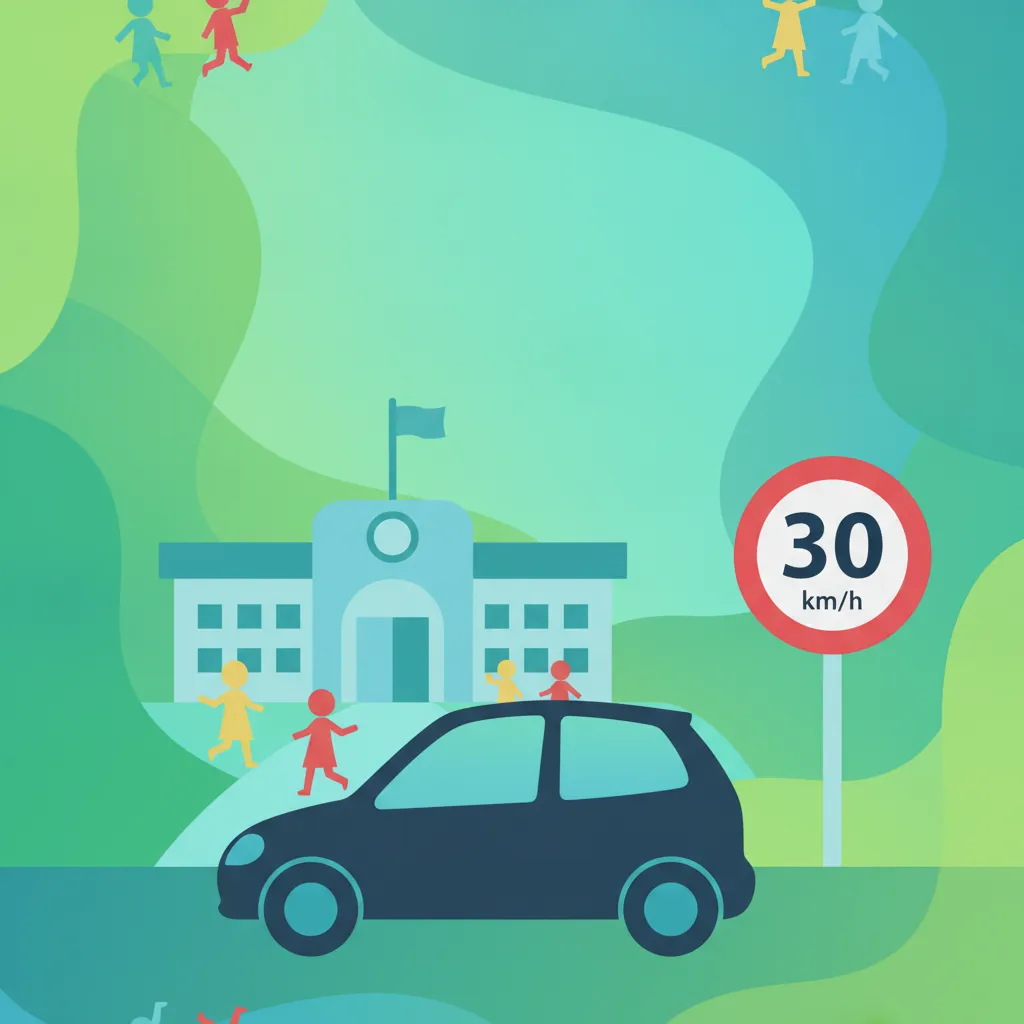
Driving in school zones in Germany demands a heightened level of awareness and caution from every driver. These areas are designated spaces around schools, kindergartens, and playgrounds where children are frequently present, either walking, cycling, or being dropped off and picked up. The core principle behind special precautions in these areas is the unpredictable behavior of children, who are considered highly vulnerable road users under the German Straßenverkehrs-Ordnung (StVO).
Unlike adults, children often lack a full understanding of traffic dangers, have limited peripheral vision, and can act impulsively. This makes areas frequented by children, such as Schulwege (school routes), Kindergärten, and Spielplätze (playgrounds), particularly hazardous.
The German driving theory test (Führerscheinprüfung) places significant emphasis on driver responsibility towards vulnerable road users, especially children. This isn't merely a suggestion; it's rooted in the StVO, which mandates that all road users must behave in a way that does not harm, endanger, or unduly impede others. For drivers, this translates into an explicit duty of heightened care when children are nearby.
Misunderstanding or underestimating the risks in school zones can lead to serious accidents and is a common pitfall for learners. The theory test frequently presents scenarios designed to assess a driver's ability to anticipate and react safely to children in traffic, making this topic crucial for passing and for real-world safety in Germany.
When you encounter a school zone or an area with children in Germany, your driving approach must change significantly. Here’s how to adapt:
Reduce Speed Dramatically:
Increase Vigilance and Observation:
Maintain a Safe Distance:
Respect Crossing Aids and Signals:
Several elements amplify the risks in school zones:
A common misconception among drivers is that if a speed limit sign (e.g., 30 km/h) is present, driving at that exact speed is always safe. In German school zones, this is often not the case. The legal speed limit is the maximum permissible speed, but the safe speed is often considerably lower.
Consider these typical situations in German school zones:
Learners often struggle with:
In the German driving theory test, questions about school zones will often focus on:
Remember, the presence of children means a general warning, not just a specific crossing point. The responsibility for their safety primarily rests with the driver, who must adapt their driving style to protect these most vulnerable road users.
When driving in German school zones, adopt the mindset of anticipating the unpredictable and prioritizing child safety above all else. Reduce your speed well in advance, stay highly vigilant, and be ready to stop at any moment. This proactive approach not only keeps children safe but also ensures you meet the high standards expected of drivers in Germany, both in your driving test and on the road.
School zones in Germany require drivers to treat children as highly unpredictable road users who may not assess traffic dangers accurately. The StVO imposes an explicit duty of heightened care in these areas, and the presence of children—even without specific signage—demands immediate speed reduction and maximum vigilance. The legal speed limit (often Tempo 30) represents a maximum, not a safe speed, particularly when visibility is reduced or during school arrival and dismissal times. Drivers must continuously scan for hidden children, obey school crossing guards (Schülerlotsen), and never overtake stationary school buses with flashing hazard lights. This topic frequently appears in the German theory test with scenarios testing hazard recognition, appropriate speed selection, and legal obligations toward vulnerable road users.
A short set of high-value points that capture the most important ideas from this theory explanation.
Children in traffic are considered highly unpredictable road users under German law and require drivers to exercise maximum caution
German traffic law (StVO) mandates a duty of heightened care whenever children are nearby, not just at marked crossings
The legal speed limit (e.g., Tempo 30) is a maximum, not a target—safe speed in school zones is often considerably lower
Drivers bear primary responsibility for child safety in school zones and must anticipate that children may not look before crossing
Zeichen 136 'Kinder' warning signs indicate areas where child presence requires immediate speed reduction regardless of other posted limits
Zeichen 136 'Kinder' warning signs apply broadly to the area, not just to specific crossing points
Schülerlotsen (school crossing guards) have mandatory authority—their signals must be obeyed like traffic lights
Never overtake a stationary school bus with flashing hazard lights when children are boarding or alighting
Speed must be adapted to circumstances (§3 StVO)—visibility obstructions, parked cars during drop-off times, and weather conditions all demand slower speeds
Bring- und Abholverkehr (school arrival and dismissal traffic) creates chaotic conditions with increased visibility obstructions and unpredictable child movements
Assuming children will follow traffic rules and look before crossing, rather than anticipating they may act impulsively
Driving at the posted speed limit as if it were automatically safe, without adjusting for visibility or child activity
Only scanning the road ahead instead of continuously checking sidewalks, parked cars, and areas where children could suddenly emerge
Failing to treat Schülerlotsen signals as legally mandatory instructions
Underestimating how visibility obstructions like parked cars during drop-off times can hide children until they are already in the road
Start with a short, direct summary of School Zones and Child Safety before reading the full explanation below.
School zones in Germany require drivers to significantly reduce speed and exercise heightened vigilance. This is due to the unpredictable nature of children who may cross roads unexpectedly, walk in groups, or emerge from behind parked vehicles. Always be prepared to stop instantly, keep an ample safety distance, and respect any temporary speed limits (often 30 km/h) indicated by signage or context, especially during school arrival and dismissal times.
Review the most important terms, rule signals, and traffic concepts linked to School Zones and Child Safety.
Explore related theory topic pages connected to School Zones and Child Safety and continue with the next useful rule explanation.
See the common search queries learners use when trying to understand School Zones and Child Safety in Germany.

Solidify your understanding of German road rules. Explore specific theory topics in detail, from priority rules to complex Autobahn situations. Review key concepts and prepare thoroughly for every aspect of your official driving license theory examination.
German Driving Theory TopicsTheory topic content overview
A short set of high-value points that capture the most important ideas from this theory explanation.
Children in traffic are considered highly unpredictable road users under German law and require drivers to exercise maximum caution
German traffic law (StVO) mandates a duty of heightened care whenever children are nearby, not just at marked crossings
The legal speed limit (e.g., Tempo 30) is a maximum, not a target—safe speed in school zones is often considerably lower
Drivers bear primary responsibility for child safety in school zones and must anticipate that children may not look before crossing
Zeichen 136 'Kinder' warning signs indicate areas where child presence requires immediate speed reduction regardless of other posted limits
Zeichen 136 'Kinder' warning signs apply broadly to the area, not just to specific crossing points
Schülerlotsen (school crossing guards) have mandatory authority—their signals must be obeyed like traffic lights
Never overtake a stationary school bus with flashing hazard lights when children are boarding or alighting
Speed must be adapted to circumstances (§3 StVO)—visibility obstructions, parked cars during drop-off times, and weather conditions all demand slower speeds
Bring- und Abholverkehr (school arrival and dismissal traffic) creates chaotic conditions with increased visibility obstructions and unpredictable child movements
Assuming children will follow traffic rules and look before crossing, rather than anticipating they may act impulsively
Driving at the posted speed limit as if it were automatically safe, without adjusting for visibility or child activity
Only scanning the road ahead instead of continuously checking sidewalks, parked cars, and areas where children could suddenly emerge
Failing to treat Schülerlotsen signals as legally mandatory instructions
Underestimating how visibility obstructions like parked cars during drop-off times can hide children until they are already in the road
Start with a short, direct summary of School Zones and Child Safety before reading the full explanation below.
School zones in Germany require drivers to significantly reduce speed and exercise heightened vigilance. This is due to the unpredictable nature of children who may cross roads unexpectedly, walk in groups, or emerge from behind parked vehicles. Always be prepared to stop instantly, keep an ample safety distance, and respect any temporary speed limits (often 30 km/h) indicated by signage or context, especially during school arrival and dismissal times.
Review the most important terms, rule signals, and traffic concepts linked to School Zones and Child Safety.
Explore related theory topic pages connected to School Zones and Child Safety and continue with the next useful rule explanation.
See the common search queries learners use when trying to understand School Zones and Child Safety in Germany.
Solidify your understanding of German road rules. Explore specific theory topics in detail, from priority rules to complex Autobahn situations. Review key concepts and prepare thoroughly for every aspect of your official driving license theory examination.
German Driving Theory TopicsUse this exam-focused revision tip to understand how School Zones and Child Safety is likely to appear in theory questions for learners in Germany. This section helps you identify the most testable part of the rule, avoid common traps, and remember the concept more effectively during German driving theory exam preparation.
The German theory test frequently includes scenarios involving children near roads. Remember that children's behavior is often unpredictable; they might not look before crossing or appear suddenly. Always choose the option that demonstrates maximum caution, reduced speed, and readiness to stop, prioritizing the safety of young pedestrians and cyclists above all else.
Read direct answers to the most common learner questions about School Zones and Child Safety in Germany. This FAQ focuses on rule confusion, practical meaning, comparison with similar concepts, and the exact uncertainties that appear most often in German driving theory revision and exam preparation.
A school zone is an area near educational facilities, playgrounds, or highly frequented school routes where children are often present, requiring drivers to exercise extra caution.
While not always signposted, drivers are generally expected to reduce their speed significantly, often to 30 km/h, especially during school hours or when children are visible. Specific signs will indicate mandatory limits.
Children can be unpredictable in traffic; they may not fully understand road dangers, cross unexpectedly, or run into the street without warning due to their limited perception and judgment.
Immediately brake firmly, steer clear if safe, and sound your horn if necessary to alert the child. Your primary goal is to prevent a collision by reacting quickly and safely.
Yes, general warning signs for children (Zeichen 136) indicate areas where children might be present. Speed limits (Zeichen 274) may also be posted specifically for these areas, often 30 km/h.
This refers to the drop-off and pick-up traffic around schools. It increases vehicle and pedestrian activity, often leading to temporary congestion, parked cars, and children moving unpredictably, demanding even greater driver attention.
Schülerlotsen assist children in safely crossing roads near schools. Drivers must always follow their instructions and yield to pedestrians crossing under their guidance.
Begin your targeted revision now. Use our practice search to quickly find specific German driving theory questions. Filter by StVO rules, road signs, or hazard perception to create your focused study plan. Master challenging areas and prepare confidently for your theoretical driving test.