
Right of way, known as Vorfahrt in Germany, is a fundamental concept in traffic law that dictates which road user has priority to proceed in situations where paths conflict. These rules are vital for maintaining order, preventing collisions, and ensuring a smooth flow of traffic. Your ability to correctly identify and apply Vorfahrt rules will be rigorously tested in the German driving theory exam and is critical for real-world driving.
Theory topic content overview
Read the full theory topic guide for Vorfahrt (Right of Way) German Rules with structured, easy-to-scan content built for learners in Germany. This detailed section explains the exact rule, meaning, traffic context, comparison points, and exam logic behind this German driving theory topic so you can study faster, understand the concept more clearly, and avoid common interpretation mistakes on the theory test.
Right of Way, known as Vorfahrt in German traffic law, is a fundamental principle that dictates which road user has priority to proceed first when their paths intersect or conflict. It establishes clear rules to prevent collisions and ensure a smooth, orderly flow of traffic on German roads.
Understanding Vorfahrt is not just about avoiding accidents; it's a cornerstone of the German driving theory (Theorieprüfung) and practical driving test. Mastering these rules allows you to anticipate other road users' actions and react correctly, making you a safe and confident driver in Germany.
The German road network, from bustling city intersections (Kreuzungen und Einmündungen) to complex Autobahn exits and rural roads, relies heavily on drivers correctly applying Vorfahrt rules. Misinterpreting these rules is a leading cause of accidents and a common pitfall in the German theory exam.
Correctly identifying who has priority ensures:
Straßenverkehrs-Ordnung (StVO) is mandatory.Vorfahrt scenarios are a major component of the Theorieprüfung.In Germany, Vorfahrt is determined by a strict hierarchy, where higher-level rules override lower ones. Always check for priority in this order:
Polizeibeamte/Verkehrsregler): Instructions given by uniformed officers directing traffic always take precedence over all other rules, signs, and signals.Lichtzeichenanlagen): Functioning traffic signals (red, yellow, green) override all Vorfahrt signs and general rules.Verkehrszeichen): When traffic lights are off or flashing, Vorfahrt signs become the primary determinant of priority. These include Vorfahrt gewähren (Yield), Halt! Vorfahrt gewähren! (Stop), and Vorfahrtstraße (Priority Road) signs.Fahrbahnmarkierungen): In some cases, specific road markings (like a Haltelinie or Vorfahrt-Dreiecke) can reinforce or indicate Vorfahrt obligations. However, these are typically subordinate to signs.Allgemeine Regeln): If none of the above are present or applicable, general rules apply. The most famous and often misunderstood is rechts vor links.Rechts vor links is the fundamental general Vorfahrt rule in Germany, applying when no traffic signals, Vorfahrt signs, or police instructions are present. It states that you must yield to any vehicle approaching from your right at an intersection (Kreuzung) or junction (Einmündung).
Rechts vor Links Applies:Vorfahrt gewähren, Halt, or Vorfahrtstraße signs, you must give way to traffic coming from your right.rechts vor links default.Rechts vor Links Does NOT Apply:This is where many German theory exam candidates make mistakes. Rechts vor links does not apply in the following crucial situations:
Vorfahrtstraße): If you are on a road marked with a Vorfahrtstraße sign (yellow diamond) or a Vorfahrt an der nächsten Kreuzung sign, you have priority, and traffic from the right must yield to you.Vorfahrt gewähren (Yield) or Halt! (Stop) Signs: If you encounter one of these signs, you must yield to all crossing traffic, regardless of its direction.Ausfahrt von Grundstück/Parkplatz): When exiting a private driveway, garage, parking lot, or unpaved road, you always have to yield to all traffic on the main road, irrespective of whether they come from your left or right.Unbefestigte Wege): Vehicles entering a paved road from an unpaved road must always yield.Abbiegen): Even if you have general Vorfahrt when going straight, if you are turning left or right, you must yield to:
Straßenbahnen): Trams often have special Vorfahrt rights in Germany. Generally, they have priority over other road users, even when coming from the left, unless specifically directed otherwise by signs or signals.Einsatzfahrzeuge): Vehicles using blue flashing lights and a siren (e.g., police, fire brigade, ambulance) always have absolute priority, and you must make way for them safely.These Verkehrszeichen are critical for determining Vorfahrt in Germany:
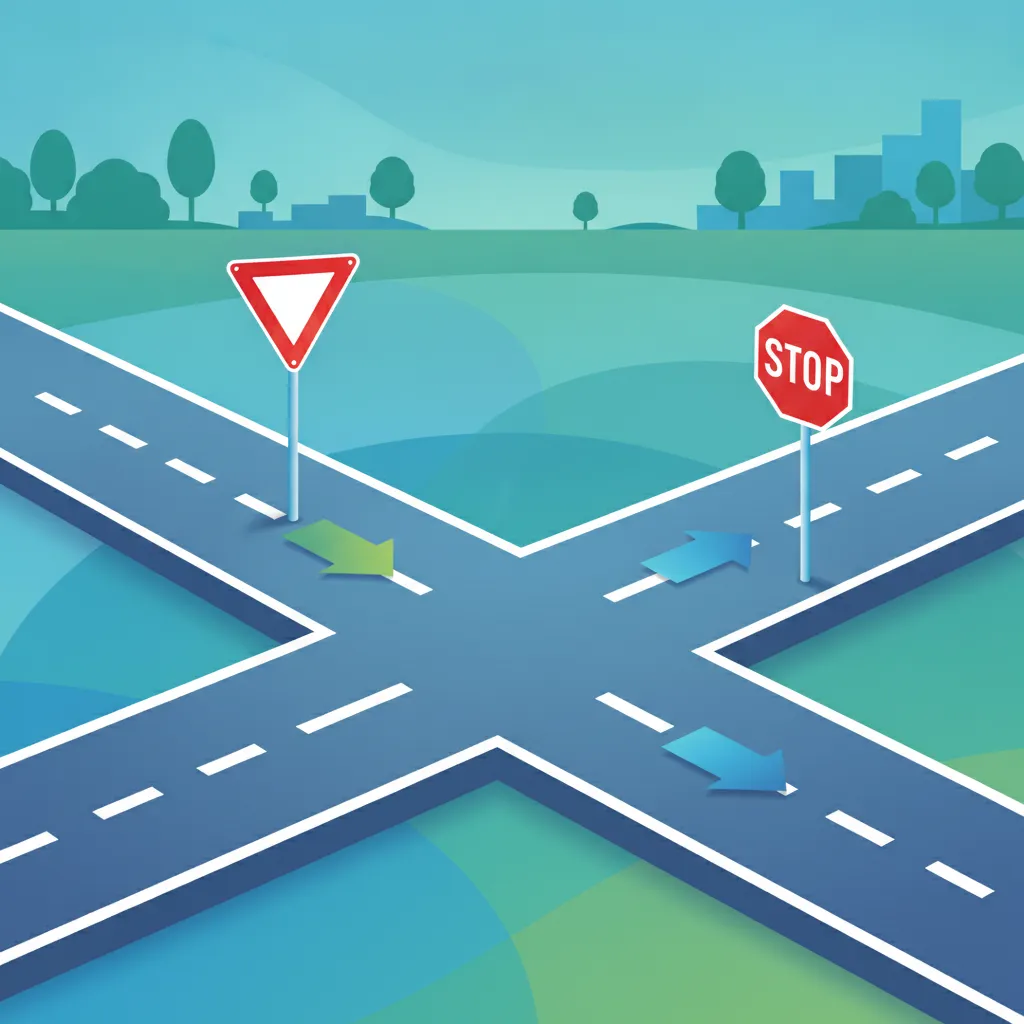
Vorfahrt gewähren! (Yield Sign): A white inverted triangle with a red border. You must yield to cross traffic.Halt! Vorfahrt gewähren! (Stop Sign): A red octagon with "STOP" in white. You must stop completely at the Haltelinie (stop line) and then yield to cross traffic before proceeding when safe.Vorfahrtstraße (Priority Road Sign): A yellow diamond with a white border. You are on a priority road and have Vorfahrt at upcoming intersections unless indicated otherwise.Vorfahrt an der nächsten Kreuzung oder Einmündung (Priority at next intersection): A white triangle with a red border, showing a black arrow. This indicates you have Vorfahrt at the immediate next intersection.Ende der Vorfahrtstraße (End of Priority Road): A yellow diamond with a white border and a black diagonal line through it. Your priority road status ends here, and rechts vor links or other signs will apply from this point.Rechts vor links diagram: While not a mandatory Vorfahrt sign itself, some warning signs (like Kreuzung mit Vorfahrt von rechts) may explicitly illustrate rechts vor links scenarios to warn of specific junction types.Kreuzung: You are driving down a residential street in Munich. There's an intersection ahead with no signs or traffic lights. A car approaches from your right. According to rechts vor links, you must yield to that car.Vorfahrt gewähren! sign (Sign 205) at your junction, and traffic on the main road is marked with Vorfahrtstraße signs (Sign 301). You must yield to all traffic on the main road, regardless of direction.Straßenbahn): You are driving in Düsseldorf and a Straßenbahn approaches from your left at an unmarked junction. Generally, the tram has Vorfahrt, and you should yield to it.Learners often struggle with Vorfahrt in the German theory exam (Theorieprüfung) and in practice. Here are typical errors:
Rechts vor links: Assuming rechts vor links applies everywhere, even when signs or traffic lights are present. Remember the strict hierarchy!Vorfahrt signs: Failing to see or correctly interpret Vorfahrt gewähren or Halt! signs, especially in complex or busy intersections.Grundstücksausfahrten: Not realizing that exiting a private driveway or parking lot always means yielding to all traffic.Straßenbahnen: Not understanding the general priority trams have in Germany.Vorfahrt can also disrupt traffic flow. Be decisive once you've confirmed your right to proceed.When approaching any intersection or conflict point in Germany, adopt this systematic approach to determine Vorfahrt:
Vorfahrt Signs: Are there Vorfahrt gewähren, Halt!, Vorfahrtstraße, or Vorfahrt an der nächsten Kreuzung signs? These dictate priority.Rechts vor links: If none of the above apply, then and only then, yield to traffic coming from your right.Always be prepared to yield, even if you believe you have Vorfahrt, if another driver makes a mistake. Your safety, and the safety of others, is always the highest priority on German roads.
In Germany, right of way (Vorfahrt) is determined by a clear hierarchy where police officers, traffic lights, road signs, and markings take precedence over the general rechts vor links rule, which only applies at uncontrolled intersections. The most important exceptions to rechts vor links include priority roads (Vorfahrtstraße), exiting private property, and situations involving trams and emergency vehicles. Drivers must always yield to straight-ahead traffic when turning and to pedestrians and cyclists crossing the road they are entering. The German theory exam frequently tests image-based questions on these priority rules, so learners should memorize the specific signs (205, 206, 301, 306, 307) and practice applying the systematic decision framework of checking for police, lights, signs, special situations, and finally rechts vor links.
A short set of high-value points that capture the most important ideas from this theory explanation.
Vorfahrt follows a strict hierarchy: police officers override all, then traffic lights, then road signs, then markings, and only when none exist does rechts vor links apply.
Rechts vor links (right before left) only applies at uncontrolled intersections where no signs, lights, or police are present.
Exiting a private driveway, parking lot, or unpaved road always requires yielding to ALL traffic on the public road, regardless of direction.
Trams (Straßenbahnen) generally have priority over other road users even at unmarked junctions.
Turning vehicles must always yield to straight-ahead traffic and to pedestrians or cyclists crossing the road being entered.
Sign 205 (white inverted triangle) means yield to cross traffic; Sign 206 (red octagon) requires a complete stop before proceeding.
Sign 301 (yellow diamond) marks a Vorfahrtstraße granting priority until Sign 307 (yellow diamond with diagonal line) ends it.
Emergency vehicles with blue lights and siren have absolute priority; you must make way safely.
When you have Vorfahrt, still proceed with caution and be prepared to yield if another driver makes a mistake.
The Vorfahrt gewähren and Halt signs require yielding to ALL crossing traffic, not just vehicles from the right.
Assuming rechts vor links applies when yield or stop signs are clearly visible at an intersection.
Neglecting to yield when exiting a parking lot or private driveway, believing only traffic from the right must be checked.
Failing to yield to pedestrians and cyclists when turning, focusing only on other vehicles.
Forgetting that traffic turning left at a green light must still yield to oncoming straight-ahead traffic.
Hesitating excessively at intersections when you actually have Vorfahrt, disrupting traffic flow unnecessarily.
Start with a short, direct summary of Vorfahrt (Right of Way) German Rules before reading the full explanation below.
Right of way (Vorfahrt) establishes which road user is allowed to proceed first when traffic paths intersect or merge. In Germany, this priority is determined by a clear hierarchy: traffic signals override signs, signs override road markings, and in the absence of any of these, general traffic rules apply, most notably the "rechts vor links" (right before left) rule at uncontrolled intersections. Correctly applying Vorfahrt is crucial for safety and successful participation in German road traffic.
Review the most important terms, rule signals, and traffic concepts linked to Vorfahrt (Right of Way) German Rules.
Explore related theory topic pages connected to Vorfahrt (Right of Way) German Rules and continue with the next useful rule explanation.
See the common search queries learners use when trying to understand Vorfahrt (Right of Way) German Rules in Germany.

Solidify your understanding of German road rules. Explore specific theory topics in detail, from priority rules to complex Autobahn situations. Review key concepts and prepare thoroughly for every aspect of your official driving license theory examination.
German Driving Theory TopicsTheory topic content overview
A short set of high-value points that capture the most important ideas from this theory explanation.
Vorfahrt follows a strict hierarchy: police officers override all, then traffic lights, then road signs, then markings, and only when none exist does rechts vor links apply.
Rechts vor links (right before left) only applies at uncontrolled intersections where no signs, lights, or police are present.
Exiting a private driveway, parking lot, or unpaved road always requires yielding to ALL traffic on the public road, regardless of direction.
Trams (Straßenbahnen) generally have priority over other road users even at unmarked junctions.
Turning vehicles must always yield to straight-ahead traffic and to pedestrians or cyclists crossing the road being entered.
Sign 205 (white inverted triangle) means yield to cross traffic; Sign 206 (red octagon) requires a complete stop before proceeding.
Sign 301 (yellow diamond) marks a Vorfahrtstraße granting priority until Sign 307 (yellow diamond with diagonal line) ends it.
Emergency vehicles with blue lights and siren have absolute priority; you must make way safely.
When you have Vorfahrt, still proceed with caution and be prepared to yield if another driver makes a mistake.
The Vorfahrt gewähren and Halt signs require yielding to ALL crossing traffic, not just vehicles from the right.
Assuming rechts vor links applies when yield or stop signs are clearly visible at an intersection.
Neglecting to yield when exiting a parking lot or private driveway, believing only traffic from the right must be checked.
Failing to yield to pedestrians and cyclists when turning, focusing only on other vehicles.
Forgetting that traffic turning left at a green light must still yield to oncoming straight-ahead traffic.
Hesitating excessively at intersections when you actually have Vorfahrt, disrupting traffic flow unnecessarily.
Start with a short, direct summary of Vorfahrt (Right of Way) German Rules before reading the full explanation below.
Right of way (Vorfahrt) establishes which road user is allowed to proceed first when traffic paths intersect or merge. In Germany, this priority is determined by a clear hierarchy: traffic signals override signs, signs override road markings, and in the absence of any of these, general traffic rules apply, most notably the "rechts vor links" (right before left) rule at uncontrolled intersections. Correctly applying Vorfahrt is crucial for safety and successful participation in German road traffic.
Review the most important terms, rule signals, and traffic concepts linked to Vorfahrt (Right of Way) German Rules.
Explore related theory topic pages connected to Vorfahrt (Right of Way) German Rules and continue with the next useful rule explanation.
See the common search queries learners use when trying to understand Vorfahrt (Right of Way) German Rules in Germany.
Solidify your understanding of German road rules. Explore specific theory topics in detail, from priority rules to complex Autobahn situations. Review key concepts and prepare thoroughly for every aspect of your official driving license theory examination.
German Driving Theory TopicsUse this exam-focused revision tip to understand how Vorfahrt (Right of Way) German Rules is likely to appear in theory questions for learners in Germany. This section helps you identify the most testable part of the rule, avoid common traps, and remember the concept more effectively during German driving theory exam preparation.
Pay close attention to image-based questions in the German theory exam that test 'rechts vor links'. Always check for hidden signs, road markings, or specific vehicle types (like public transport or emergency vehicles) which can override this general rule. A common trap involves junctions with unusual road layouts or seemingly minor roads that still grant right of way from the right.
Read direct answers to the most common learner questions about Vorfahrt (Right of Way) German Rules in Germany. This FAQ focuses on rule confusion, practical meaning, comparison with similar concepts, and the exact uncertainties that appear most often in German driving theory revision and exam preparation.
Vorfahrt refers to the rules that determine which road user has priority to proceed first at intersections or other points where traffic paths cross. It is the German term for right of way.
The "rechts vor links" (right before left) rule is a general right of way principle in Germany that applies at uncontrolled intersections. If there are no traffic signals, signs, or specific road markings, vehicles approaching from the right have priority.
Yes, traffic signals (traffic lights) take precedence over all other right of way rules, including road signs and the "rechts vor links" principle, when they are functioning.
Road signs like 'Stop' (Zeichen 206) or 'Give Way' (Zeichen 205) explicitly assign or deny right of way. These signs override the "rechts vor links" rule but are superseded by active traffic signals.
You must generally yield to pedestrians at designated pedestrian crossings (zebra crossings) if they intend to cross. Pedestrians also often have priority when turning at an intersection, where they are already crossing the road you are turning into.
While often used interchangeably in general language, in German traffic law, "Vorfahrt" specifically applies to priority at intersections. "Vorrang" is a broader term for general priority, for example, giving way to oncoming traffic at a narrow point, as indicated by a 'Vorrang des Gegenverkehrs' sign (Zeichen 208).
No, "rechts vor links" does not apply everywhere. It is only valid at uncontrolled intersections where no traffic signals, road signs (like a priority road sign), or traffic officers are present. It also doesn't apply when exiting a private property, a dirt track, or a pedestrian zone.
Begin your targeted revision now. Use our practice search to quickly find specific German driving theory questions. Filter by StVO rules, road signs, or hazard perception to create your focused study plan. Master challenging areas and prepare confidently for your theoretical driving test.