
When your vehicle suffers a mechanical failure or emergency on an Italian motorway, knowing the correct legal procedure is mandatory for safety and exam success. This guide explains how to properly utilize the hard shoulder, the required safety equipment like the high-visibility vest and warning triangle, and how to contact official emergency assistance. Learning these steps will help you handle real-world hazards and avoid common pitfalls identified in the theory exam.
Article content overview
Experiencing a vehicle breakdown on an Italian autostrada can be a stressful and potentially dangerous situation. According to the Codice della Strada (Article 176), specific, mandatory procedures must be followed to ensure the safety of yourself, your passengers, and other road users. Understanding these rules is not only vital for real-world safety but is also a frequent subject in the Italian driving theory exam, where identifying the correct sequence of actions is essential for a passing score.
When your vehicle suffers a mechanical failure or a forced stop, you are legally required to move it as quickly as possible onto the hard shoulder, known in Italian as the corsia di emergenza. If the hard shoulder is unavailable or too narrow, you must reach the nearest emergency parking area or bay. Stopping on the main carriageway or in a travel lane is strictly prohibited and carries severe penalties, including heavy fines and the deduction of points from your driving licence.
The hard shoulder is reserved exclusively for emergencies. You cannot use it to bypass traffic jams, nor is it a place for casual stops, phone calls, or resting. Unauthorized use of the corsia di emergenza is a serious traffic violation under Italian law.
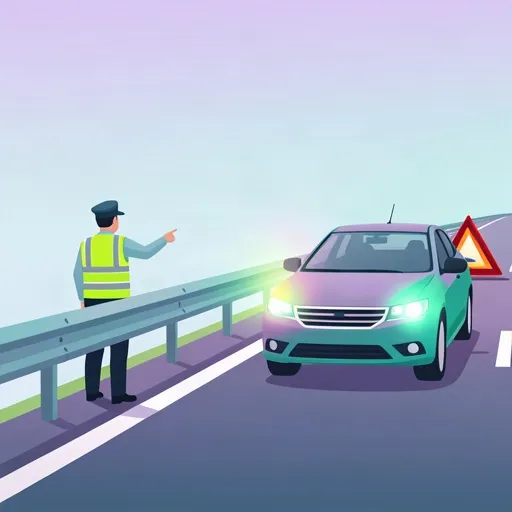
Once your vehicle is safely positioned on the hard shoulder, you must immediately take steps to warn other drivers of your presence. Start by activating your hazard lights to ensure high visibility, especially in low-light conditions or poor weather. Before you step out of the vehicle, you must put on your high-visibility safety vest (giubbotto retroriflettente). In Italy, it is a legal requirement that this vest is stored within the passenger compartment—such as in the glove box or side pockets—so that it is accessible before you exit the car.
When you need mechanical aid on the autostrada, do not rely on just any roadside service. Only authorized operators are permitted to work on the motorway network. You can request help by using the official SOS emergency phones located every 2 kilometers along the road, or by calling the dedicated toll-free emergency numbers for Autostrade per l'Italia. Common providers authorized on the network include ACI (803.116), Europ Assistance (803.803), and IMA (800.613.613).
The Italian driving theory exam often includes trick questions regarding vehicle recovery and passenger safety. For example, you should never attempt to walk along the motorway carriageway or cross the lanes to reach an emergency phone; always stay on the side of the guardrail. Additionally, remember that while you may be allowed to transport pets in your vehicle, they must be contained in a way that does not impede the driver; during a breakdown, your primary focus remains the swift and safe evacuation of all occupants behind the safety barrier.
Article content overview
Explore related topics, search based questions, and concepts that learners often look up when studying Autostrada Breakdown Procedures. These themes reflect real search intent and help you understand how this topic connects to wider driving theory knowledge in Italy.
Find clear and practical answers to common questions learners often have about Autostrada Breakdown Procedures. This section helps explain difficult points, remove confusion, and reinforce the key driving theory concepts that matter for learners in Italy.
You must immediately pull over to the hard shoulder (corsia di emergenza), activate hazard lights, put on your high-visibility vest before leaving the vehicle, and place your warning triangle at least 100 meters behind the vehicle.
By Italian law, the high-visibility vest must be stored inside the passenger compartment of the vehicle so that the driver can wear it before stepping out onto the carriageway.
No, stopping on the motorway carriageway, ramps, or junctions without a genuine emergency or vehicle failure is strictly prohibited and carries severe penalties.
You can use the emergency SOS phones located every 2 km or call official services like ACI at 803.116 or the specific motorway operator emergency numbers for mechanical assistance.
Refine your search or explore related Italian driving theory articles to build a stronger foundation for your exam. Dive deeper into specific traffic regulations, road signs, and practical driving scenarios that are essential for passing your official licence test.