
Electric scooters are increasingly common on Portuguese roads, and the Código da Estrada defines strict rules for their operation. This article clarifies where these devices can travel, their legal requirements, and how drivers must anticipate their behavior to prevent accidents. By understanding these regulations, you will be prepared for specific exam questions while learning how to navigate urban environments safely alongside vulnerable road users.
Article content overview
Electric scooters, known in Portugal as trotinetes elétricas, have fundamentally changed urban mobility. As they become a common sight in cities like Lisbon and Porto, the Código da Estrada has been updated to provide clear legal frameworks for their operation. For those preparing for the IMT theory exam, it is essential to distinguish between these personal mobility devices and other vehicles, as failing to understand their status can lead to incorrect answers regarding right-of-way and road positioning.
In the context of the Portuguese traffic code, motorized personal mobility devices are defined by specific technical characteristics, generally including a maximum continuous power output of 0.25 kW and a maximum design speed of 25 km/h. Because these devices are motorized, they are subject to strict circulation rules that prioritize safety for both the rider and other road users.
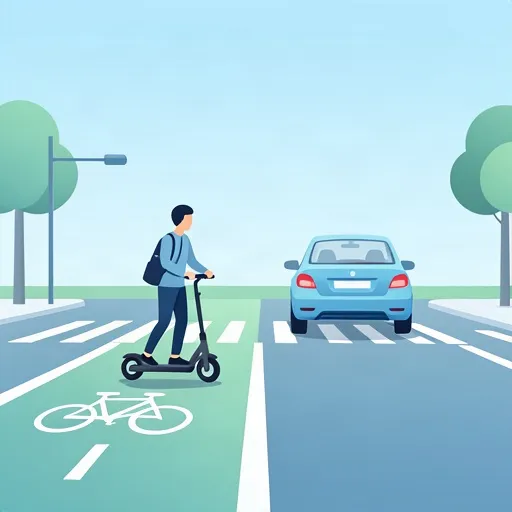
A common trap in the IMT theory exam involves the usage of sidewalks. Under the Código da Estrada, it is generally prohibited to ride electric scooters on sidewalks, as these are reserved for pedestrians. Scooters must use the road network, specifically favoring cycle lanes (ciclovias) whenever they are available. When cycle lanes are not provided, riders must use the carriage-way, keeping as close to the right-hand edge as possible to minimize obstruction.
Learners often mistake trotinetes for bicycles in every legal aspect. While their circulation rules are similar, always check if the specific exam question mentions speed limits or child-specific exemptions, as the law provides specific provisions for children under 10 riding bicycles on sidewalks that do not apply to motorized scooters.
As a driver, you must recognize that electric scooter riders are considered vulnerable road users. They lack the protection of a vehicle frame and are significantly less stable than motorcycles or cars. When approaching intersections or areas where cycle lanes cross the road, you should perform a thorough check of your blind spots. Many accidents occur because drivers turn right across a cycle lane without noticing a scooter approaching at a speed higher than that of a pedestrian.
When passing a scooter, you are required to maintain a safe lateral distance. While the law mandates specific distances for overtaking bicycles, the spirit of safe driving dictates that you should treat a scooter with the same level of caution, providing enough clearance to account for any sudden wobbling or obstacle avoidance by the rider.
Understanding sign-posted infrastructure is vital for passing the theory exam. You will encounter signs that designate paths solely for velocipedes, which also apply to authorized motorized mobility devices.
The IMT theory exam frequently tests your knowledge of "what if" scenarios. A classic question might involve a rider using a mobile phone while operating a scooter, or a rider failing to stop at a red light. Remember that the Código da Estrada applies to all vehicle operators; therefore, scooter riders are prohibited from using handheld mobile devices while moving and must obey all traffic lights and stop signs.
Another area of confusion is the hierarchy of priority. Drivers should never assume that because a scooter is small, it will yield. If a scooter is in a priority position—such as on a main road at an unmarked junction—you must yield to them exactly as you would to a passenger car.
Article content overview
Explore related topics, search based questions, and concepts that learners often look up when studying Electric Scooter Rules for IMT Exam. These themes reflect real search intent and help you understand how this topic connects to wider driving theory knowledge in Portugal.
Find clear and practical answers to common questions learners often have about Electric Scooter Rules for IMT Exam. This section helps explain difficult points, remove confusion, and reinforce the key driving theory concepts that matter for learners in Portugal.
No, as a general rule, personal mobility devices like electric scooters are not allowed on sidewalks. They must use cycle lanes when available or the road, following the same traffic rules as other vehicles.
Yes, you should exercise extra caution. Because scooters are smaller and less stable, they are more vulnerable. Always check your blind spots for scooters before turning across a cycle lane or changing lanes.
The law classifies them based on their technical characteristics, such as motor power and maximum speed. Generally, if they meet specific criteria, they are regulated similarly to velocipedes, requiring compliance with all road signals and priority rules.
If you haven't found what you're looking for, use our powerful article search to explore related topics, refine your understanding of Portuguese road rules, or discover new insights for your IMT driving exam preparation. Continue building your knowledge effectively.