
Understanding the legal requirements for interacting with cyclists is a fundamental aspect of the Portuguese driving theory curriculum. This article clarifies the 1.5-metre distance rule, the legal conditions under which you may cross a continuous line, and the safety precautions necessary to protect vulnerable road users. By learning these principles, you will be well-prepared to answer complex theory exam questions regarding traffic rules and cyclist safety.
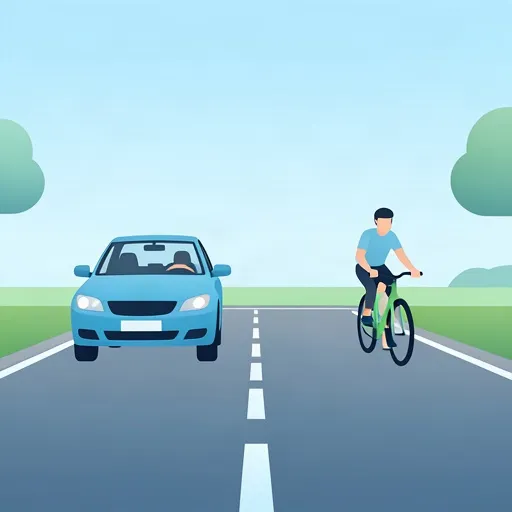
Article content overview
In the Portuguese driving curriculum, the interaction between motorized vehicles and vulnerable road users is a critical topic that appears frequently in the IMT theory exam. As a driver, you are expected to prioritize safety over speed when sharing the road with cyclists. Understanding the 1.5-metre rule is not merely a suggestion for cautious driving; it is a legal requirement under the Código da Estrada (Portuguese Highway Code) designed to protect the most exposed individuals on our roads.
A road user whose physical exposure to traffic makes them more susceptible to severe injury in the event of a collision, including cyclists, pedestrians, and riders of scooters or mopeds.
The legal core of overtaking a bicycle in Portugal is defined by the requirement to maintain a lateral distance of at least 1.5 metres between your vehicle and the bicycle. This distance must be maintained throughout the entire duration of the overtaking maneuver. The law acknowledges that cyclists are prone to unpredictable movements caused by factors such as strong wind gusts, road surface imperfections like potholes, or the need to steer clear of roadside hazards like drainage grates.
Failing to maintain the mandatory 1.5-metre distance when overtaking a cyclist is considered a serious administrative offense in Portugal, carrying significant penalties and potential points on your license.
Before you initiate an overtaking maneuver, you must perform a thorough assessment of the situation. This includes checking your mirrors, confirming there is sufficient visibility, and ensuring that no oncoming traffic is approaching. If the road is too narrow to provide the required 1.5-metre buffer, you must have the patience to wait behind the cyclist until the geometry of the road changes and it becomes safe to perform the maneuver.
A common area of confusion for learners preparing for the IMT exam concerns the use of road markings. Many students wonder if they are permitted to cross a continuous center line to bypass a cyclist. Under Portuguese law, it is legally permissible to cross a continuous longitudinal line to overtake a bicycle, provided that you can do so safely and without endangering oncoming traffic or the cyclist themselves.
It is essential to remember that while the law allows for this maneuver, it does not mandate it regardless of circumstances. Safety remains the absolute priority. If you cannot see far enough ahead—for instance, in a blind curve or on the crest of a hill—you must wait. Never force a cyclist to move toward the edge of the road, and never attempt a "squeezed" pass that puts the cyclist at risk of being pushed off the tarmac.
Cyclists often ride in ways that may seem counterintuitive to a driver, such as riding further from the curb than expected. However, they are often positioning themselves to avoid debris or to stay visible. Furthermore, when cyclists are in a group, they are permitted to ride two abreast under specific conditions. As a driver, you must be prepared to adjust your speed and your strategy accordingly, ensuring that you do not "pressure" the cyclist by honking or driving too close behind them.
When you finally complete an overtaking maneuver, remember to signal your intent, pull out smoothly, pass with the required clearance, and only return to your lane when you have sufficient distance ahead of the cyclist. Never cut back in front of a cyclist immediately after passing, as this can force them to brake sharply and lose their balance.
Exam questions regarding cyclists often focus on identifying your responsibilities as a driver. You may be asked whether you must yield to a cyclist in a specific scenario or whether a certain maneuver is permissible. Remember that the Código da Estrada prioritizes the protection of the most vulnerable. If a question presents a situation where safety is compromised by an attempt to pass, the correct answer will almost always be to wait.
Article content overview
Explore related topics, search based questions, and concepts that learners often look up when studying Overtaking Cyclists in Portugal. These themes reflect real search intent and help you understand how this topic connects to wider driving theory knowledge in Portugal.
Find clear and practical answers to common questions learners often have about Overtaking Cyclists in Portugal. This section helps explain difficult points, remove confusion, and reinforce the key driving theory concepts that matter for learners in Portugal.
According to the Código da Estrada, motorized vehicles must maintain a lateral distance of at least 1.5 metres when overtaking a cyclist in the same lane.
Yes, you may legally cross a continuous center line to maintain the 1.5-metre safety distance, provided that it is safe to do so and you have verified there is no oncoming traffic.
The exam evaluates your ability to recognize vulnerable road users. Understanding this specific legal mandate demonstrates your awareness of road safety and your duty to prevent accidents caused by close passes.
Yes, cyclists are permitted to ride two abreast on the road, provided that they do not block traffic unnecessarily and conditions are safe, which drivers must account for when planning an overtake.
If you haven't found what you're looking for, use our powerful article search to explore related topics, refine your understanding of Portuguese road rules, or discover new insights for your IMT driving exam preparation. Continue building your knowledge effectively.