
Understanding how to interact with vulnerable road users like cyclists is a fundamental requirement for passing the Portuguese driving theory exam. This guide details the legal obligations for drivers, including proper overtaking maneuvers and the specific safety considerations required by the Instituto da Mobilidade e dos Transportes (IMT). You will learn how to identify safe conditions for passing and why situational awareness is essential for both your exam success and daily driving.
Article content overview
Understanding how to interact with vulnerable road users is a core component of the Portuguese Código da Estrada. In the context of your IMT theory exam, cyclists are categorized as highly vulnerable participants in road traffic. Their safety is a shared responsibility, and the rules regarding their treatment are strictly enforced and frequently tested. Mastering these concepts is not just essential for passing your exam; it is a fundamental skill for becoming a responsible and safe driver on Portuguese roads.
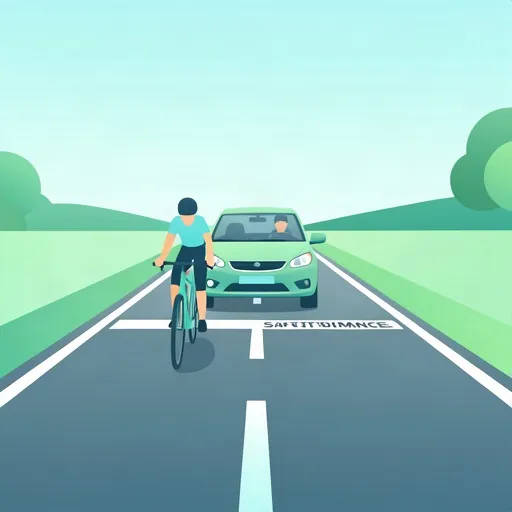
The most critical regulation regarding the overtaking of bicycles is the mandatory lateral distance. Under Article 18 of the Código da Estrada, drivers of motor vehicles must maintain a lateral distance of at least 1.5 meters when overtaking a cyclist. This distance is non-negotiable and is designed to account for the instability of bicycles, which may be forced to swerve suddenly due to road irregularities, wind, or the need to avoid obstacles like potholes or parked vehicles.
Failing to maintain the 1.5-meter safety distance when overtaking is considered a serious traffic offense in Portugal. During your theory exam, any question involving overtaking a cyclist in a narrow lane where the 1.5m buffer cannot be guaranteed will almost certainly require you to choose the option that dictates waiting until the path is clear.
Before initiating an overtaking maneuver, you must perform a thorough assessment of the environment. You should verify that you have sufficient visibility and that the road width allows for the 1.5-meter margin. If the road is too narrow, has a blind curve, or if there is oncoming traffic, you are legally and ethically obligated to remain behind the cyclist until conditions become safe.
It is important to note that you may legally cross a continuous center line if it is necessary to maintain the 1.5-meter distance to a cyclist, provided that this does not pose a danger to oncoming traffic. This is a common trap in IMT exam questions, where students are often tempted to say the overtake is "forbidden" because of the line. Always remember that protecting the vulnerable road user takes priority over standard road markings, as long as it is done safely.
When answering multiple-choice questions about overtaking, you should always adopt the "vulnerable user first" mindset. The exam expects you to demonstrate patience. If you are presented with a scenario where the road is too narrow or visibility is restricted, the correct answer is never to "squeeze" past the cyclist. Instead, look for answers that involve slowing down, signaling clearly, and waiting for an appropriate gap in traffic.
Students often lose points by failing to distinguish between different types of road signs. For instance, signs indicating a "Cycle Path" (pista obrigatória) are different from signs warning of a "Cyclist Crossing" or "Cyclist Exit." Misidentifying these signs can lead to incorrect answers regarding speed or priority. Always study the specific visual cues provided in the exam materials to ensure you are interpreting the road environment correctly.
When you encounter "Cedência de passagem" (Right-of-Way) questions involving cyclists, remember that in many scenarios, the same rules apply as with other vehicles, but with added caution due to their vulnerability. Never assume a cyclist will move out of your way; your driving conduct must adapt to their presence, not the other way around.
Article content overview
Explore related topics, search based questions, and concepts that learners often look up when studying Overtaking Cyclists and Safety Rules. These themes reflect real search intent and help you understand how this topic connects to wider driving theory knowledge in Portugal.
Find clear and practical answers to common questions learners often have about Overtaking Cyclists and Safety Rules. This section helps explain difficult points, remove confusion, and reinforce the key driving theory concepts that matter for learners in Portugal.
According to the Código da Estrada, drivers must maintain a lateral distance of at least 1.5 meters when overtaking a cyclist to ensure their safety.
Yes, you may cross a continuous line if it is necessary to maintain the required 1.5-meter lateral distance and it is safe to do so, provided there is no oncoming traffic.
Cyclists are considered vulnerable road users. Exam questions often test your ability to anticipate their movements, such as swerving to avoid road obstacles, and your responsibility to prioritize their safety over speed.
If the road width or oncoming traffic prevents you from maintaining the 1.5-meter safety buffer, you must wait behind the cyclist until it is safe to complete the maneuver.
If you haven't found what you're looking for, use our powerful article search to explore related topics, refine your understanding of Portuguese road rules, or discover new insights for your IMT driving exam preparation. Continue building your knowledge effectively.