
Electric scooters have become a staple of urban mobility in Portugal, and knowing how to navigate around them is a critical part of your driver training. This guide explains their classification under current traffic laws, where they are permitted to travel, and the defensive driving techniques necessary to prevent collisions at intersections and roundabouts.
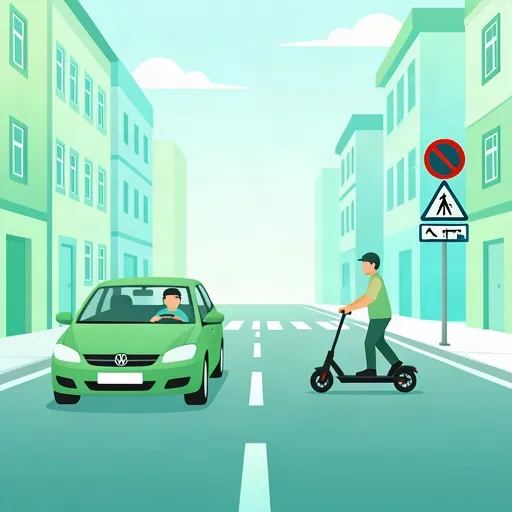
Article content overview
Electric scooters, or trotinetes elétricas, have become an integral part of the urban landscape in Portuguese cities like Lisbon and Porto. As a learner driver, you must understand that these devices are considered vehicles under the Código da Estrada, and interacting with them safely is a critical skill for your practical driving and the IMT theory exam. Because they share the road with motor vehicles, failing to correctly identify their legal status or miscalculating their speed can lead to serious accidents and exam failure.
Under Portuguese law, electric scooters and similar personal mobility devices are subject to specific circulation rules. They are primarily required to use cycle lanes (ciclovias) whenever these are available. When no designated cycle lane exists, they must use the road, keeping as close to the right-hand edge of the carriageway as possible.
It is strictly forbidden for electric scooters to circulate on sidewalks (passeios) unless they are children’s vehicles or specific low-speed mobility devices allowed by local regulations. Never assume a scooter will remain on the sidewalk; always check your surroundings before maneuvering.
Drivers must treat scooter riders as vulnerable road users. They are often less visible than cars, can accelerate quickly from a standstill, and may be operated by inexperienced individuals who are unfamiliar with the rules of the road. Your responsibility as a driver is to anticipate their movements, especially when they are attempting to navigate around obstacles or potholes.
One of the most frequent conflict points for drivers and scooter riders occurs at intersections. When you are turning right, you must ensure that there is no scooter attempting to overtake you on the right side. This is a common "blind spot" scenario that frequently appears in IMT theory test questions. Always use your mirrors and signal your intention to turn well in advance.
When entering a roundabout, be aware that scooters are entitled to the same lane positioning as bicycles. They may take up more of the lane than you expect to ensure visibility. Never squeeze past a scooter within a roundabout; wait until it is safe to pass with adequate lateral clearance once you are clear of the intersection.
The Código da Estrada mandates that when you overtake a vulnerable road user, such as a cyclist or a scooter rider, you must maintain a sufficient lateral distance to ensure their safety. While the specific legal requirement often emphasizes a minimum of 1.5 meters, the golden rule for your exam and real-world safety is to provide as much space as the road conditions allow.
The minimum distance required when overtaking a vulnerable road user, designed to prevent collisions caused by the vehicle's air displacement or the rider losing balance.
If you cannot maintain a safe distance due to oncoming traffic or narrow road lanes, you must wait behind the scooter until the road opens up. Attempting to "squeeze by" is a common cause of accidents and is heavily penalized in the driving test.
To succeed in your IMT theory exam, you must be comfortable with the following terminology regarding micromobility and road safety in Portugal.
A major trap in the IMT theory exam involves assuming that electric scooters always have the same right-of-way as cars. While they generally follow the same priority rules as bicycles, their lack of speed can make them appear to be moving slower than they are. If you are ever in doubt about who has the right-of-way, the safest course of action is to yield. Defensive driving requires you to expect the unexpected from other road users.
Article content overview
Explore related topics, search based questions, and concepts that learners often look up when studying Driving Rules for Electric Scooters. These themes reflect real search intent and help you understand how this topic connects to wider driving theory knowledge in Portugal.
Find clear and practical answers to common questions learners often have about Driving Rules for Electric Scooters. This section helps explain difficult points, remove confusion, and reinforce the key driving theory concepts that matter for learners in Portugal.
Electric scooters must generally use cycle lanes when available or travel on the road. They are not permitted to use sidewalks, except in specific cases where they are being used by children or where local regulations explicitly allow it.
Yes, drivers should maintain a safe lateral distance when overtaking scooters, treating them with the same caution as bicycles to ensure safety, especially in urban traffic.
Scooters are subject to the same general priority rules as other vehicles on the road. When approaching an intersection or roundabout, you must anticipate their movement, as they can be less visible and may lack the experience of a seasoned driver.
If you haven't found what you're looking for, use our powerful article search to explore related topics, refine your understanding of Portuguese road rules, or discover new insights for your IMT driving exam preparation. Continue building your knowledge effectively.