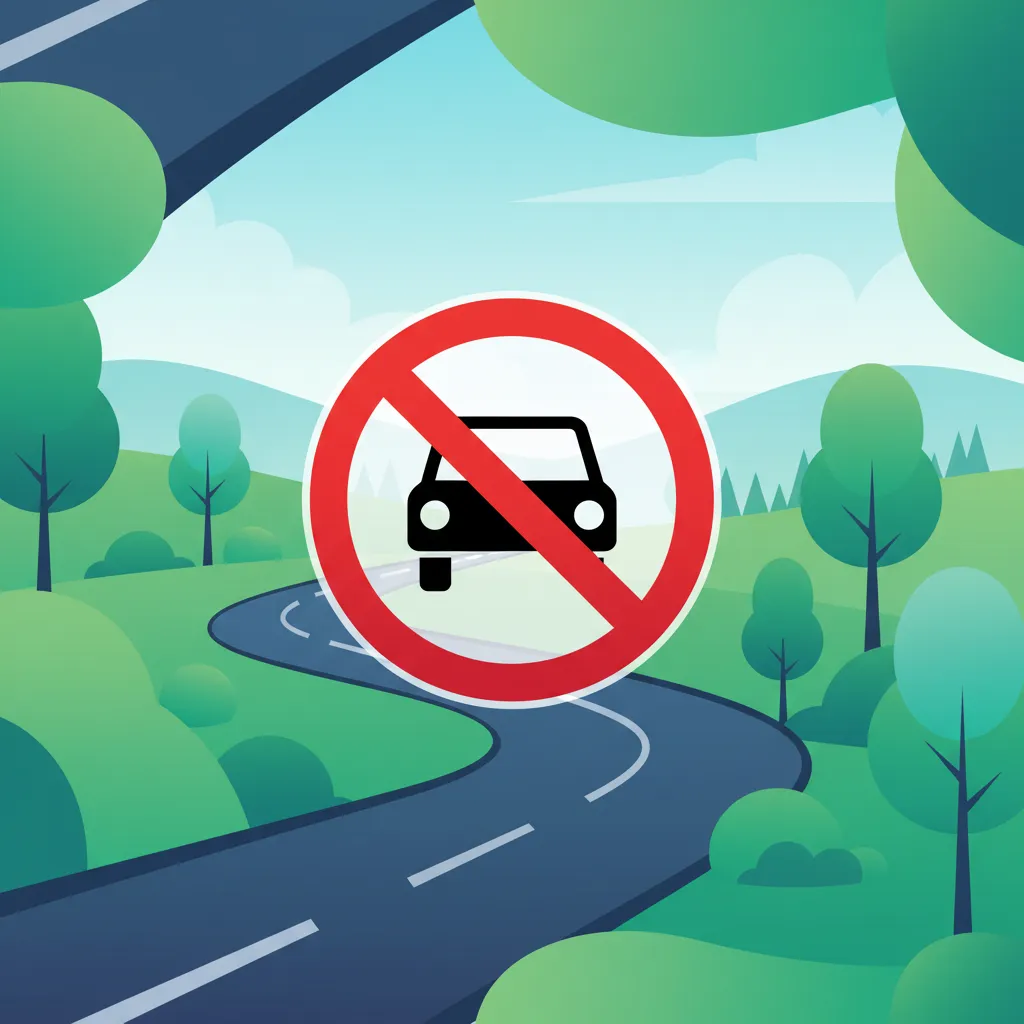
Prohibition signs are a fundamental category of traffic signs designed to enforce safety and order by explicitly forbidding certain actions. These signs are instantly recognizable, often featuring a distinct circular shape with a red border, making it clear to drivers that a restriction is in effect. Understanding and strictly obeying these signs is vital for preventing accidents, maintaining smooth traffic flow, and successfully passing your Swedish driving theory exam.
Theory topic content overview
Read the full theory topic guide for Prohibition Signs Explained with structured, easy-to-scan content built for learners in Sweden. This detailed section explains the exact rule, meaning, traffic context, comparison points, and exam logic behind this Swedish driving theory topic so you can study faster, understand the concept more clearly, and avoid common interpretation mistakes on the theory test.
Prohibition signs are a fundamental category of regulatory traffic signs in Sweden and globally, designed to explicitly forbid drivers from performing specific actions. These signs are non-negotiable legal instructions that override general traffic rules and are crucial for maintaining safety, order, and efficient traffic flow on Swedish roads.
The core concept behind a prohibition sign is simple: "You are not allowed to do this." They act as immediate, clear directives to prevent dangerous situations, conflicts between road users, or disruption to the road network. Understanding and strictly adhering to these signs is paramount for every driver, especially when preparing for the Swedish driving theory exam.
Prohibition signs are more than just symbols; they are direct commands from Swedish traffic authorities. Their importance stems from several critical aspects:
Infart förbjuden – No Entry), or overtaking in hazardous zones (Omkörning förbjuden – No Overtaking).Parkering förbjuden – No Parking) or stopping (Stannaförbud – No Stopping), they ensure roads remain clear and accessible, preventing bottlenecks and congestion.In Sweden, as in much of Europe, prohibition signs are instantly recognizable due to their distinct visual characteristics:
Parkering förbjuden features a diagonal line).This consistent design ensures that drivers can quickly identify a prohibition sign and understand its regulatory nature, even at a glance or in challenging conditions.
Here are some of the most frequently encountered prohibition signs in Sweden, along with their specific meanings:
Infart förbjuden): A red circle with a white horizontal bar in the middle. This means absolutely no vehicles are permitted to enter from this direction. Crucial for one-way streets.Omkörning förbjuden): A red circle with a black car attempting to overtake another car, crossed by a red diagonal line. Drivers are forbidden to overtake other motor vehicles (except two-wheeled mopeds and bicycles) from this point onwards.Omkörning förbjuden för lastbilar): Similar to the general no overtaking sign, but specifically showing a lorry attempting to overtake a car. Restricts lorries from overtaking.Parkering förbjuden): A blue circle with a red border and a single red diagonal line from top-left to bottom-right. You may stop briefly (e.g., to pick up/drop off passengers) but cannot leave your vehicle unattended or stop for an extended period.Stannaförbud): A blue circle with a red border and two red diagonal lines forming an 'X'. This is a more stringent restriction than 'No Parking'. You are not allowed to stop your vehicle for any reason, not even briefly, unless traffic conditions absolutely require it (e.g., in a queue).Maxhastighet): A red circle with a number (e.g., 50). This indicates the absolute maximum speed in km/h that you are legally permitted to drive. This is often seen in urban areas or near sensitive locations.U-sväng förbjuden): A red circle with a black arrow curving back on itself, crossed by a red diagonal line. Indicates that making a U-turn at this location is forbidden.Vänstersväng förbjuden) / No Right Turn (Högersväng förbjuden): A red circle with a black arrow indicating the forbidden turn, crossed by a red diagonal line.Understanding what prohibition signs are not is as important as knowing what they are:
Varningsmärken):
No Overtaking sign (prohibition) forbids overtaking, while a Sharp Bend sign (warning) advises caution for an upcoming bend.Påbudsmärken):
No Entry sign (prohibition) means you cannot enter, while a Turn Left Ahead sign (mandatory) means you must turn left.Anvisningsmärken):
No Parking sign (prohibition) forbids parking, while a Parking Area sign (information) indicates where parking is permitted.Consider these common scenarios on Swedish roads:
No Entry (Infart förbjuden) sign: You are driving down a road and see this sign at an intersection. You must not turn into that street. Ignoring it means driving against traffic, a highly dangerous and illegal act with immediate risk of head-on collision.No Overtaking (Omkörning förbjuden) on a winding country road: This sign is often placed before bends, hills, or junctions where visibility is limited. Attempting to overtake here not only breaks the law but puts you and oncoming traffic at severe risk.No Stopping (Stannaförbud) zone outside a busy Stockholm train station: Even stopping for a moment to check your phone or let someone out is forbidden. This restriction is often enforced in areas needing continuous vehicle movement or emergency access. Violations are quickly spotted and ticketed.Learners often trip up on prohibition signs in these ways:
No Parking with No Stopping: This is a very common mistake. Remember: an 'X' (two lines) means no stopping at all, while a single diagonal line means you can stop briefly, but not park.End of Prohibition sign (a white circular sign with a grey diagonal line), a prohibition generally remains in effect until the next intersection, or until a specific End of... sign indicates otherwise.Swedish road signs, including prohibition signs, are standardised by the Swedish Transport Agency (Transportstyrelsen) and are an integral part of Swedish traffic regulations (Trafikförordningen). The emphasis in Swedish driving education is on instant recognition and correct interpretation under all conditions.
The theory test will challenge your understanding of these signs in various scenarios, sometimes combined with other traffic rules or road conditions. For instance, a question might ask about safe conduct when a Maximum Speed sign is present, but road conditions (like snow or rain) suggest an even lower safe speed. While the sign sets the legal maximum, safe driving always prioritises adapting to conditions.
For all drivers in Sweden, the red circle of a prohibition sign should immediately signal a non-negotiable directive. Always ask yourself: "What action is this sign telling me I cannot do?"
By mastering the recognition and meaning of prohibition signs, you not only ensure compliance with Swedish traffic law but also become a safer, more predictable, and responsible participant in Swedish traffic, ultimately contributing to a secure road environment for everyone.
Prohibition signs in Sweden are circular regulatory signs with a red border that forbid specific driver actions and carry legal consequences if disobeyed. They feature a black symbol on white background, often crossed by a red diagonal line indicating 'forbidden'. Key distinctions include No Parking (brief stops allowed) versus No Stopping (no stops whatsoever), and signs applying to all vehicles versus specific types like lorries. These signs override general traffic rules and remain in effect until explicitly cancelled by an 'End of Prohibition' sign or a specified endpoint. Understanding visual differences between prohibition, warning (triangular), and mandatory (blue circular) signs is essential for both safe driving and passing the Swedish theory exam.
A short set of high-value points that capture the most important ideas from this theory explanation.
Prohibition signs are circular with a red border and indicate actions you are legally forbidden from performing, overriding general traffic rules.
A red diagonal line through a symbol means 'forbidden' or 'no', while an 'X' (two diagonal lines) represents a stricter prohibition than a single diagonal.
No Parking allows brief stops to pick up or drop off passengers, but No Stopping forbids stopping for any reason unless traffic conditions require it.
Prohibition signs remain in effect until you see an 'End of Prohibition' sign or reach a specified point, not necessarily at the next intersection.
Swedish prohibition signs apply specifically within Swedish traffic law governed by Transportstyrelsen and Trafikförordningen.
No Parking = single diagonal line = brief stops allowed; No Stopping = double diagonal 'X' = no stopping at all.
Warning signs are triangular (caution ahead); Mandatory signs are blue circles (you must do this); Prohibition signs are white circles with red border (do not do this).
Supplementary panels under signs specify time periods, vehicle types, or distances - always read them.
No Overtaking for Lorries restricts only heavy vehicles from overtaking, while general No Overtaking applies to all motor vehicles except bicycles and two-wheeled mopeds.
Driving below the speed shown on a Maximum Speed sign is legal if conditions require lower speeds for safety.
Confusing No Parking with No Stopping, believing no stopping means no parking is allowed.
Ignoring supplementary panels that specify when or where a prohibition applies.
Assuming a prohibition ends at the next intersection without looking for an 'End of Prohibition' sign.
Treating prohibition signs as suggestions rather than legally binding commands.
Not recognizing that some signs apply only to specific vehicle types, such as lorries.
Start with a short, direct summary of Prohibition Signs Explained before reading the full explanation below.
Prohibition signs are traffic signs that indicate actions drivers are not permitted to perform, serving to prevent dangerous situations and regulate traffic flow. They are typically circular with a red border and often feature a black symbol on a white background, clearly illustrating the forbidden action. Common examples in Sweden include 'No Entry', 'No Overtaking', and 'No Parking', each representing a legal restriction that all drivers must respect to ensure road safety.
Review the most important terms, rule signals, and traffic concepts linked to Prohibition Signs Explained.
Explore related theory topic pages connected to Prohibition Signs Explained and continue with the next useful rule explanation.
See the common search queries learners use when trying to understand Prohibition Signs Explained in Sweden.

Dive deeper into specific theory topics, review detailed explanations of road rules, and reinforce your understanding of Swedish traffic regulations. Continue your preparation for the driving licence exam by exploring each core concept in detail.
Explore Driving Theory TopicsTheory topic content overview
A short set of high-value points that capture the most important ideas from this theory explanation.
Prohibition signs are circular with a red border and indicate actions you are legally forbidden from performing, overriding general traffic rules.
A red diagonal line through a symbol means 'forbidden' or 'no', while an 'X' (two diagonal lines) represents a stricter prohibition than a single diagonal.
No Parking allows brief stops to pick up or drop off passengers, but No Stopping forbids stopping for any reason unless traffic conditions require it.
Prohibition signs remain in effect until you see an 'End of Prohibition' sign or reach a specified point, not necessarily at the next intersection.
Swedish prohibition signs apply specifically within Swedish traffic law governed by Transportstyrelsen and Trafikförordningen.
No Parking = single diagonal line = brief stops allowed; No Stopping = double diagonal 'X' = no stopping at all.
Warning signs are triangular (caution ahead); Mandatory signs are blue circles (you must do this); Prohibition signs are white circles with red border (do not do this).
Supplementary panels under signs specify time periods, vehicle types, or distances - always read them.
No Overtaking for Lorries restricts only heavy vehicles from overtaking, while general No Overtaking applies to all motor vehicles except bicycles and two-wheeled mopeds.
Driving below the speed shown on a Maximum Speed sign is legal if conditions require lower speeds for safety.
Confusing No Parking with No Stopping, believing no stopping means no parking is allowed.
Ignoring supplementary panels that specify when or where a prohibition applies.
Assuming a prohibition ends at the next intersection without looking for an 'End of Prohibition' sign.
Treating prohibition signs as suggestions rather than legally binding commands.
Not recognizing that some signs apply only to specific vehicle types, such as lorries.
Start with a short, direct summary of Prohibition Signs Explained before reading the full explanation below.
Prohibition signs are traffic signs that indicate actions drivers are not permitted to perform, serving to prevent dangerous situations and regulate traffic flow. They are typically circular with a red border and often feature a black symbol on a white background, clearly illustrating the forbidden action. Common examples in Sweden include 'No Entry', 'No Overtaking', and 'No Parking', each representing a legal restriction that all drivers must respect to ensure road safety.
Review the most important terms, rule signals, and traffic concepts linked to Prohibition Signs Explained.
Explore related theory topic pages connected to Prohibition Signs Explained and continue with the next useful rule explanation.
See the common search queries learners use when trying to understand Prohibition Signs Explained in Sweden.
Dive deeper into specific theory topics, review detailed explanations of road rules, and reinforce your understanding of Swedish traffic regulations. Continue your preparation for the driving licence exam by exploring each core concept in detail.
Explore Driving Theory TopicsUse this exam-focused revision tip to understand how Prohibition Signs Explained is likely to appear in theory questions for learners in Sweden. This section helps you identify the most testable part of the rule, avoid common traps, and remember the concept more effectively during Swedish driving theory exam preparation.
Pay close attention to prohibition signs in the theory exam, as questions often test your ability to recognize the sign AND understand the specific action it forbids. Remember that a diagonal line over a symbol often means 'no' or 'forbidden', such as in 'no parking' or 'no overtaking'.
Read direct answers to the most common learner questions about Prohibition Signs Explained in Sweden. This FAQ focuses on rule confusion, practical meaning, comparison with similar concepts, and the exact uncertainties that appear most often in Swedish driving theory revision and exam preparation.
Prohibition signs are official road signs in Sweden that clearly indicate actions drivers are not allowed to perform, such as entering a road, overtaking, or parking. They are legally binding and designed to ensure traffic safety and order.
Most prohibition signs in Sweden are circular with a distinctive red border and a black symbol on a white or blue background, representing the forbidden action. This visual design makes them easy to identify quickly while driving.
Typical examples include signs for 'No Entry' (enkelriktad gata – förbud att köra in), 'No Overtaking' (omkörningsförbud), 'No Parking' (parkeringsförbud), 'No Stopping' (stoppförbud), and specific speed limit restrictions.
Obeying prohibition signs is crucial for road safety, preventing collisions, maintaining traffic flow, and avoiding legal penalties such as fines or license points. They communicate essential rules that protect all road users.
Yes, some prohibition signs may include additional panels below them that specify when or where the restriction applies, such as certain hours of the day, specific vehicle types, or weather conditions. Always read any supplementary signs.
Prohibition signs forbid actions and are typically circular with a red border. Warning signs, on the other hand, alert drivers to potential dangers ahead (e.g., sharp bend, children playing) and are usually triangular with a red border.
Speed limit signs (hastighetsbegränsning) are a type of prohibition sign, circular with a red border and a number indicating the maximum speed allowed in kilometres per hour. Driving above this speed is prohibited.
Refine your study plan by exploring practice sets on specific Swedish traffic rules, road signs, or driving situations. Use the search to quickly access relevant questions and focus your preparation for the official driving licence theory exam.