
Tailgating, or following too closely, drastically reduces your reaction time and increases the risk of serious accidents. In Sweden, understanding how to maintain a safe distance is vital for all drivers, as it directly impacts your ability to react to sudden stops and changing traffic conditions. This page explains the principles of safe following distances and methods like the 3-second rule.
Theory topic content overview
Read the full theory topic guide for Tailgating & Safe Distance with structured, easy-to-scan content built for learners in Sweden. This detailed section explains the exact rule, meaning, traffic context, comparison points, and exam logic behind this Swedish driving theory topic so you can study faster, understand the concept more clearly, and avoid common interpretation mistakes on the theory test.
Tailgating and maintaining a safe following distance are fundamental aspects of road safety and crucial topics for anyone pursuing a driving licence in Sweden. Understanding these concepts is not only vital for preventing accidents but also a key component of the Swedish driving theory test.
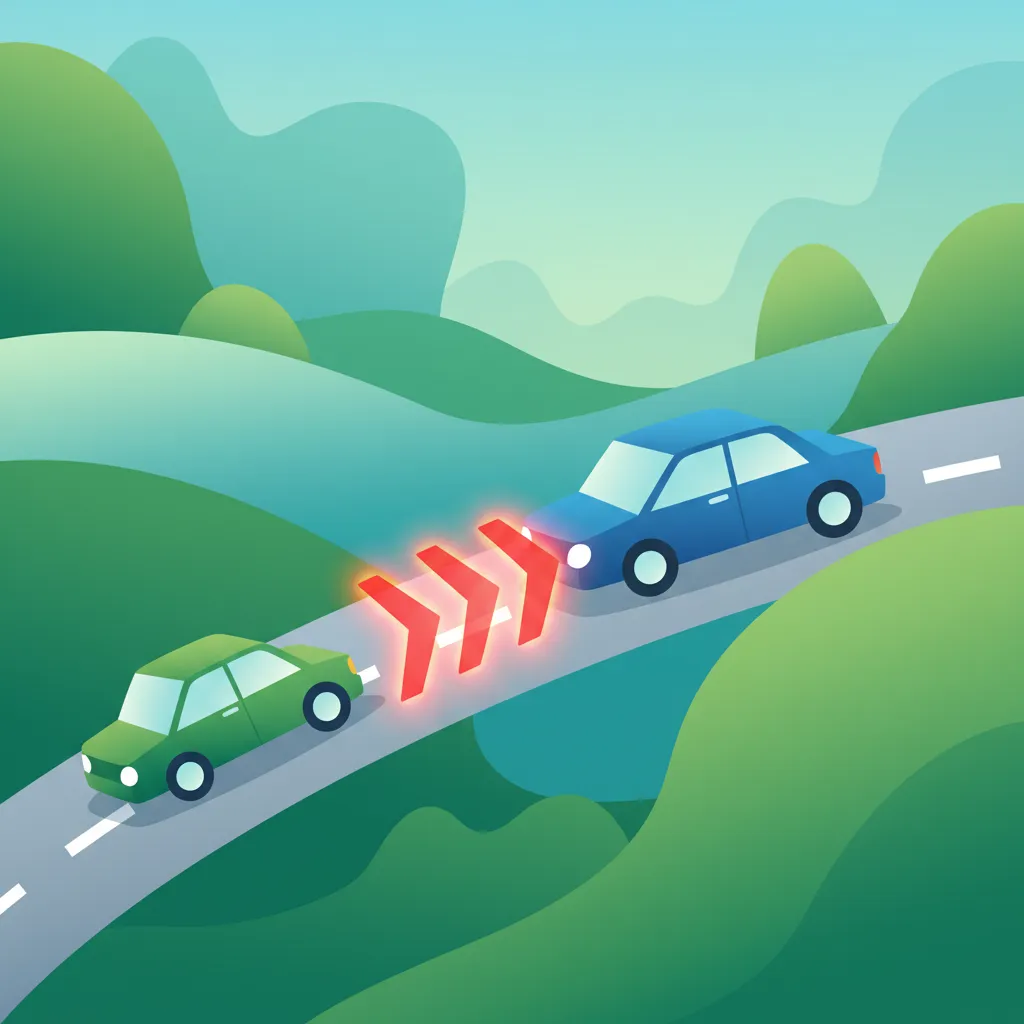
Tailgating refers to the dangerous practice of driving too closely behind another vehicle, failing to maintain an adequate safety margin. In Swedish, this often translates to driving with insufficient avstånd till framförvarande (distance to the vehicle ahead). This severely limits a driver's ability to react safely to sudden changes in traffic, such as the vehicle in front braking unexpectedly, or to hazards further down the road.
A safe following distance, conversely, is the minimum space you should keep between your vehicle and the one ahead to allow sufficient time and distance to react and stop safely under current conditions. This distance must account for your perception-reaction time and your vehicle's braking distance.
Maintaining a safe following distance is perhaps one of the most effective ways to prevent collisions, particularly rear-end crashes, which can lead to severe injuries and multi-vehicle pile-ups. In Sweden, where driving conditions can vary dramatically from dry summer roads to icy winter motorways, adjusting your following distance is paramount.
stoppsträcka (stopping distance), which is the sum of your reaction distance and braking distance. Without enough space, you simply cannot stop in time.Swedish driving instruction emphasizes several practical rules of thumb to help drivers maintain a safe avstånd till framförvarande. These methods are designed to be easily applied on the road:
This is the most widely taught and universally applicable method for judging safe following distance:
kantstolpe (white edge post), when the vehicle in front of you passes it.Important: The 3-second rule is a minimum. In adverse conditions (e.g., rain, snow, ice, darkness, heavy traffic, driving a heavy vehicle, or when tired), you should increase this to 4, 5 seconds, or even more.
Unique to many Swedish rural roads, white edge posts (kantstolpar) are placed along the roadside at specific intervals:
landsvägskörning), a good rule of thumb is to aim for a distance of two to three kantstolpar, which corresponds to 100-150 meters. This provides a clear visual cue for distance.Another practical method taught in Sweden for estimating a safe distance in meters is to simply convert your speed from km/h to meters:
This provides a quick mental estimation, especially useful on motorways or well-marked rural roads.
The ideal safe following distance is not fixed; it constantly changes based on various factors that affect your reaktionssträcka (reaction distance) and bromssträcka (braking distance), which together form your stoppsträcka (stopping distance):
The core distinction lies in control and risk.
The Swedish traffic rules implicitly demand that drivers always maintain a distance that allows them to stop safely, which directly condemns tailgating.
Consider these common Swedish driving situations:
landsväg at 70 km/h, the 3-second rule should be extended to 5-6 seconds, or more. This could mean a distance equivalent to 4-5 kantstolpar (200-250 meters) to account for drastically reduced grip.Learners and even experienced drivers often make these mistakes regarding following distance:
stoppsträcka increases with speed, especially the exponential effect on braking distance.Om bilen bakom ligger för nära)Being tailgated can be stressful and dangerous. If a driver behind you is following too closely, do not brake sharply or aggressively. Instead, the safest course of action is to:
landsväg) to allow the aggressive driver to pass. This removes the immediate risk.Always remember: Space equals Time equals Safety. In Swedish traffic, where varying conditions are the norm, proactively creating a safety buffer by maintaining a generous following distance is the mark of a responsible and skilled driver. It gives you the time to perceive, process, and react, ensuring a safer journey for everyone on the road. This principle is not just about avoiding fines; it's about mastering hazard anticipation and protecting lives.
Tailgating—driving too close to the vehicle ahead—severely limits your ability to react safely and is condemned by Swedish traffic rules. Safe following distance must account for both reaction distance and braking distance, which together form your stopping distance. Swedish driving instruction teaches practical methods including the 3-second rule, counting kantstolpar (white edge posts placed 50m apart), and the km/h-to-meter conversion. The ideal distance is not fixed; it varies with speed, road conditions, visibility, vehicle condition, and driver state. Remember: space equals time equals safety, and a proactive safety buffer protects both you and other road users.
A short set of high-value points that capture the most important ideas from this theory explanation.
The 3-second rule is the universal minimum following distance, but you must increase it in adverse conditions such as rain, snow, ice, or darkness
Doubling your speed roughly doubles your reaction distance and quadruples your braking distance, dramatically increasing stopping distance
Speed determines your minimum safe following distance in meters: at 90 km/h aim for at least 90 meters, at 70 km/h aim for at least 70 meters
White edge posts (kantstolpar) are placed 50 meters apart on rural Swedish roads, so 2-3 posts represent a safe 100-150 meter gap
Maintaining adequate space gives you time to perceive hazards, process information, and react safely rather than being dependent on the driver ahead
Safe following distance equals reaction distance plus braking distance (stoppsträcka), both of which increase with speed
The 3-second rule requires you to count 'one thousand one, one thousand two, one thousand three' between when the vehicle ahead passes a fixed point and when you reach it
On Swedish rural roads, count kantstolpar: 2-3 posts (100-150m) provides a reliable visual reference for safe following distance
Tailgating gives up control—you become dependent on the driver ahead's actions and ability to stop
If being tailgated, do not brake sharply; instead increase your distance to the car ahead and allow the tailgater to overtake when safe
Underestimating how dramatically stopping distance increases with speed—many drivers don't grasp that braking distance quadruples when speed doubles
Failing to increase following distance in poor conditions (rain, snow, black ice), assuming the same gap is sufficient
Feeling pressured by the driver behind and reducing their own safe distance, creating a dangerous squeeze effect
Memorizing the 3-second rule for the exam but not consistently applying it in diverse real-world traffic situations
Focusing only on the brake lights of the car directly ahead rather than observing traffic further down the road to anticipate hazards earlier
Start with a short, direct summary of Tailgating & Safe Distance before reading the full explanation below.
Tailgating refers to driving too close to the vehicle in front, leaving insufficient time to react and stop safely. This significantly raises the risk of rear-end collisions. To prevent tailgating, Swedish traffic rules and best practices recommend maintaining a safe following distance, often calculated using methods like the 3-second rule or specific distance estimates based on speed, to ensure you can stop in time.
Review the most important terms, rule signals, and traffic concepts linked to Tailgating & Safe Distance.
Explore related theory topic pages connected to Tailgating & Safe Distance and continue with the next useful rule explanation.
See the common search queries learners use when trying to understand Tailgating & Safe Distance in Sweden.

Dive deeper into specific theory topics, review detailed explanations of road rules, and reinforce your understanding of Swedish traffic regulations. Continue your preparation for the driving licence exam by exploring each core concept in detail.
Explore Driving Theory TopicsTheory topic content overview
A short set of high-value points that capture the most important ideas from this theory explanation.
The 3-second rule is the universal minimum following distance, but you must increase it in adverse conditions such as rain, snow, ice, or darkness
Doubling your speed roughly doubles your reaction distance and quadruples your braking distance, dramatically increasing stopping distance
Speed determines your minimum safe following distance in meters: at 90 km/h aim for at least 90 meters, at 70 km/h aim for at least 70 meters
White edge posts (kantstolpar) are placed 50 meters apart on rural Swedish roads, so 2-3 posts represent a safe 100-150 meter gap
Maintaining adequate space gives you time to perceive hazards, process information, and react safely rather than being dependent on the driver ahead
Safe following distance equals reaction distance plus braking distance (stoppsträcka), both of which increase with speed
The 3-second rule requires you to count 'one thousand one, one thousand two, one thousand three' between when the vehicle ahead passes a fixed point and when you reach it
On Swedish rural roads, count kantstolpar: 2-3 posts (100-150m) provides a reliable visual reference for safe following distance
Tailgating gives up control—you become dependent on the driver ahead's actions and ability to stop
If being tailgated, do not brake sharply; instead increase your distance to the car ahead and allow the tailgater to overtake when safe
Underestimating how dramatically stopping distance increases with speed—many drivers don't grasp that braking distance quadruples when speed doubles
Failing to increase following distance in poor conditions (rain, snow, black ice), assuming the same gap is sufficient
Feeling pressured by the driver behind and reducing their own safe distance, creating a dangerous squeeze effect
Memorizing the 3-second rule for the exam but not consistently applying it in diverse real-world traffic situations
Focusing only on the brake lights of the car directly ahead rather than observing traffic further down the road to anticipate hazards earlier
Start with a short, direct summary of Tailgating & Safe Distance before reading the full explanation below.
Tailgating refers to driving too close to the vehicle in front, leaving insufficient time to react and stop safely. This significantly raises the risk of rear-end collisions. To prevent tailgating, Swedish traffic rules and best practices recommend maintaining a safe following distance, often calculated using methods like the 3-second rule or specific distance estimates based on speed, to ensure you can stop in time.
Review the most important terms, rule signals, and traffic concepts linked to Tailgating & Safe Distance.
Explore related theory topic pages connected to Tailgating & Safe Distance and continue with the next useful rule explanation.
See the common search queries learners use when trying to understand Tailgating & Safe Distance in Sweden.
Dive deeper into specific theory topics, review detailed explanations of road rules, and reinforce your understanding of Swedish traffic regulations. Continue your preparation for the driving licence exam by exploring each core concept in detail.
Explore Driving Theory TopicsUse this exam-focused revision tip to understand how Tailgating & Safe Distance is likely to appear in theory questions for learners in Sweden. This section helps you identify the most testable part of the rule, avoid common traps, and remember the concept more effectively during Swedish driving theory exam preparation.
The Swedish theory test frequently includes questions on safe following distances, especially calculations involving the 3-second rule or relating speed to required meters. Remember that the distance needed doubles if your speed doubles, and poor road conditions significantly increase braking distance. Practice these calculations and apply them to various scenarios.
Read direct answers to the most common learner questions about Tailgating & Safe Distance in Sweden. This FAQ focuses on rule confusion, practical meaning, comparison with similar concepts, and the exact uncertainties that appear most often in Swedish driving theory revision and exam preparation.
Tailgating is when a driver follows another vehicle too closely, leaving insufficient space to react safely if the vehicle ahead brakes or slows down. It's a dangerous practice that increases collision risk.
In Sweden, maintaining a safe following distance is crucial for road safety, allowing you enough time to react to hazards, brake effectively, and prevent rear-end collisions, especially given varied road and weather conditions.
A common rule in Sweden is the 3-second rule: pick a fixed point, and when the vehicle ahead passes it, count three seconds. If you reach the point before counting three, you are too close. For landsväg (country roads), one approach is to keep a distance in meters roughly equal to your speed in km/h.
Key factors include your speed, road conditions (wet, icy), vehicle type and load, and your own reaction time. Higher speeds and poor conditions require significantly greater distances.
If another driver is tailgating you, increase your distance to the vehicle in front of you. This gives you more space to slow down gradually if needed, reducing the risk of being rear-ended. You can also move to another lane or pull over if it's safe to do so.
A safe following distance must cover both your reaction distance (the distance your car travels before you start braking) and your braking distance (the distance your car travels while you are braking). Tailgating means you haven't allowed enough space for these combined distances.
Refine your study plan by exploring practice sets on specific Swedish traffic rules, road signs, or driving situations. Use the search to quickly access relevant questions and focus your preparation for the official driving licence theory exam.