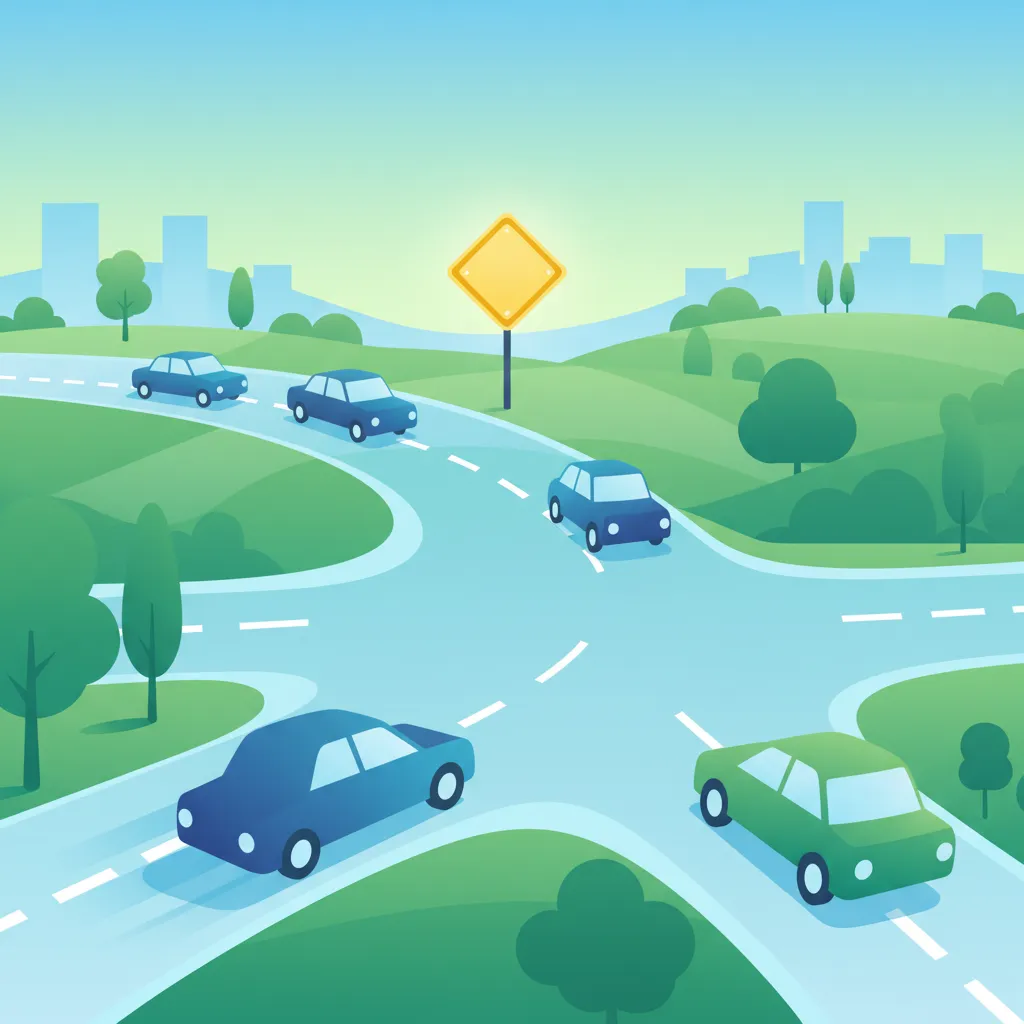
A priority road (huvudled) is designed to give traffic on it precedence over traffic entering from intersecting roads. This section clarifies how to identify priority roads through specific Swedish traffic signs and markings, and details the rules for yielding to and from these roads. Pay close attention to how these rules streamline traffic flow and prevent collisions at intersections.
Theory topic content overview
Read the full theory topic guide for Priority Roads with structured, easy-to-scan content built for learners in Sweden. This detailed section explains the exact rule, meaning, traffic context, comparison points, and exam logic behind this Swedish driving theory topic so you can study faster, understand the concept more clearly, and avoid common interpretation mistakes on the theory test.
A priority road (huvudled) in Sweden is a designated main road where traffic generally has förkörsrätt (precedence or right of way) over vehicles entering from intersecting roads. The fundamental purpose of a priority road is to facilitate a smoother, more continuous flow of traffic along key routes, reducing the need for drivers on these roads to stop or slow down unnecessarily at every intersection.
Understanding huvudled rules is not just vital for safe navigation in Sweden, but it's also a frequently tested topic in the Swedish driving theory exam. Misinterpreting these rules can lead to dangerous situations and direct test failures.
Knowing when you are on a priority road or approaching one is critical. In Sweden, huvudledar are clearly marked using specific traffic signs and sometimes supplemented by road markings.
The primary sign indicating a priority road in Sweden is the yellow diamond sign (sign D1).
Equally important is the end of priority road sign (sign D2).
högerregeln – right-hand rule) will apply unless otherwise specified by other signs or signals.While signs are the primary indicator, look for supplementary road markings that reinforce the rules for those entering a priority road:
väjningsplikt). They are almost always present on roads leading into a huvudled.huvudledar.The existence of a huvudled dictates specific actions for drivers both on the priority road and on roads intersecting with it.
huvudled, you generally have the right of way over traffic entering from side roads. This means you can typically proceed through intersections without stopping or slowing down to yield to traffic from the sides, provided it is safe to do so.gångpassage or övergångsställe if marked), you still have a duty to give way to pedestrians who are crossing or clearly about to cross. At marked pedestrian crossings, drivers always have a duty to give way to pedestrians already on or about to enter the crossing.väjningsplikt): If you are on a road that intersects with a huvudled and is marked with a "Give Way" sign (sign B4) or a "Stop" sign (sign B5), you must give way to all traffic on the priority road. This includes vehicles, cyclists, and mopeds.huvudled, carefully check for traffic from both directions. Traffic on the priority road may be moving at higher speeds.It's crucial for Swedish driving theory learners to understand when huvudled rules apply and when they are overridden.
Högerregeln)Högerregeln: In Sweden, the högerregeln (right-hand rule) applies at unmarked intersections where no other signs or signals dictate priority. It means you must give way to traffic approaching from your right.Huvudled overrides högerregeln: The huvudled rule takes precedence over the högerregeln. If you are on a priority road, traffic from your right on an intersecting side road must give way to you, not the other way around. This is a common point of confusion for learners.While huvudled status grants precedence, certain situations always override its rules:
huvudled status at that specific point.Let's consider some typical situations involving huvudledar:
huvudled from a residential street. You are driving through a residential area and approach an intersection marked with a "Give Way" sign and shark's teeth. Beyond the intersection, you see the yellow diamond sign indicating a huvudled. You must slow down, stop if necessary, and ensure the huvudled is clear of traffic before you proceed.huvudled in an urban area. You are on a huvudled in a city, marked with yellow diamond signs. You approach an intersection where a vehicle from a side street stops at a "Stop" sign. You can continue driving without stopping, but you must still observe the vehicle, make eye contact if possible, and be ready to react if they fail to yield.huvudled. You are on a huvudled approaching an intersection that also has active traffic lights. The lights are red. Despite being on a huvudled, you must stop at the red light. The priority road status is suspended by the traffic lights.Learners frequently make mistakes regarding huvudledar in the Swedish theory test and practical driving:
huvudled with högerregeln: A common error is applying the högerregeln at an intersection with a priority road, giving way to traffic from the right when they should have yielded to you, or vice-versa. Always check for the priority road sign first.huvudled status can lead to dangerous and illegal maneuvers.huvudled from a road with a "Stop" sign, some drivers roll through without a complete stop, which is illegal and dangerous.huvudledar: Traffic on priority roads, especially outside urban areas, often moves at higher speeds. Learners failing to properly assess the speed and distance of approaching vehicles before entering can misjudge gaps.Always remember that huvudledar are designed for efficiency but demand constant vigilance. When driving in Sweden, your primary task at any intersection is to identify who has förkörsrätt.
haitänder) and stop lines reinforce väjningsplikt.högerregeln.By systematically checking for these indicators, you can confidently navigate intersections and contribute to safe and efficient traffic flow on Sweden's roads.
A priority road (huvudled) in Sweden is a main route where traffic has förkörsrätt, identified by the yellow diamond sign D1. Drivers on a priority road generally proceed without yielding, while those entering must give way at shark's teeth markings and stop fully at stop lines. The högerregeln only applies when the priority road ends (sign D2) or at unmarked intersections with no other signs. Traffic lights and police directions always override priority road signs.
A short set of high-value points that capture the most important ideas from this theory explanation.
A priority road (huvudled) gives traffic on it förkörsrätt (precedence) over vehicles entering from side roads, identified by the yellow diamond sign D1.
The End of Priority Road sign D2 (yellow diamond with diagonal stripe) means normal högerregeln rules apply unless otherwise indicated.
Shark's teeth road markings (haitänder) always indicate väjningsplikt (yielding duty) for drivers entering a huvudled.
Traffic signals and police directions always override priority road signs regardless of huvudled status.
Priority roads streamline traffic flow but require constant defensive driving awareness.
The yellow diamond sign D1 marks a priority road; the same sign with a black diagonal stripe (D2) marks its end.
Huvudled rules override the högerregeln right-hand rule at intersections.
At a Stop sign you must come to a complete stop even if no traffic is visible.
Active traffic lights always take precedence over priority road status.
Drivers on a huvudled must still yield to pedestrians at crossings.
Assuming absolute right of way on a priority road and failing to drive defensively.
Applying the högerregeln at an intersection that has a valid priority road sign.
Ignoring active traffic lights or police directions when on a huvudled.
Rolling through a Stop sign without a complete stop before entering a priority road.
Underestimating the speed and distance of vehicles on a priority road before entering.
Start with a short, direct summary of Priority Roads before reading the full explanation below.
A priority road (huvudled) is a main thoroughfare in Sweden where vehicles typically have the right of way over traffic approaching from side roads. Drivers on a priority road can generally proceed without yielding, while those entering or crossing it must give way. Priority roads are identified by distinctive yellow diamond signs and often by road markings, ensuring smooth traffic flow and reducing confusion at intersections in Sweden.
Review the most important terms, rule signals, and traffic concepts linked to Priority Roads.
Explore related theory topic pages connected to Priority Roads and continue with the next useful rule explanation.
See the common search queries learners use when trying to understand Priority Roads in Sweden.

Dive deeper into specific theory topics, review detailed explanations of road rules, and reinforce your understanding of Swedish traffic regulations. Continue your preparation for the driving licence exam by exploring each core concept in detail.
Explore Driving Theory TopicsTheory topic content overview
A short set of high-value points that capture the most important ideas from this theory explanation.
A priority road (huvudled) gives traffic on it förkörsrätt (precedence) over vehicles entering from side roads, identified by the yellow diamond sign D1.
The End of Priority Road sign D2 (yellow diamond with diagonal stripe) means normal högerregeln rules apply unless otherwise indicated.
Shark's teeth road markings (haitänder) always indicate väjningsplikt (yielding duty) for drivers entering a huvudled.
Traffic signals and police directions always override priority road signs regardless of huvudled status.
Priority roads streamline traffic flow but require constant defensive driving awareness.
The yellow diamond sign D1 marks a priority road; the same sign with a black diagonal stripe (D2) marks its end.
Huvudled rules override the högerregeln right-hand rule at intersections.
At a Stop sign you must come to a complete stop even if no traffic is visible.
Active traffic lights always take precedence over priority road status.
Drivers on a huvudled must still yield to pedestrians at crossings.
Assuming absolute right of way on a priority road and failing to drive defensively.
Applying the högerregeln at an intersection that has a valid priority road sign.
Ignoring active traffic lights or police directions when on a huvudled.
Rolling through a Stop sign without a complete stop before entering a priority road.
Underestimating the speed and distance of vehicles on a priority road before entering.
Start with a short, direct summary of Priority Roads before reading the full explanation below.
A priority road (huvudled) is a main thoroughfare in Sweden where vehicles typically have the right of way over traffic approaching from side roads. Drivers on a priority road can generally proceed without yielding, while those entering or crossing it must give way. Priority roads are identified by distinctive yellow diamond signs and often by road markings, ensuring smooth traffic flow and reducing confusion at intersections in Sweden.
Review the most important terms, rule signals, and traffic concepts linked to Priority Roads.
Explore related theory topic pages connected to Priority Roads and continue with the next useful rule explanation.
See the common search queries learners use when trying to understand Priority Roads in Sweden.
Dive deeper into specific theory topics, review detailed explanations of road rules, and reinforce your understanding of Swedish traffic regulations. Continue your preparation for the driving licence exam by exploring each core concept in detail.
Explore Driving Theory TopicsUse this exam-focused revision tip to understand how Priority Roads is likely to appear in theory questions for learners in Sweden. This section helps you identify the most testable part of the rule, avoid common traps, and remember the concept more effectively during Swedish driving theory exam preparation.
In the Swedish driving theory exam, pay close attention to scenarios involving priority roads. Many questions test your ability to correctly identify the priority road sign and apply the 'give way' rule when entering or crossing it. Remember that traffic signals and police directions always override priority road signs.
Read direct answers to the most common learner questions about Priority Roads in Sweden. This FAQ focuses on rule confusion, practical meaning, comparison with similar concepts, and the exact uncertainties that appear most often in Swedish driving theory revision and exam preparation.
A priority road in Sweden is a designated road where traffic has automatic right of way over vehicles approaching from connecting roads, unless otherwise specified by traffic signals.
Priority roads are primarily indicated by the yellow diamond-shaped sign (Väjningsplikt mot trafik på huvudled) and may also have specific road markings.
While you generally have right of way, you must still be attentive and ready to react. Emergency vehicles, police instructions, and traffic lights can override priority road rules.
When entering a priority road from a side road, you must always yield to traffic already on the priority road. Look for 'Give Way' signs or 'Stop' signs.
On a regular road without specific signs, the 'right-hand rule' (högerregeln) often applies at unmarked intersections. On a priority road, traffic on the main road always has precedence.
Yes, traffic lights can be present on priority roads. In such cases, the traffic light instructions take precedence over the priority road sign.
Refine your study plan by exploring practice sets on specific Swedish traffic rules, road signs, or driving situations. Use the search to quickly access relevant questions and focus your preparation for the official driving licence theory exam.