
School zones are specific areas around educational facilities where children frequently walk, cycle, or cross the road. Due to their limited awareness of traffic hazards and often unpredictable movements, drivers must take extra precautions. This means reducing your speed significantly, increasing your vigilance, and being prepared to react instantly to unexpected situations.
Theory topic content overview
Read the full theory topic guide for School Zones with structured, easy-to-scan content built for learners in Sweden. This detailed section explains the exact rule, meaning, traffic context, comparison points, and exam logic behind this Swedish driving theory topic so you can study faster, understand the concept more clearly, and avoid common interpretation mistakes on the theory test.
Driving in school zones – areas surrounding educational facilities where children are frequently present – requires a distinct level of caution and awareness from drivers. In Swedish traffic, the emphasis on protecting vulnerable road users is paramount, and this is particularly true near schools, kindergartens, and playgrounds. It's not just about a posted speed limit; it's about adapting your driving to the potential for unpredictable child behaviour.
The need for extra vigilance in Swedish school zones stems from several critical factors related to children:
Understanding these vulnerabilities is crucial for anticipating risks and preventing accidents. The Swedish driving theory test frequently includes scenarios related to driving near schools to ensure learners grasp this vital safety concept.
Navigating a school zone effectively involves more than just obeying signs; it requires a proactive and defensive mindset.
gångfartsområde).Several elements influence the level of caution required:
Learners often make these errors when driving in school zones:
The Swedish Driving License Theory emphasizes that the driver carries the primary responsibility for safety on the road, especially concerning vulnerable road users. When approaching or driving through a school zone, your mindset should be one of extreme caution and anticipation. Always expect the unexpected from children. By significantly reducing your speed, staying alert, and being prepared to stop, you ensure the safety of children and demonstrate the responsible driving behavior expected in Sweden.
School zones require drivers to exercise extreme caution due to children's limited traffic awareness and unpredictable behavior. The triangular Varningsskylt A26 'Barn' warning sign marks areas where children frequently appear near roads. Drivers must reduce speed well below posted limits when children are present, continuously scan pavements and parked vehicles, and always be prepared to stop immediately. The Swedish driving theory test emphasizes that drivers bear primary responsibility for protecting vulnerable child road users, including stopping for school buses and prioritizing safe speed over legal maximums in these areas.
A short set of high-value points that capture the most important ideas from this theory explanation.
Children in school zones have limited hazard awareness and unpredictable behavior, making them particularly vulnerable road users
Reduce your speed significantly below the posted limit whenever children are present or likely to be present in the area
The triangular Varningsskylt A26 'Barn' warning sign indicates areas where children frequently appear near the road, requiring extra vigilance
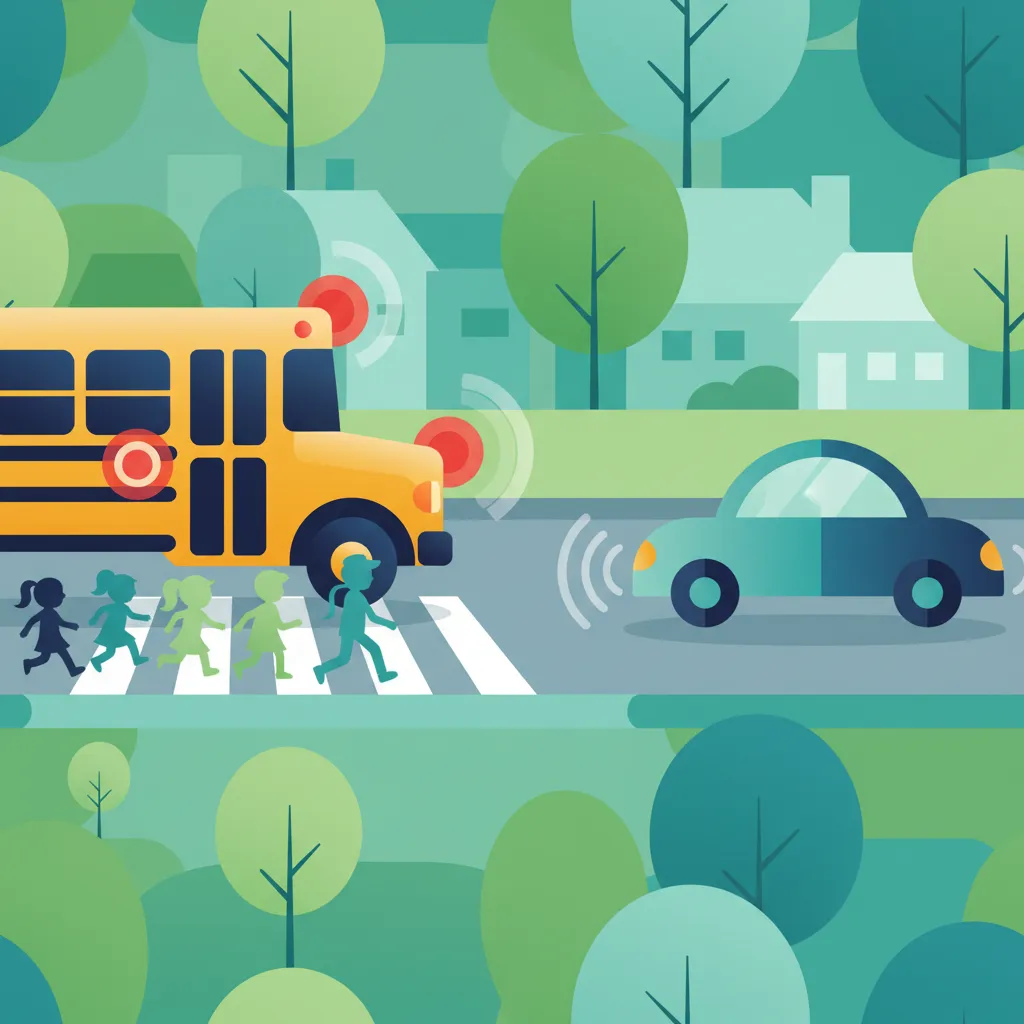
When a skolbuss (school bus) stops to let children on or off, you must stop from both directions until it moves and children have crossed
Always prioritize safe speed over the legal maximum when vulnerable road users are present in school zones
Children have underdeveloped peripheral vision and cannot accurately judge the speed or distance of approaching vehicles
Never assume children will use designated crossings or wait for vehicles—they may cross unexpectedly at any time
Peak danger times in school zones are early morning arrivals and mid-afternoon dismissals
The posted speed limit is the absolute legal maximum; the safe speed is determined by conditions and child presence
You must stop for a stopped school bus from both directions when children are boarding or alighting
Driving at the full 30 km/h speed limit even when children are clearly present or emerging from parked vehicles
Focusing only on the road ahead and failing to scan pavements and parked cars for children who may dart out
Assuming children will behave like adults and wait at crossings rather than being prepared for unpredictable crossings
Becoming distracted by a phone or other devices when driving through school zones, drastically reducing critical reaction time
Failing to stop for a stopped skolbuss or attempting to pass it while children are still crossing in front
Start with a short, direct summary of School Zones before reading the full explanation below.
A school zone requires drivers to exercise extreme caution, significantly reduce speed, and maintain heightened awareness for children who may behave unpredictably. These areas are characterized by increased pedestrian and bicycle traffic, especially during school arrival and dismissal times. Drivers must be ready to stop suddenly to ensure the safety of vulnerable road users near schools.
Review the most important terms, rule signals, and traffic concepts linked to School Zones.
Explore related theory topic pages connected to School Zones and continue with the next useful rule explanation.
See the common search queries learners use when trying to understand School Zones in Sweden.

Dive deeper into specific theory topics, review detailed explanations of road rules, and reinforce your understanding of Swedish traffic regulations. Continue your preparation for the driving licence exam by exploring each core concept in detail.
Explore Driving Theory TopicsTheory topic content overview
A short set of high-value points that capture the most important ideas from this theory explanation.
Children in school zones have limited hazard awareness and unpredictable behavior, making them particularly vulnerable road users
Reduce your speed significantly below the posted limit whenever children are present or likely to be present in the area
The triangular Varningsskylt A26 'Barn' warning sign indicates areas where children frequently appear near the road, requiring extra vigilance
When a skolbuss (school bus) stops to let children on or off, you must stop from both directions until it moves and children have crossed
Always prioritize safe speed over the legal maximum when vulnerable road users are present in school zones
Children have underdeveloped peripheral vision and cannot accurately judge the speed or distance of approaching vehicles
Never assume children will use designated crossings or wait for vehicles—they may cross unexpectedly at any time
Peak danger times in school zones are early morning arrivals and mid-afternoon dismissals
The posted speed limit is the absolute legal maximum; the safe speed is determined by conditions and child presence
You must stop for a stopped school bus from both directions when children are boarding or alighting
Driving at the full 30 km/h speed limit even when children are clearly present or emerging from parked vehicles
Focusing only on the road ahead and failing to scan pavements and parked cars for children who may dart out
Assuming children will behave like adults and wait at crossings rather than being prepared for unpredictable crossings
Becoming distracted by a phone or other devices when driving through school zones, drastically reducing critical reaction time
Failing to stop for a stopped skolbuss or attempting to pass it while children are still crossing in front
Start with a short, direct summary of School Zones before reading the full explanation below.
A school zone requires drivers to exercise extreme caution, significantly reduce speed, and maintain heightened awareness for children who may behave unpredictably. These areas are characterized by increased pedestrian and bicycle traffic, especially during school arrival and dismissal times. Drivers must be ready to stop suddenly to ensure the safety of vulnerable road users near schools.
Review the most important terms, rule signals, and traffic concepts linked to School Zones.
Explore related theory topic pages connected to School Zones and continue with the next useful rule explanation.
See the common search queries learners use when trying to understand School Zones in Sweden.
Dive deeper into specific theory topics, review detailed explanations of road rules, and reinforce your understanding of Swedish traffic regulations. Continue your preparation for the driving licence exam by exploring each core concept in detail.
Explore Driving Theory TopicsUse this exam-focused revision tip to understand how School Zones is likely to appear in theory questions for learners in Sweden. This section helps you identify the most testable part of the rule, avoid common traps, and remember the concept more effectively during Swedish driving theory exam preparation.
On the Swedish theory test, pay close attention to questions involving school zones. The key is always to prioritize the safety of children. This often means driving significantly slower than the posted limit if conditions warrant, being prepared to stop, and demonstrating advanced hazard perception for unpredictable movements. Avoid assuming children will act like adults in traffic.
Read direct answers to the most common learner questions about School Zones in Sweden. This FAQ focuses on rule confusion, practical meaning, comparison with similar concepts, and the exact uncertainties that appear most often in Swedish driving theory revision and exam preparation.
While specific 'school zone' signs are not universally used in Sweden, areas around schools are implicitly recognized as zones requiring extra caution. Drivers should identify these areas by the presence of school buildings, children, and often signs indicating reduced speed limits or warning of children (like the 'Barn' sign).
Lower speeds provide more reaction time to unexpected movements from children, who may dart into the road without looking. It significantly reduces the severity of potential accidents, making it easier to stop in time.
Children are less predictable than adults; they may be distracted, misjudge distances, or not understand traffic rules. This requires drivers to anticipate sudden actions like running into the street or cycling erratically.
Be alert for groups of children, crossing guards, school buses stopping, and vehicles parked along the road that might obscure children. Always scan widely and prepare for the unexpected.
Sweden primarily uses general warning signs for children (like 'Barn', A17) and speed limit signs (C31) to indicate reduced speeds in areas where children are present. There isn't a single 'school zone' sign like in some other countries.
The Swedish theory test frequently includes questions about hazard perception and safe driving in areas with vulnerable road users, especially children. You'll be tested on your knowledge of appropriate speed, vigilance, and understanding the risks involved.
Refine your study plan by exploring practice sets on specific Swedish traffic rules, road signs, or driving situations. Use the search to quickly access relevant questions and focus your preparation for the official driving licence theory exam.