
This lesson teaches you the essential techniques for navigating tight turns and intersections with heavy goods vehicles. By mastering pivot points and trailer tracking, you will gain the confidence needed to handle large dimensions safely in accordance with French road regulations.

Lesson content overview
Navigating turns in a heavy goods vehicle (poids lourd) or an articulated combination (véhicule articulé) is one of the most demanding skills required of a professional driver. Unlike standard passenger cars, large vehicles require substantial physical space to negotiate intersections, roundabouts, and narrow urban streets.
Under the French Code de la route, drivers seeking Category C (rigid goods vehicles) and Category CE (articulated vehicles or road trains) must master the physics of vehicle movement, understand exact lane marking regulations, and anticipate how their vehicle interacts with surrounding traffic.
This lesson provides a comprehensive, textbook-grade analysis of the principles, laws, and techniques required to plan and execute wide turns safely and legally on French roads.
To execute a wide turn safely, you must first understand the physical forces and spatial dimensions at play. Every vehicle has unique turning characteristics dictated by its wheelbase, overall length, and articulation joints.
The turning radius is defined as the radius of the smallest circular turn that a vehicle can make when its steering wheel is at full lock.
For a standard Category C vehicle, a turning radius of up to 12.5 metres is common under European and French regulations (Code de la route, articles R312-11 to R312-14). This means a turning path of at least 25 metres in diameter is required to complete a full 180-degree turn. Believing that a rigid truck or semi-trailer can negotiate a corner using the same tight line as a passenger car is a dangerous misunderstanding that leads to infrastructure damage and collisions.
The pivot point is the effective center of rotation around which the vehicle turns.
The physical point around which a vehicle rotates during a maneuver. In forward motion, this is typically centered near the front steering axle(s); during reverse maneuvers with a trailer, the pivot point shifts toward the rear trailer axles.
Before initiating any turn, you must align the vehicle so that this pivot point remains safely within the designated lane boundaries. Misjudging the pivot point causes the rear wheels to either cut the corner too tightly (striking curbs or pedestrians) or swing too wide (encroaching on oncoming traffic).
For Category CE drivers, turning is complicated by the connection between the tractor unit (tracteur routier) and the semi-trailer (semi-remorque).
The articulation angle is the angle formed between the longitudinal axis of the towing vehicle and that of its trailer.
A large articulation angle significantly increases the risk of trailer swing (balayage) and off-tracking (the trailer cutting inside the tractor's path). If you turn too sharply, the rear of the trailer will swing out in the opposite direction of the turn, potentially striking vehicles in adjacent lanes, signs, or pedestrians on the pavement.
The Danger of Off-Tracking: During a sharp turn, the rear wheels of a semi-trailer do not follow the path of the tractor's front wheels. Instead, they cut inward toward the corner. The longer the distance between the kingpin and the trailer axles, the greater this inward "cut-in" effect will be.
Under French road law, maintaining strict lane discipline is a legal obligation designed to ensure predictability and protect vulnerable road users. However, the Code de la route recognizes that heavy goods vehicles cannot physically complete some turns without utilizing more than one lane's width.
When approaching a turn, you must utilize the full width of your designated lane to accommodate your vehicle’s turning radius.
The legal framework governing lane markings during wide turns is strict but practical:
Executing a flawless wide turn requires a systematic, proactive approach. Use the following step-by-step procedure to manage your vehicle's speed, path, and surroundings:
Assess and Plan: Scan the intersection at least 150 metres in advance. Identify obstacles such as traffic lights, signs, utility poles, parked vehicles, and pedestrians. Check your mirrors to locate nearby cyclists and motorists.
Signal Early: Activate your turn indicator at least 10 seconds before initiating the maneuver to give surrounding traffic ample time to react and stay back.
Position the Vehicle: Align the vehicle toward the outer edge of your lane. For a right turn, position the vehicle towards the left of your lane; for a left turn, position it towards the right, ensuring you do not cross into oncoming traffic lanes.
Manage Speed: Reduce your speed significantly before starting the turn. Slowing down to 10–15 km/h reduces the articulation angle, minimizes trailer swing, and gives you more time to monitor your blind spots.
Establish the Pivot Point: Drive forward until your pivot point (front axle area) is aligned with the center of the turn before turning the steering wheel.
Execute the Turn: Turn the steering wheel smoothly. Monitor your mirrors constantly—especially the wide-angle and close-proximity mirrors—to ensure the trailer wheels clear the curb and that no vehicles are attempting to squeeze past on the inside.
Re-align and Accelerate: Once the trailer has cleared the corner and is fully aligned behind the tractor, gently straighten the steering wheel and gradually accelerate to match the flow of traffic.
Surrounding motorists and cyclists often do not understand the spatial requirements of a heavy vehicle. They may assume that because you have positioned your vehicle to the left side of a lane, you intend to turn left, when you are actually preparing for a wide right turn. This makes clear communication paramount.
The "Right-Side Squeeze" Hazard: When preparing for a wide right turn, your vehicle will temporarily leave a gap on its right side. Motorists, motorcyclists, and cyclists often try to fill this gap, unaware that your vehicle will swing back to the right. Activating your right turn signal early and maintaining a defensive lane position are your best protections against this hazard.
Modern French goods vehicles are equipped with specialized blind-spot (angles morts) warning stickers and advanced mirror systems, including:
Despite these mirrors, blind spots remain, especially during the turn when the tractor-trailer bends and the mirrors point away from the rear of the trailer. You must continuously scan your mirrors and physical blind spots, particularly looking out for cyclists who may attempt to pass on your inside during slow urban maneuvers.
Operating a heavy vehicle comes with significant legal responsibilities. Failure to execute turns safely can result in severe legal and financial penalties under the French Code de la route.
Drivers must stay within their lane markings while turning unless the physical dimensions of the vehicle require crossing a broken line (ligne discontinue) for safety. Crossing solid white lines (lignes continues) is strictly prohibited (Article R412-19) and carries a €135 fine and a 3-point deduction from your driving licence.
You must activate your turn signals at least 5 seconds before standard maneuvers, and at least 10 seconds before executing a wide turn where the vehicle's trailer or body will occupy more than one lane width. Failure to signal a change of direction carries a €35 fine and a 3-point deduction.
Drivers must reduce speed before initiating a turn to ensure that the articulation angle remains within safe limits and to prevent trailer swing or roll-over. Speed must be adapted to road conditions, visibility, and load weight (Article R413-17).
Drivers must utilize the full width of their designated lane to safely accommodate the vehicle’s turning radius, thereby preventing encroachment into oncoming lanes.
When turning at an intersection, you must yield the right-of-way to pedestrians crossing the road you are entering, as well as to cyclists riding on adjacent cycle paths (pistes cyclables) (Article R415-3). Failure to yield to a pedestrian carries a €135 fine and a 6-point deduction.
Avoiding errors during wide turns requires constant vigilance. Below are the most common violations and operational mistakes made by heavy vehicle drivers, along with their consequences and correct behaviors.
A professional driver must adapt their turning strategy to shifting environmental conditions:
Before executing any wide turn, run through this mental checklist:
Explore all units and lessons included in this driving theory course.
Lesson content overview
Explore all units and lessons included in this driving theory course.
Explore search topics learners often look for when studying Planning and Executing Wide Turns. These topics reflect common questions about road rules, driving situations, safety guidance, and lesson level theory preparation for learners in France.
Browse additional driving theory lessons that cover connected traffic rules, road signs, and common driving situations related to this topic. Improve your understanding of how different rules interact across everyday traffic scenarios.
Understand the specific challenges of operating large goods vehicles in restricted urban environments. This lesson covers strategies for managing tight delivery spaces, navigating narrow streets, and mitigating risks to vulnerable road users and infrastructure in dense city centers under French traffic regulations.
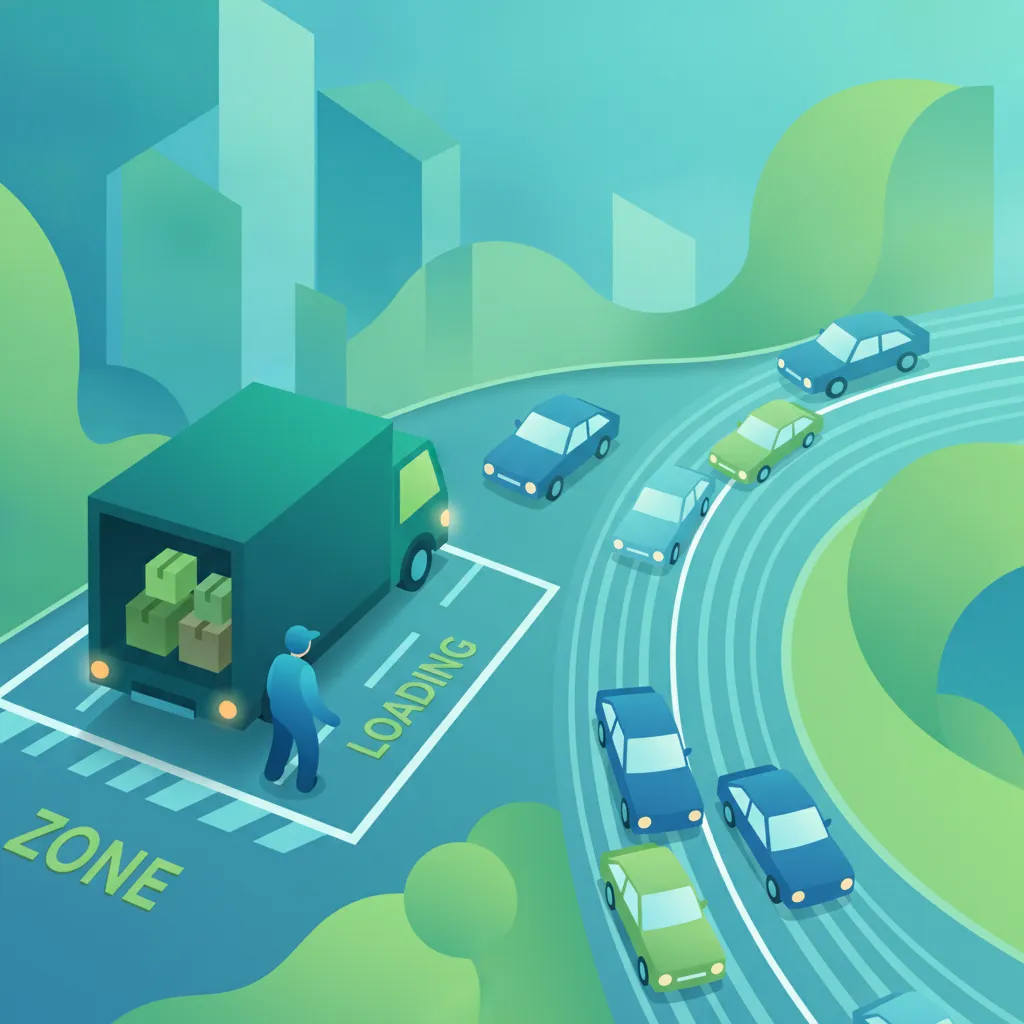
In this lesson, drivers will learn how to navigate urban delivery zones, understanding the rules surrounding loading bays, time windows, and restricted access areas. The content includes the process for obtaining delivery permits, strategies for safe maneuvering in congested city streets, and best practices for minimizing impact on pedestrian traffic. Learners will also be introduced to French city-specific regulations that govern goods vehicle deliveries.
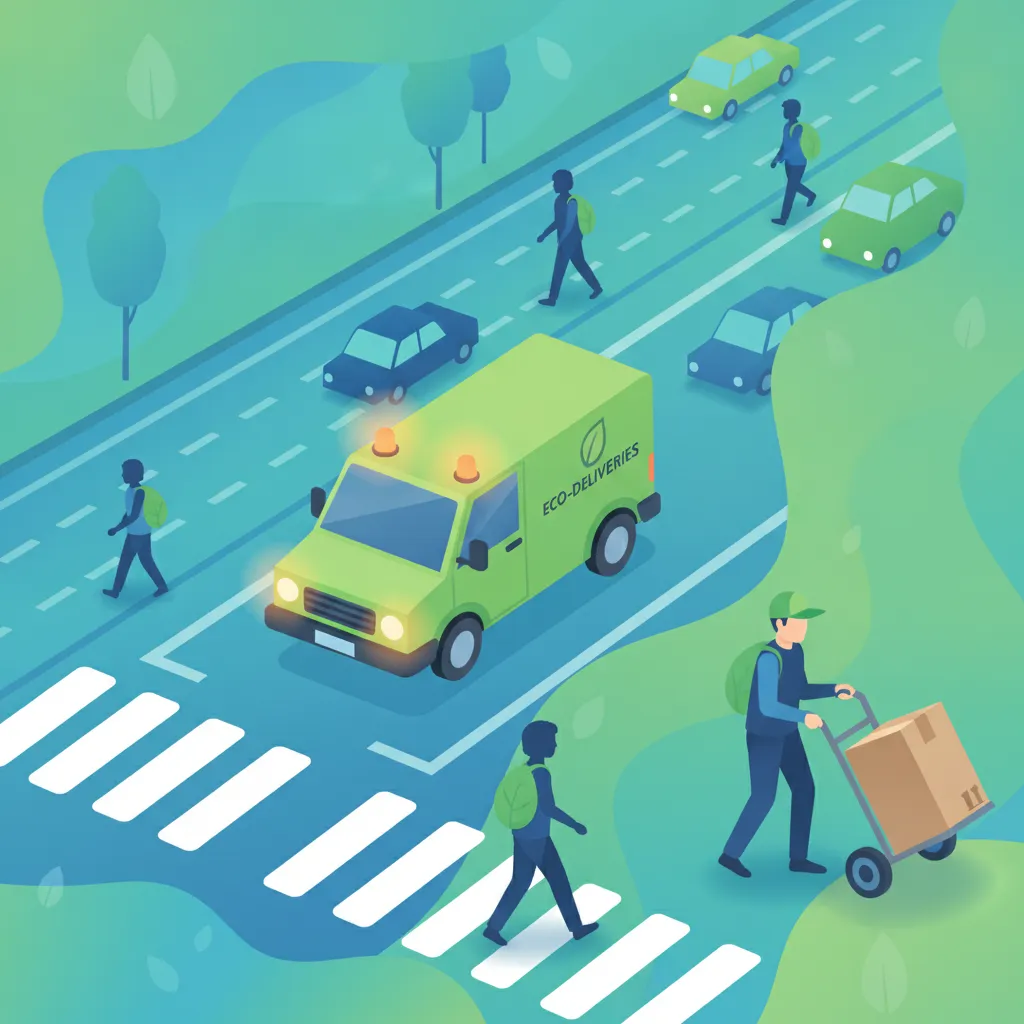
This lesson focuses on the unique challenges of performing deliveries in dense urban areas. Learners will explore best practices for loading and unloading safely, navigating traffic congestion, and minimizing risks to pedestrians and cyclists. The content also covers compliance with city regulations for delivery zones, scheduling considerations, and the importance of careful maneuvering to avoid accidents.

In this lesson, drivers will learn best practices for manoeuvring goods vehicles into loading docks and other confined spaces. The content covers the use of spotting aids, guidance markings, and reverse assistance technologies. Learners will understand how to align the vehicle and trailer correctly with dock doors, maintain situational awareness, and use proper signaling for safety. The lesson also emphasizes the importance of communication with dock personnel.

This lesson analyzes the various traffic challenges unique to operating large passenger vehicles in historic and modern French urban areas. Drivers will learn to manage narrow street layouts, double-parked delivery trucks, and high-density multi-lane roundabouts safely. The lesson emphasizes defensive driving strategies, route adjustments, and maintaining mental focus under severe schedule and time pressures.
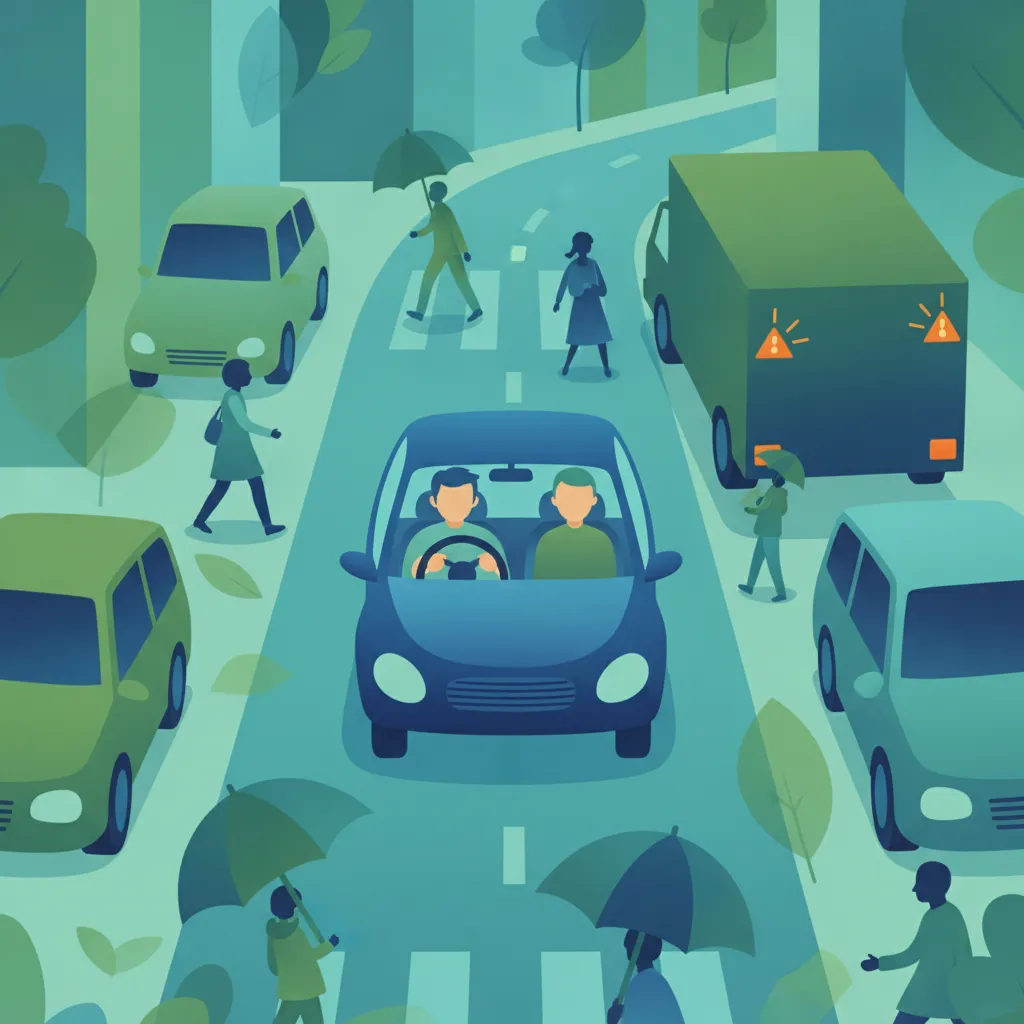
This lesson focuses on maneuvering in extremely crowded areas, passenger terminals, or narrow streets blocked by parked vehicles and obstacles. Drivers will learn to assess clearance distances precisely before committing to narrow pathways. The content teaches steering techniques that maintain stability, optimize space usage, and prioritize public safety during slow-speed, high-difficulty maneuvers.
Explore the physical principles governing heavy vehicle stability during turns and manoeuvres. Learn how load distribution, center of gravity, and articulation angles impact vehicle handling, and discover the essential theoretical concepts for preventing rollovers and off-tracking incidents with articulated goods vehicles.

In this lesson, drivers will learn about the relationship between a vehicle’s centre of gravity and its susceptibility to rollover incidents. The content covers how high-center-of-gravity loads, load shifts, and overloading can compromise lateral stability, especially during cornering or evasive maneuvers. Learners will gain insight into calculating safety margins and understanding the impact of cargo weight distribution on the overall stability of the vehicle.

In this lesson, learners explore the fundamental principles governing load distribution in goods vehicles, focusing on how cargo placement affects the centre of gravity and overall vehicle stability. The content emphasizes the importance of achieving longitudinal and lateral balance to prevent adverse vehicle dynamics such as excessive sway or unintended pivoting. By understanding weight transfer phenomena and the impact of cargo positioning on the vehicle’s pivot point, drivers can make informed decisions to ensure safe loading.
Find clear answers to common questions learners have about Planning and Executing Wide Turns. Learn how the lesson is structured, which driving theory objectives it supports, and how it fits into the overall learning path of units and curriculum progression in France. These explanations help you understand key concepts, lesson flow, and exam focused study goals.
Because of the trailer's off-tracking, the rear wheels will follow a tighter path than the front wheels. Positioning your vehicle correctly allows you to increase the turning radius, preventing the trailer from cutting corners and hitting the curb or other vehicles.
The primary risk is a collision with vulnerable road users, such as cyclists or pedestrians, in your blind spots. You must constantly monitor your mirrors and the trailer's pivot point throughout the entire manoeuvre to ensure no one is caught in the sweep path.
You must adapt your speed significantly and wait for a clear path. In some cases, you may need to wait for oncoming traffic to clear the intersection completely to safely occupy the necessary space to complete the wide turn without mounting the sidewalk.
Ready to focus your study? Use the practice search to find exactly the French driving theory questions you need for the Code de la route and permis de conduire ETG. Refine your knowledge on specific topics or challenging rules to boost your confidence and exam readiness.